Tag Archives: Easel Paintings

Wet Winter Road

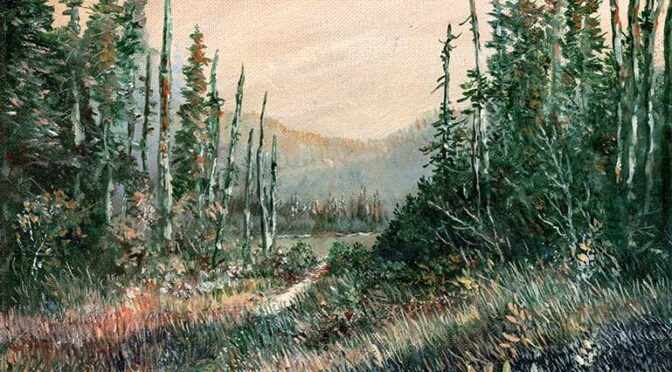
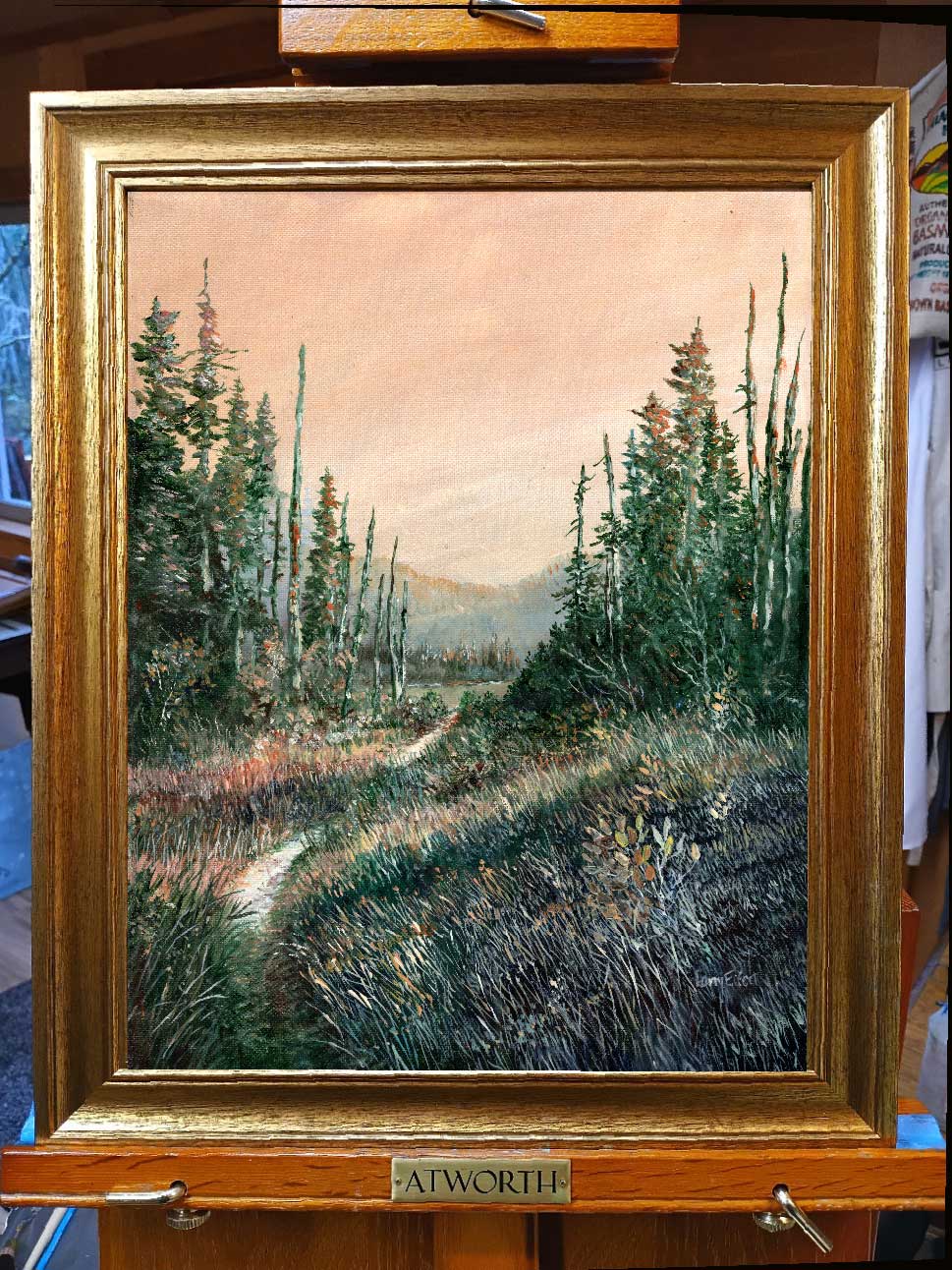
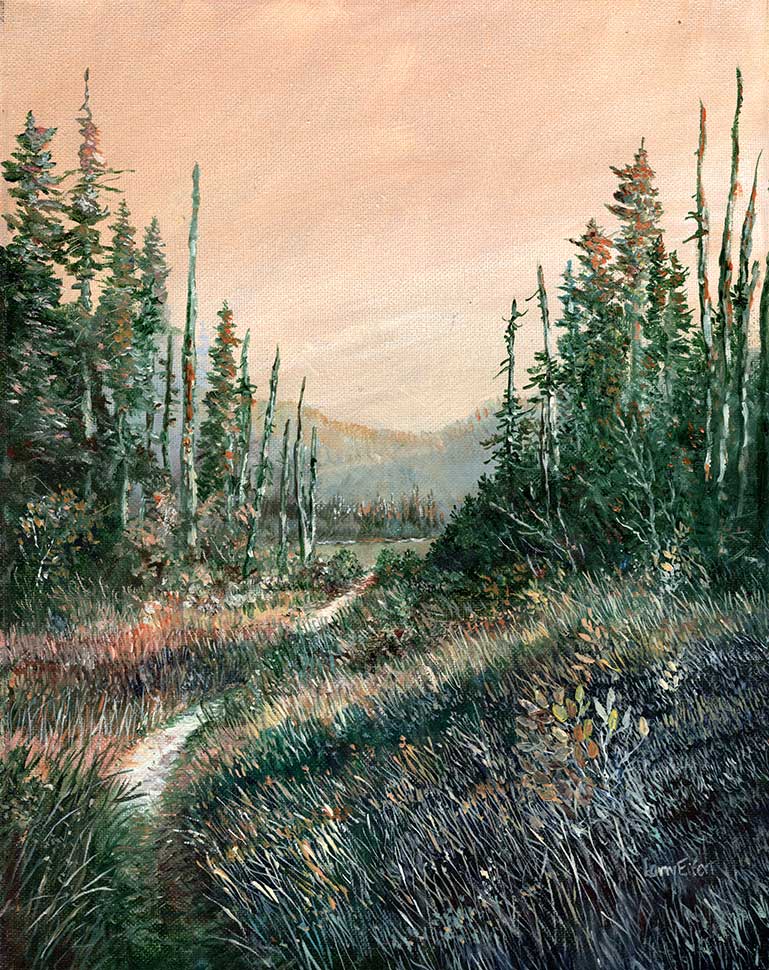
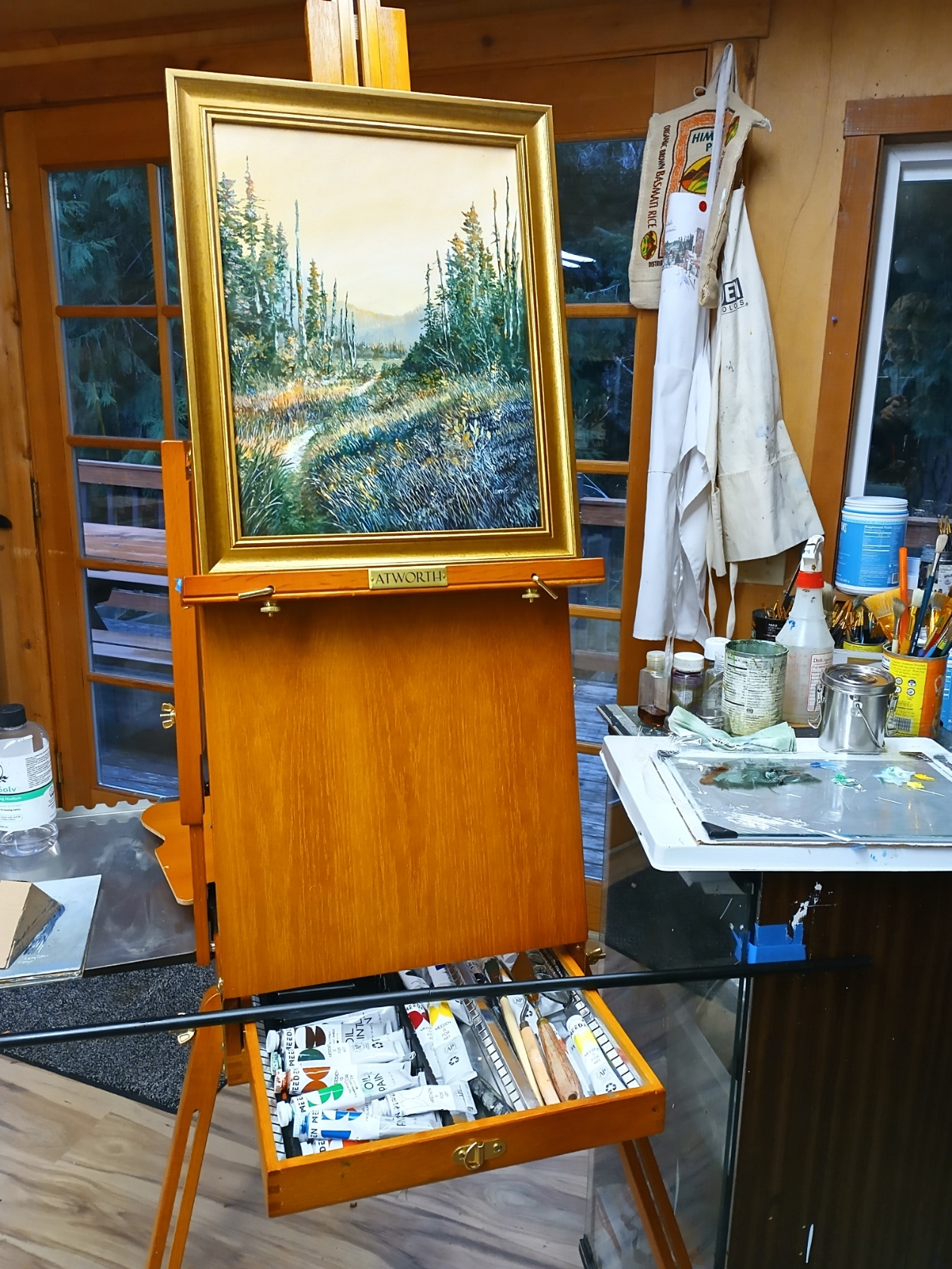
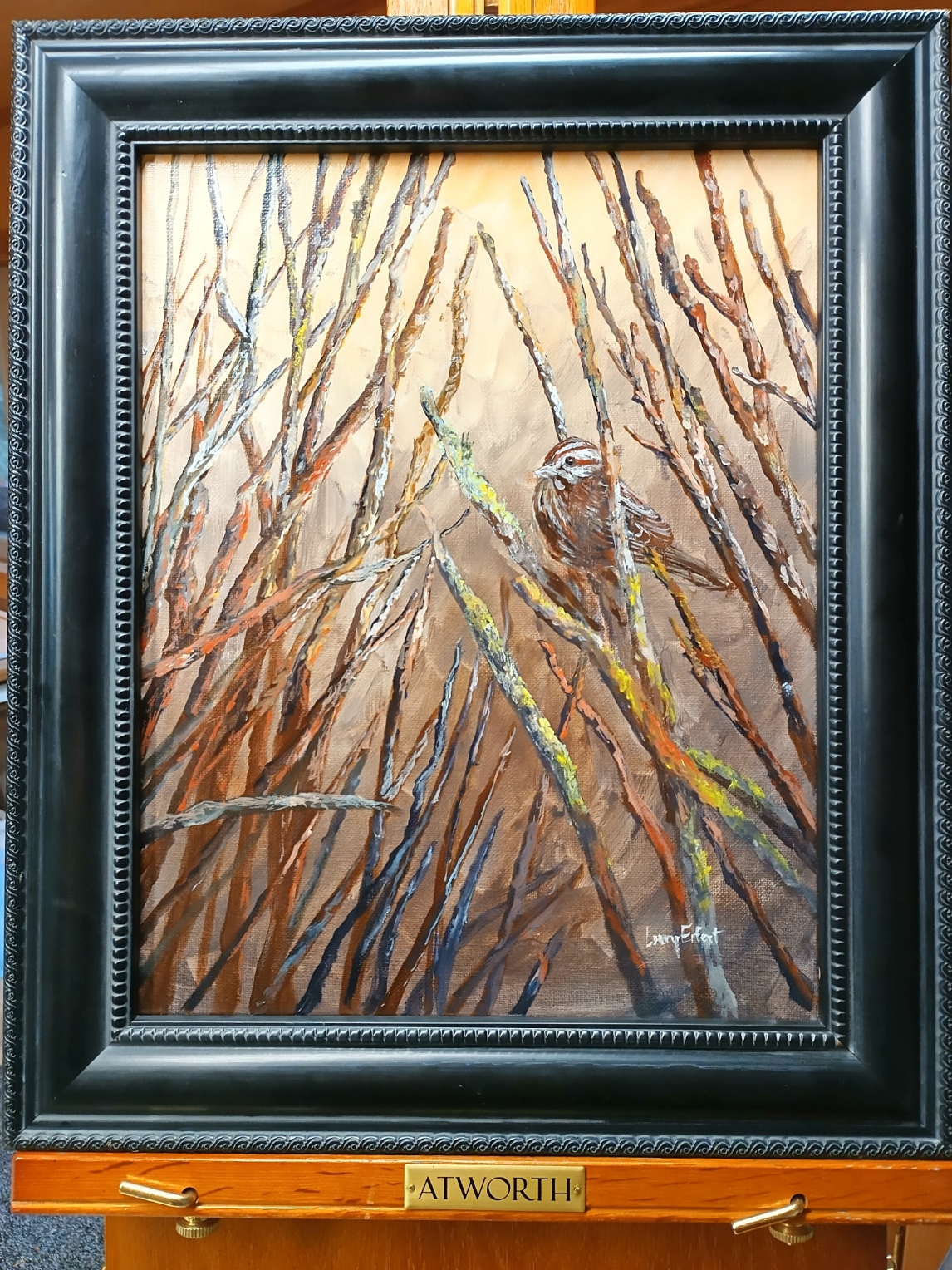
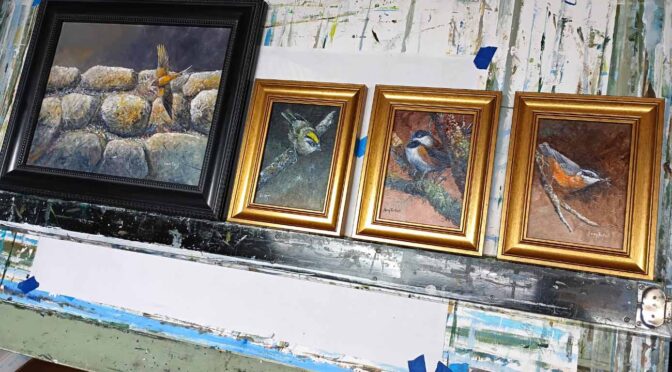
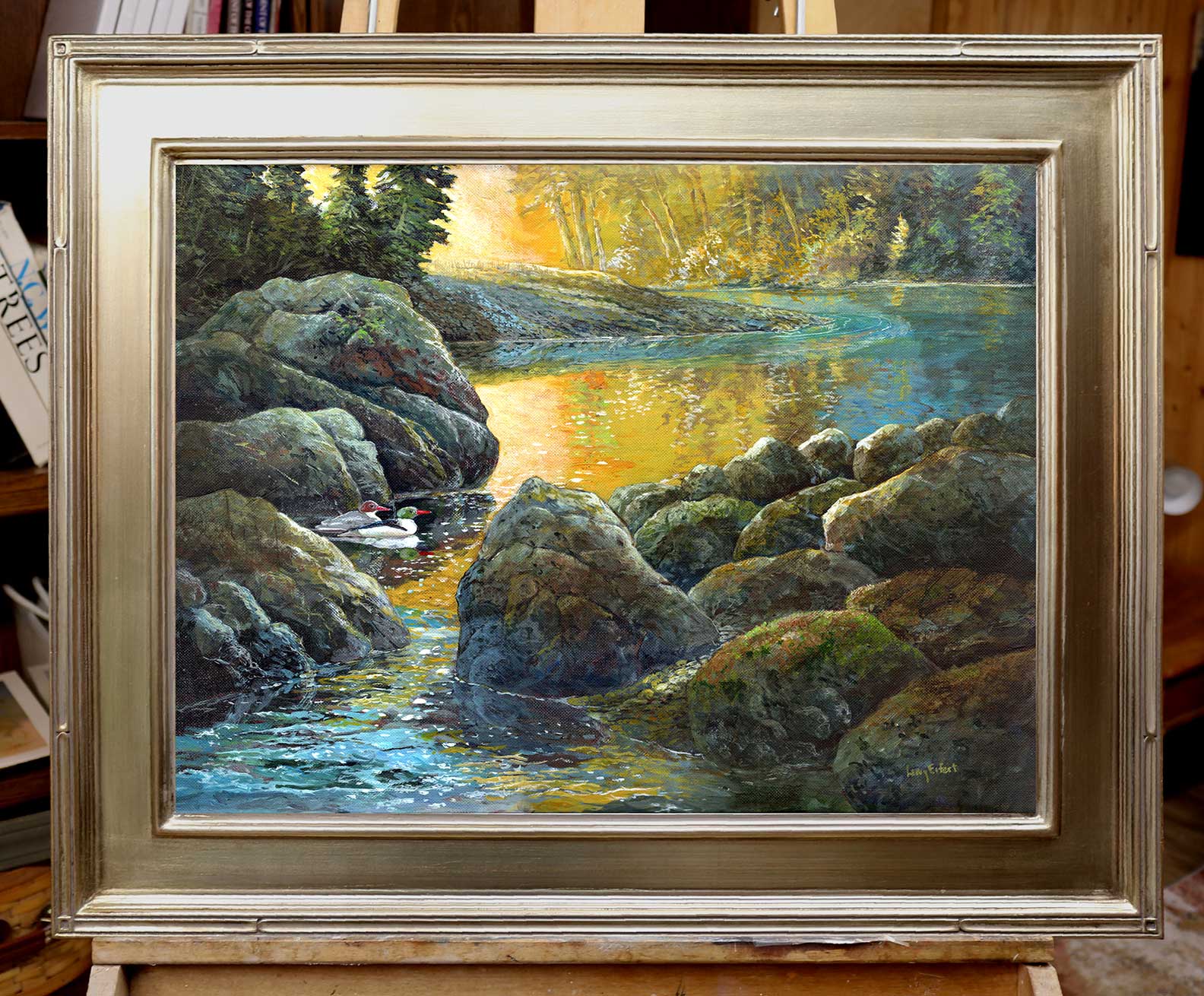
A new easel painting appeared between a couple of larger park projects. I continue to happily paint all these big public art pieces but it helps to create a bit of of whimsy on a smaller, looser scale. So, here’s a happy little place, at least for me. 

This painting is already sold, sorry. Just a show-and-tell here.

This painting was a collaboration with Nancy. We’ve never done this before, even after 25 years of working together on giant walls and making a living selling our individual efforts. We painted this together, each of us doing some, then the other moving forward and fixing the other’s deadends. I think it resulted in a refined and well thought-out painting. We might even try it again. Maybe next time I can get her to sign her name.

Over the years, I’ve learned a lot about color values and painting low winter light. It’s far more interesting than painting anything in summer – absolutely anything. It takes some time and thought to keep the image slanted over into a monochrome pallet of similar values, mix each with a bit of all the rest, and save the center-of-interest for the only intense place to blast away with slightly more color.

There are lots of layers in this painting, as you can see, but they’re all on a level of dullness to not get excited about. The road beckons the viewer to join us in a walk up the road, dodging puddles, to discover what’s just over the ridge.

Thanks for reading this week.

Larry Eifert

Here’s my Facebook fan page. I post lots of other stuff there.

Click here to go to our main website – with jigsaw puzzles, prints, interpretive portfolios and lots of other stuff.
Nancy’s web portfolio of stunning photography

And here to go to Virginia Eifert’s website. Her books are now becoming available as Amazon Kindle books.

Tidepool Sculpin – My 48 North story for September 2018

Never got around to posting this in the midst of a bunch of much bigger paintings, but this was my September magazine page for 48 North magazine.  It’s late to post here, but I always want to leave a record of my stuff to keep track of it all.

Sculpins: a quick little color study of these tiny fish that live in rocky tidepools in the Northwest. There are many reasons to make these little guys (smaller than your thumb) featured here, but my favorite is the rather homebody lifestyle they have. Simply put, they like where they live and never stray far. Sure, they can live out of the water through an entire tidal change, and sure, they check out other pools as far away as a football field, but they always return home, and to the same pool!

Here’s a closeup of the little guy, loose pencil and watercolor. I don’t give myself much time on these and I like the process because it’s so very different than many of my bigger projects that are tight and detailed. Compare this with the 500 square feet of Hoh Rain Forest paintings I was doing at the same time I did this little sculpin and you can imagine the relief of starting and finishing something in the same session. Ahhh.

And here is the text that went with it in 48 North magazine:

Go ashore – poke around tidepools, and chances are good you’ll find this little sculpin. It might take a bit of looking, because their habit of secrecy means staying put, not moving a fin and waiting for you to pass by. Superbly camouflaged, these small 3.5” fish settle to the tide pool bottom and blend in so well with sand, crushed shells and bits of seaweed they just disappear. Put your hand over the water and, like a flash, they shoot forward to a safer place. It’s still the same tidepool, so just watch them flash, settle, and then have a good look. As the tide returns, sculpins could move about to other areas, but they have a home pool and rarely stray far. If moved, say 300 feet to another tidepool, they return to their original pool, not unlike salmon returning to spawn to their home stream.

There are five sculpin species here and all are carnivores, hunting small crustaceans and seaworms. In turn, they are hunted by all sorts of predators from herons to otters, so sharp spines that take the place of scales are protection as they live in a confined space with no escape. Sculpins occasionally get stranded out of water at low tide, beneath seaweed or under rock ledges. Not to worry. These fish can breathe air until the water returns a few hours later. Other fish can do this, too, and it begs the comparison to when fish crawled out of the water for good and took to the land in an evolutional move that eventually became us. Think about that next time you see one of these little fish. Is that you, grand dad?

This is the tidepool where I did much of the research for this story, Beach 4 at Olympic National Park. It’s one of our favorites for a low-tide poking around.

Thanks for reading this week – and the entire year for that matter.
Larry Eifert

Here’s my Facebook fan page. I post lots of other stuff there.

Click here to go to our main website – with jigsaw puzzles, prints, interpretive portfolios and lots of other stuff.
Nancy’s web portfolio of stunning photography

And here to go to Virginia Eifert’s website. Her books are now becoming available as Amazon Kindle books.

Dismal Nitch – Chinook Salmon Story

I like this Chinook salmon painting but it’s going to change, so I thought I’d post it here so at least there’s a memory of it. What’s wrong with it, you ask, well, the National Park Service says it’s not fat enough! Welcome to MY life, and I guess I’d agree. They have some compelling reasons – so, back to the easel.


Here’s the entire fish. The final painting will go on one of seven waysides stands at the Dismal Nitch area beside the Columbia Estuary, part of Lewis and Clark National Historic Park. This is where ‘The Corps’, in 1804, spent a week hunkered down, starving, wet and miserable before a group of Chinook Indians paddled by and sold them some salmon. It’s a good story, and one I knew from my childhood when Virginia wrote a book about the wildlife and flora this bunch found and named, not to mention the Lewis River, Clark’s Fork and others. Now, here I am 50 years later painting exhibit art for the same place! The apples didn’t fall far from her tree, did they?

This painting of spawning salmon is one of over a dozen I’ve painted in the past couple of years, most for salmon restoration areas around the Salish Sea where I live. I’ve gotten much better at understanding these amazing fish and what they look like, how they live and suffer in their final days in fresh water. They feed us, they feed the riverside forest trees and all the creatures that live next to salmon streams. They’re not a gift to be taken lightly.

Thanks for reading this week – and the entire year for that matter.
Larry Eifert

Here’s my Facebook fan page. I post lots of other stuff there.

Click here to go to our main website – with jigsaw puzzles, prints, interpretive portfolios and lots of other stuff.
Nancy’s web portfolio of stunning photography

And here to go to Virginia Eifert’s website. Her books are now becoming available as Amazon Kindle books.

Anemones – My monthly magazine story for August 2018

I’m a bit late on posting some of my 48 North magazine stories. Just too many interesting paintings happening that always seem more current. This one was the story pages back in August, so that meant I painted it in June. I promise, I’ll catch up to current soon.

And here’s just the art. It’s watercolor and pencil, brightened up with the computer before assembling the story with a readable font. I’ve tried this with my own lettering but it’s just not nearly as readable. 48 North magazine is here.

I have over 70 stories in past issues and you can read them on my website here.

I did another plumose anemone story before this one. Here it is from 2027,

And here’s the story:

Plumose Anemone

Look down the closest piling at low tide and chances are good you’ll see these animals. Yes, they animals, animals that look like flowers. Animals with deadly stinging tentacles that can move around and even grab, kill and eat small fish. There are many species of anemones in the Salish Sea, some tiny inch-wide creatures that congregate in colorful crowds, others can be two feet tall. The plumose averages a respectful 12” tall and can have up to 100 tentacles that sting and grab any morsel that floats by. The meal, often microscopic, is then transferred down into a waiting mouth, throat and stomach to be consumed. Remember Little Shop of Horrors? This is an oceanic equivalent, except there are millions of them under our docks and floats. Low tide might expose them to air, in which case they sort of fold up like a deflated balloon and wait for the incoming tide.

Anemones can move about, leaving one spot behind when it senses danger or a lack of food. When it does, it simply walks off, but leaves behind some anemone DNA and from this a new anemone will grow. In summer, it also creates and releases sperm and eggs that drift around until ‘things happen’. This animal is well-armed, as I said. It possesses two types of stinging tentacles, the most common is for stinging prey, a second set is for defense. These can elongate 2 or 3 times their length and reach out to attach anything passing by – think stinging nettles on your favorite river trail. Others from inside the body can be shot through the body column or mouth to do the same attacking. Basically, this beautiful animal may look great but it’s a killer if you’re a small witless creature swimming past. So, here’s the drill: at low tide, put your stomach on the dock, peep down the piling well and have a look for yourself. You won’t regret it.

Thanks for reading this week – and the entire year for that matter.
Larry Eifert

Here’s my Facebook fan page. I post lots of other stuff there.

Click here to go to our main website – with jigsaw puzzles, prints, interpretive portfolios and lots of other stuff.
Nancy’s web portfolio of stunning photography

And here to go to Virginia Eifert’s website. Her books are now becoming available as Amazon Kindle books.

Lime Kiln Point – Orca Wayside Art in the San Juan Islands

This painting is one of four for Lime Kiln State Park, west side of San Juan Island and Friday Harbor. If you want to see whales in the Northwest without getting on a boat, this is the place. Well, technically, you have to get on a ferry to get to the island, but you get the point. On a summer day, there can be hundreds of people lined up here on the cliff to watch the killer whale show right in front of them – and soon they’ll also be immersed in my paintings as well. 

After adding the text to the panel, words and art go together fairly well on this one. Two panels are in the six-foot range, but this one is half that. The others are coming soon and I’ll try to post them as we go along.

I lived six summers in Friday Harbor when my first bigger boat, 40′ sloop “October” was here – and I had my gallery in Ferndale, Ca. This was in the 80’s, and I learned to paint the Northwest here. I’d go out to Lime Kiln Point and watch these big guys come right up to shore. Later, when Nancy and I lived on our 45′ Monk “Rumpy”, we’d come up from Port Townsend and lucky timing once put us here when an entire pod was too. We stopped the boat, turned off the engine and watched, shocked, as the entire family casually swam under us. The big male was bigger than the boat, or so it seemed. No one touched, we were thrilled, dry mouths and all. And now my art goes on shore. Paint hard, live long and connections like this happen all the time. I’m constantly thrilled at this life-long deep connection to nature. Not much matters more except the lovely person I share this with!

Thanks for reading my stuff this week.
Larry Eifert

Here’s the blog on the web. And here’s my Facebook fan page. I post lots of other stuff there.

Click here to go to our main website – with jigsaw puzzles, prints, interpretive portfolios and lots of other stuff.
Nancy’s web portfolio of stunning photography

And here to go to Virginia Eifert’s website. Her books are now becoming available as Amazon Kindle books.

Acorn Woodpeckers – Waka Waka Waka

“Tending their graineries”.  I haven’t painted these interesting birds in years, and a private commission presented an opportunity to that just that. I was first made aware of these crazy guys when I was teaching painting at the Yosemite Association back in the early 80’s. A big deal for me, I was in the old historic railroad building at El Portal to meet the Executive Director and try to make a decent impression. He had a marvelous second story office, old wood paneling, a big railroad desk, casement windows. In the middle of the conversation, he suddenly got up and started pounding on the walls, first one then another. No explanation and he didn’t even break up a sentence. Later I found out it was acorn woodpeckers trying to store nuts in the knotholes, probably been doing it a hundred years! And I’ve been in love with these clown-faced birds since.

And then the buyer, who has been trying to get another original painting from me since, he says, 1990. What took so long I’m  not sure, but I’m glad to help out. Yes, these birds actually drill holes in dead snags and dry their acorns, hundreds of them and often in drilled rows like sapsuckers do as well. Yaka, yaka, yaka. Once heard, never forgotten.

Yes, I do private commissions on occasion. If you’re interested, just let me know, and be patient (but not 30 years).

Thanks for reading my stuff this week.
Larry Eifert

Here’s the blog on the web. And here’s my Facebook fan page. I post lots of other stuff there.

Click here to go to our main website – with jigsaw puzzles, prints, interpretive portfolios and lots of other stuff.
Nancy’s web portfolio of stunning photography

And here to go to Virginia Eifert’s website. Her books are now becoming available as Amazon Kindle books.

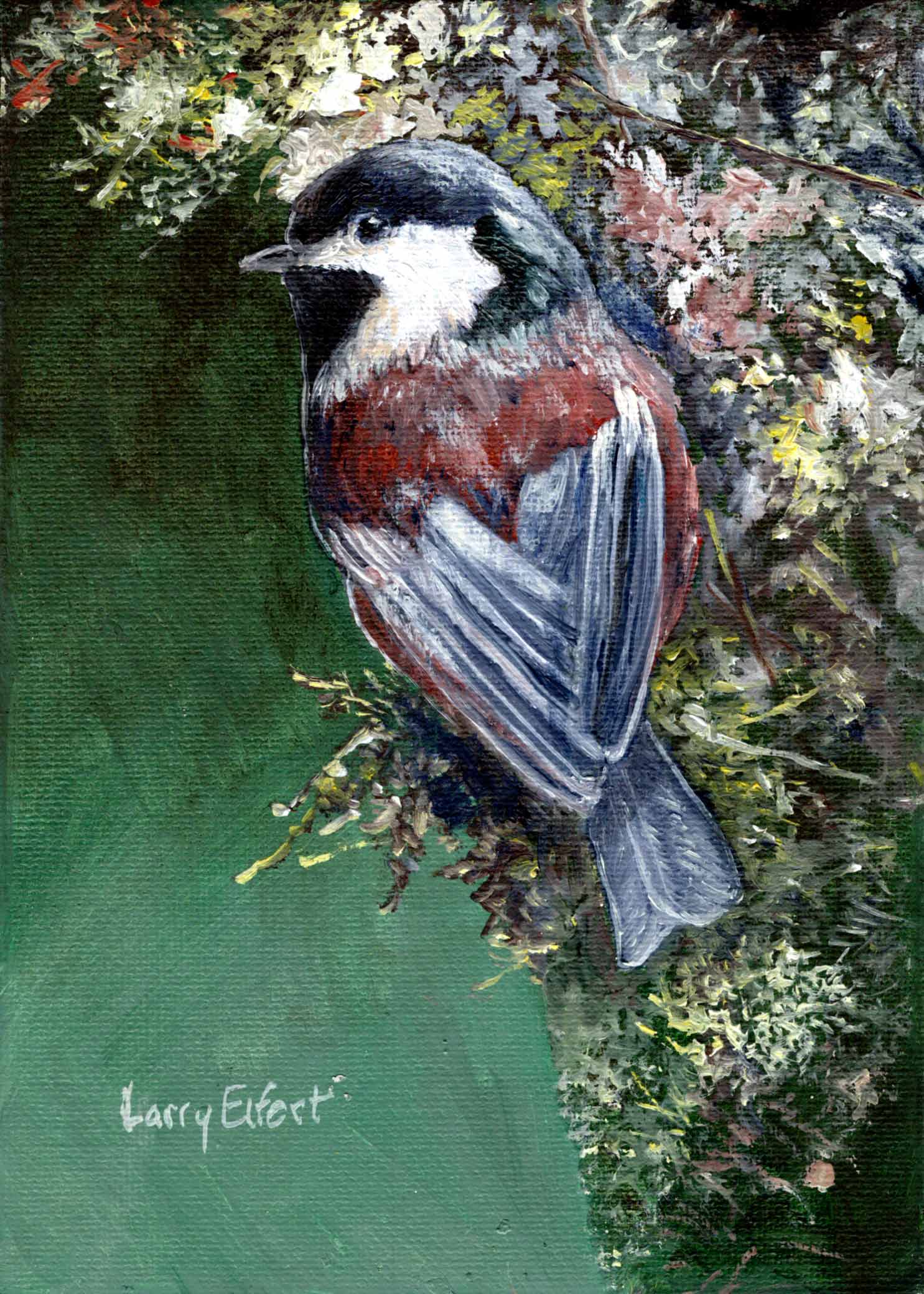
Chickadee and Our Apple Tree

{sorry, it’s sold}

This painting is now available. We have a half dozen apple trees in our little meadow. They were planted by the original couple who built the place, and I’d guess they were set in the ground in the mid-1980’s. All are reaching maturity at 30, and starting to look very artistic with twists and turns, tortured branches and mossy parts. The deer yank on the apples and lower branches and we used to try to fend them off – but we’ll take the deer over apples any day, so now we just enjoy them all.

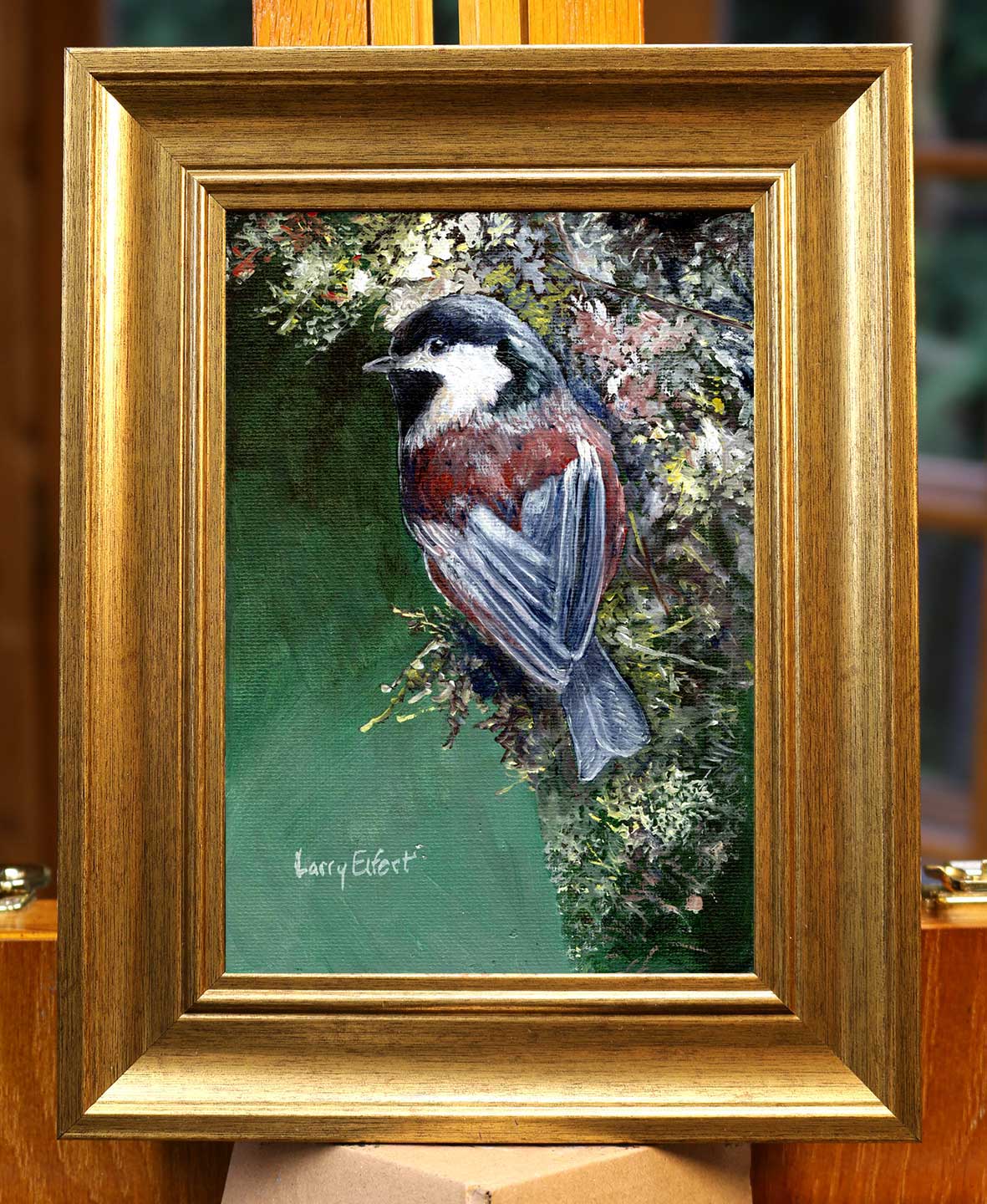
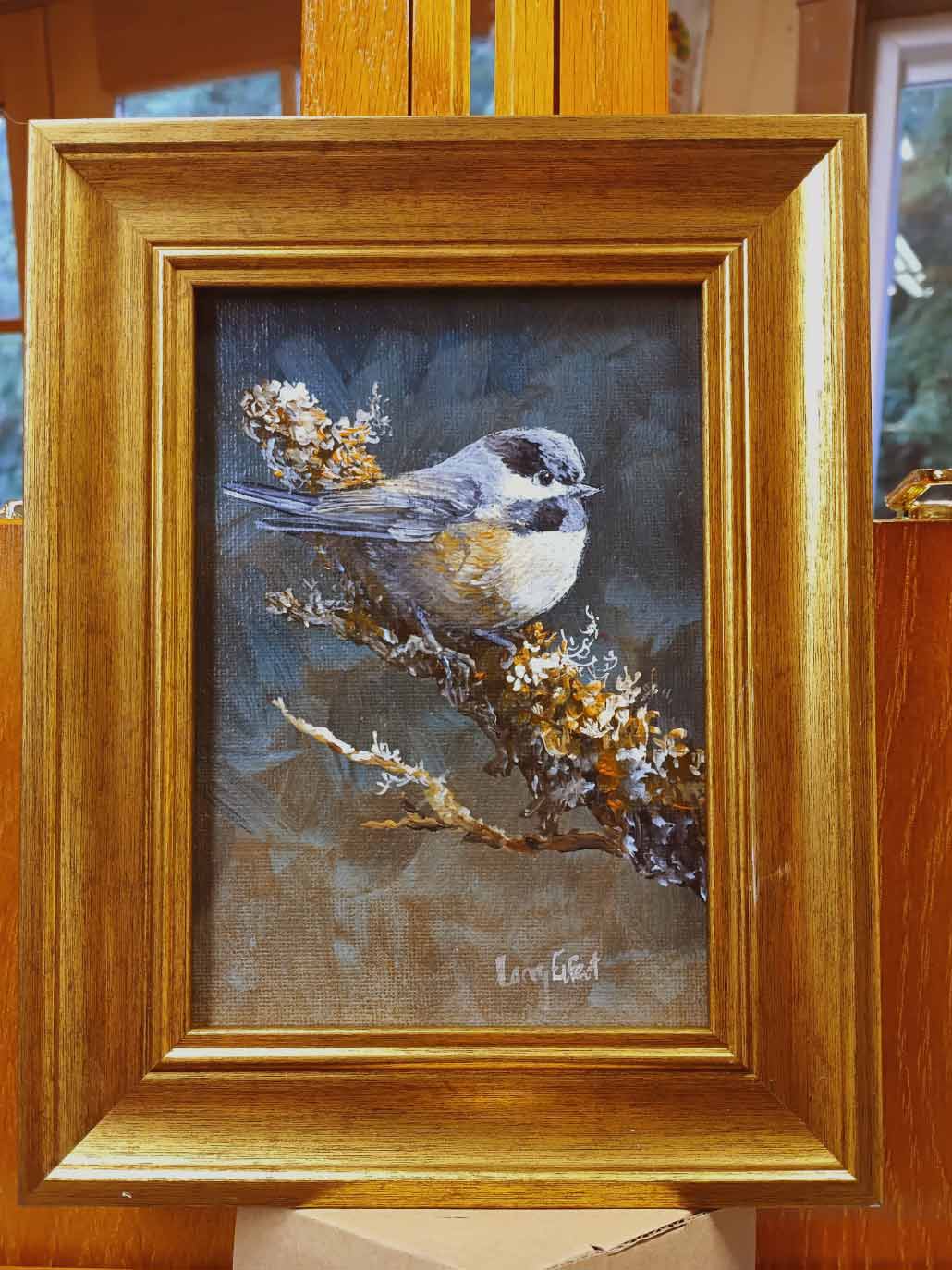
Our local chestnut-backed chickadees and nuthatches also enjoy the trees as well for the bugs that come in for the fall sweetness, so I wanted to show that in this painting. The original idea was to have an apple or two, fall red and contrasting with the chestnut colors of the bird, but the apples are just too big. So, the leaves took the apples place. I can stand right next to these trees and the birds don’t notice, or at least mind. They’d probably sit on my finger if it had an insect.

Here’s the custom frame and mat for the painting. It’s about 12″ x 15″ on the outside and a triple custom mat. We’re offering it for $195 with a bit of shipping (usually Priority mail). If you’re interested, just email me at larry@larryeifert.com.

And this is one of the branches of this tree, the one by the pump shed. Almost ready to eat, whoever gets there first, the squirrels, deer, thrushes – or us!

Thanks for reading my stuff this week.
Larry Eifert

Here’s the blog on the web. And here’s my Facebook fan page. I post lots of other stuff there.

Click here to go to our main website – with jigsaw puzzles, prints, interpretive portfolios and lots of other stuff.
Nancy’s web portfolio of stunning photography

And here to go to Virginia Eifert’s website. Her books are now becoming available as Amazon Kindle books.

American Goldfinch – Sunflower

2018-8-25 American Goldfinch

{This painting is sold}

A new painting. A little story to go with it. We have American Goldfinches here in our meadow that come to the seed feeders. Red squirrels, gray squirrels and Townsend’s chipmunks are here as well. Some get a mouthful of seeds and run over to Nancy’s summer flower pots – bury them for some later meal – first-rate horders. Some seeds grow, most don’t, but of course Nancy doesn’t uproot them – every plant gets a chance around here.

Recently, a goldfinch decided to short-cut the process, forget the feeder and come straight for the giant seed-grocery.  The sunflower just dwarfed the bird and smaller flowers beneath it, and I think this shows the collective and frantic growing energy of the Northwest in summer – grow fast and die, or head south. Soon, this bird will head for warmer winter digs, the sunflower will be toast, but for now, it was a painting waiting to happen.

2018-8-25-Goldfinch-and-Sunflower-framed

This painting is in a custom pecan frame, has a triple mat and is  under glass. It’s outside measurements are 12″ x 15″. If you’d like this painting, just email me at larry@larryeifert.com.  It’s $195, framed and shipping is included if shipped within the U.S. Yes, freight free, usually Priority Mail!

If you’re Facebook friends with Nancy, you’ll likely notice an almost identical painting on her feed. We painted these two together on the same table – and we’re still married!

Thanks for reading my stuff this week.
Larry Eifert

Here’s the blog on the web. And here’s my Facebook fan page. I post lots of other stuff there.

Click here to go to our main website – with jigsaw puzzles, prints, interpretive portfolios and lots of other stuff.
Nancy’s web portfolio of stunning photography

And here to go to Virginia Eifert’s website. Her books are now becoming available as Amazon Kindle books.

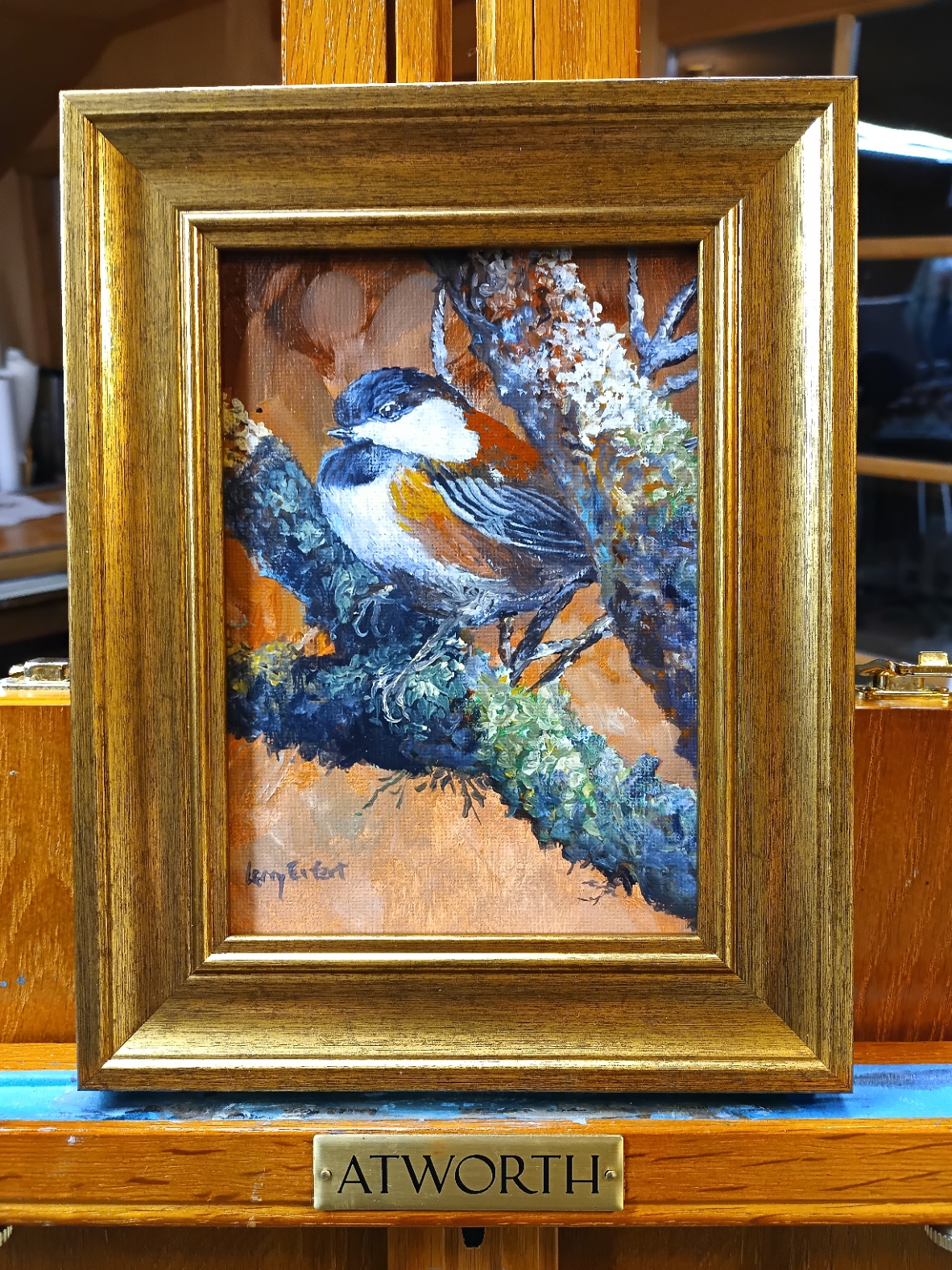
Little Chickadee – Giant Trees

{this painting is sold – thanks, Michael}

A new painting, a portrait of one of the ‘cloud’ of chickadees that gather regularly here each day – right outside my studio. Each bird is slightly different in personality – each slightly different in ‘flitterings’ and all are a joy to watch. In these Northwestern forests, where the trees are giants and organic matter constantly rains down, these little birds have evolved to fit their world perfectly. Nuthatches, creepers, chickadees of three varieties, they all ‘hang’ together for safety. When you’re a tiny bird, there’s safety in solidarity.

The branch this chickadee is on sports lungwort, a lichen that grows into lettuce-like sheets of ‘air plants’. Some fall to the ground each winter during storms. They don’t have roots or solid attachments of any major sort, but exist by taking nutrients and water from the air. Some loberia can be a square foot in size. Once on the ground, they leach nutrients into the soil, then used by the very trees they once grew on. You won’t see these plants in a younger forest as it takes many years for them to grow – so if you see lung wort and chickadees together, you’re in an old-soul place.

Too much science? How about a nice painting?

If you’d like this original painting, an acrylic on board, it’s outside dimensions are about 12″ x 15″ and has this pecan frame. It has a custom triple mat and is under glass. We’re offering it for $195 including the frame and shipping is free within the US (usually Priory Mail). We take all sorts of payment types, just email at larry@larryeifert.com if you’re interested.

If I stand still and watch these birds, and get close, I’m struck by the noise they make when flying. “Whirrrrrrl” or try rattling your tongue, it gets pretty close to how it sounds for them. It’s relatively loud, all that air rushing about. Think what the bird hears, with ears within an inch of all that feather-flapping. It must be deafening and I wonder if that’s why they only fly short distances, to land and be able to hear again – to check if life is still safe.

Thanks for reading this week – and the entire year for that matter.
Larry Eifert

Here’s the blog on the web. And here’s my Facebook fan page. I post lots of other stuff there.

Click here to go to our main website – with jigsaw puzzles, prints, interpretive portfolios and lots of other stuff.
Nancy’s web portfolio of stunning photography

And here to go to Virginia Eifert’s website. Her books are now becoming available as Amazon Kindle books.

Red-breasted Sapsucker – Driller Extraordinaire

(click the images to enlarge this in your browser)

{This painting is sold, sorry}

Here’s a new original painting that’s actually available for sale. I’m finally enjoying some easel time to develop art that isn’t already commissioned. I counted something like 28 paintings I’ve painted for the National Park Service since I’ve finished something like this one. Long overdue!

We saw this interesting woodpecker in the Hoh Rain Forest where it was just walking down the trail and looking for insects. It seemed very curious about us, too, so maybe this is a homage to that experience. This is NOT how we normally see them here in our forest, where they do uncharacteristic woodpecker-stuff. They peck out rows of perfectly lined up and symmetric holes about 1/4″ in diameter – many rows on a single tree. Sap accumulates in these holes and the sapsucker (perfect name, someone was thinking) returns later to feed on the sap – as well as the insects that have congregated to do the same thing. It’s a good story you can tell when showing off your new painting.

Here’s a real tree with the lines of sapsucker holes.

And here’s the framed painting.

If you’d like this original painting, an acrylic on board, it’s outside dimensions are about 12″ x 15″ in this pecan frame with a triple mat and under glass. We’re offering it for $195 including the frame and shipping will be added (usually Priory Mail). We take all sorts of payment, just email me at larry@larryeifert.com if you’re interested.

Thanks for reading this week – and the entire year for that matter.
Larry Eifert

Here’s the blog on the web. And here’s my Facebook fan page. I post lots of other stuff there.

Click here to go to our main website – with jigsaw puzzles, prints, interpretive portfolios and lots of other stuff.
Nancy’s web portfolio of stunning photography

And here to go to Virginia Eifert’s website. Her books are now becoming available as Amazon Kindle books.