Tag Archives: Interpretive Panels

The Chattering Winter Wren

I’m attempting a new and “improved” emailer and I’m a bit worried to hit the send button. If it’s botched, don’t give up on me.

Several have asked if I’m still painting wildlife as stand-alone images. Of course! I’m still hooked on doing these single-focus themes – sort of a wildlife moment.

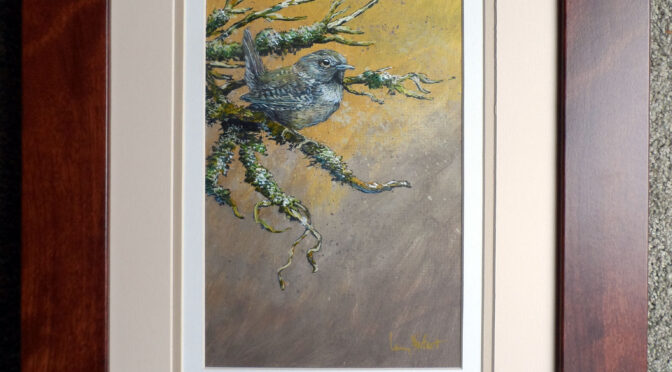
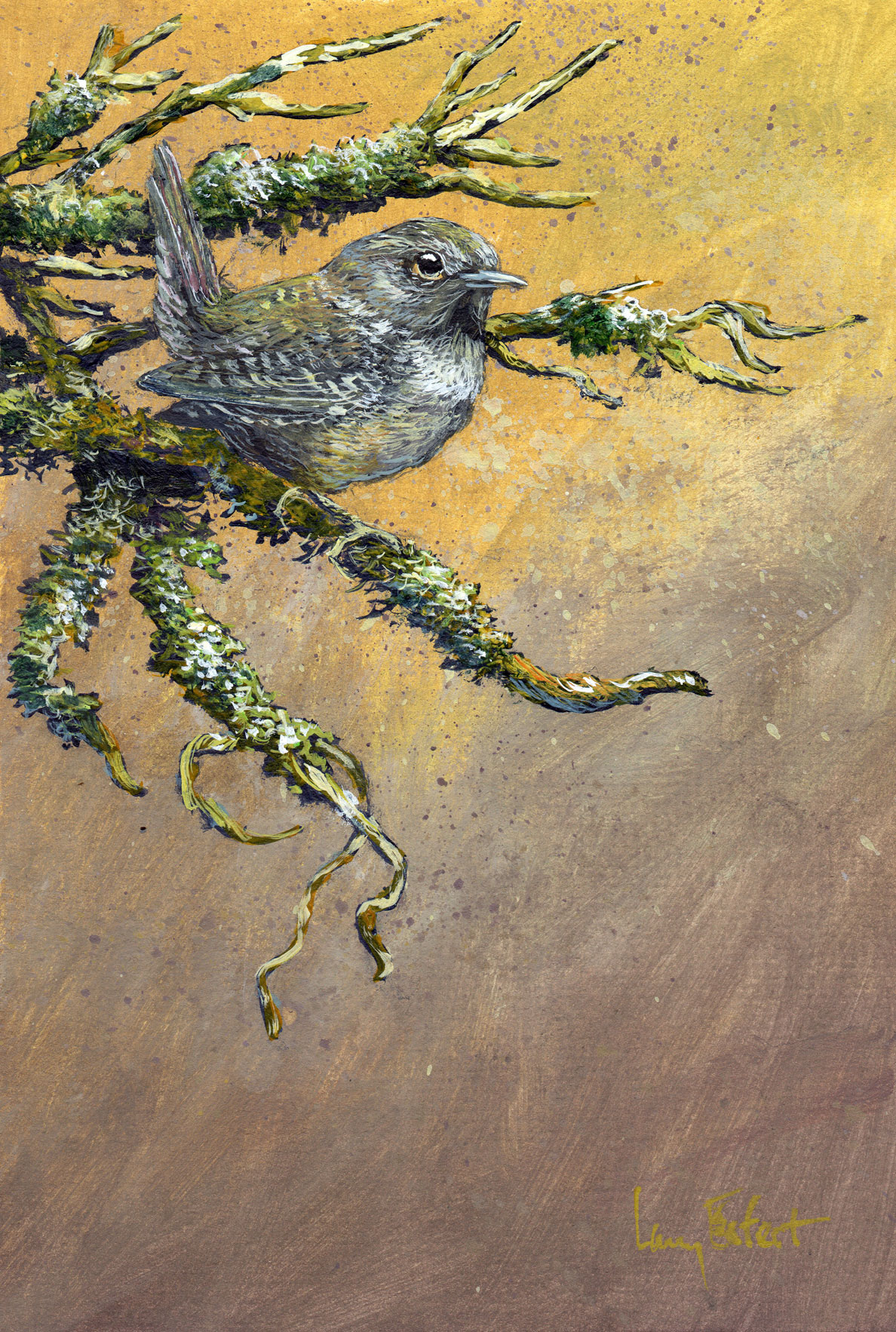
Here’s a new effort along those lines. This little winter wren and its stump are soon to be on an interpretive panel for Olympic National Park. We have these little birds right here in the meadow below my studio, so studying the real deal was pretty easy. So was the stump. I used a broken and leaning mossy log down by the compost pile as the model.

Winter wrens are about the size of my big toe. They have amazing courage (or stupidity) and come boldly out of the ferns to confront you trespassing in their territory. They’ll let go a stream of sizzling, bubbling chatter that goes on for ten seconds or so, possibly a rapid series of threats in wren-lingo. Recently, I had one fly from a nearby fern frond and land on the brim of my cap. As it landed I could hear the flutter of its little wings, like the sound of a deck of cards being shuffled. To them, that must sound very loud, like an airplane propeller.
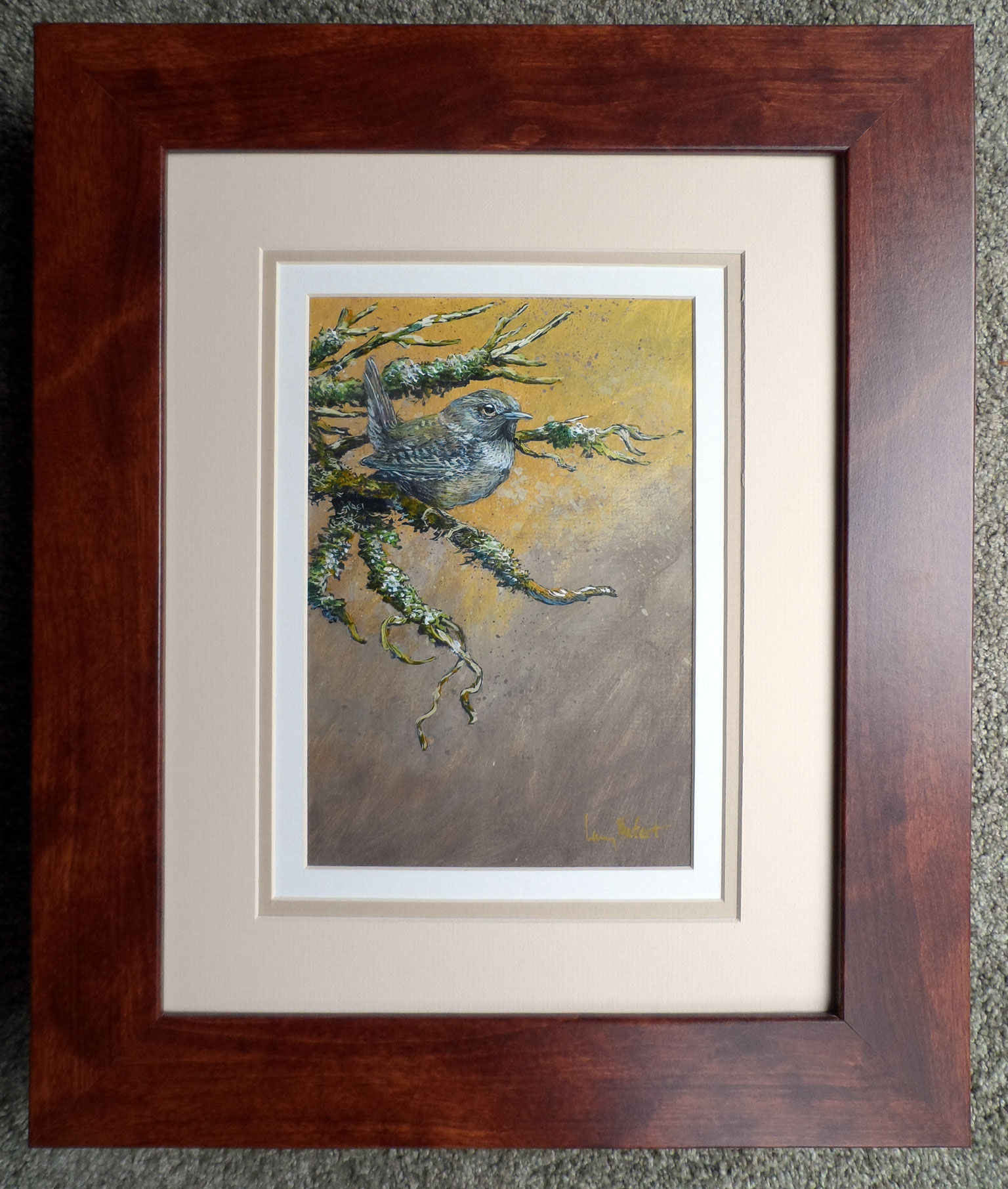
Sorry, but this painting already belongs to the National Park Service who commissioned me for it.

Link here to many other wildlife prints on our website.

Or, you can go to our Giclee Print Index here

Or, send us an email to opt in or out of our email family – or just ‘talk’ with us.

Thanks for reading, now I’m going to start painting.
Larry
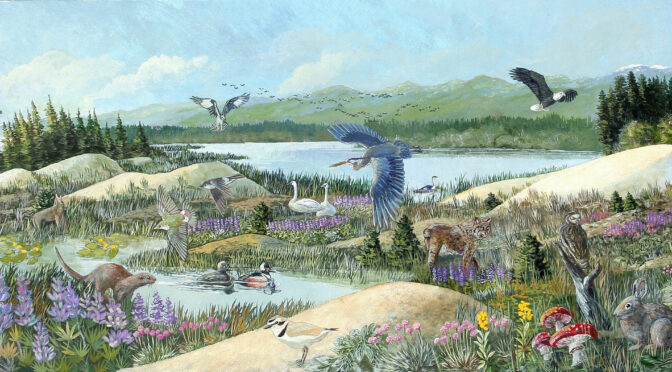
Tolowa Dunes State Park, Crescent City CA

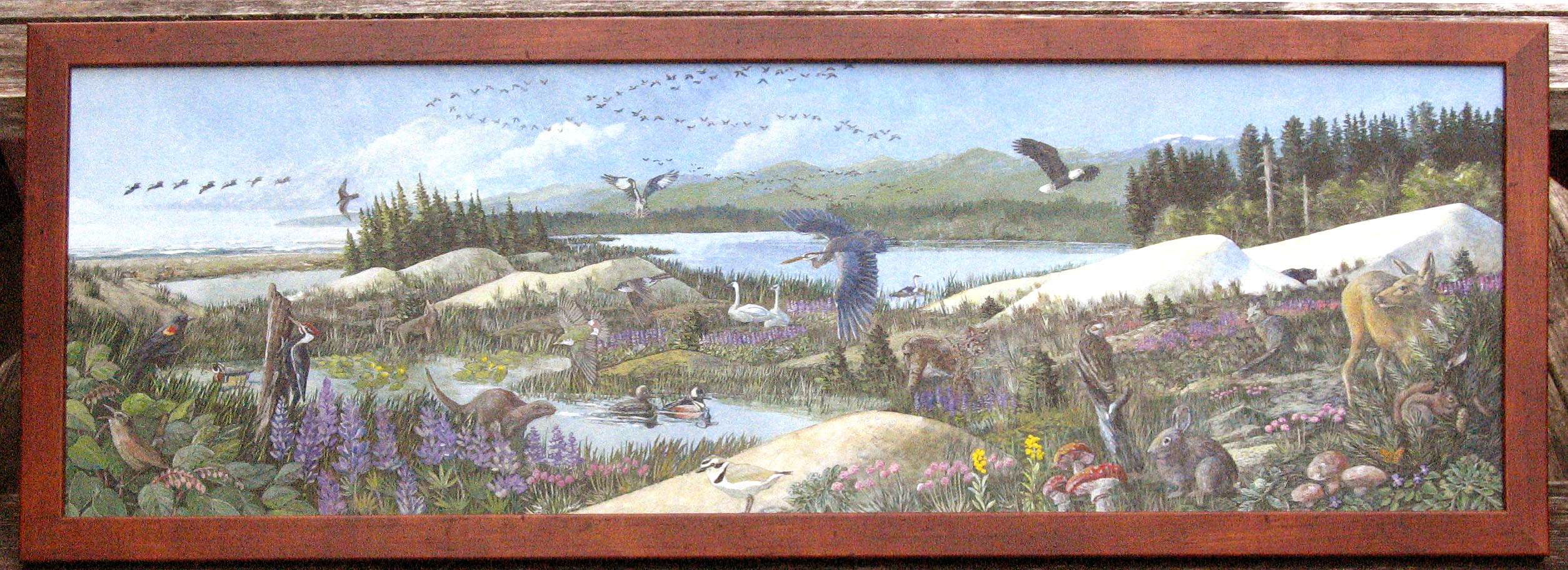
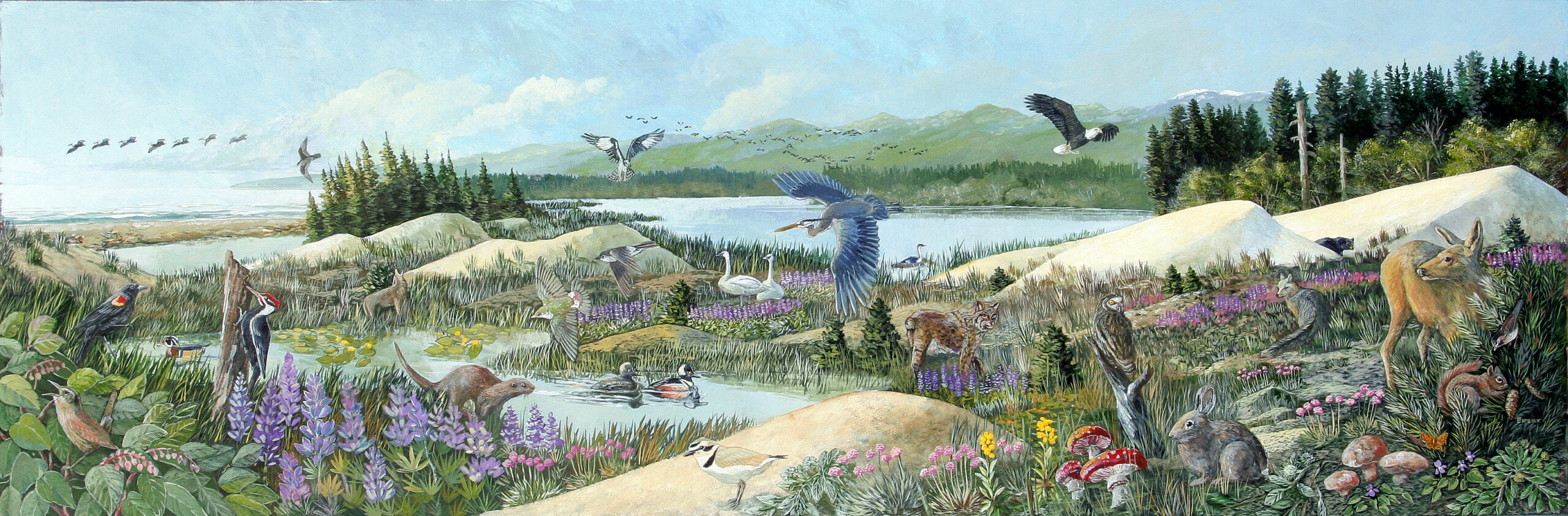
Tolowa Dunes Stewards funded this painting for interpretive and educational efforts. Tolowa Dunes State Park is a 5,000-acre California State Park located on California’s far North Coast near Crescent City. Lake Earl and Lake Tolowa are there, as well as a significant portion of the relatively large coastal plain around it. As one local scientist said: “The Lake Earl sand dunes and wetlands represent one of the richest hotspots for bio-diversity of both plants and animals found along the West Coast of the United States.”

I’ve spent many years living just south of this area and know it well – so this was a fun project. Just to the north on the Smith River, I painted my very first large-scale interpretive mural back in the 1980’s for Redwood National Park. That original is still at the Crescent City Visitor Center, and the exhibit still at Hiouchi Visitor Center up on the river. It’ll probably outlive me!

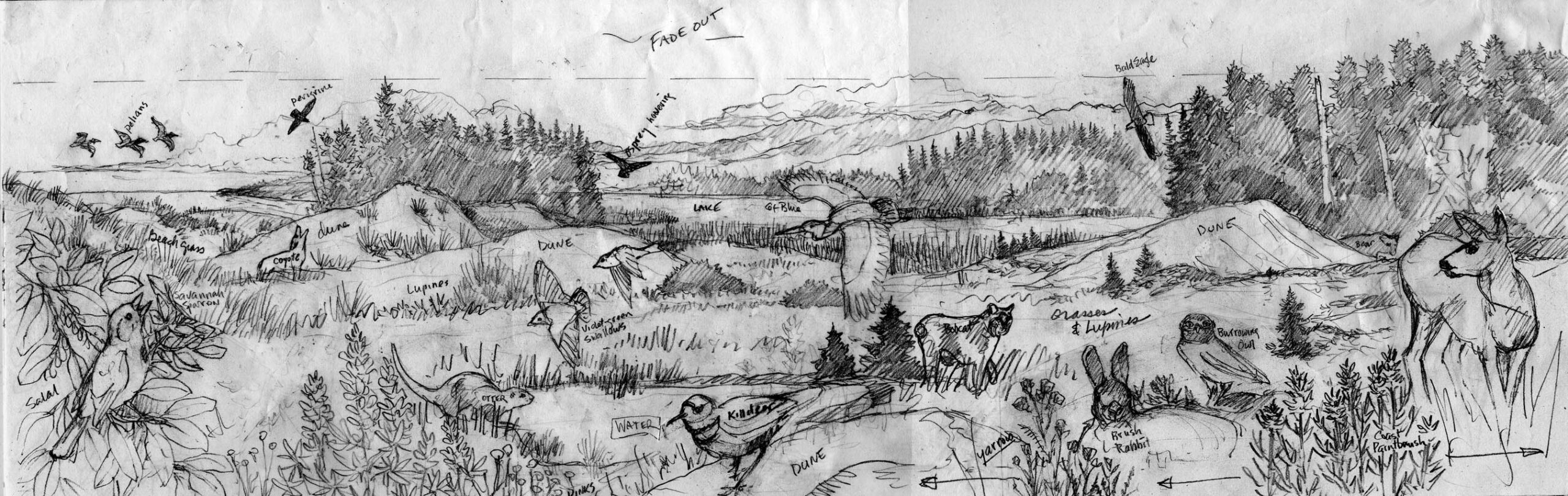
So here’s the sketch.

It was a speedy one, even for me. Because of a funding deadline, the painting was finished in less than a week – but then you guys probably knew that. It’s painted with acrylic on paper board and is about 40″ wide.

Click here to see lots of other national and state park interpetive art on our website.

Some of you have asked where the full website is with all the puzzles, posters and park exhibit stuff. Just click here.

Or, send us an email to opt in or out of our email family – or just ‘talk’ with us.

Thanks for reading.
Larry

Olympic National Park Bugler Cover

Bugler-cover
We’ve been away for two weeks, so no posts for awhile. We were in Hilo Hawaii, better known as Hi-Town, enjoying sea turtles, Coqui frogs, volcanoes and the most interesting blend of people, music and art we’ve seen in awhile. The Big Island has turned into quite some place.

Meanwhile, the summer visitors are a’comin, and this year’s Olympic National Park’s Bugler cover is a painting I recently finished of the Sol Duc Valley for Olympic National Park, northwest of Seattle on the Olympic Peninsula. It was commissioned for a roadside wayside exhibit, but these paintings often end up doing double duty. Now, I’m pleased to say that, for the second year in a row, the park has used my work on the cover of the park’s summer newspaper (that’s the giveaway publication you often get at most national park’s gate or visitor centers). I heard that the initial spring printing was about 100,000 copies.

Of course there’s a back story:
Here’s one of the many Sol Duc River reference photos I took to get the painting going.

And here’s the draft sketch for this painting. You can see the exhibit text blocks that will eventually overlay the painting, which never makes it easy for the painter. I have to not only create a good painting that might be used for, say, the Bugler cover, but also allow areas for text when it’s used for a roadside exhibit. After decades of doing this, I guess it’s just all in a day’s work – but I continue to be very interested in the serious challenge of making it all work up into a good artistic work of art and not just a photo-like exhibit. Some work better than others.

If you’re interested in more of the interpretive art I’ve completed, click here to see lots of other national and state park art on our website.

If you know someone else that might enjoy these occasional emails, you can always send us an email to opt in or out of our email family – or just ‘talk’ with us.

Thanks for reading this post.
Larry Eifert

***previous*** — – ***next***

Logging the Redwoods

New Interpretive Panel for Muir Woods National Monument

(Clicking these images should show you a larger view.)

I can say clearly that I’ve never painted anything like this before. For more than forty years I’ve always painted and written about glorious living nature, not the industrial slaying of our national legacy. But this is Muir Woods National Monument afterall, which is turning into somewhat of an Eifert Gallery in the California redwoods. Thanks to the good folks who work there, you’d be hard-pressed to NOT bump into an Eifert on the trail or in the visitor center.

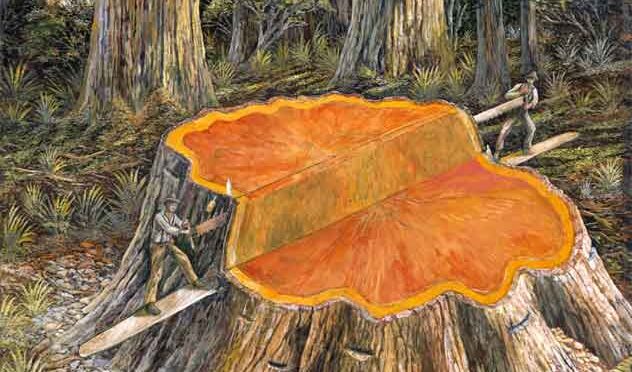
So here’s the set-up. They have an enormous slab of redwood sitting against the visitor center’s wall. An old, worn-out interpretive sign showed how it was cut, and, after many years of duty, it was time for a new one. Here’s what the old sign looked like and a corner of the enormous slab that goes off to the right for many feet.

Now, after looking at the corner of the slab, go back to the top picture and look at the whopper of a tree that this piece of wood would have come from. That was some tree, but not unusual back when many more of these legacy redwoods were still standing. These two guys would have cut it using custom-forged hand saws, first cutting a wedge on the near side, then cutting a second cut above this on the far side. The tree would have fallen towards the viewer.

The painting shows them cutting this slab section out, and it’s been on display here at Muir Woods for many years. Now my painting is part of it too, the ancient tree, the cutting of it, and the history of showing this amazing piece of wood to millions of visitors in what is the busiest redwood park in California. Thanks, Brett and Mia! This is why I paint interpretive art.

Click here to see lots of other national and state park interpetive art on our website.

Click here to see some of the other paintings at Muir Woods National Monument near San Francisco.

Or, send us an email to opt in or out of our email family – or just ‘talk’ with us.

Thanks for reading. More soon.
Larry Eifert

Elk Prairie, Prairie Creek Redwoods State Park

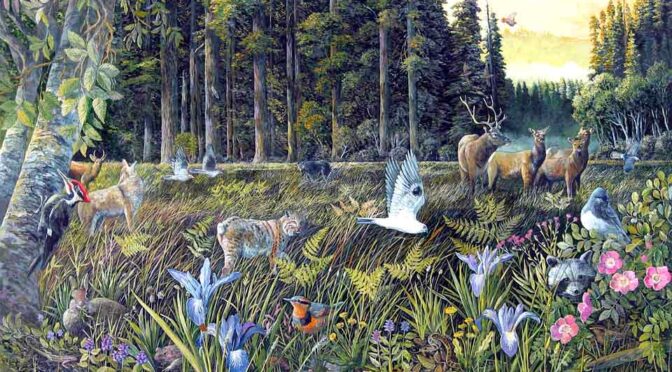
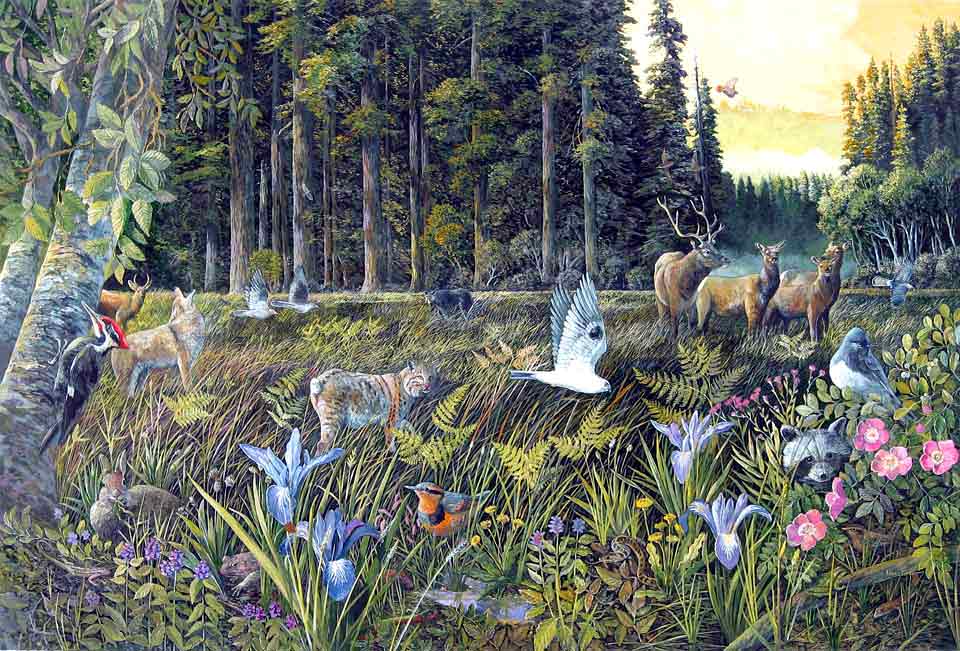
Elk Prairie, Prairie Creek Redwoods State and National Park, is south of Crescent City California – north of Eureka. I have a lot of work there, two large commissions in the visitor center museum, many roadside panels, lots of printed products in the non-profit store (posters, puzzles, books – you name it).

So, when the State of California asked if I was interested in doing another one for an interpretive exhibit, I jumped at the chance. I have this legacy-thing going there and want it to continue. Big opening night for the mural installation is mid-June, 2008.

Whitebark Pines in Peril

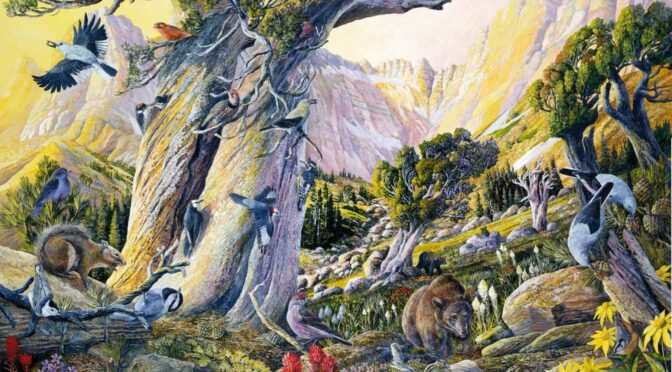
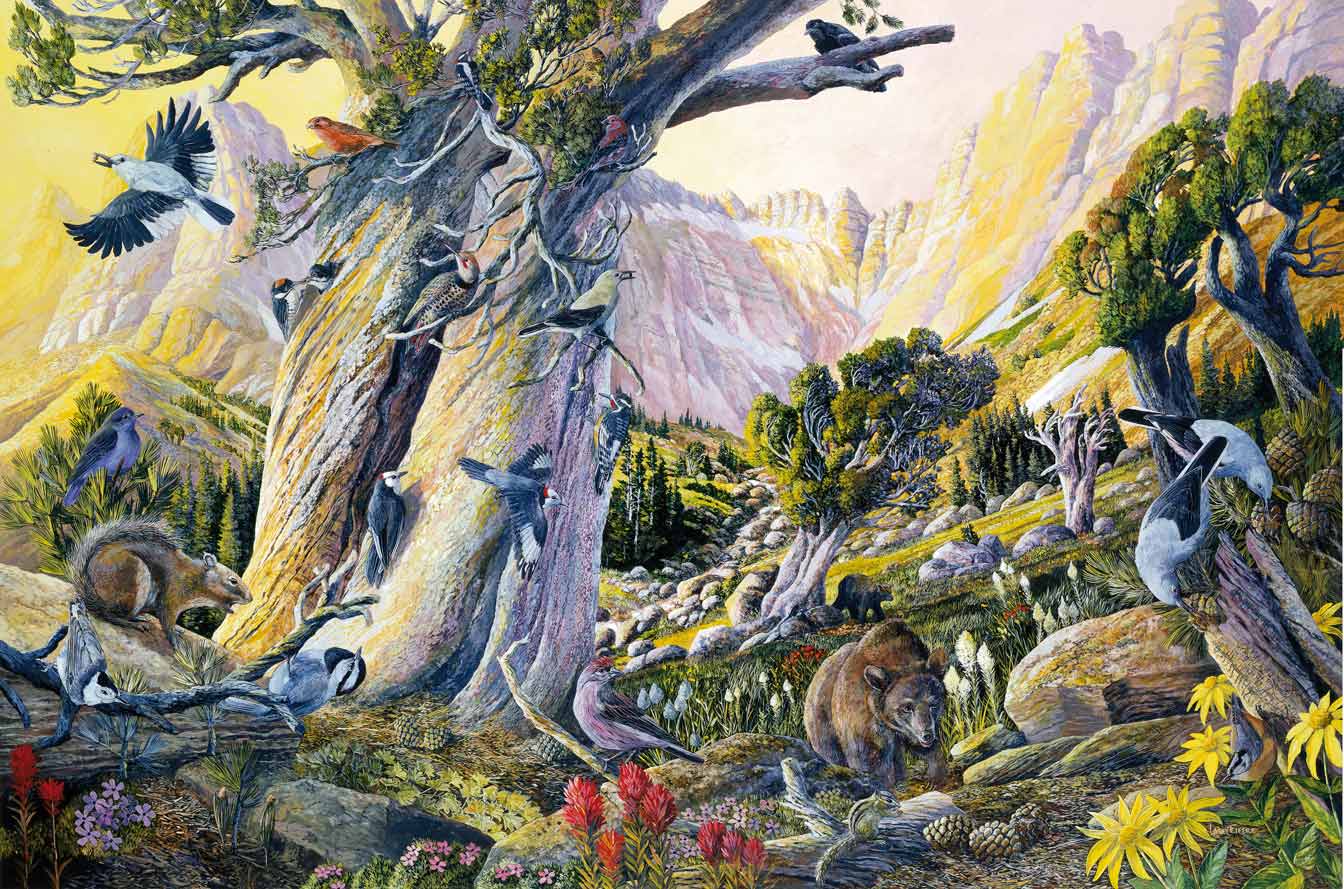
Whitebark Pines in the West are in serious trouble, thanks to a pathogen unleashed by us (of course it’s US, isn’t ALL of this mess because of US).

Commissioned by the Crater Lake Institute in cooperation with the Whitebark Pine Ecosystem Foundation, this mural shows the interwoven lives of all that depend on this tree species. Grizzlies, squirrles, birds and all in peril as well.

Currently, a large format poster installation is being installed in the Grand Targhee National Forest of this image, as well as puzzles and posters coming in summer 2008.