Tag Archives: Parks

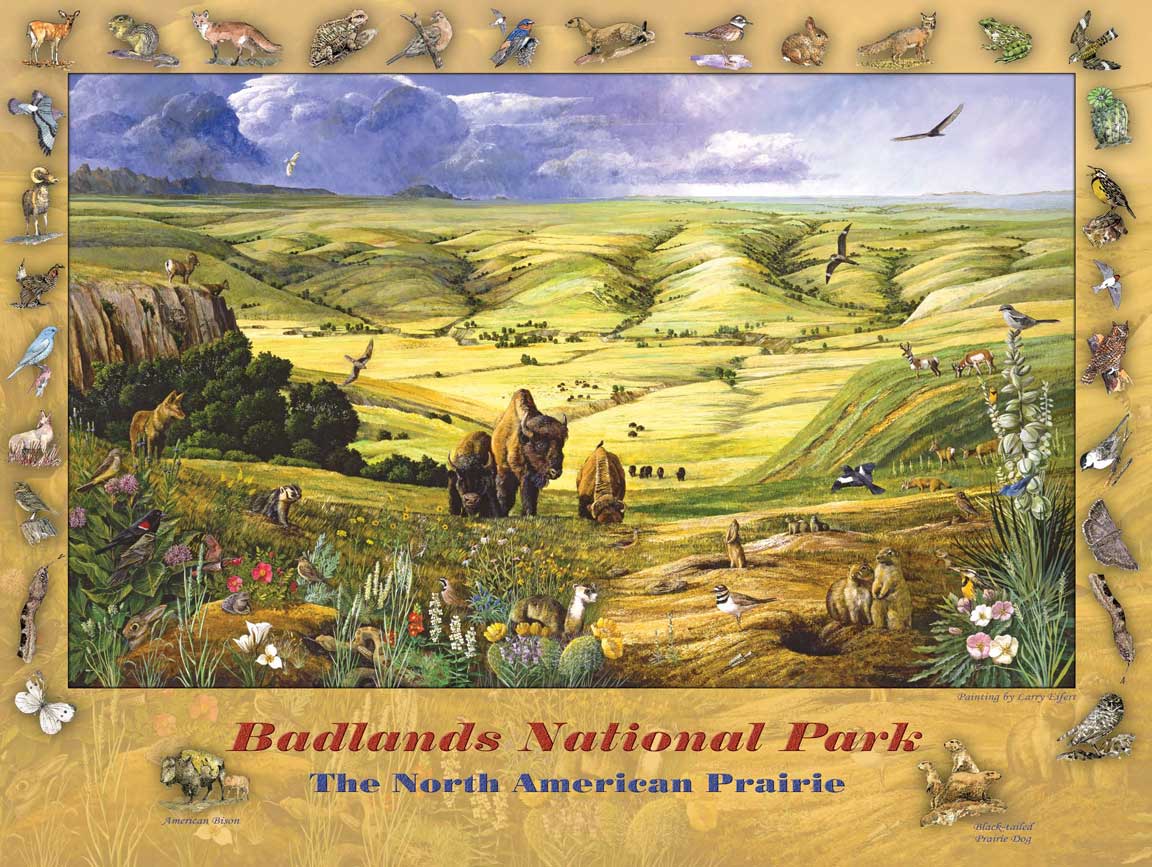
A New Badlands National Park Puzzle

Eifert-Badlands-puzzle

    Looking for some comments here. This is a new design for one of our favorite 500-piece jigsaw puzzles, and used to be called ‘The Vanishing Prairie’. Time to spice it up a bit, so here’s the new version coming out in spring of 2014. If you have the time and are fans of our puzzles, I’d love some feedback. Some of you guys have bought dozens of them.

     I began counting up the number of these things we’ve done. It’s been over 20 years now since we stopped focusing on posters and moved our interpretive products more into jigsaw puzzles. It seems there’s more actual usage of the art than just hanging a poster on the wall. It all started back in about 1990 when a German company bought three images I had previously painted for Yosemite and (I think) Crater Lake. Over the years, that number has grown to between 70 and 75. That’s a LOT of puzzles. Other companies have bought the rights to use the images, but I still prefer to mess around with the designs myself. It’s like building a stage set, with lots of layers and story-telling. This one has 34 layers, and never mind the box front and back – that’s just the puzzle. There’s another new one coming out in spring for Crater Lake that has a lesson plan inside – more layers!

Anyway: what do you think? Seems like this will be a fun time finding all these little extra critters, but I don’t know. You see, I’m almost ashamed to say I’ve never put one of them together!

Thanks for reading this week.
Larry Eifert

Here’s the blog on the web.  And here’s my Facebook fan page. I post lots of other stuff there.

Click here to go to our main website – with jigsaw puzzles, prints, interpretive portfolios and lots of other stuff.

Nancy’s web portfolio of beautiful photographs

And Click here to go to Virginia Eifert’s website. Her books are now becoming available as Amazon Kindle books.
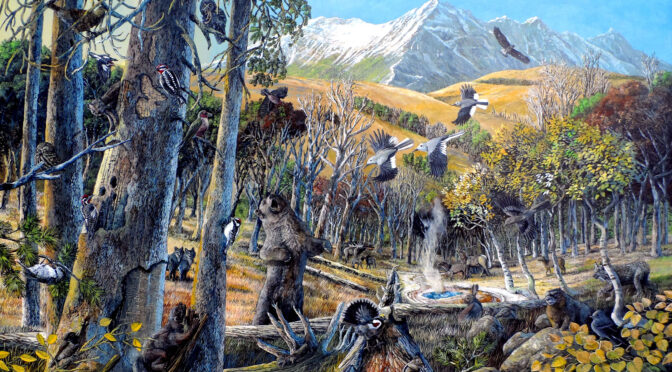
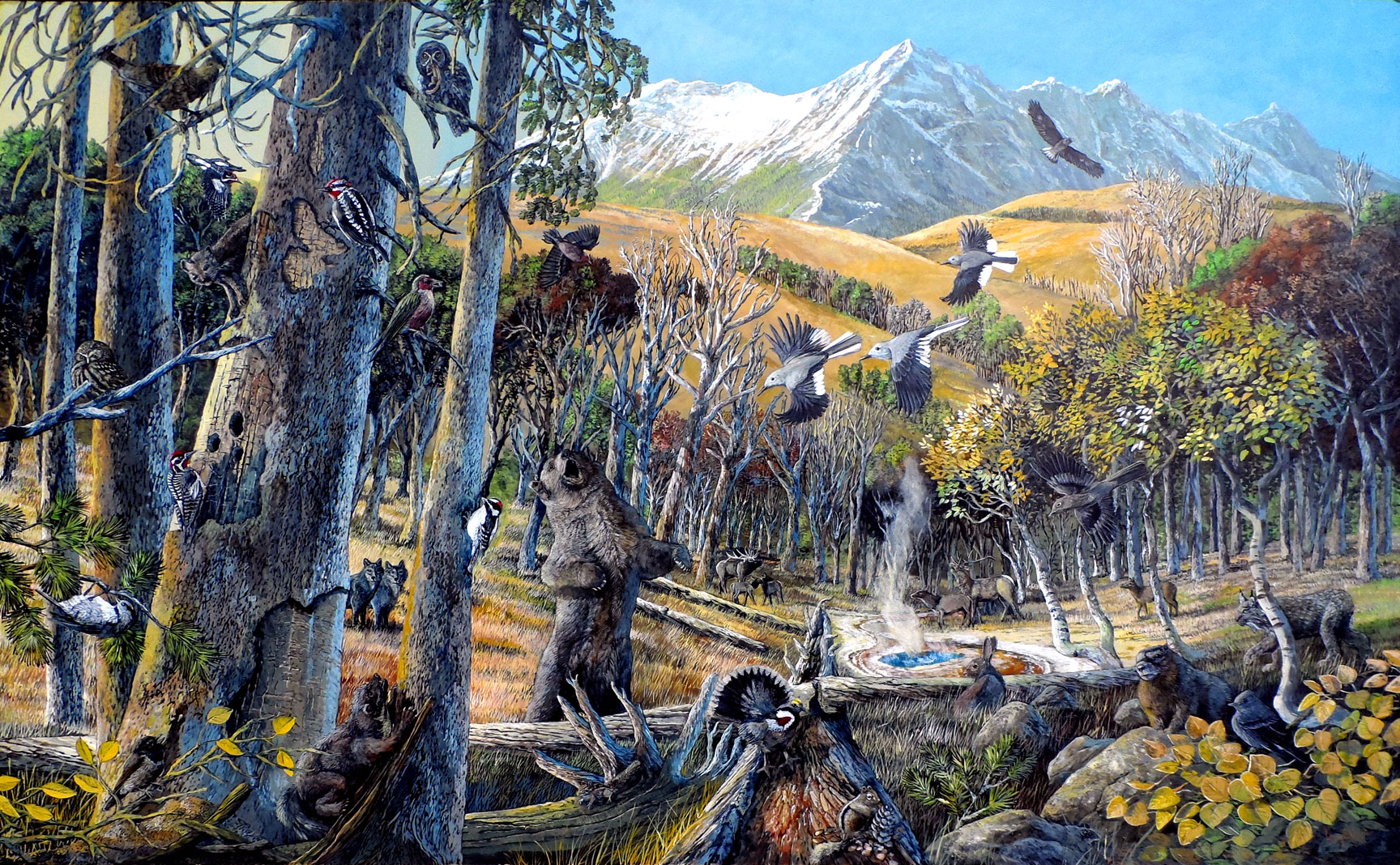
Yellowstone Climate Change mural #2

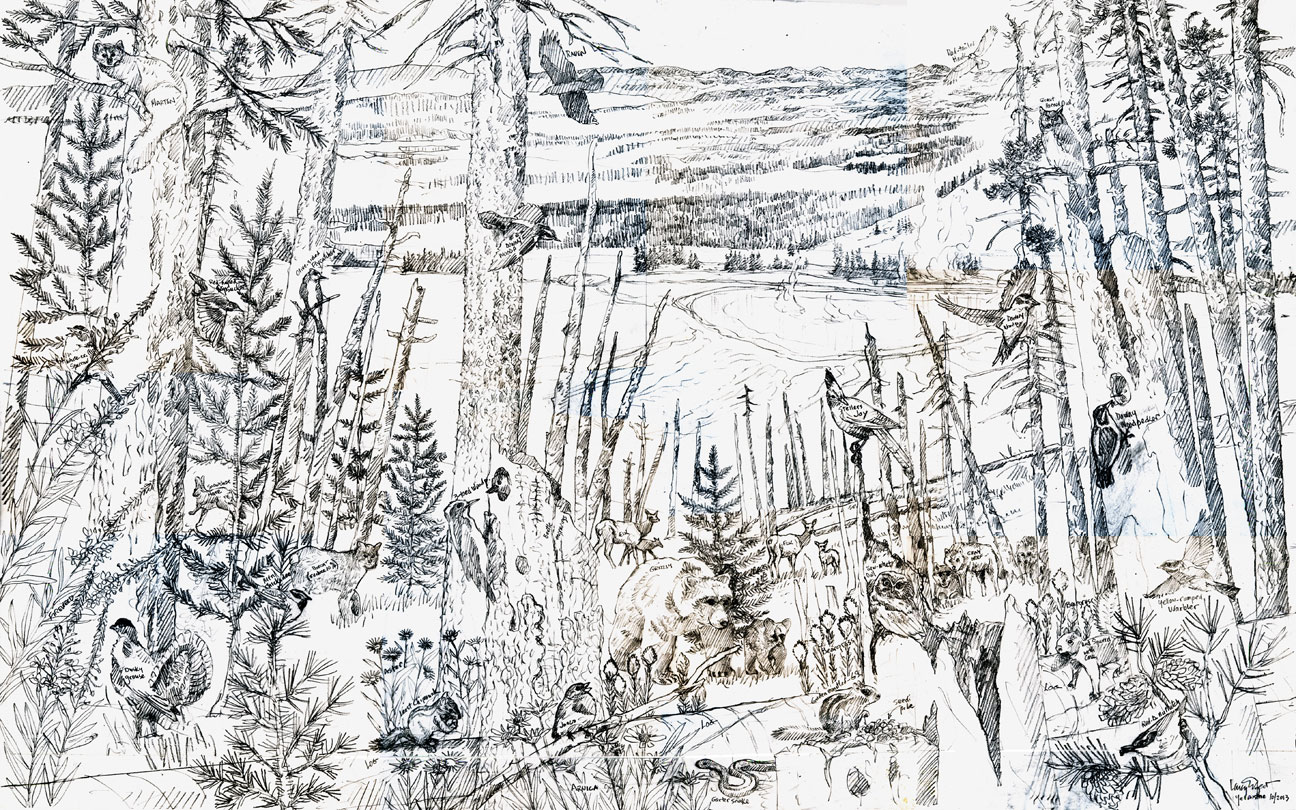
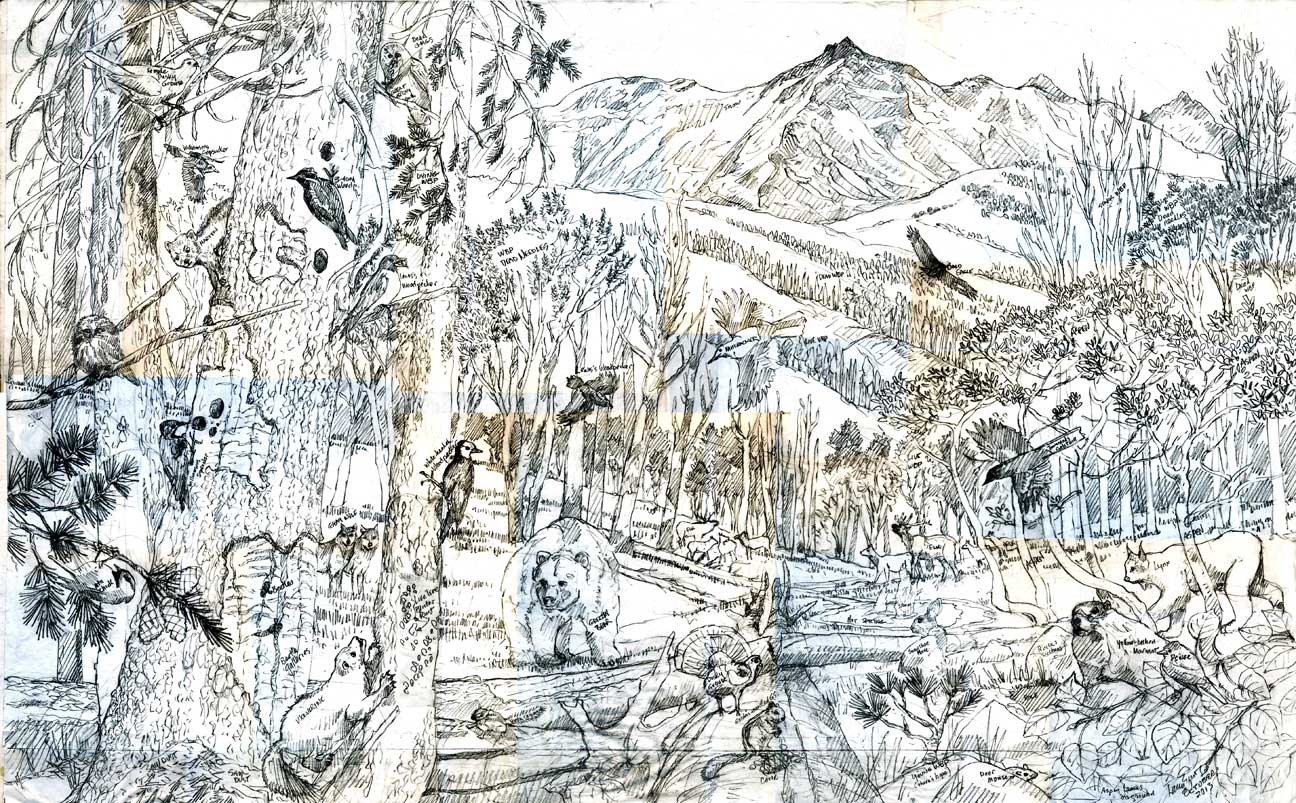
Hot-Spring-sketch-vs1

This enlarges in your browser so you can see details.

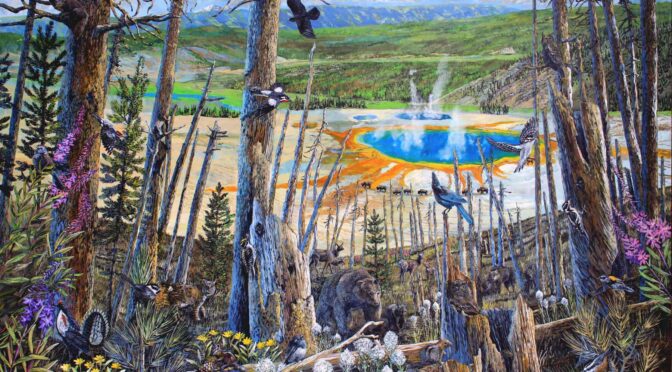
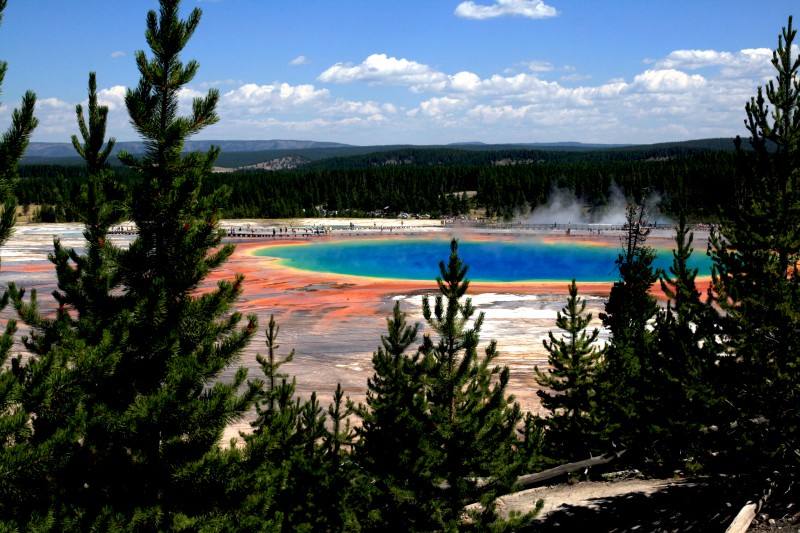
Midway Geyser Basin and the Grand Prismatic Hot Spring, Yellowstone National Park

This is a second and very different sketch than the one posted two weeks ago.

    There are still critters to add, bison crossing near the hot spring, a few birds and maybe a bat, but it’s essentially complete. The idea for this one developed as a visual counter-punch to the first sketch I drew two weeks ago of Whitebark Pines at Yellowstone. That one shows high-elevation Climate Change effects to the park, while this sketch shows thermal features and lodgepole pine forests (where most visitors go).  Both show all the critters and plants that will be effected by Climate Change, change that is already seriously in progress.

    Below is one of my reference photos of the Grand Prismatic Hot Spring, largest hot spring in America. The sketch shows a burned-out forest and lots of diseased trees caused by warmer winters. Warmer winters allow pine bark beetles and then blister rust to ravage these forests. Warmer and drier summers then mean bigger wild fires, a possible lowering of the summer water table – and many changes in wildlife populations. Stay tuned, the first painting is already underway. These two are funded by the Crater Lake Institute, but more like them are being planned through the National Park Service Climate Change Response Program. It’s a bold series of paintings I’m thrilled to be involved with.

Grand_Prismatic_Spring_and_Midway_Geyser_Basin_Yellowstone_NP

Thanks for reading this week.
Larry Eifert

Here’s the blog on the web.  And here’s my Facebook fan page. I post lots of other stuff there.

Click here to go to our main website – with jigsaw puzzles, prints, interpretive portfolios and lots of other stuff.

Nancy’s web portfolio of beautiful photographs

And Click here to go to Virginia Eifert’s website. Her books are now becoming available as Amazon Kindle books.
Yellowstone – Whitebark Pines Ecosystem Mural

Whitebark-Sketch-vs2

Click on the image and it’ll enlarge in your browser for better viewing – and this one deserves it!

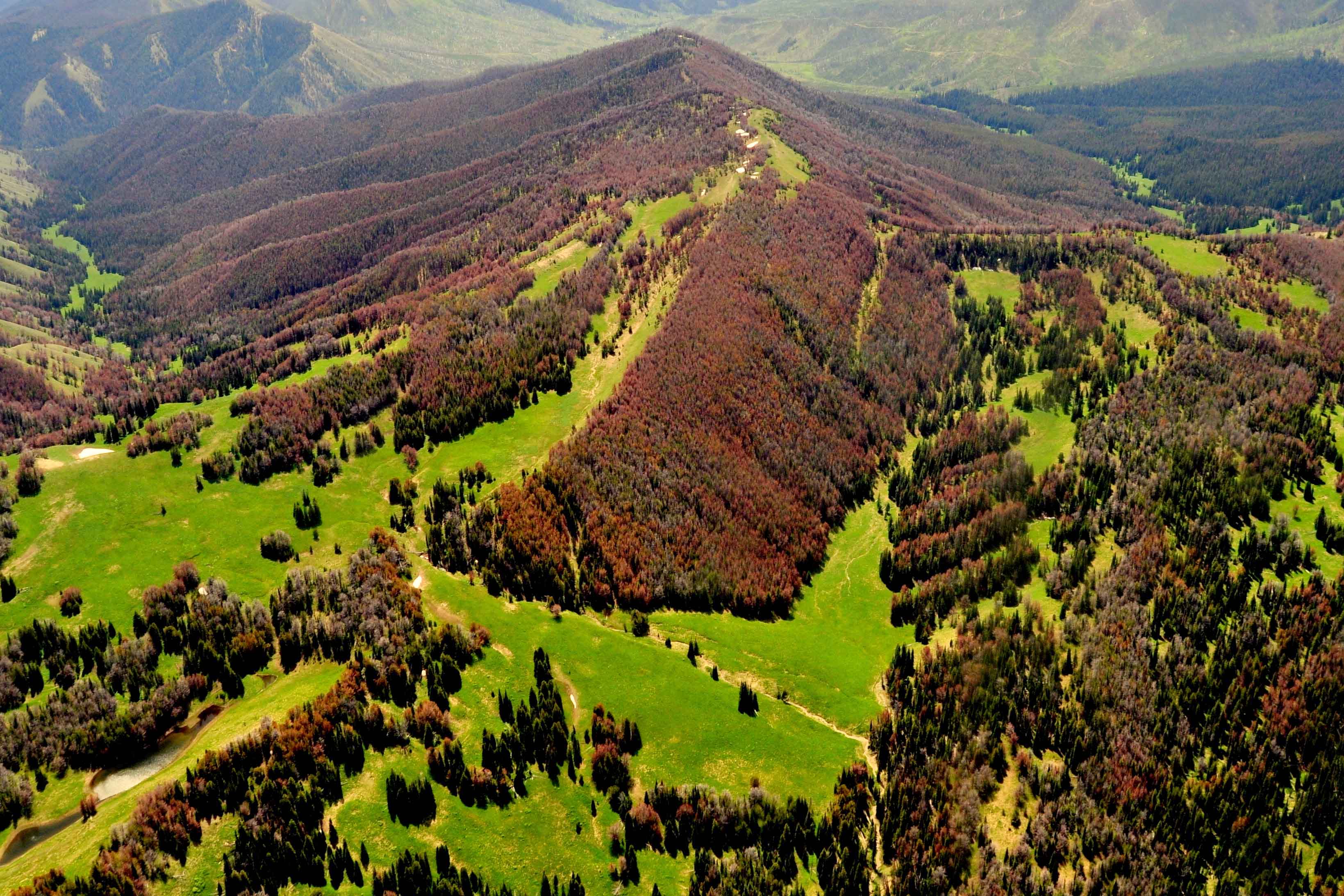
A new project is in the works – funded by the Crater Lake Institute. Here’s the sketch awaiting comments and maybe a few changes, but I can already see it’ll be a grand painting. And this is one of two large murals I’m working on at once. I’ll have the second sketch for you next week (I hope, if my fingers don’t give out). They’re both about Climate Change and the Yellowstone area.

    This is a ecosystem in great peril, thanks to us: Climate Change is causing mountain pine beetles to over-live usually colder winters. Then there’s an introduced fungus called white pine blister rust that is believed to be native to Asia or Europe and was subsequently introduced to North America by us – and put the three together and you have the recipe for real disaster. Thousands upon thousands of these important trees are either dying or are already standing stark and ghostly against the Yellowstone sky, ghost forests – and most of the critters represented in the sketch rely on this tree for survival, for food, shelter and their way of life.

Wally Macfarlane

YES: those are dead trees! Photo from University of Utah researcher Wally Macfarlane. 

    So, the sketch: The big background peak was patterned after Electric Peak along the northern border of Yellowstone, and will show fresh fall snow – but snow is a factor in this story too. Warmer winters mean less summer ground water, and the elk birth rates are already declining there because of the lack of proper summer grass to produce milk for their young. Below the peak, the whitebark pine forests show as dying or dead with brown-red needles by the millions. A back-country hot springs to the right of the grizzly places it over the Yellowstone Caldera. Aspen are in full fall yellow on the far right side, another species in danger. Aspen are important because they are one of the few hardwoods growing here, but they need summer water to survive – oops, that too is declining. I could go on, but you get the ‘picture’.

    Art should stimulate discussion, and that’s what this is all about. I’m excited to be a part of it. Global Climate Change is the single most important threat to our well-being – as well as the health of all the creatures and plants we are now responsible for. It wasn’t this way before humans learned to alter the planet they live on, but now it’s up to us to make sure they have a place to live. Onward – I say to my painting arm. What else could matter more?

Thanks for reading this week. Stay tuned for the painting!

Larry Eifert

Here’s the blog on the web.  And here’s my Facebook fan page. I post lots of other stuff there.

Click here to go to our main website – with jigsaw puzzles, prints, interpretive portfolios and lots of other stuff.

Nancy’s web portfolio of beautiful photographs

And Click here to go to Virginia Eifert’s website. Her books are now becoming available as Amazon Kindle books.
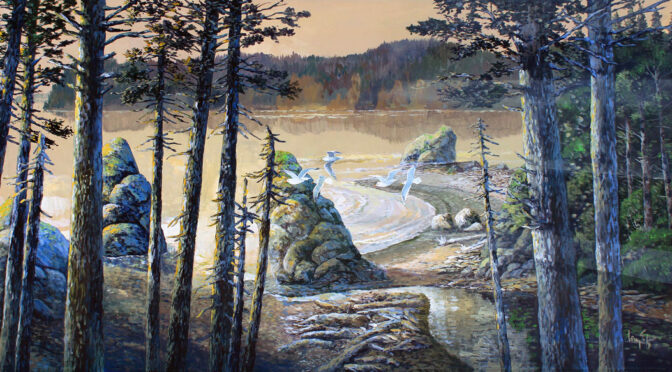
The Gulls at Ruby Beach

Gulls-at-Ruby-Beach

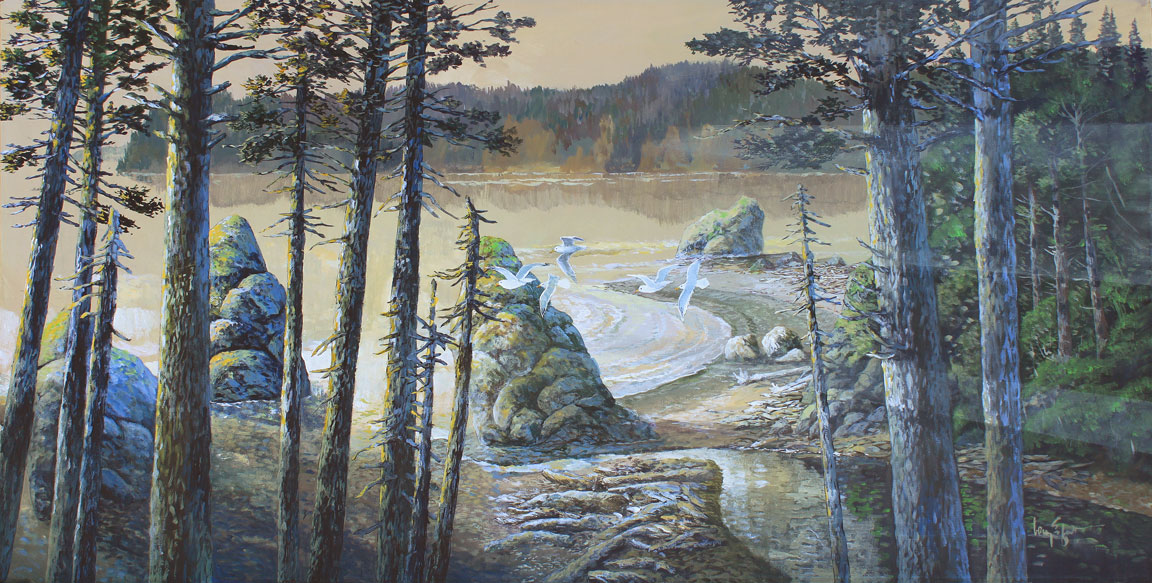
“The Gulls at Ruby Beach” is a new acrylic painting on canvas, 20″ x 40″ and offered here for $1750 framed. Email us for details if you’re interested. Click it and you’ll see enlarged versions of both these images.

  Ruby Beach is usually a vibrant and wild Olympic National Park beach, but on occasion in late summer the ocean can be more like a calm lake – little surf and almost no wind. We were there to see a sunset and it felt like this. It felt like warm coffee. The headlands beyond the beach aren’t quiet as close as what I painted, but it just seemed like I needed to stack up the levels of receding shorelines and show some abstract textures to that area. And maybe some of you will notice the big missing sea stack on the left side. No, not on purpose, but if you stand just here on the trail down to the beach, that big rock is more to the left and out of view. I think it works.

Gulls-at-Ruby-Beach-framed


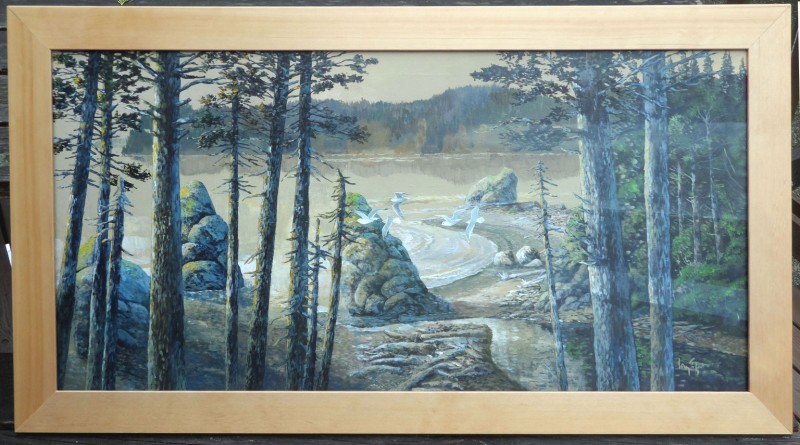
Here’s a photo of the painting and frame that’s included. If you don’t want the custom frame, we can do that too. This is the original painting, NOT a print.

And, if you’re interested, you might go over to my Facebook Fan page and like it. I post lots of trail albums and other art there. See the link below.

Thanks for reading this week.
Larry Eifert

Here’s the blog on the web.  And here’s my Facebook fan page. I post lots of other stuff there.

Click here to go to our main website – with jigsaw puzzles, prints, interpretive portfolios and lots of other stuff.

Nancy’s web portfolio of beautiful photographs

And Click here to go to Virginia Eifert’s website. Her books are now becoming available as Amazon Kindle books.
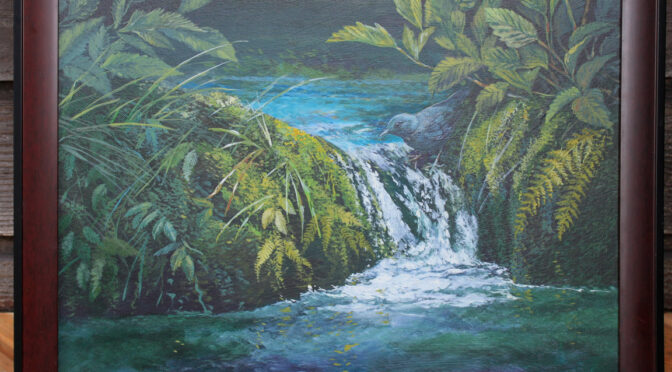
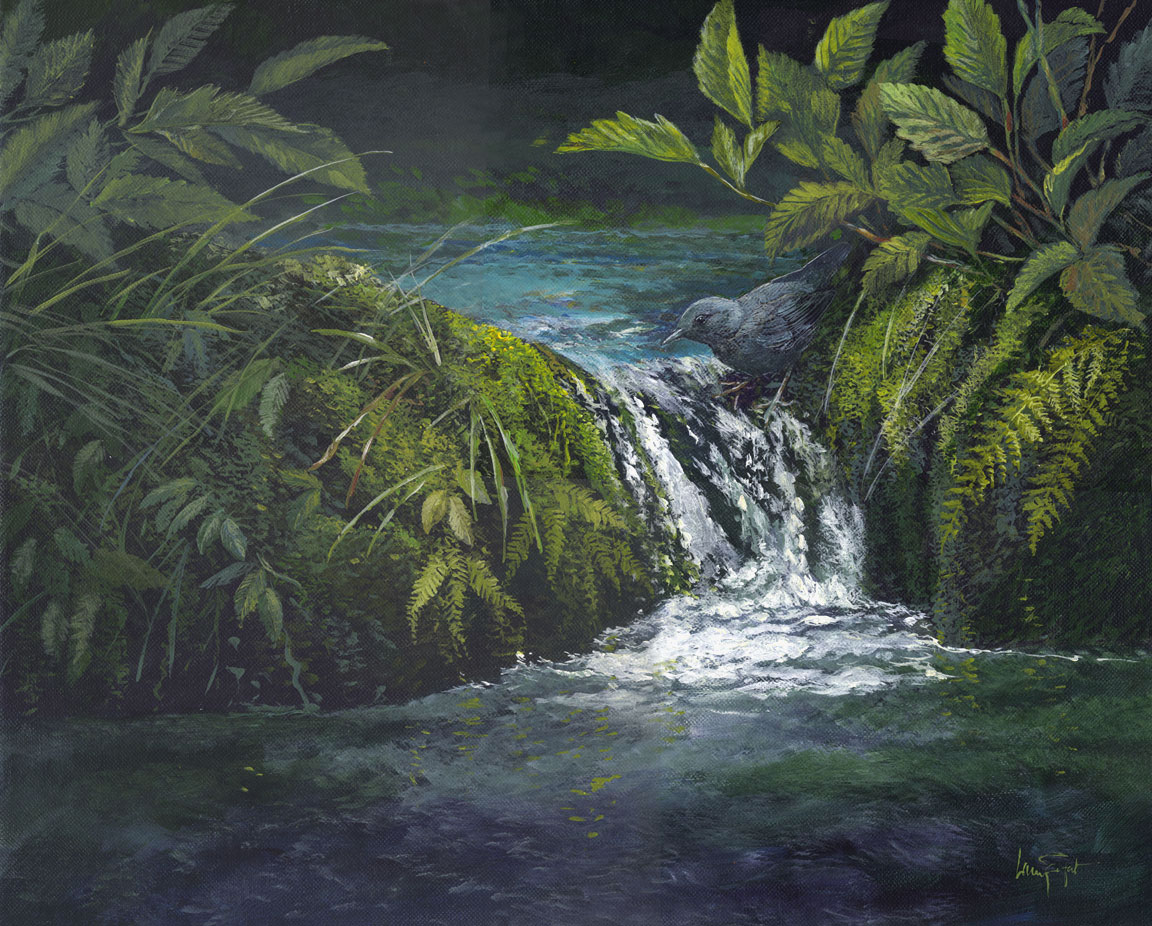
American Dipper 4

Dipper-4

This ORIGINAL painting is  acrylic on linen canvas, 16″ x 20″ and $190 unframed.
This is the original painting, NOT a print.
Email us for details.

    Long ago, I saw some paintings of a South American rain forest. I have no idea who the artist was, but they were moody, dark, ethereal – and had this ‘feeling’ about them that a painter can only get if they’d actually been to a place like that. And it’s not just going there, but they would have to really get to know a place, not just how it looks, but WHY it looks the way it does.

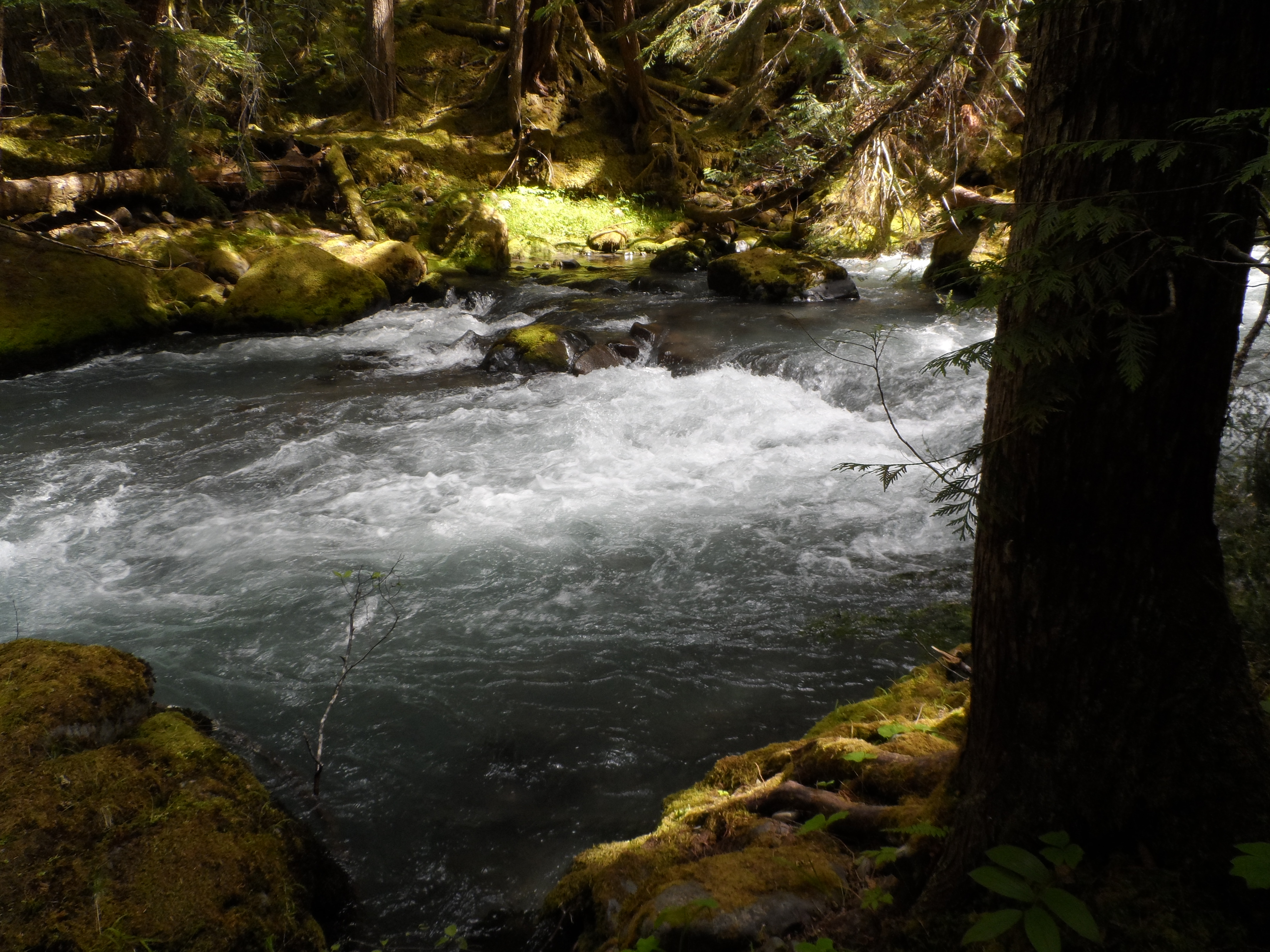
    I think that way about this painting. If just feels like it really was. We’ve spent a spring and summer doing a lot of hiking, more than normal, and much of it has been beside these pure, ethereal and pristine Northwest rivers that are unlike any others I know. The water is often blue-gray because of ice melt far upstream, streamside moss and salmonberries are sculptured gardens of lush green and fresh life – never dusty and tired-looking. And that little dipper. It just keeps reappearing in these paintings, over and over, the symbol of wilderness and these Northwest waters.

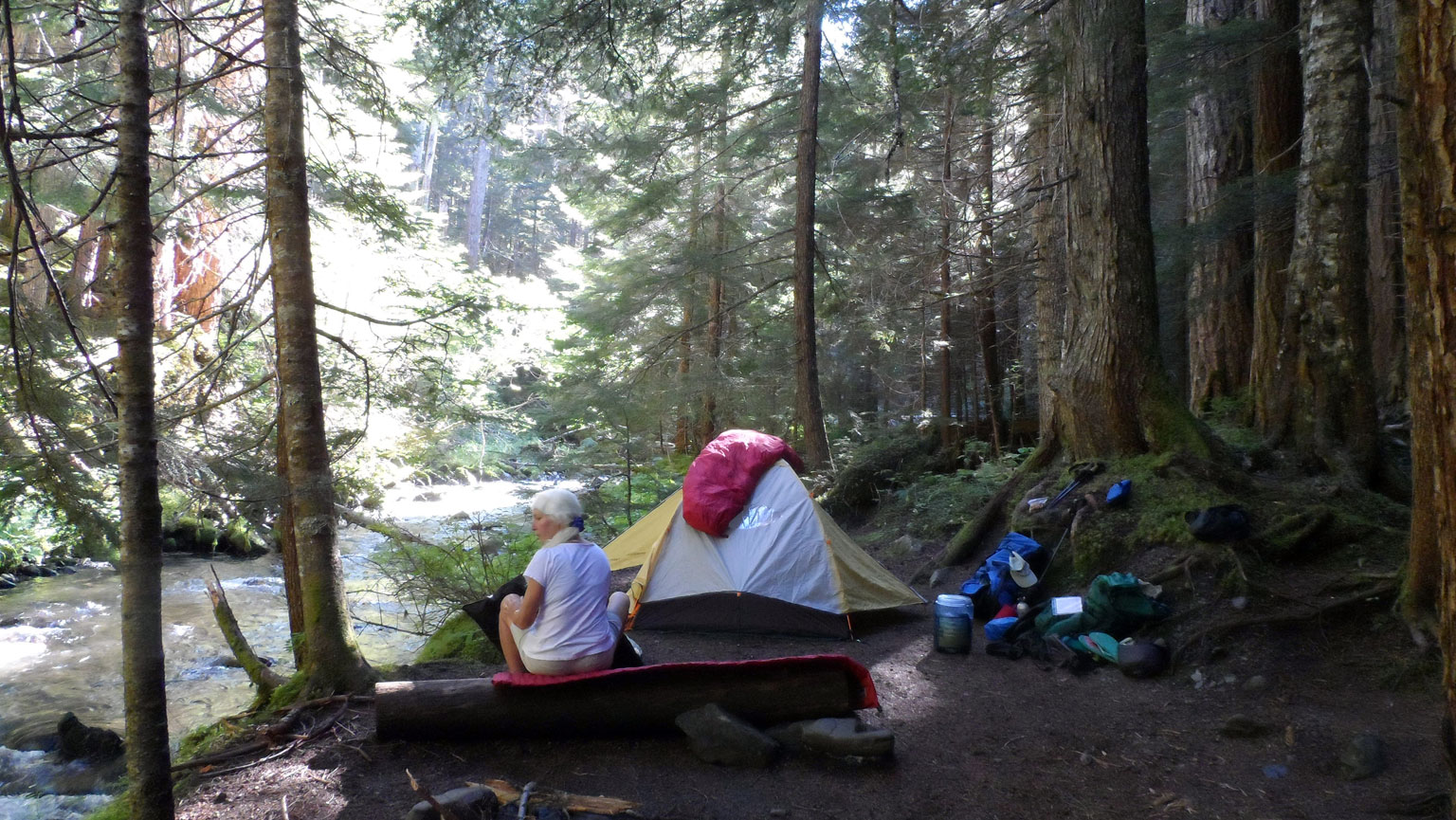
    Last week Nancy and I backpacked into Royal Basin in the Olympics – the epitome of these types of landscapes. For over six miles we hiked beside the Dungeness River, then Royal Creek, never out of earshot of its roaring and rumbling as it dropped through the canyon. We broke the climb up into two sections and camped so near the creek that all night I thought I heard voices – well, I guess I did if you consider rushing water to have a voice. The river-talkers were almost too loud at times.

River-camp

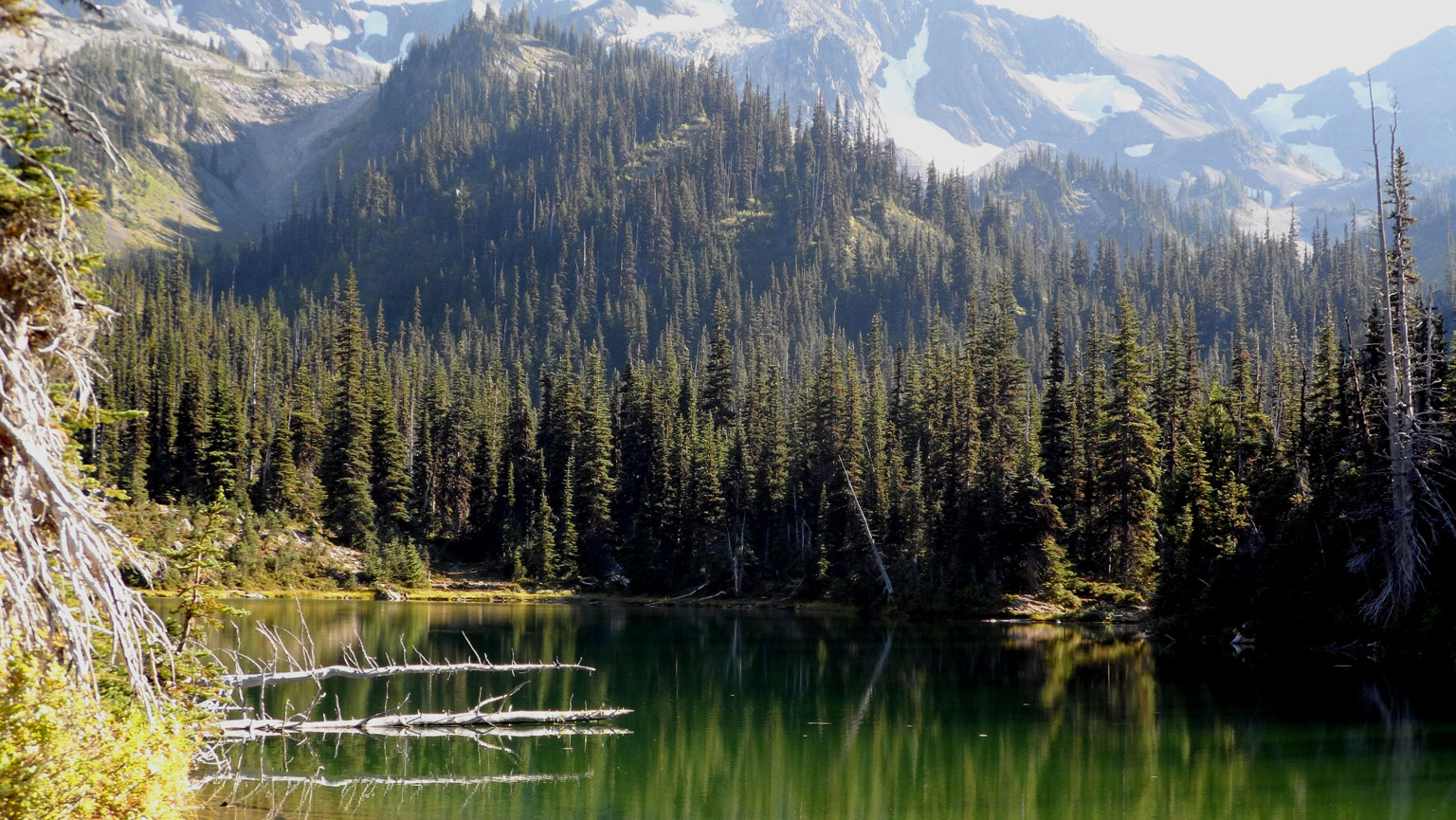
Towards the top, Royal Lake appeared, encircled by some of the highest peaks in the Olympics – and we were the only ones camping here. Somehow, this dipper painting needed to be posted afterwards. So I did!

Royal-Lake-and-Mt-Fricaba

Thanks for reading this week. There’s an album of these trip hikes on my Facebook fan page.
Larry Eifert

Here’s the blog on the web.  And here’s my Facebook fan page. I post lots of other stuff there.

Click here to go to our main website – with jigsaw puzzles, prints, interpretive portfolios and lots of other stuff.

Nancy’s web portfolio of beautiful photographs

And Click here to go to Virginia Eifert’s website. Her books are now becoming available as Amazon Kindle books.
A Fantastic Finish for Sitka

Sitka-estuary-painting-vs2

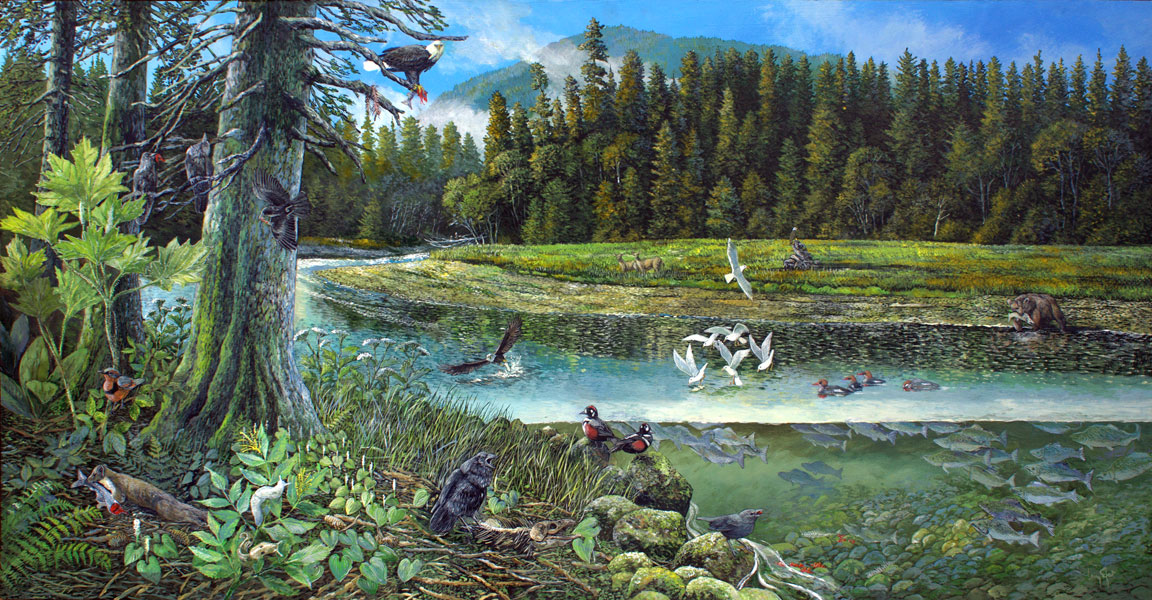
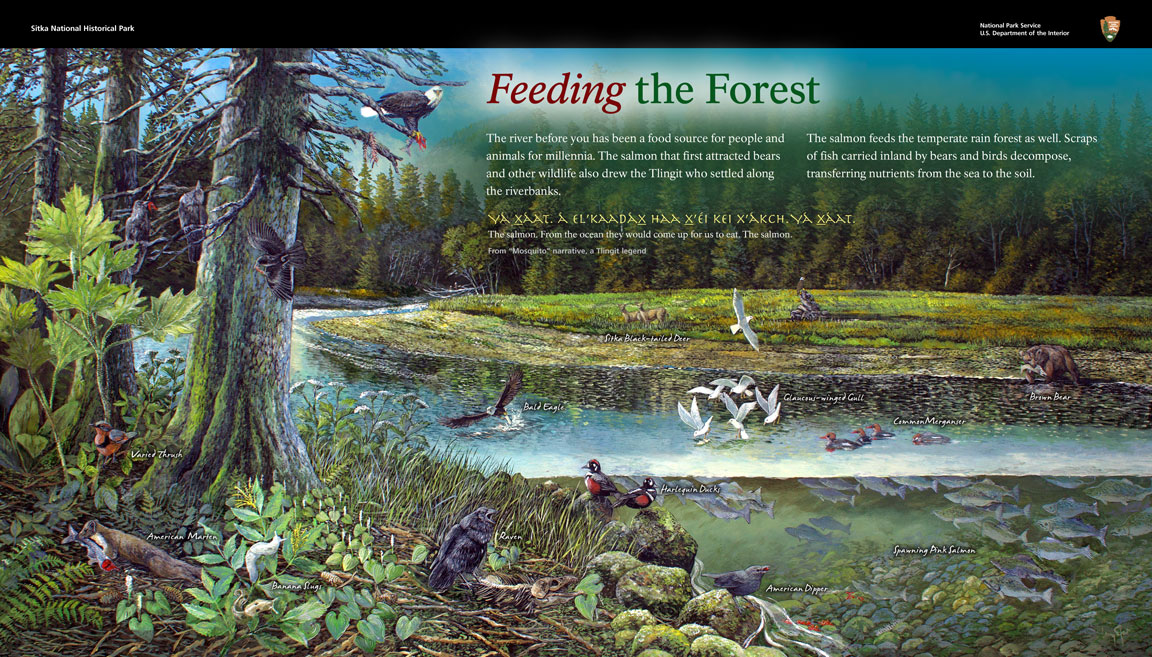
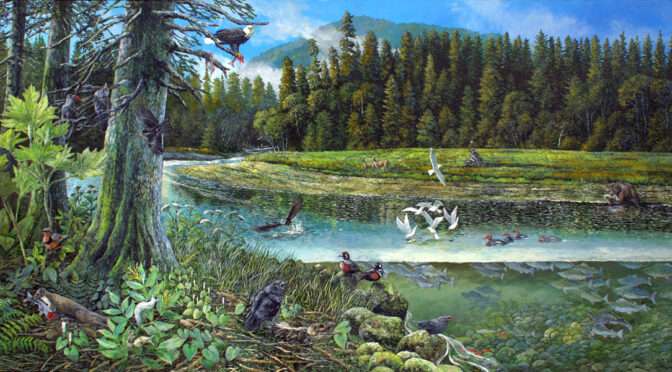
Last week I finished up my painting for Sitka National Historical Park in Alaska.  I think it hits the mark pretty well. I was tasked with showing the relationships between spawning pink salmon and the forest around Indian River, right in the town of Sitka. The park actually surrounds this Estuary. Essentially it’s the story of how the returning fish feed the local critters and even the trees themselves. See the American Marten running deeper into the forest with a fish? The dipper with an egg in its mouth, a brown bear catching the salmon, or eagles and ravens doing the same? I thought it pretty great that this coincided with our local “pink” salmon stream, the Dungeness River that is having a huge spawning run right now too – over 100,000 fish and still counting.

Indian-River-Panel

And here’s the finished installation (or at least a design mockup from Harpers Ferry Center in West Virginia). It’s not approved yet, but well on the way. I left the web version large, so click the image so you can see the text and other details. This will eventually be installed along the trail in the exact location as what the painting shows. At 42″ wide, it will be a pretty large panel, almost as big as the original painting.

This installation is a great example of why I just love my job. This will be there for many years, teaching visitors about this special place by using art in an outdoor location – right at the point of contact with nature itself. My mom taught people about nature, but she did it with her books, photography and outdoor classes. I’m just doing the same thing in another way, with paintings – and I hope it never ends.

Thanks for reading this week.
Larry Eifert

Here’s the blog on the web.  And here’s my Facebook fan page. I post lots of other stuff there.

Click here to go to our main website – with jigsaw puzzles, prints, interpretive portfolios and lots of other stuff.

Nancy’s web portfolio of beautiful photographs

And Click here to go to Virginia Eifert’s website. Her books are now becoming available as Amazon Kindle books.
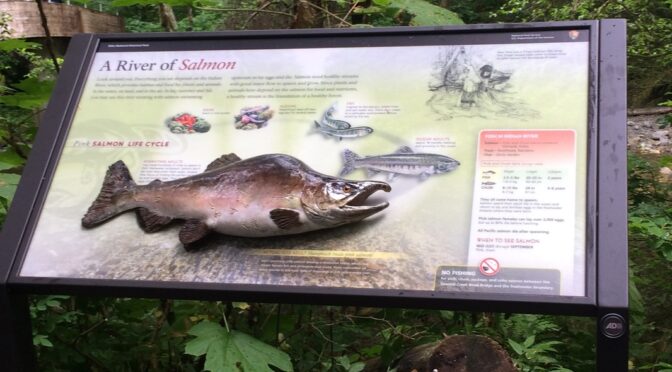
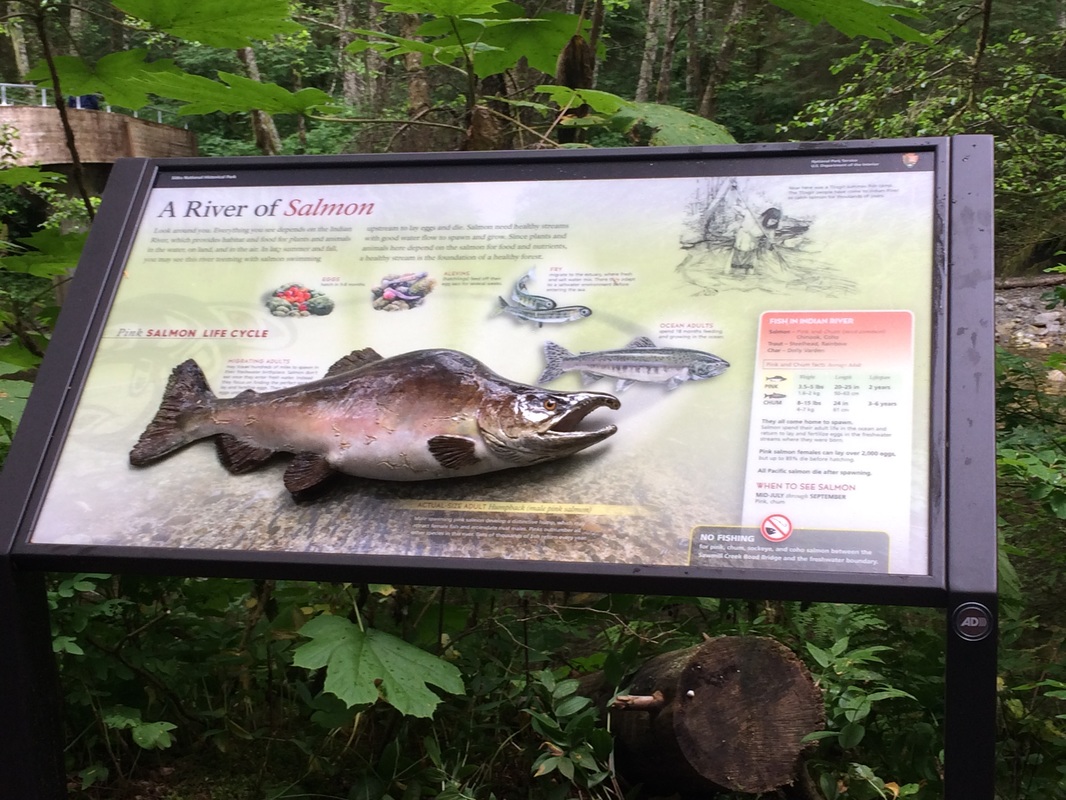
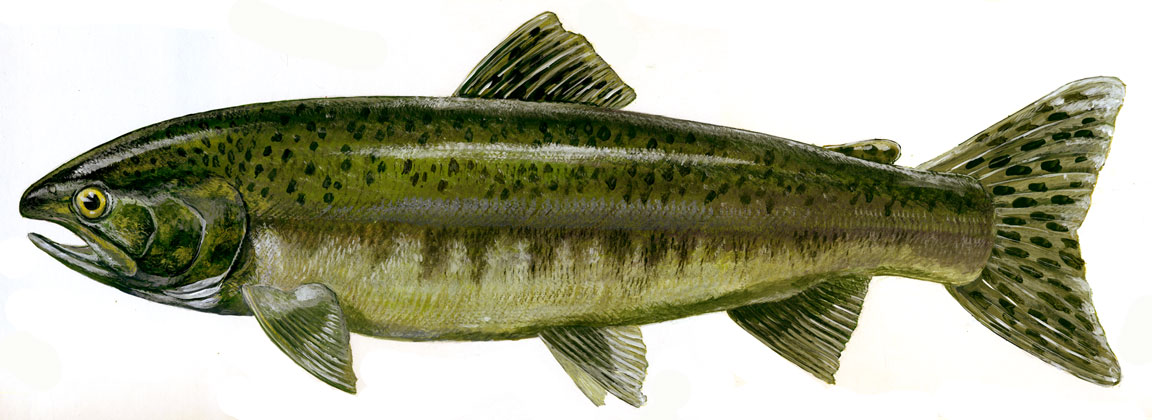
A Sea-run Humpy for Sitka

No post last week – just too busy. But this just came off the easel today and will be sent out tomorrow for approval, so let’s get your approval as well.

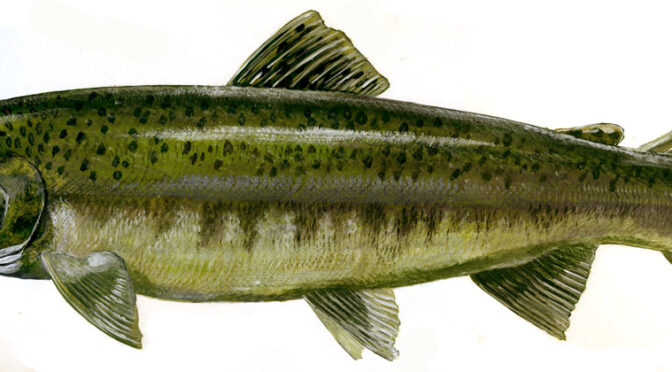
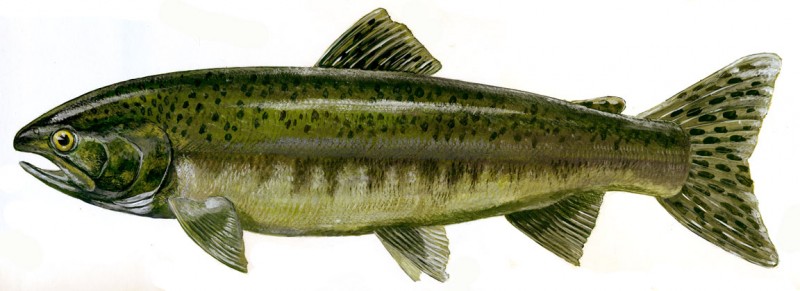
This is going to Sitka National Historical Park in Alaska. My task here was to paint the ocean form of the humpbacked or pink salmon in a realistic way so it looks like it’s the real deal. I also painted the eggs, alevin and fry in the same manner, but I’ll post those later. This one seemed to have gotten that pretty well. There was some debate about the shine. If it’s out of the water, it would shine, but in the water this fish wouldn’t shine anywhere. In fact, they look pretty dull and camouflaged, and needs to be or it would be a seal’s meal. After I scanned it and looked at the reference photos (about 25 of them), I thought that the fish might need to be more reddish since my scanner is always on the cool side. So Photoshop did that, and now I’m not sure.

So here’s that second version with the red.

Sea-run-pink-salmon

Art is always like that. There’s no THERE there. You never know when it’s finished, or if it’s ‘right’, since there is no ‘right’ – just someone else’s opinion. Years ago, in the Eifert Gallery in California, a woman came in and went right around the main exhibit hall.  I happened to be upstairs on the mezzanine and overheard her comment as she went around the room: “Wrong, wrong, wrong, wrong” she declared in a voice that I thought was louder than necessary. It was a teachable moment for me, because I realized my confidence had grown and I was solidly in command of my feelings, and what did she know – nothing more than I did, and probably less.

Thanks for reading this week.
Larry Eifert

Here’s the blog on the web.  And here’s my Facebook fan page. I post lots of other stuff there.

Click here to go to our main website – with jigsaw puzzles, prints, interpretive portfolios and lots of other stuff.

Nancy’s web portfolio of beautiful photographs

And Click here to go to Virginia Eifert’s website. Her books are now becoming available as Amazon Kindle books.
Sitka National Historical Park Mural Sketch

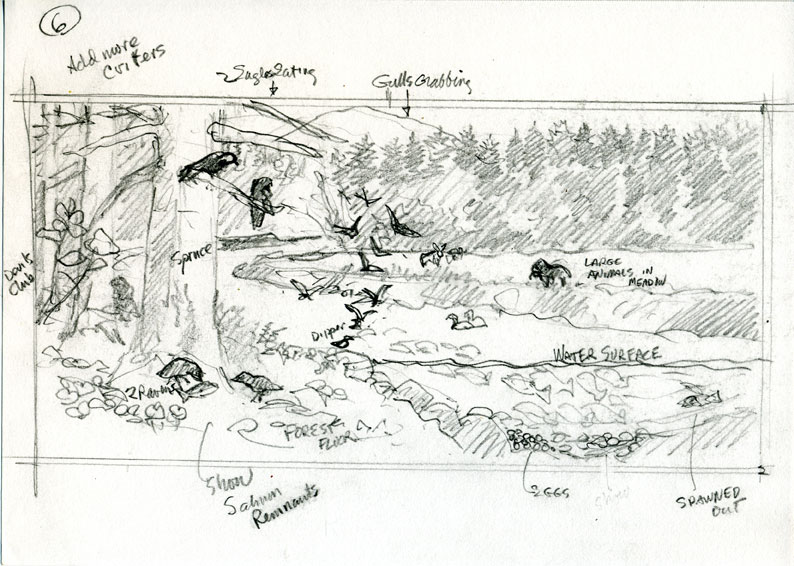
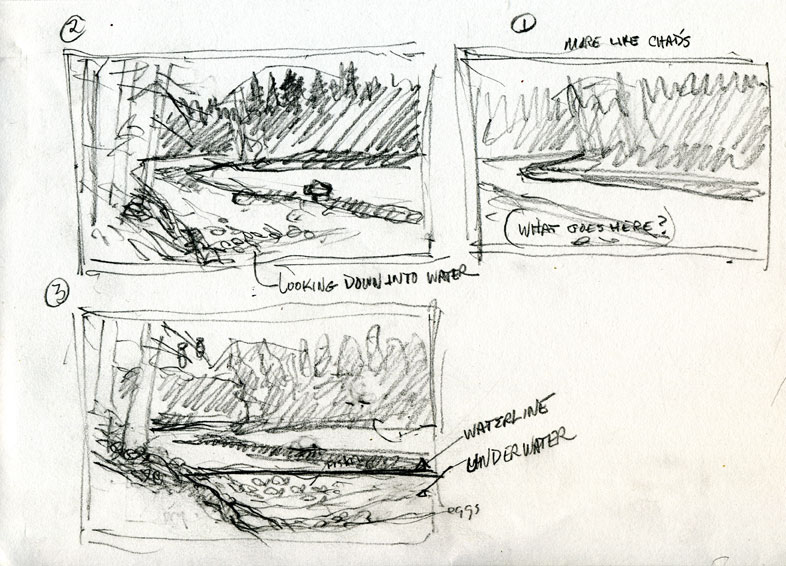
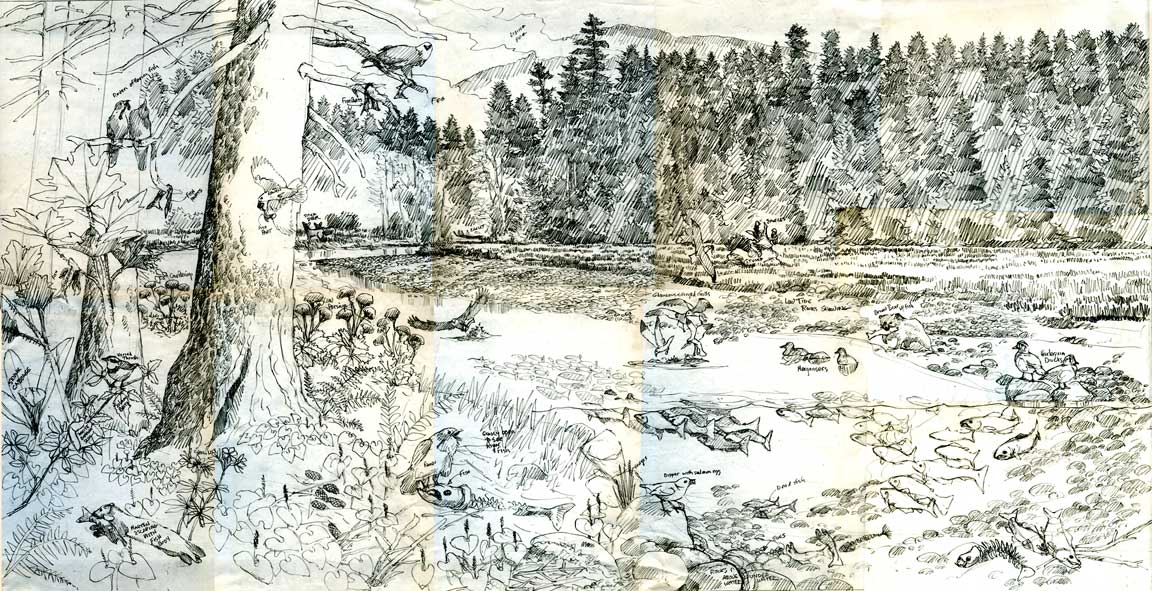
 Here’s my sketch for the biggest of six paintings for Sitka National Historical Park. I’m now awaiting approval or change requests to begin painting – oh boy. I loaded a big 16″ version of this on the web, so just click the drawing to see it.

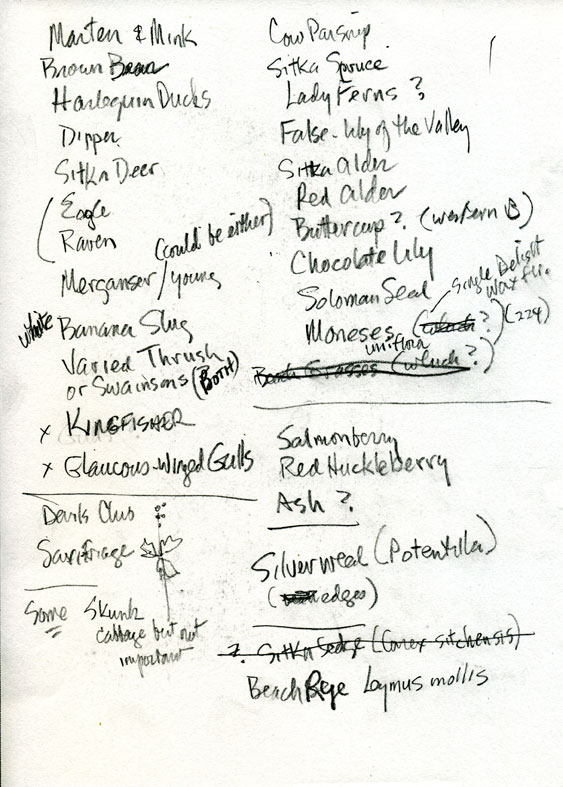
There are some areas that still need figuring out. The right side needs defining better, harlequin ducks are too big, the upper left (spruce forest). The overall concept is probably Okay, but I won’t know until the National Park Service releases comments (which they’re very good at).

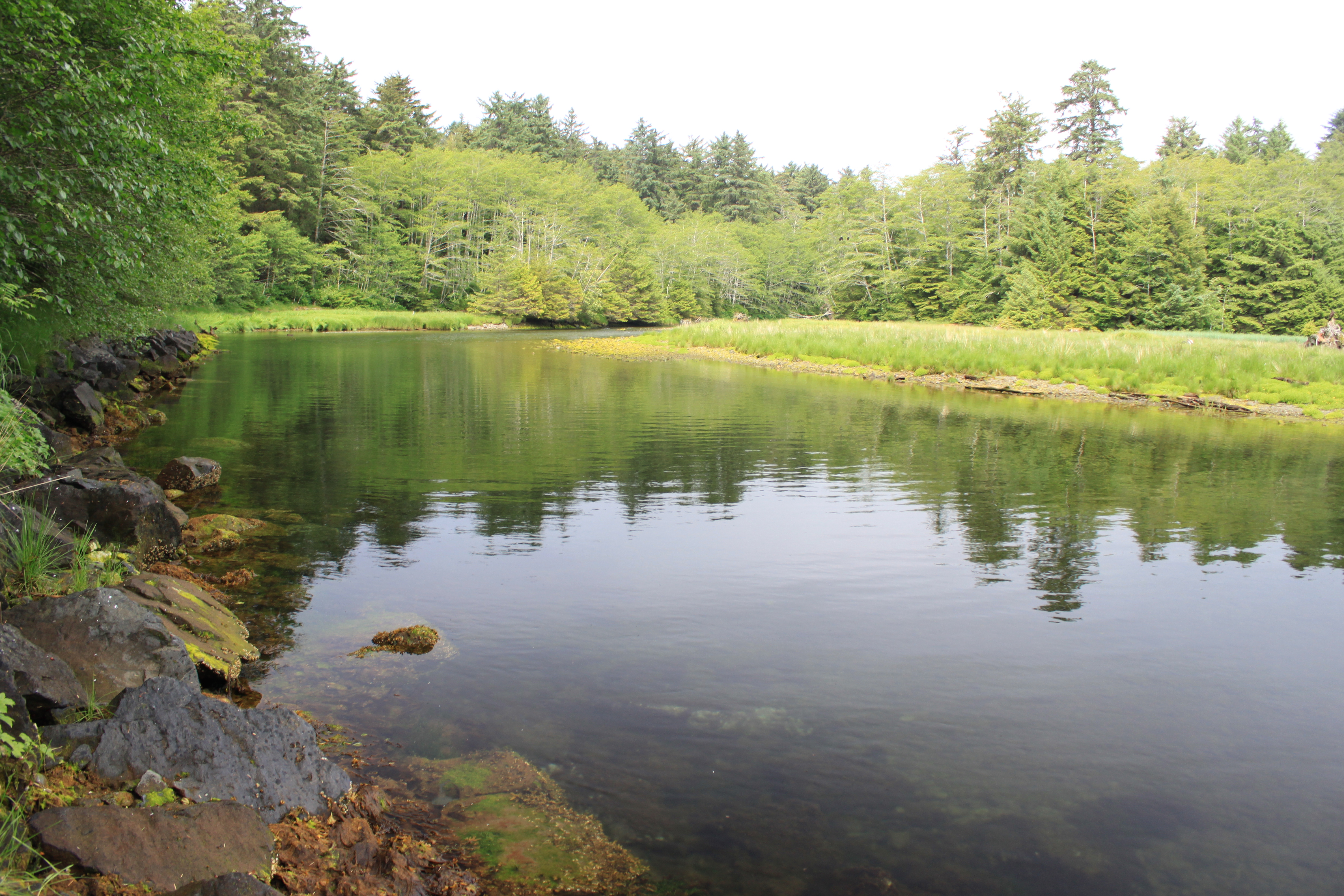
And here’s one of my reference photos of the location to show how I arrived at the sketch. This is the story I’m trying to tell: pink or humpy salmon come into the Indian River to spawn and then die. Bears, eagles, ravens, martens and more come in to get the fish; some are dragged or flown off into the forest to be eaten – and the remains leach into the soil feeding the trees. It’s some of the only nitrogen these trees get, and a healthy forest is needed to feed and shelter the new eggs after they hatch and young (alevin) as they grow. It’s a story only recently discovered. I had a tough time with the rocks on the left, which were obviously placed there to keep the bank from eroding, but they’re not natural, and in fact are not healthy for young fish. In the end, I added a few.

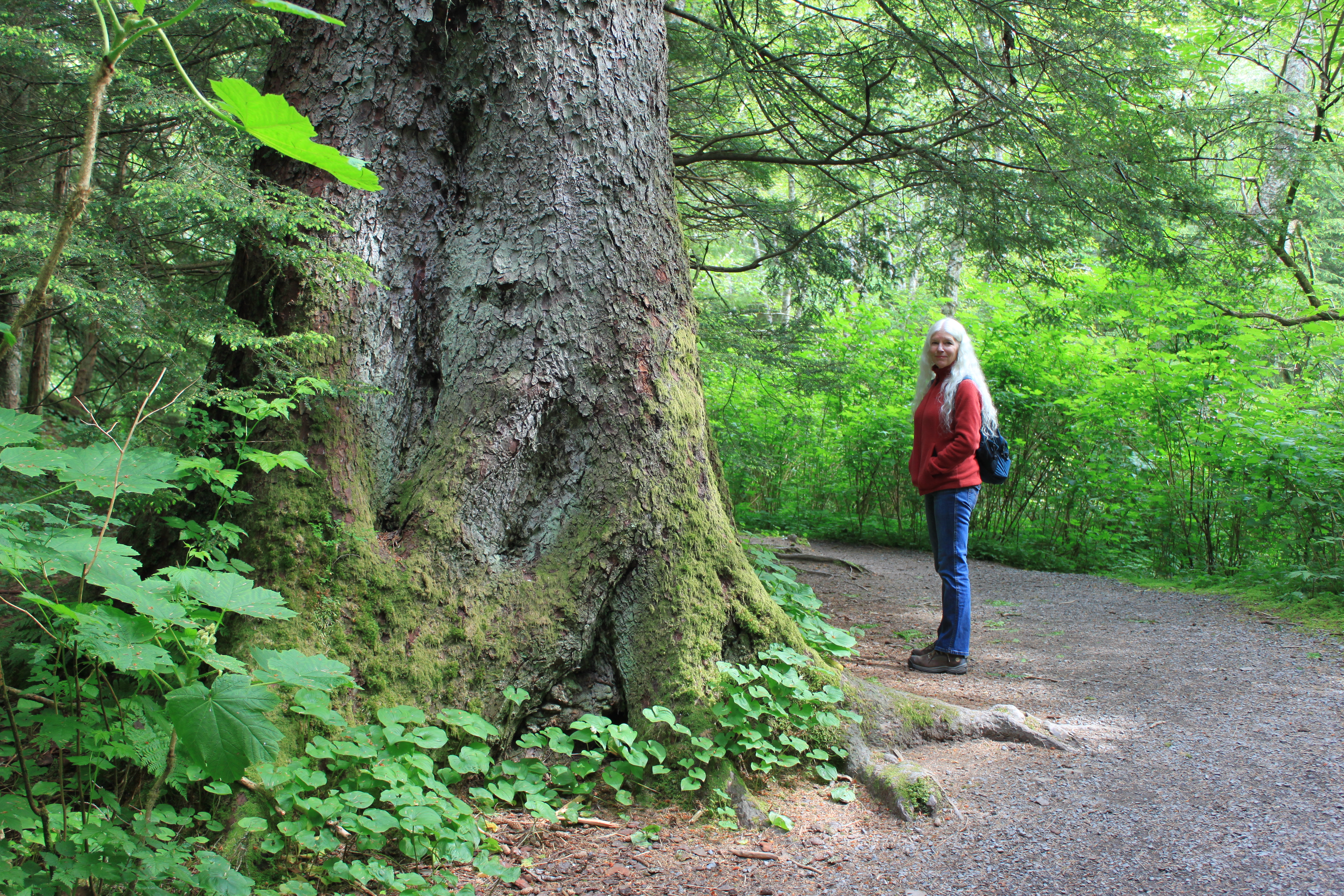
And here’s the ‘Subject Sitka Spruce’ within 100 feet of the other photo, with devils club on the left, false Soloman-seal on the ground and Nancy (the real subject of interest to me) to add a size-scale. These were taken on our field trip there last month.

This painting will eventually become an interpretive exhibit placed right here, and an entire generation of people to see and learn about the Indian River’s salmon. It will outlast me, I’m sure.

Thanks for reading this week.
Larry Eifert

Here’s the blog on the web.  And here’s my Facebook fan page. I post lots of other stuff there.

Click here to go to our main website – with jigsaw puzzles, prints, interpretive portfolios and lots of other stuff.

Nancy’s web portfolio of beautiful photographs

And Click here to go to Virginia Eifert’s website. Her books are now becoming available as Amazon Kindle books.
Dipper Bobbing – Dungeness River

American Dippers cannot seem to just stand there, but have to constantly bob up and down. This one was at the bottom of the bob.

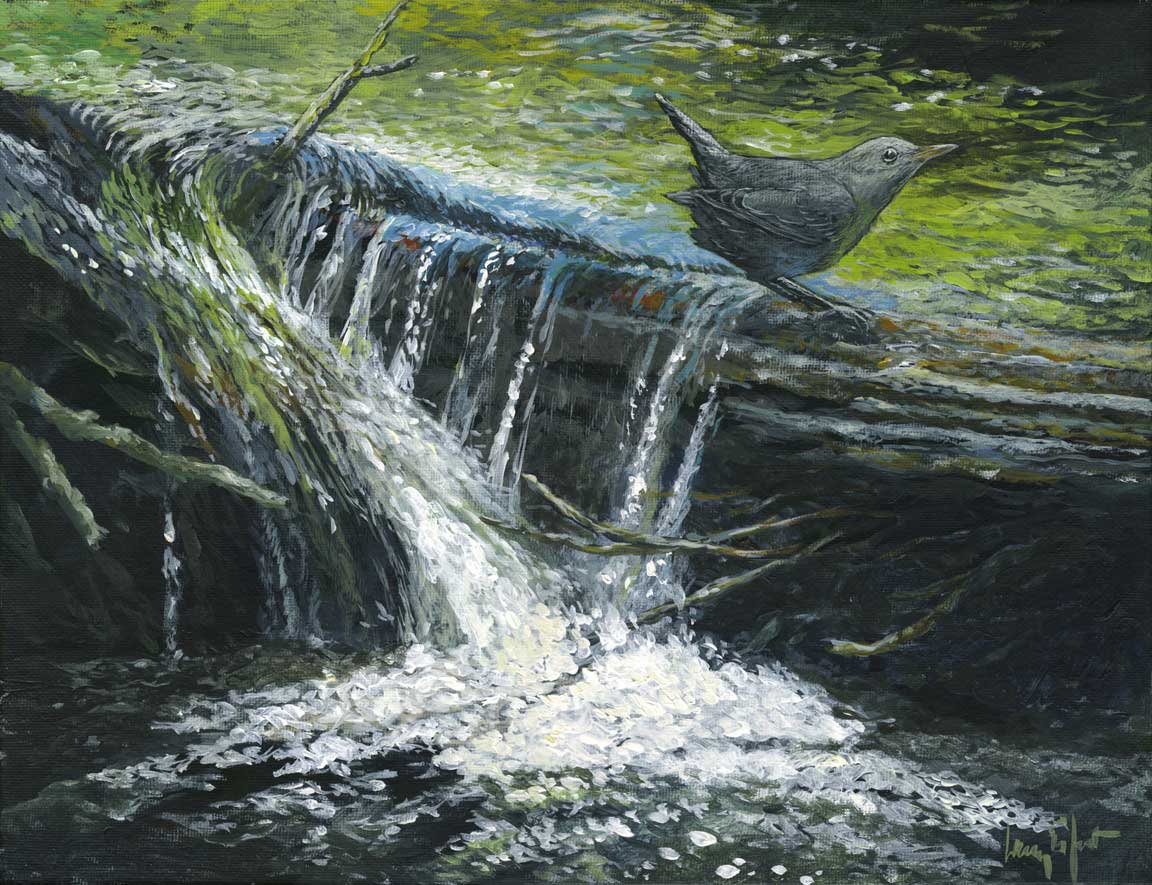
I just have this thing for American Dippers and clear, rushing little waterfalls. So here’s another painting of my favorite little bird, mainly because we’ve seen many of them on our recent summer hikes. Dippers were also John Muir’s favorite bird. He said it was because they only live along the cleanest mountain streams and represented what’s best about American wilderness. They never stray from rushing water. Given a river bend, dippers will fly the long route around instead of short-cutting across the neck. They build nests of moss and twigs behind waterfalls, so the chicks are wet from birth. Now here’s the best part: dippers feed by jumping into the water, sometimes barely above freezing, and with wings open for balance, they just walk around underwater kicking over stones looking for aquatic insects to eat. It’s as if they’re oblivious to the fact it’s water at all. They can jump into a huge current, and then appear someplace completely different, at home just ‘ambling around’ underwater. Pop, they’ll just jump out of a pool and sit for a moment on a log, just like this painting shows, seemingly without a drop of water on them. In fact, come to think of it, I’ve never seen a dipper actually shake off water.

 Here’s where I saw this little guy, the Dungeness River up in the Buckhorn Wilderness, featured today on the Wild Olympics website and just 20 miles from home. It’s the second steepest river in America, falling 7700 feet in just 28 miles.


This ORIGINAL painting is varnished acrylic on linen canvas, 11″ x 14″ and $145 unframed.
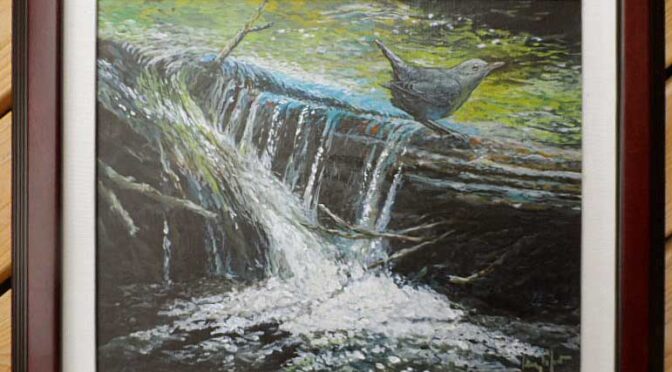
This custom frame (sorry, color seems a bit off in the photo) with a linen liner makes it a total of $180 and shipping adds just a bit more depending on your zone or if you take the frame. This is the original painting, NOT a print. I have other frames of various styles too.
Email us for details.

Sorry, but it’s sold.

Thanks for reading this week.
Larry Eifert

Here’s the blog on the web.  And here’s my Facebook fan page. I post lots of other stuff there.

Click here to go to our main website – with jigsaw puzzles, prints, interpretive portfolios and lots of other stuff.

Nancy’s web portfolio of beautiful photographs

And Click here to go to Virginia Eifert’s website. Her books are now becoming available as Amazon Kindle books.
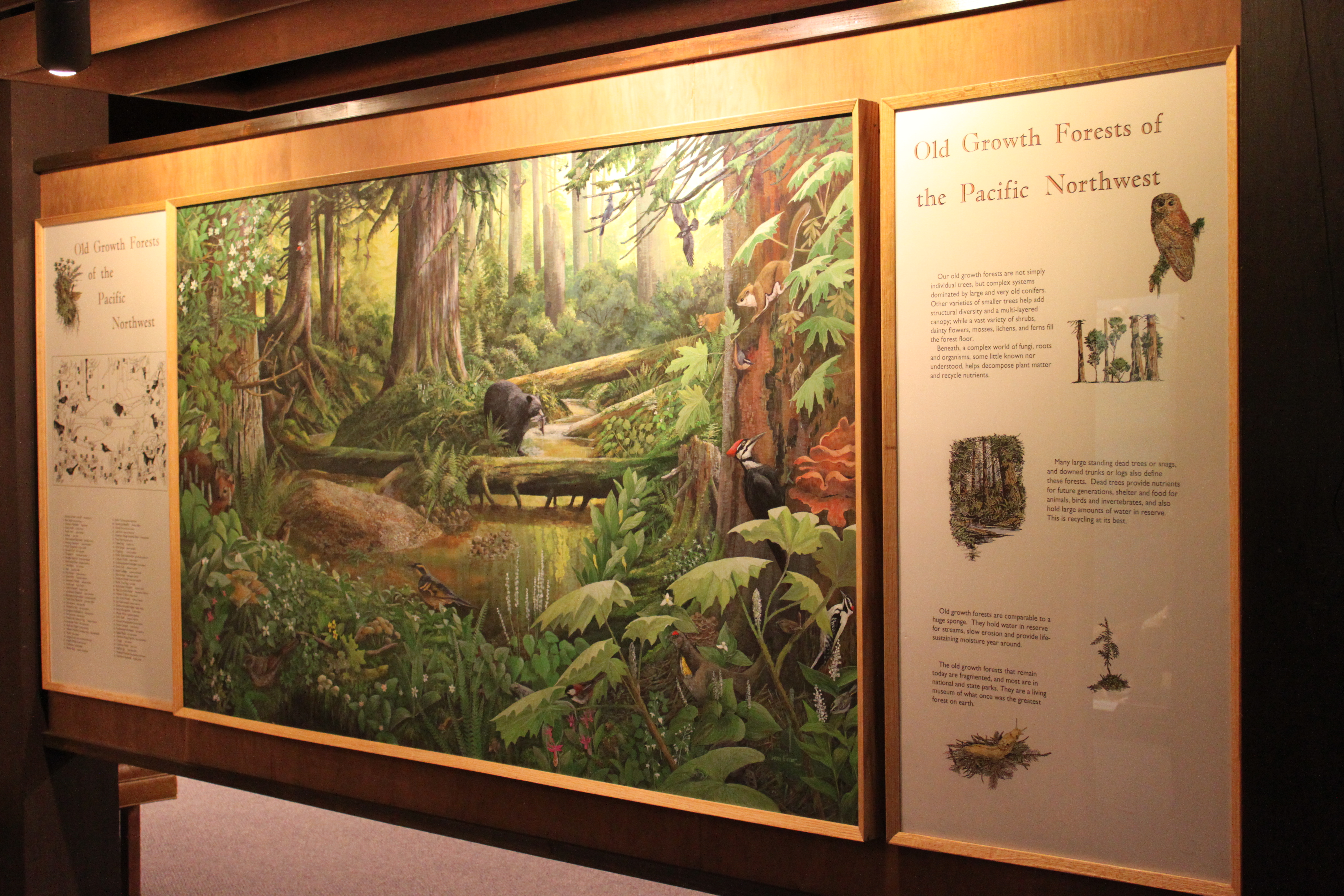
Old-growth Forest Poster Is Now Available

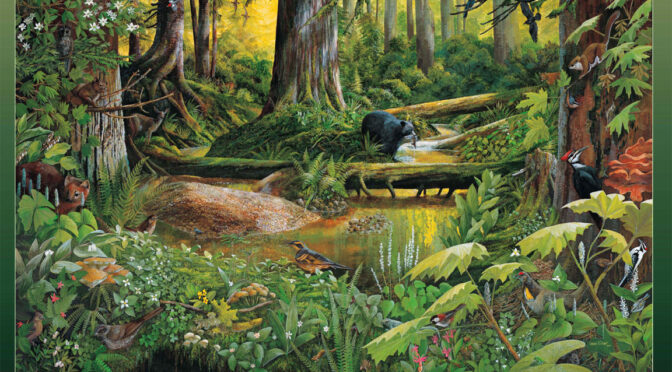
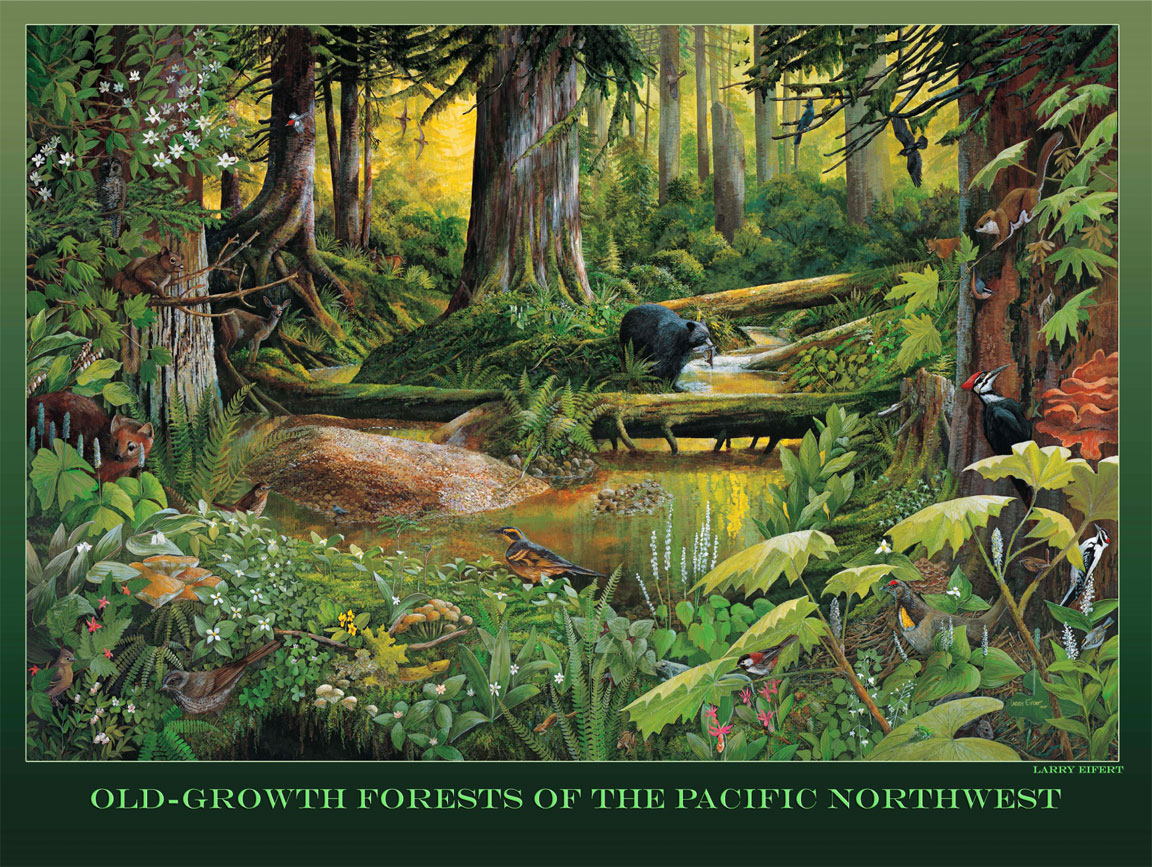
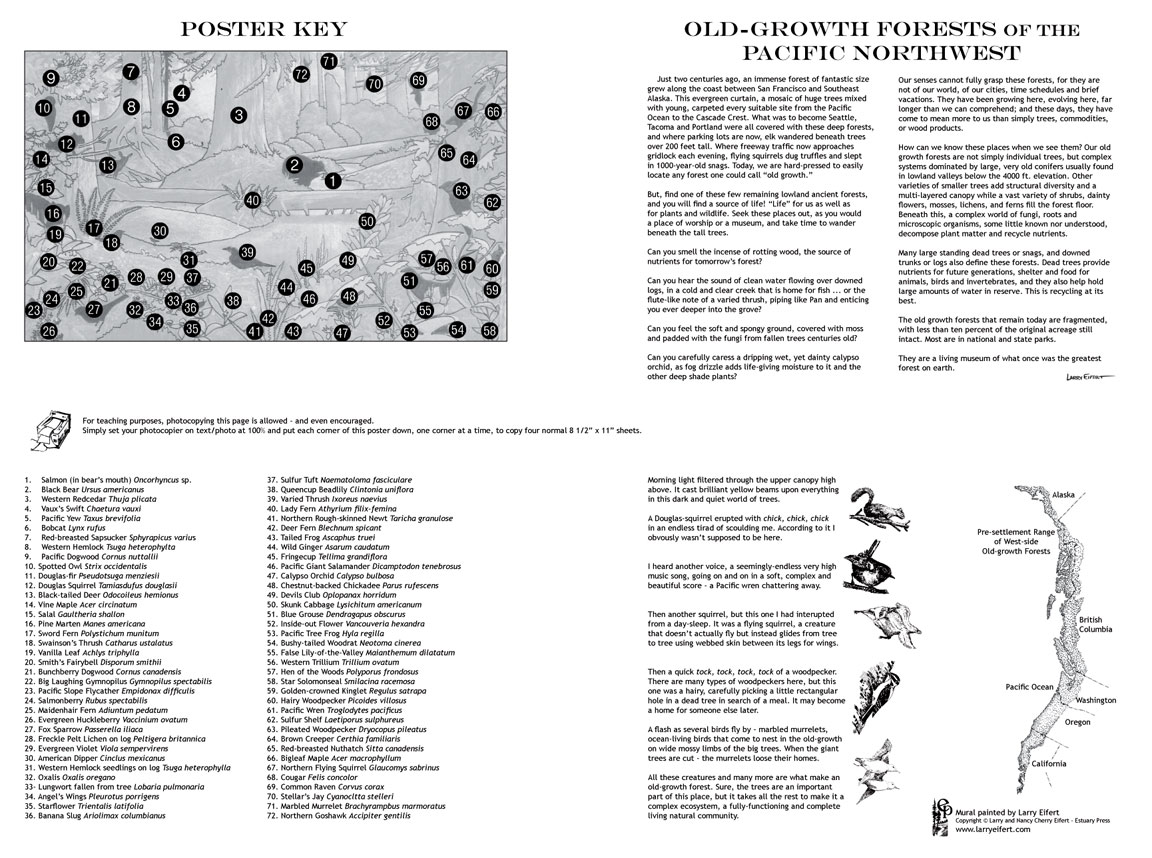
We’ve now printed my Mount Rainier National Park mural as a 18″x 24″ poster. I spent some time on a different type of design for this, with a really great interpretive key on the back. We’ve already had orders from several big parks, so I’m feeling this is going to work.

Awhile ago, I got to thinking about how posters are used. Hang them up, you can’t see the back, all that backside space lost to the viewers. So, I reworked this to make it so anyone can slam it on a copy machine and get four full sheets of the back that create a nice teaching guide and interpretive key. I’m hoping classes use this, but also people who just want to use the painting as a field guide reference.

The poster back is sectioned off so teachers can photocopy each of four panels and create a lesson plan.

And here’s the original painting installed in Mount Rainier National Park. It’s in the main room filled with oiled wood trim and cedar walls, and seems to fit almost like it’s in an art gallery, but guess what, it’s CLOSED because of the SEQUESTER. It’s the nicest visitor center (I think) at that world-class park, and so why would this great country just shut this off, board it up and not allow people to use it at the very busiest season? Let’s see, by doing this, it might staff cuts (people out of work and on unemployment), the non-profit there can’t sell books (meaning private publishers loose money and therefore pay fewer taxes) and artists (us) loose income to pay our printer and and therefore pay fewer taxes.

But while you may not be able to buy this poster at the Ohanapecosh Visitor Center, you CAN get them from us. Here’s a direct link to our shopping cart. 18″ x 24″ poster for $8.95 each. Help us pay the bill that Mount Rainier’s Ohanapecosh would have helped with!

Thanks for reading this week.
Larry Eifert

Here’s the blog.  And here’s my Facebook fan page. I post lots of other stuff there.

Click here to go to our main website – with jigsaw puzzles, prints, interpretive portfolios and lots of other stuff.

Nancy’s web portfolio of photographs

And Click here to go to Virginia Eifert’s website. Her books are now becoming available as Amazon Kindle books.