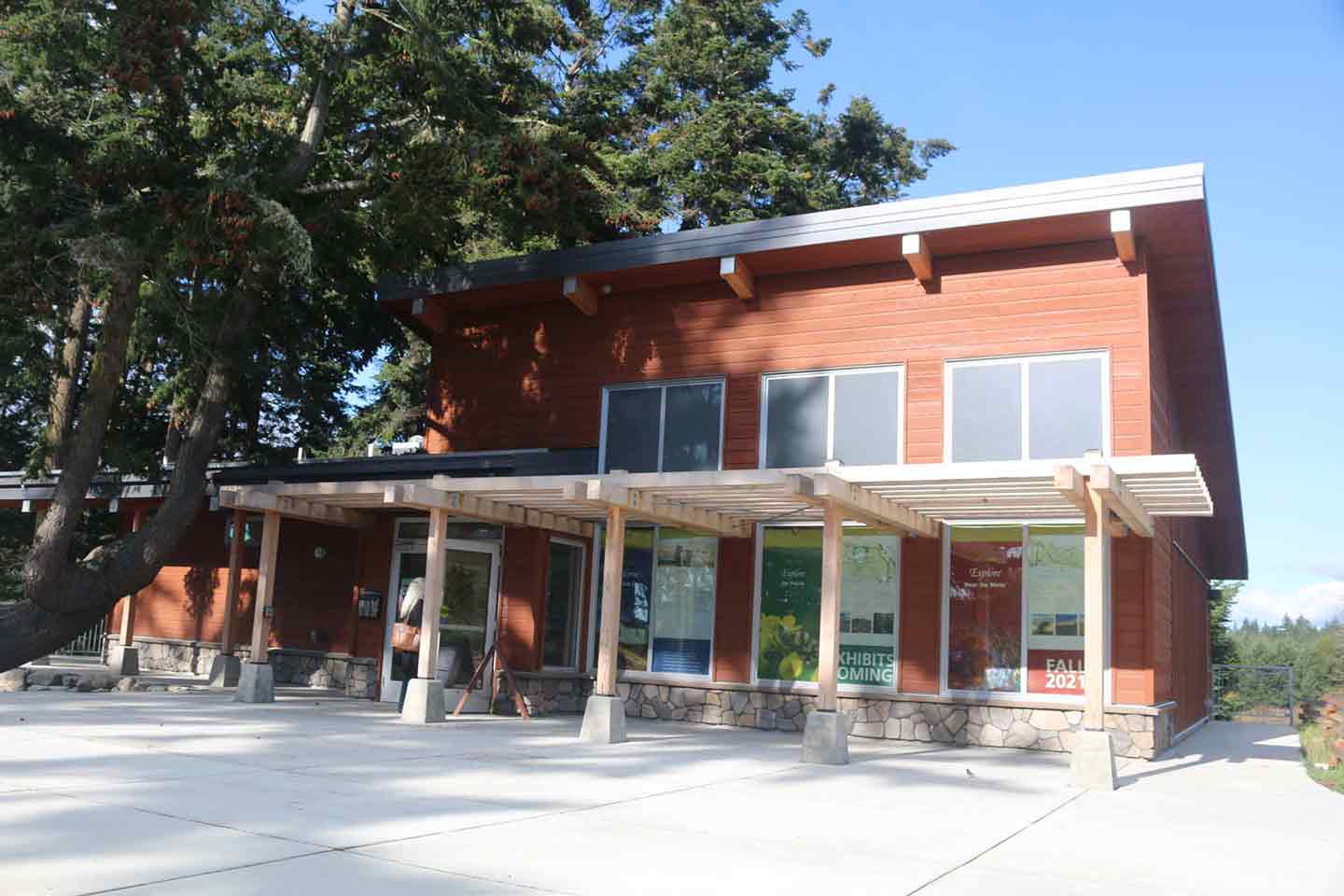
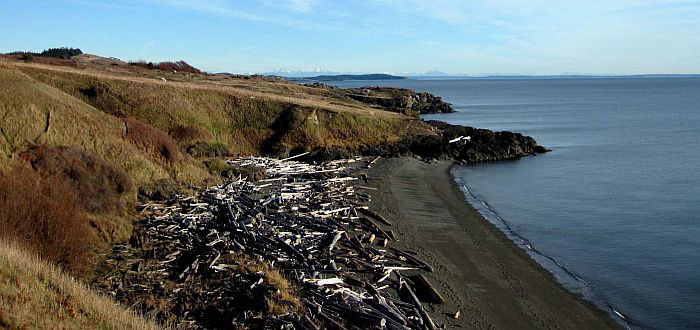
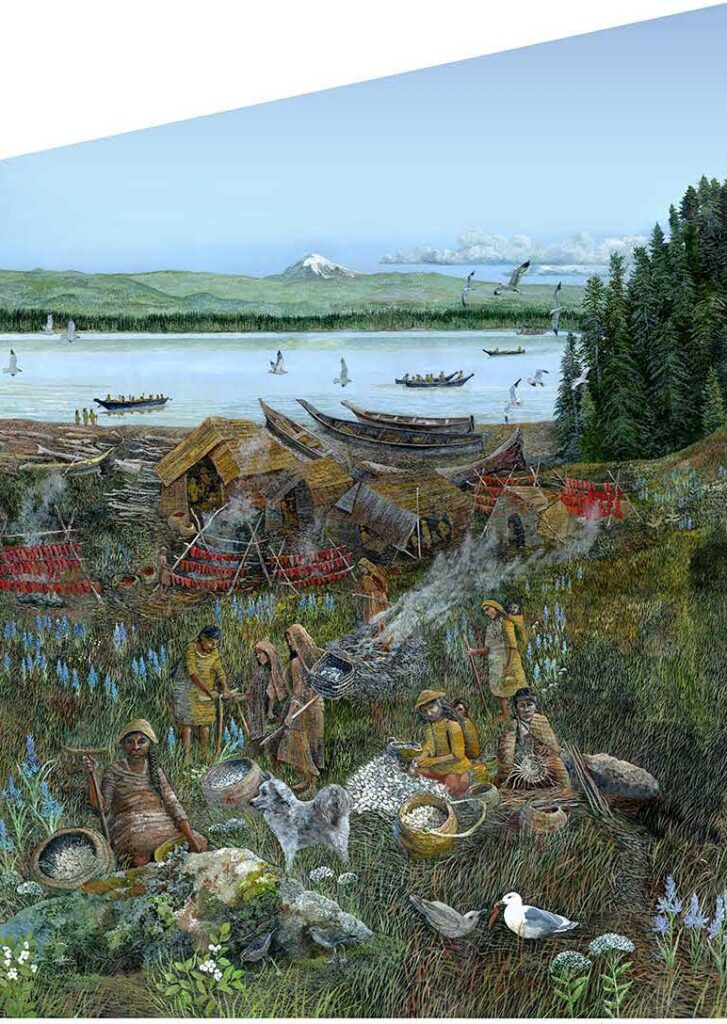
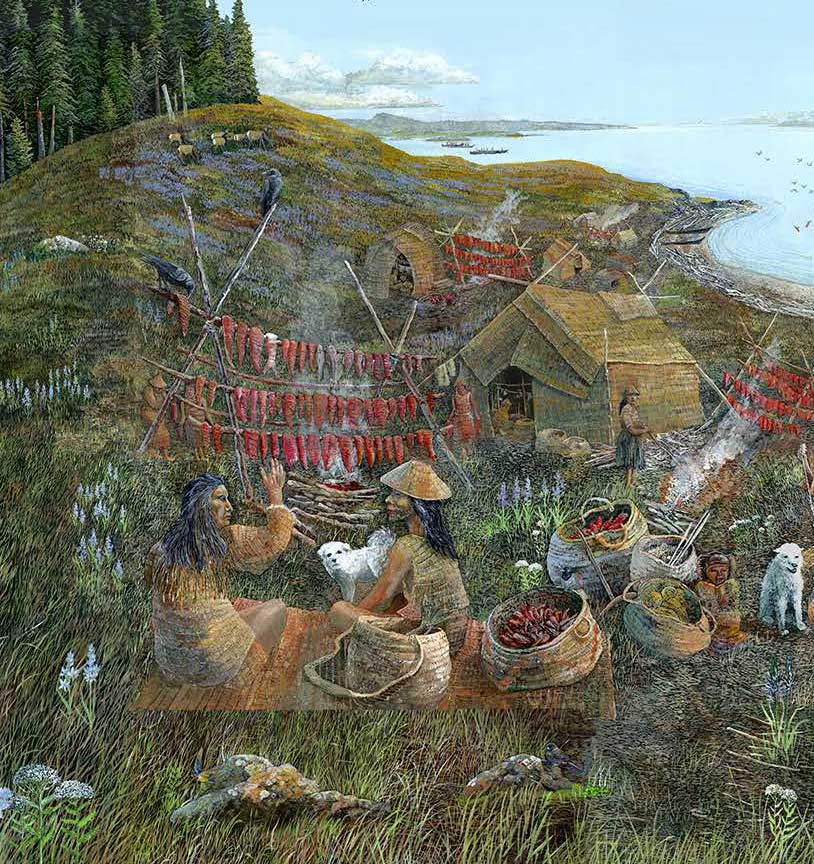
I have a long history with the San Juan Islands of Washington State. In the 80’s and on my own restored boat, I summered here while I learned to paint (heck, I’m still learning to paint). And now I’m back there making some rather large murals for the new visitor center at the American Camp unit of the National Historical Park down at the island’s south end at Cattle Point and South Beach. Nancy and I went there a few weeks ago, a FOUR ferry ride for us up and back!
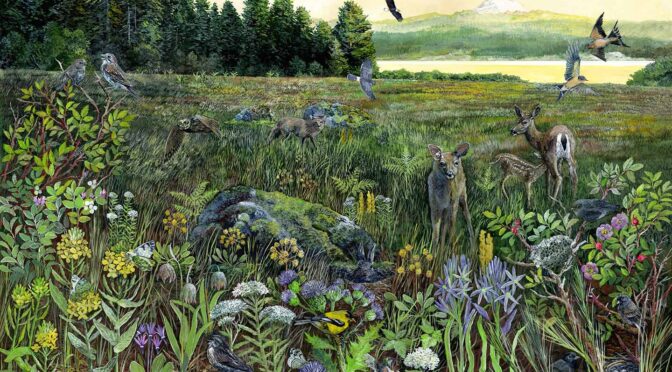
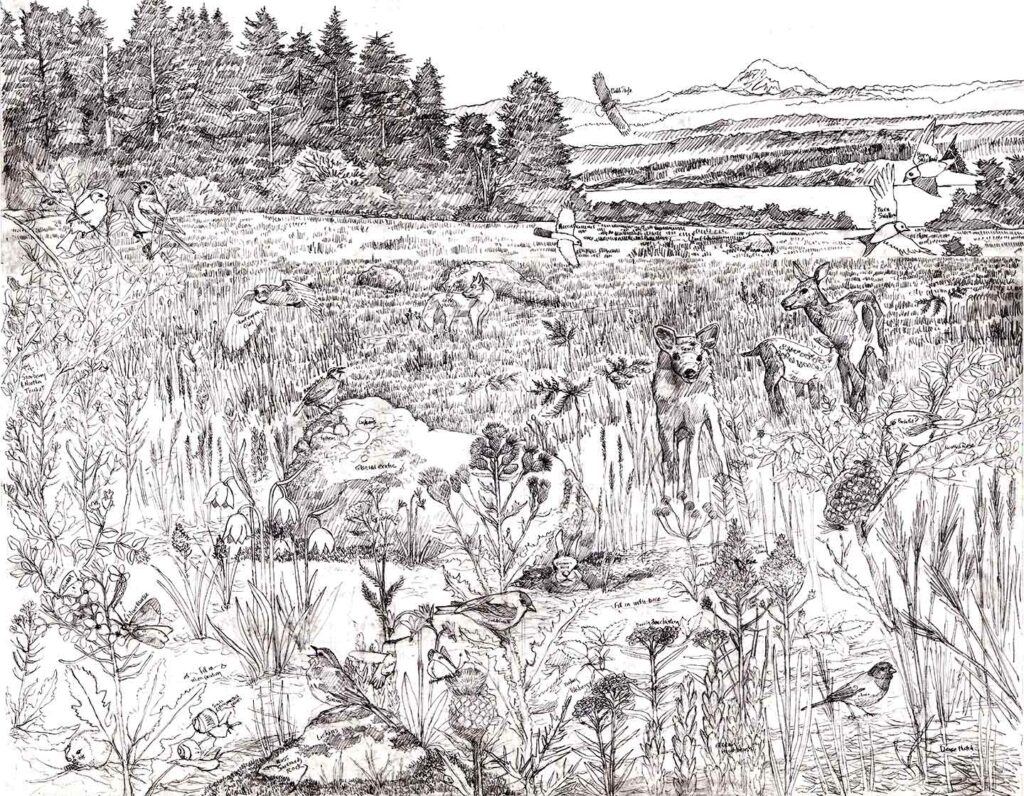
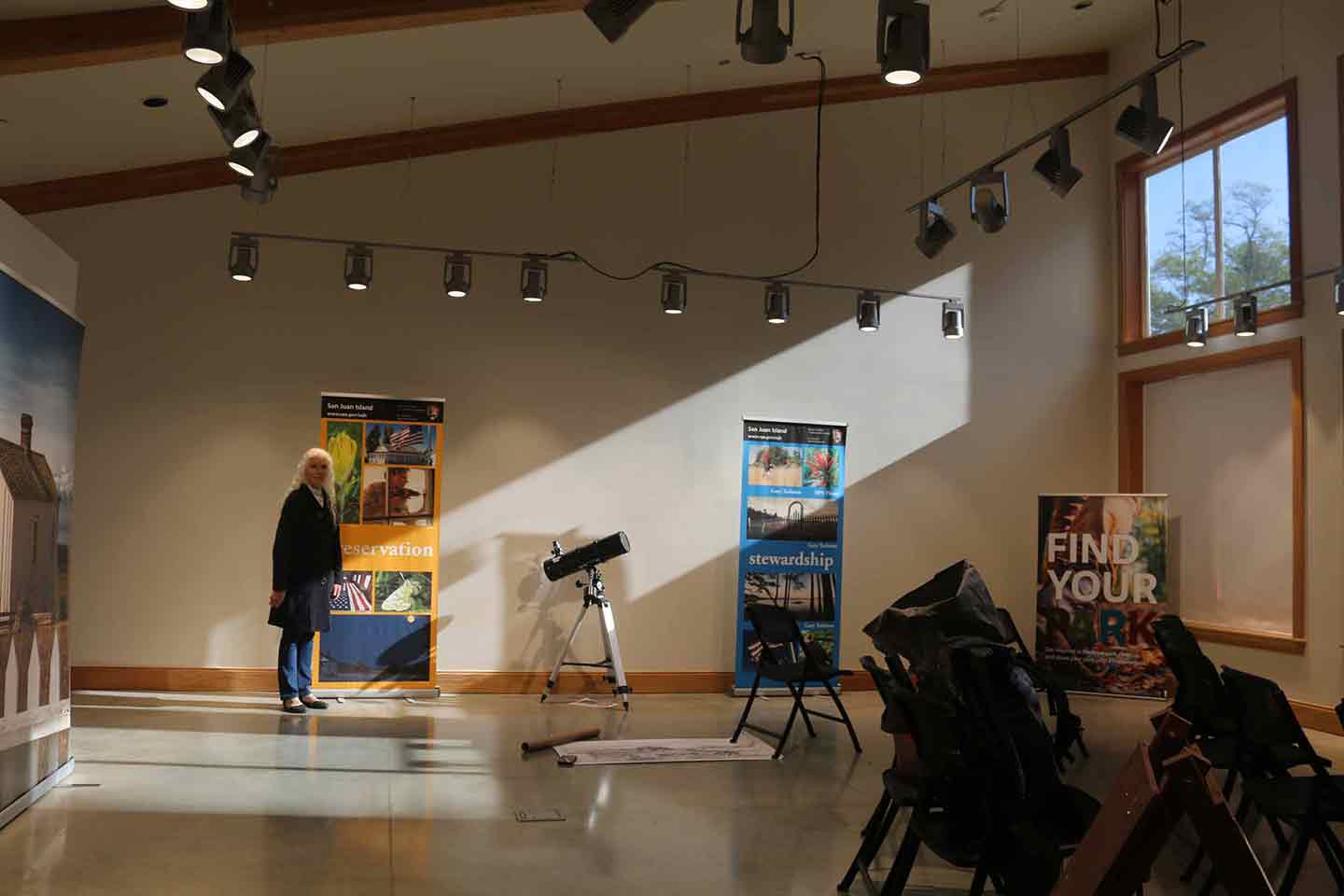
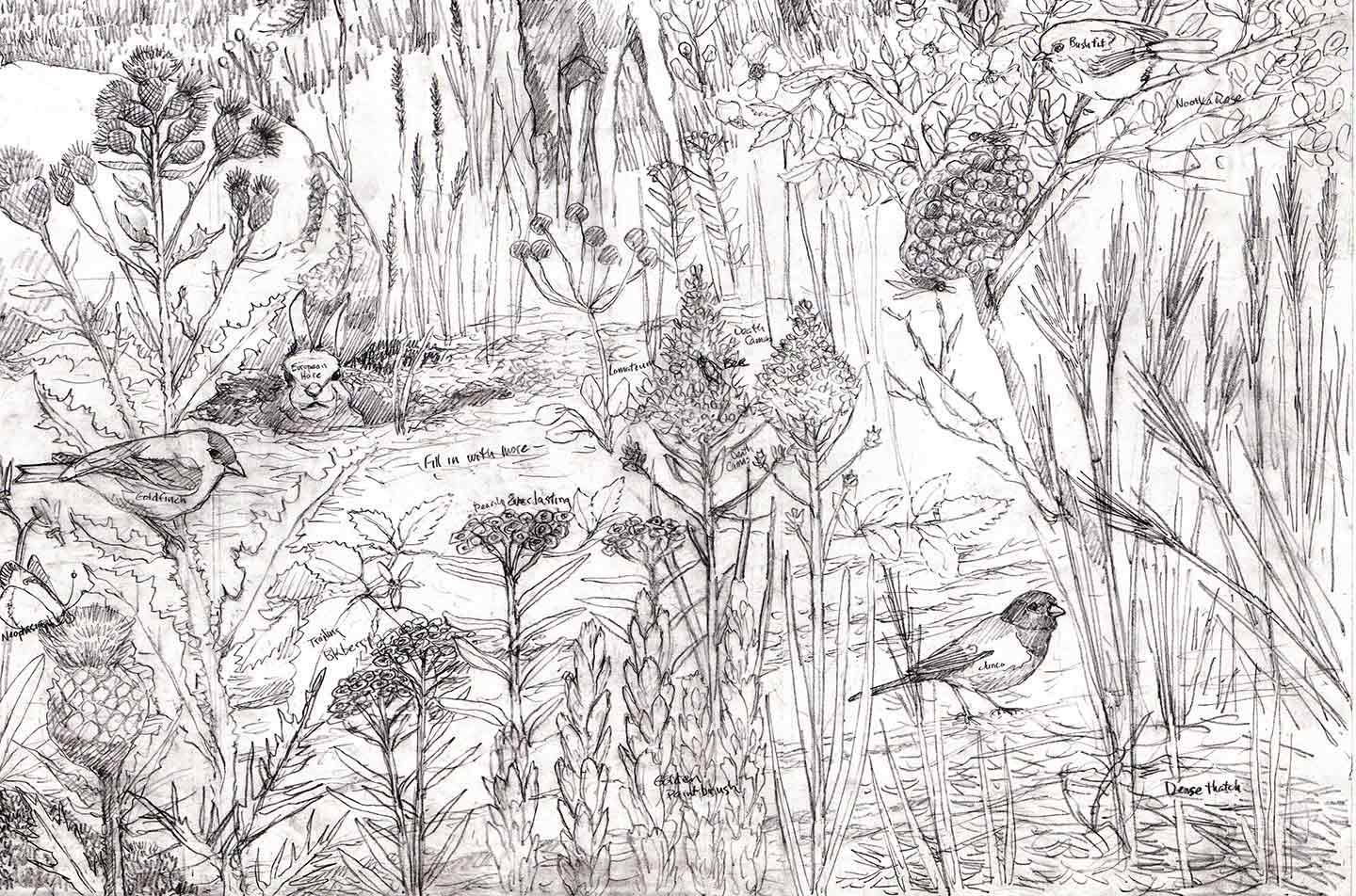
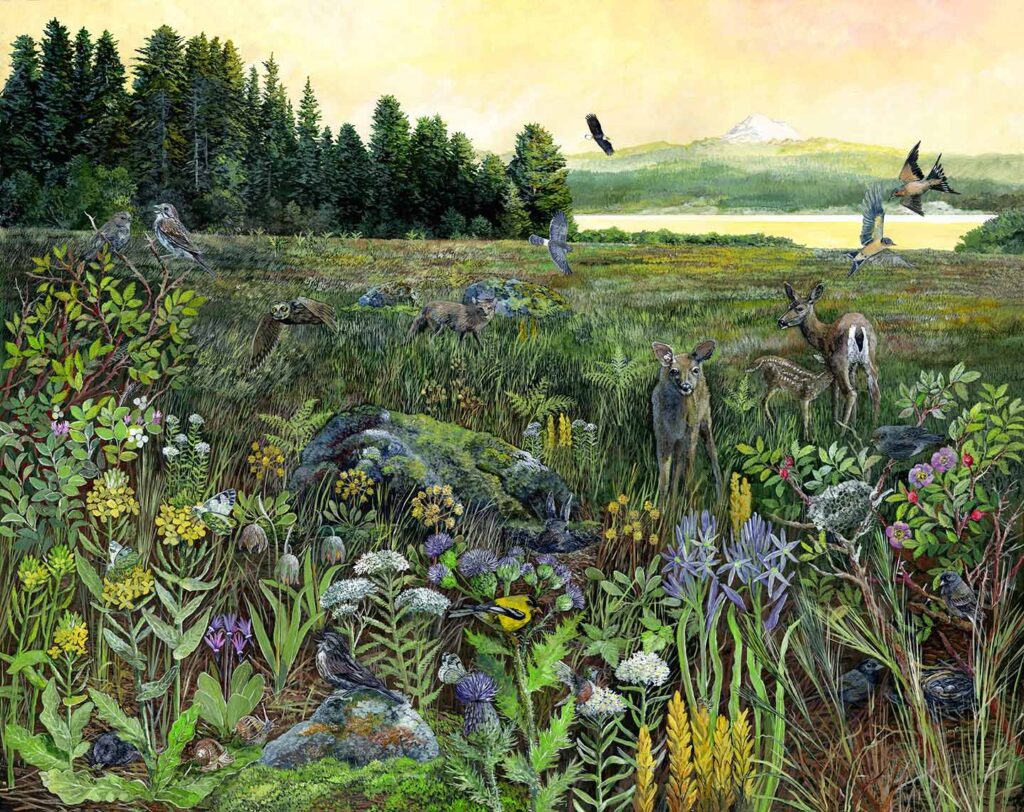
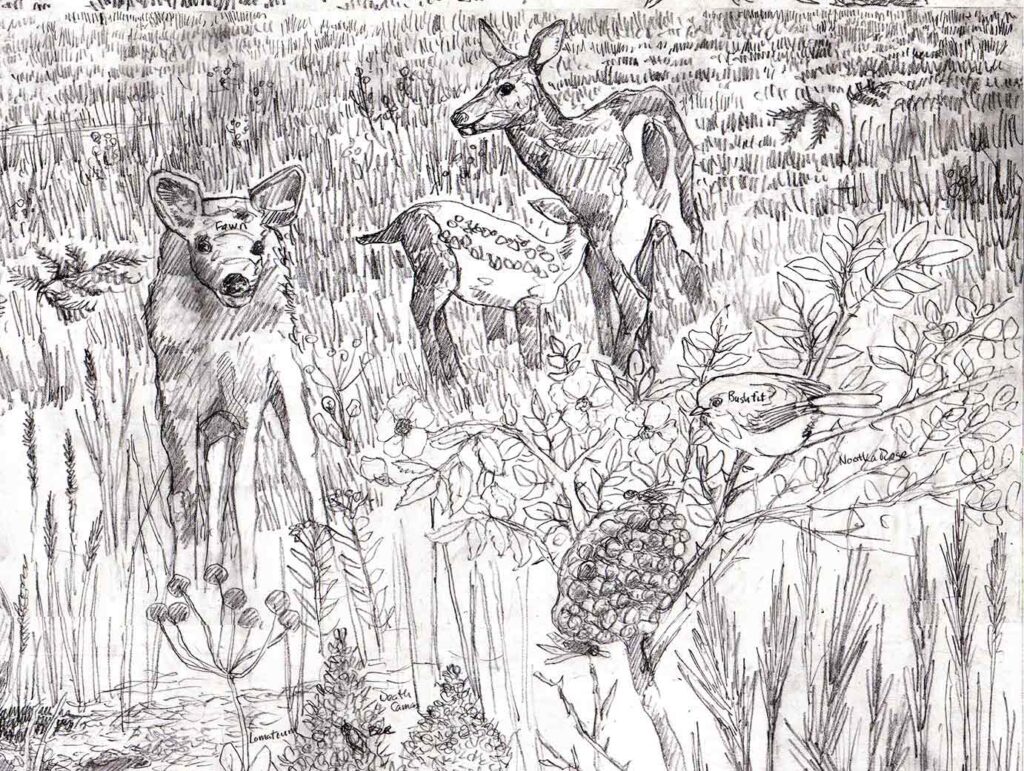
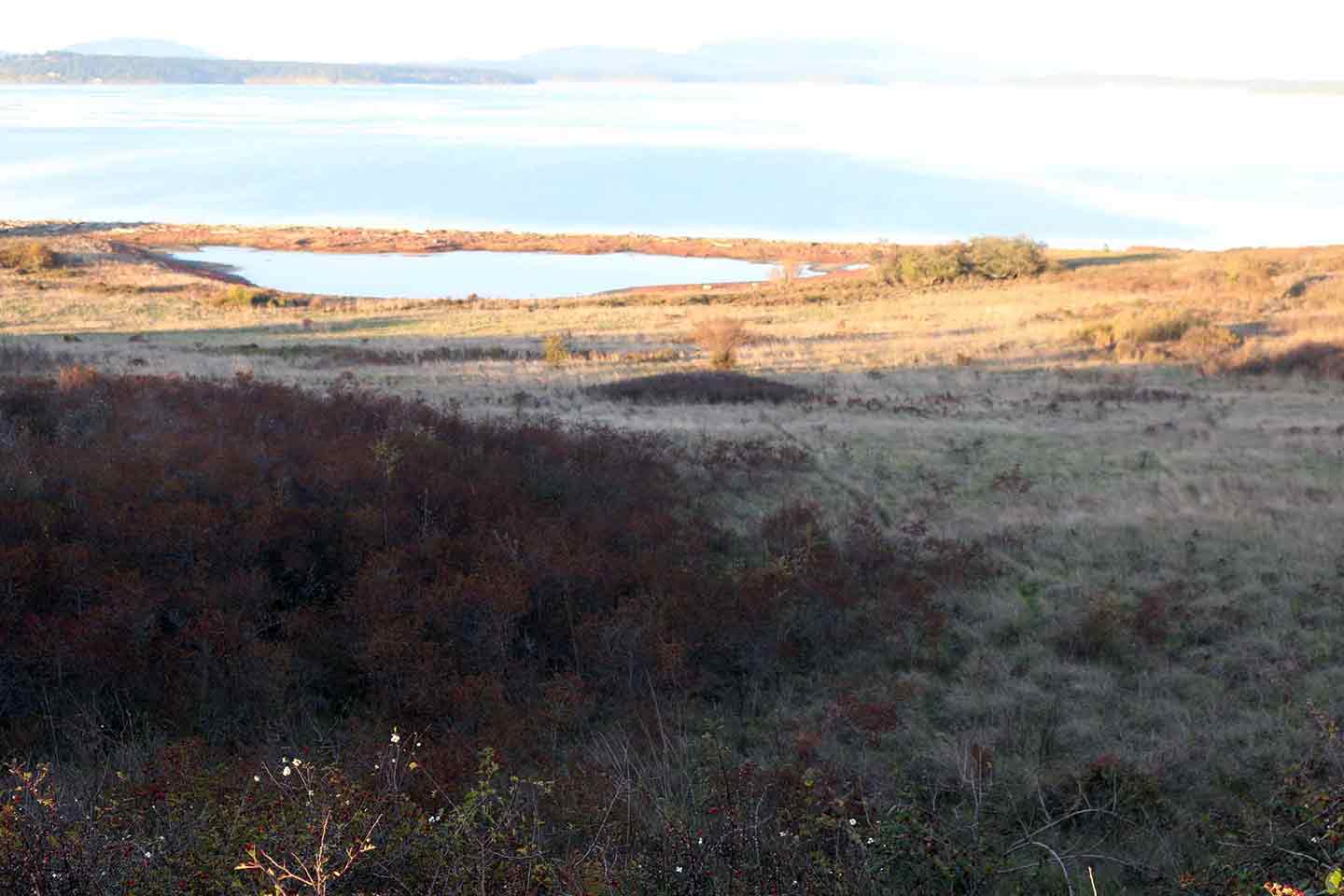
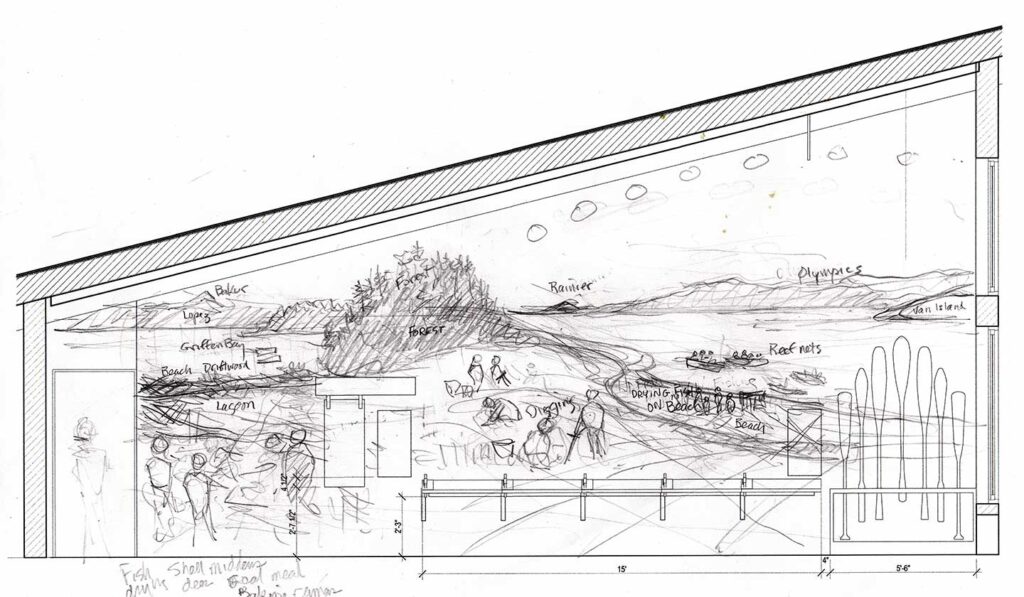
It was truly fun to see all these places again, and I got some good references, one of which is shown above in drawing form. This one is 6′ x 5′ and will be on the wall shown below, far left, and shows the complex natural prairie that grows here. It’s open prairie stuck out on a point with water on both sides – and one of the most beautiful places in the Salish Sea.
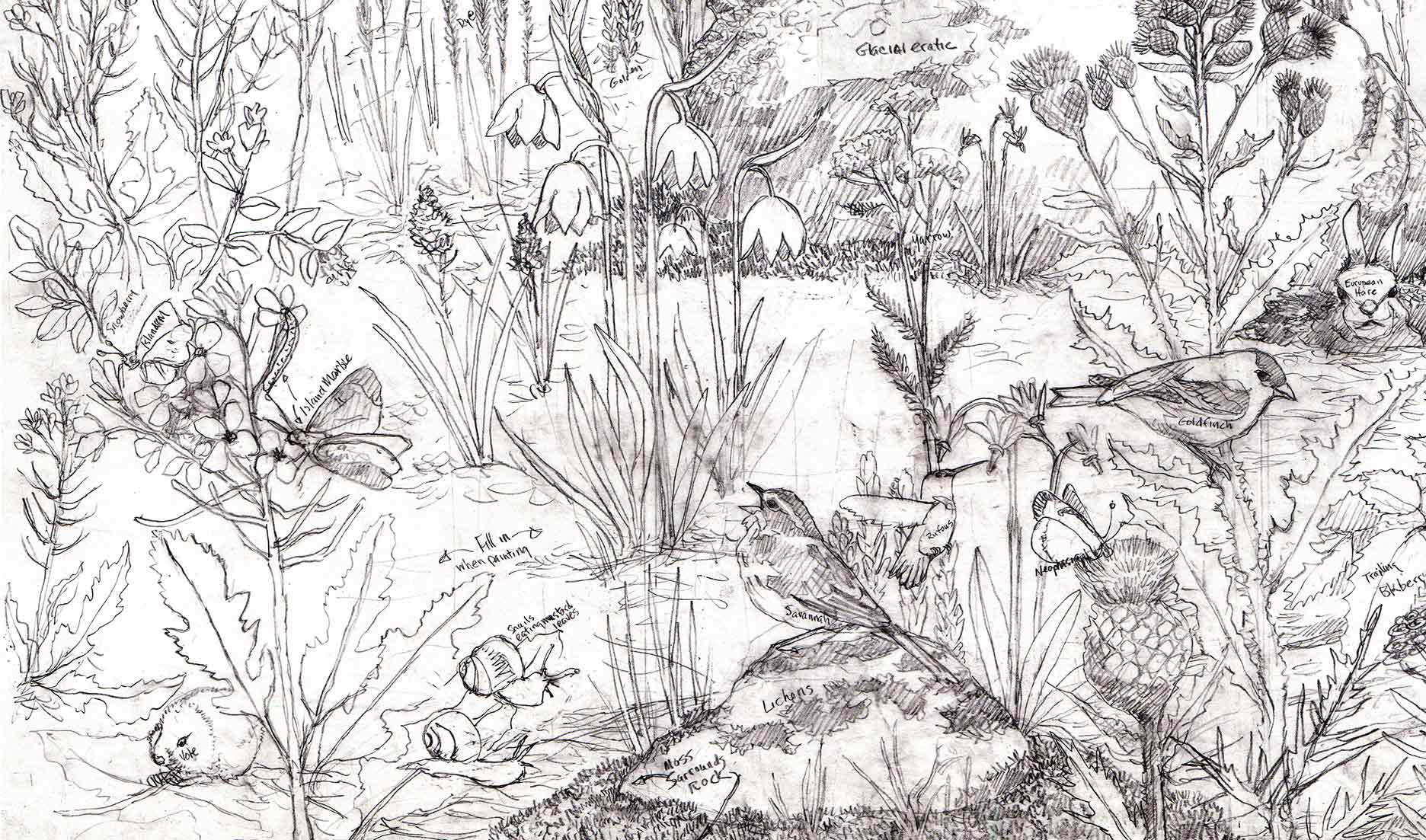
I cropped out some detailed sections so you could see the drawing better, but even so it’s a fairly complex bunch of lines. There are glacial eratic boulders that have some strange mossy adaptions, a butterfly only found here, voles and snails, birds and invasive rabbits. Red foxes that are Cascade dark phase colors, lots of black-tailed deer and meadowlarks (a bird we’ve never seen here at home just 30m south) We saw almost everything going in the painting on the site visit.
Both of these paintings will be the main focus of the inside. The second painting (shown at the bottom) will need to be redrawn, but it fills the entire main wall, 38 feet by 17 ft high. That’ll be another post or two. Our goal was getting that beautiful prairie drawn before the wind and rain came. Which we did!
And here’s the 38′ wall with my concept sketch. How the heck I show a 38′ wall in a dinky blog post, I’m not even going to try to do. So stay tuned.
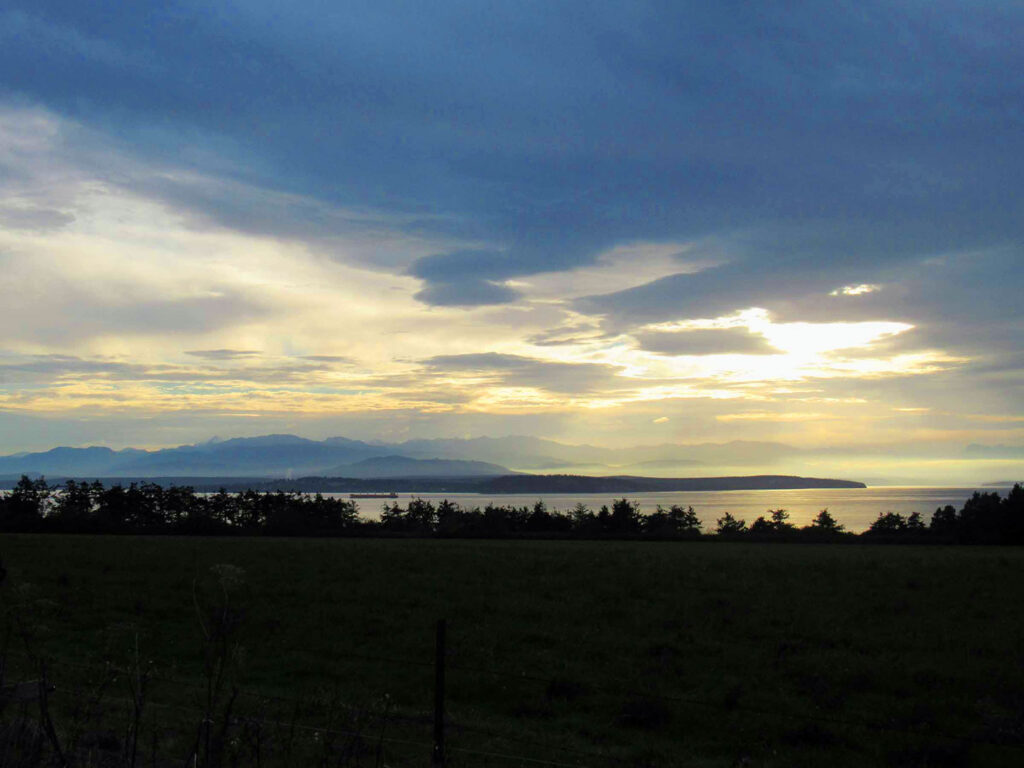
On the way home the next day, we were coming across Whidbey Island in between the two ferries. That road always has a stunning view of the Olympics and our home in Port Townsend, but the sunset did it up right, showing us yet again why we picked this place to be a artists. See that big freighter? Port Townsend is just on shore behind it.
Thanks for reading this week. You can sign up for emails for these posts on my website at larryeifert.com.
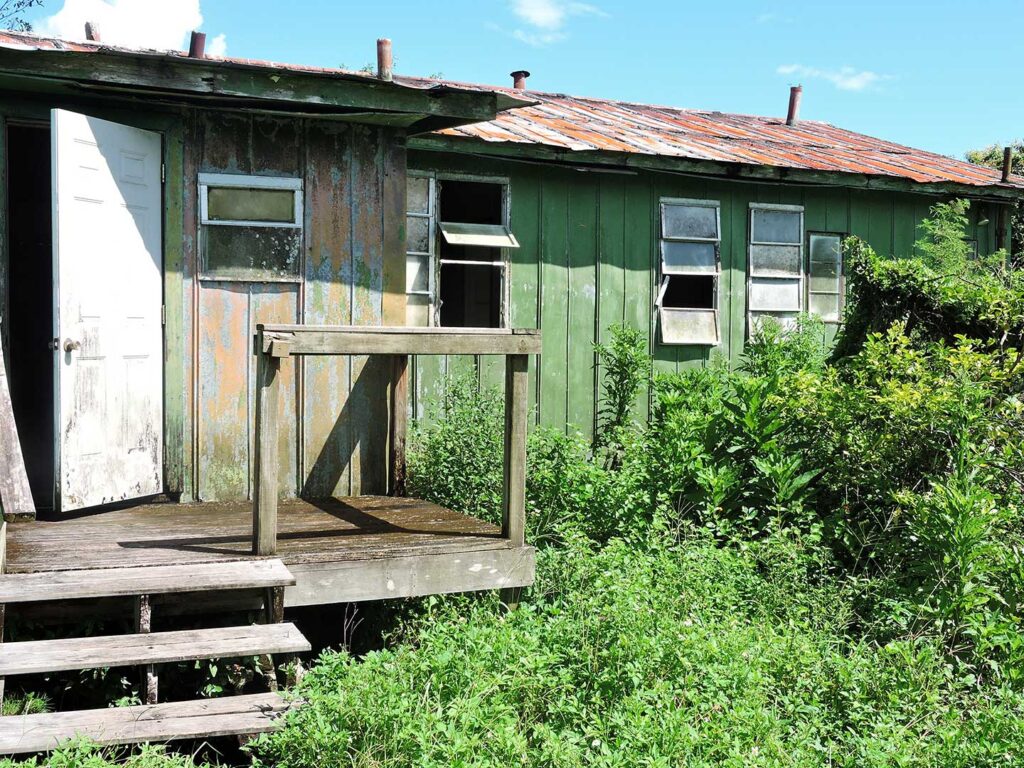
This is the fishing camp we could have stayed in, accessible only by air boat – but NO, I had to sleep in the Best Western in Homestead, Florida! Yes, I checked it out and the python had left.
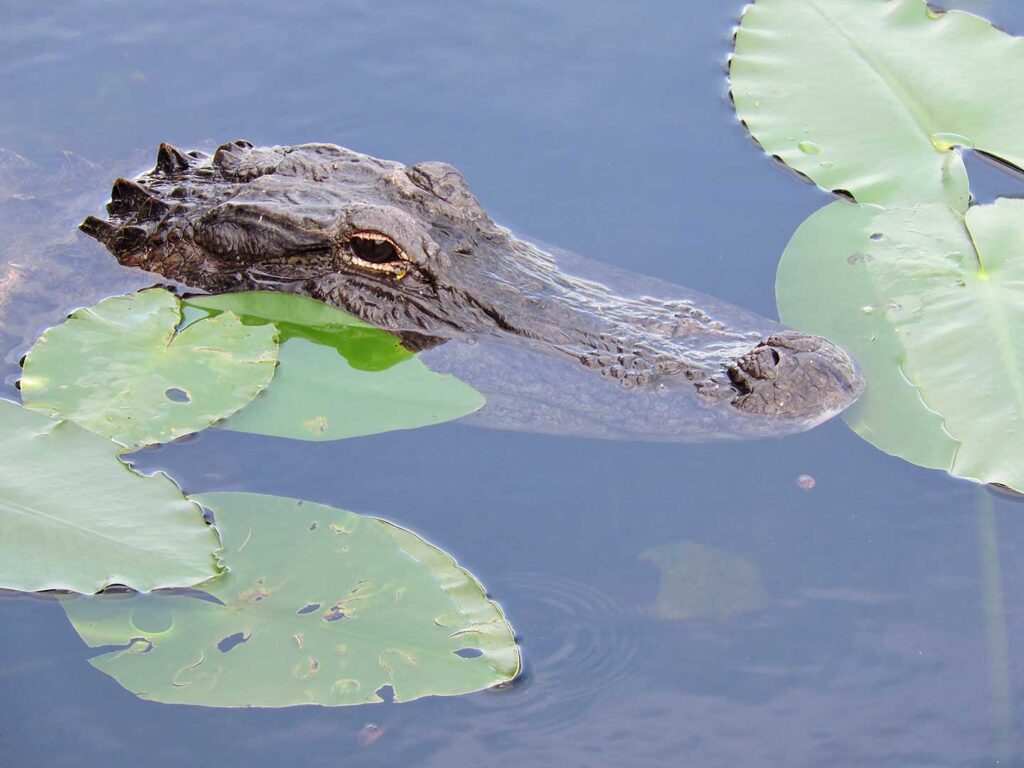
Sorry I haven’t posted in a few weeks, but the art has been flowing out of here like a narrow channel after a King Tide. Meaning fast and furious. I was in Everglades National Park in July for a site visit for this and now have all 17 drawings in refined versions finished up. After this, let the paint begin so this gater-guy can admire the installation right next to his home slough.
All these are for outdoor waysides, so they’ll have text blocks. That’s what the empty white areas are for. I know, it would be better if it was all painting, but these installations will teach people about this place for many decades – long after I’m gone, kids will wander down these boardwalks and maybe learn something. One is bigger, an 8′ wide mural, but I haven’t started that yet.
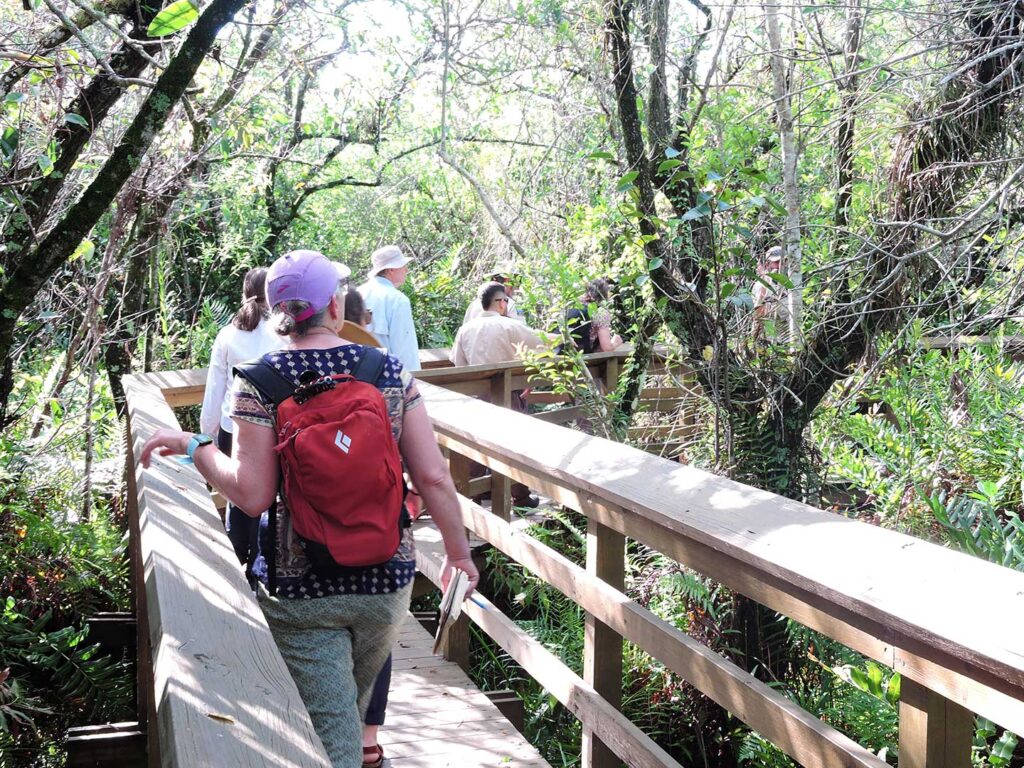
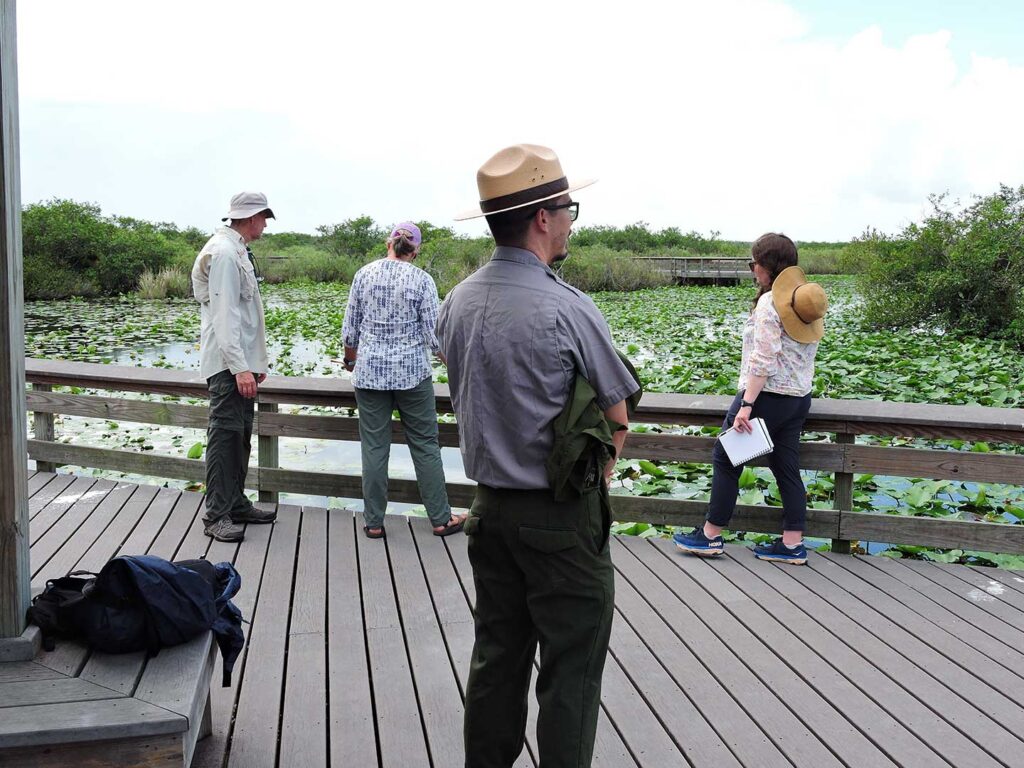
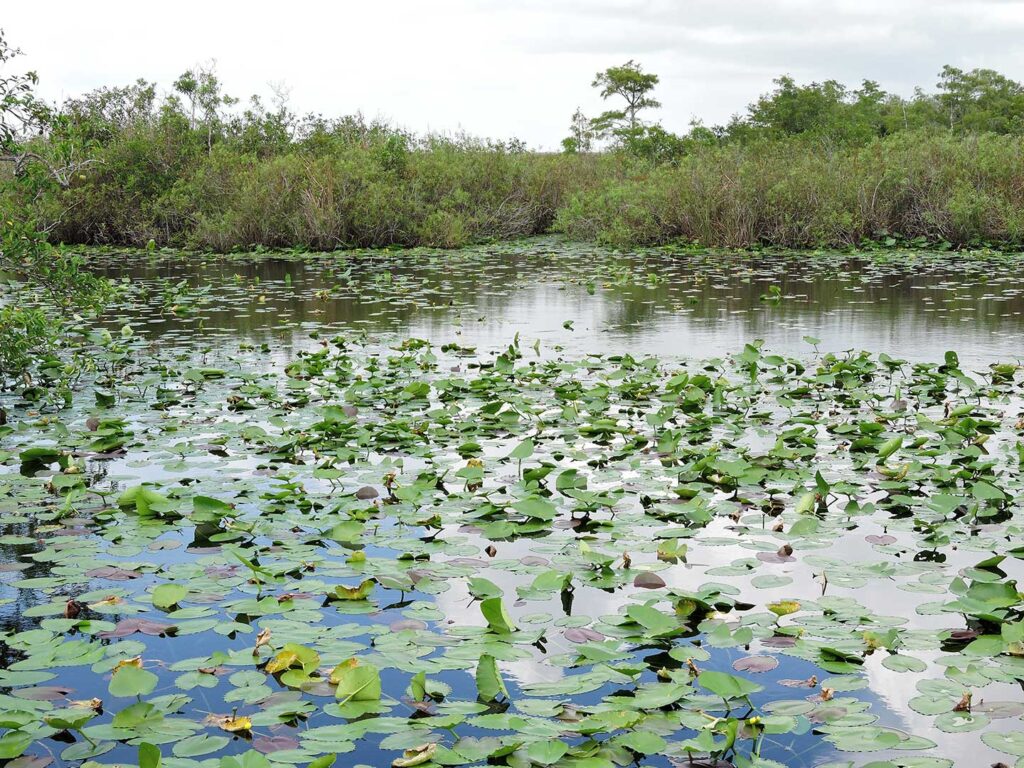
These are some photos of the site visit. Lots of walking slowly around and talking, the pros telling us Northwesterners the scoop about this rare place. I learned a lot about a lot, from one end of the Sea of Grass to the other.
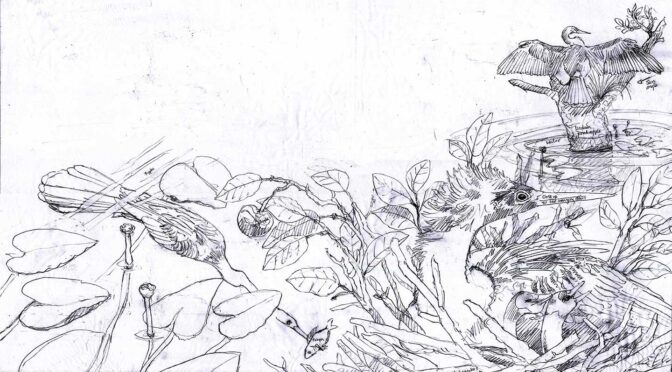
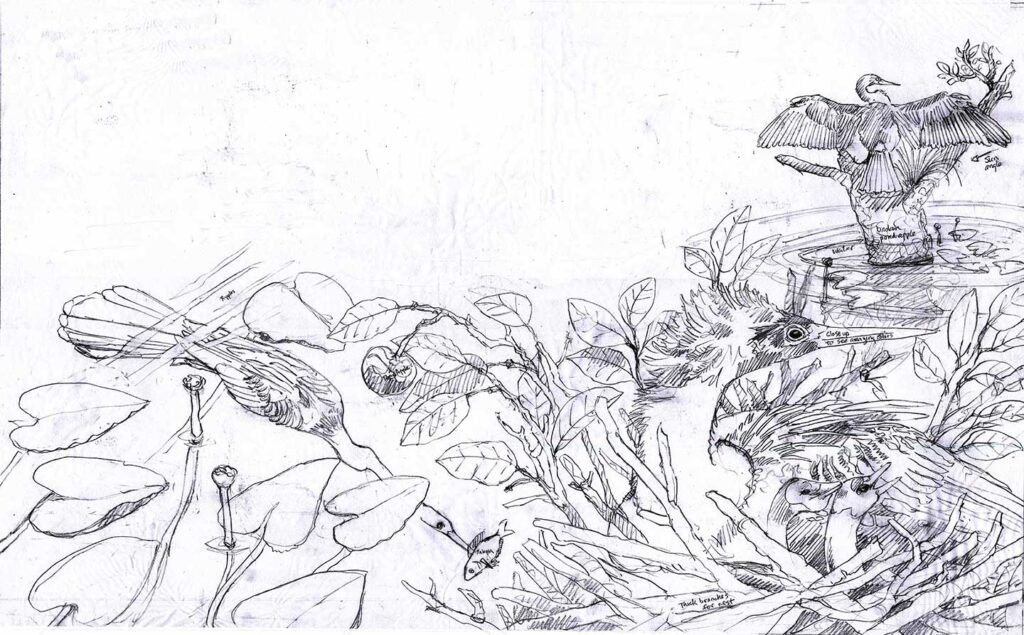
This drawing is about the strange and wonderful anhinga bird, and it’s actually going ON the anhinga trail. These birds hunt by slowly swimming along underwater and stabbing fish, and I got to watch that in action.
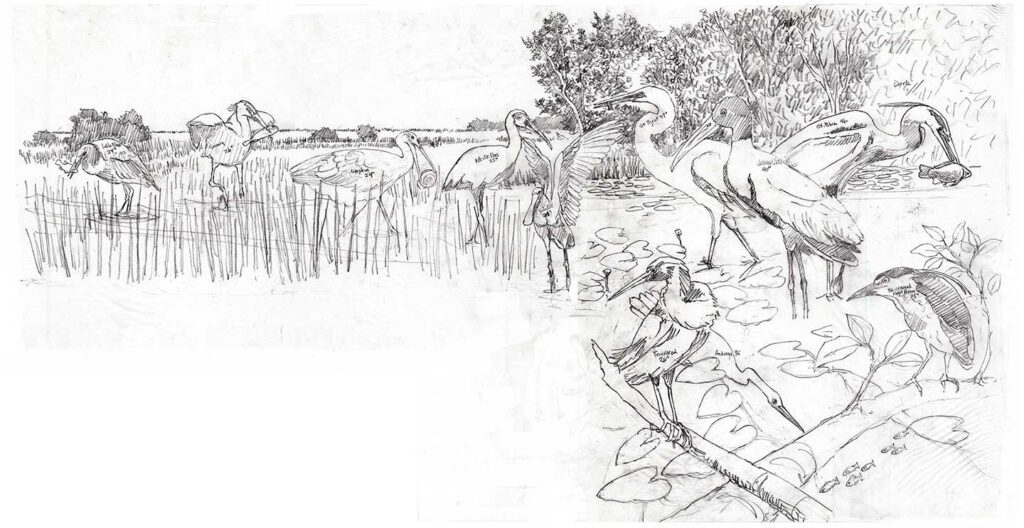
And several pieces of art are about herons. Lots of herons. There are TEN species of herons in this one painting and shows how they follow the receding water level as the season’s change and the ‘river’ dries.
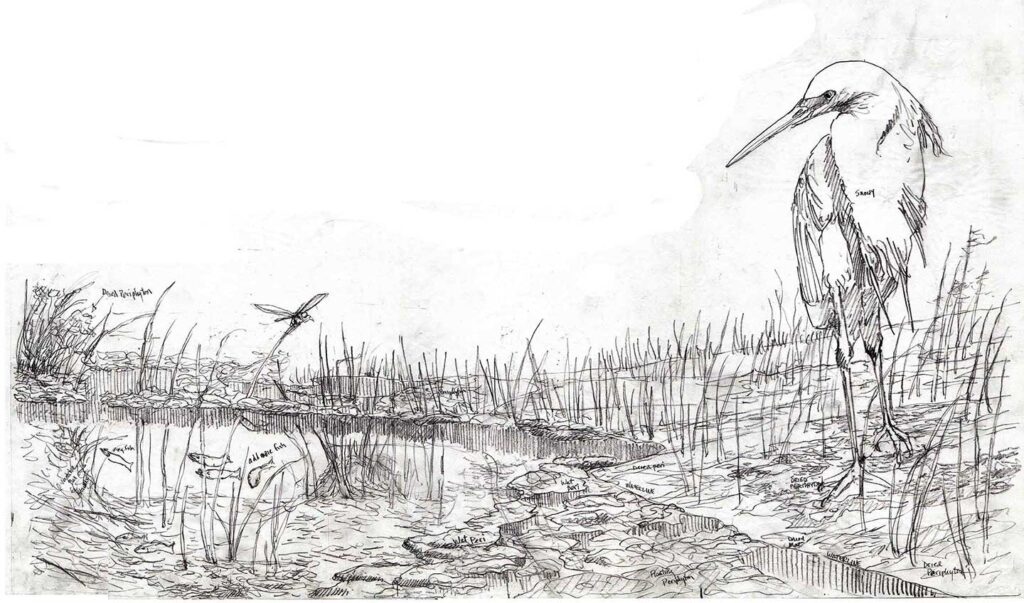
There’s an algae that grows all over the place here. Periphyton. It’s food, shelter and covers the ground pretty much everywhere the shallow water is. It floats, then dives to the bottom, then dries out then the water recedes. All in one painting!
Stay tuned as this project develops. I want to thank the good folks at EDX Exhibits in Seattle for taking another chance on me, for traveling across the country and then still speak to me! Life is good.
Thanks for reading this week. You can sign up for emails for these posts on my website at larryeifert.com.
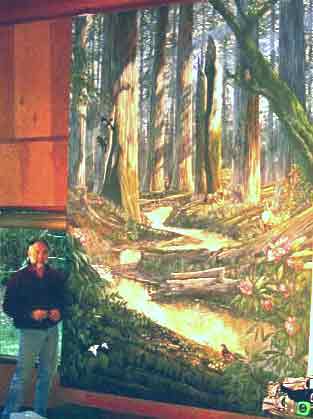
The winding road of life sometimes loops back to the start. In the 1980’s, I was commissioned to paint a mural of Mill Creek in Redwood National Park near Crescent City, California. It was my first piece of public art for any national park, and it opened my eyes to what might be possible for my future. That project made me see the value in painting for a bigger cause than simply art for people’s walls. That idea has remained with me ever sense.
After that first effort, I was soon painting for other parks and some for The Save-the-Redwoods League in San Francisco, which, at that time, was the front line in trying to stop commercial logging of the last 2% of the Coastal Redwoods. That’s right, 2%! I painted a lot of redwoods in those years.
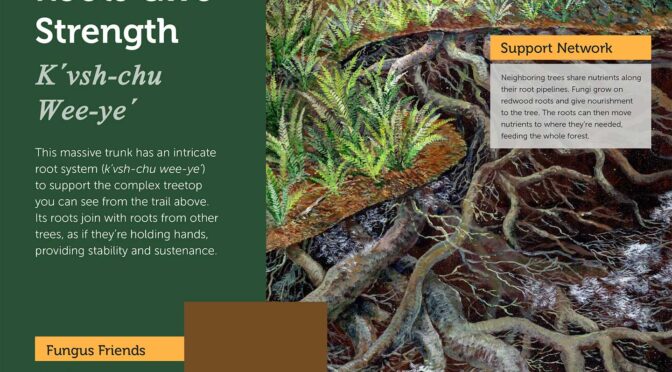
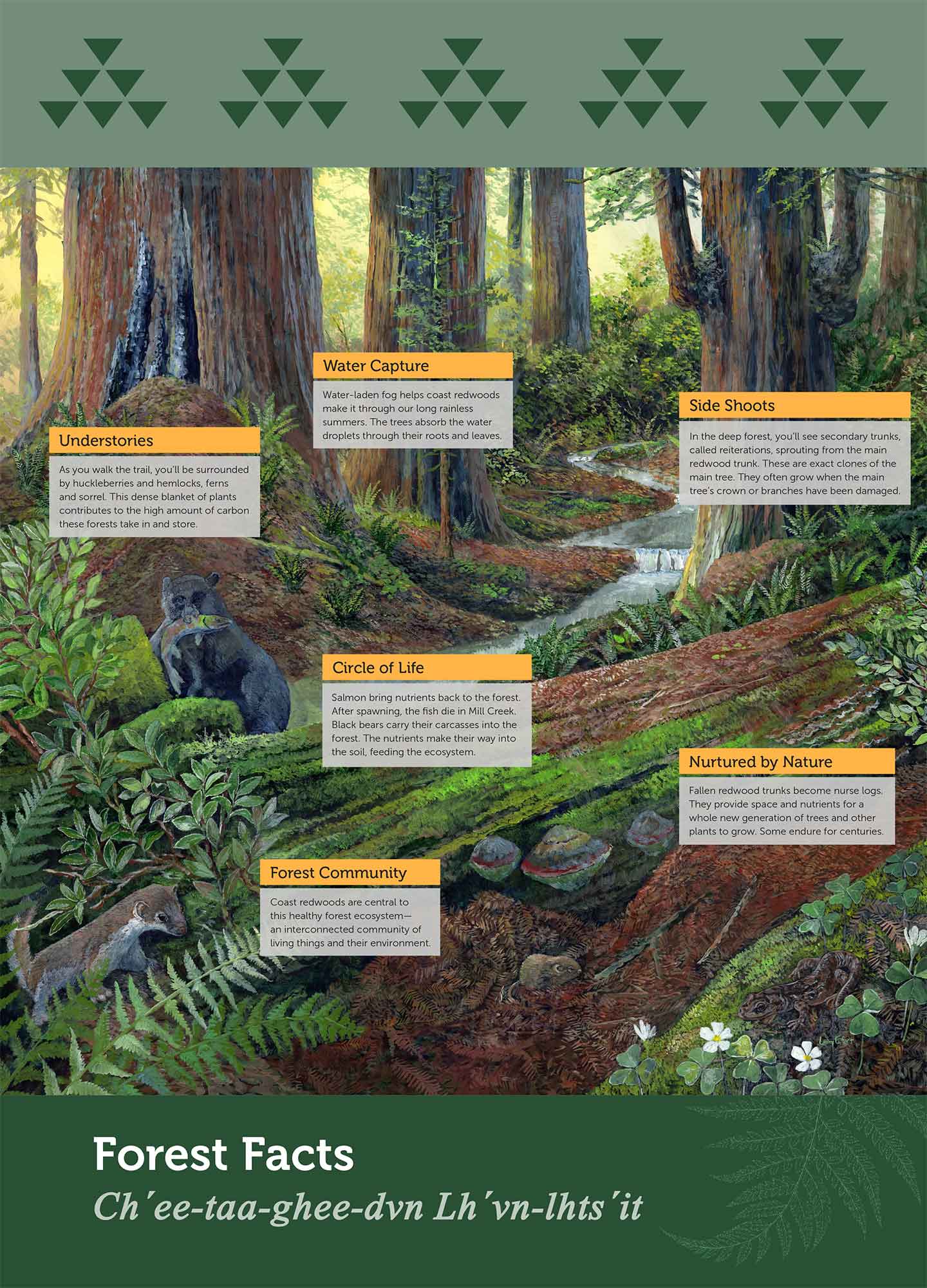
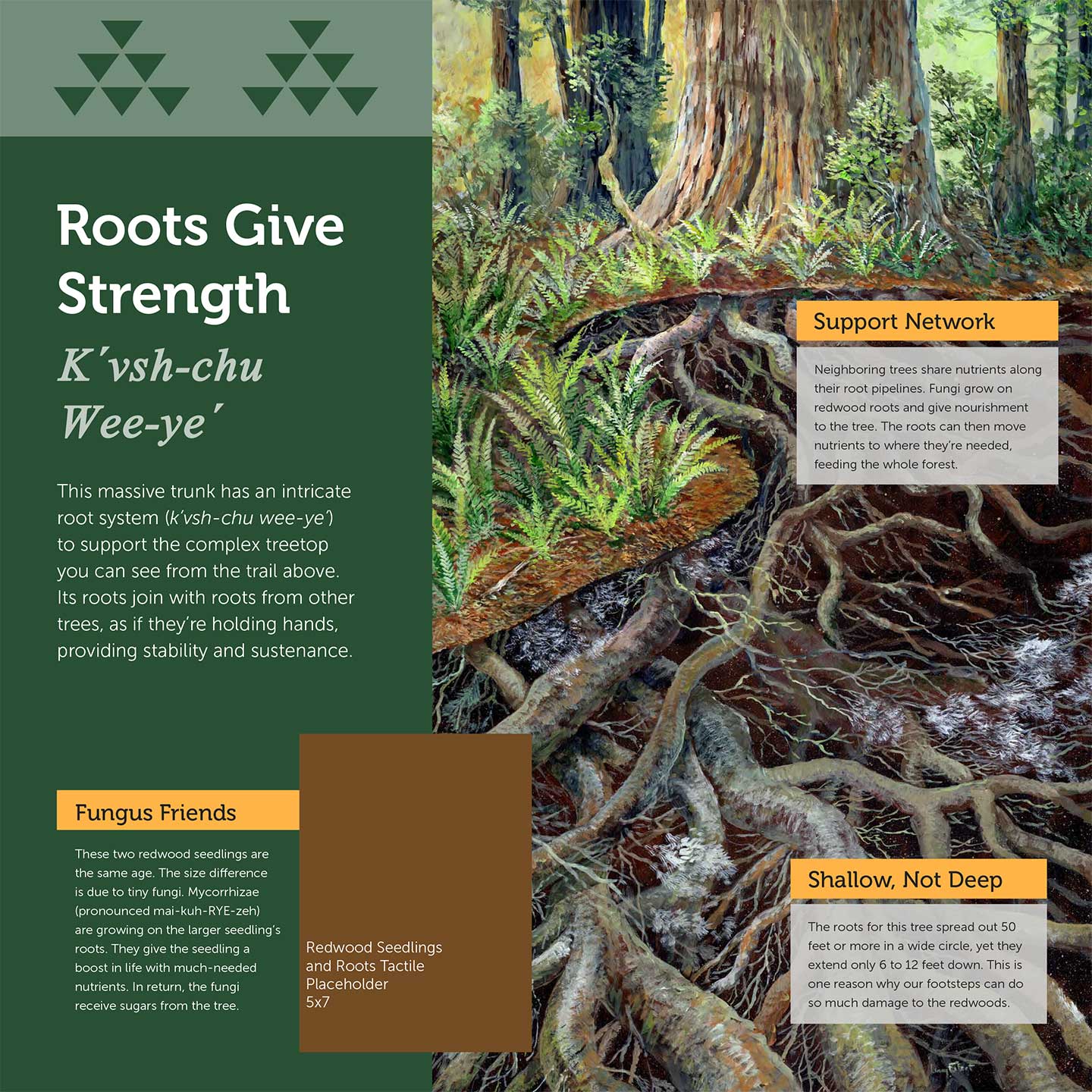
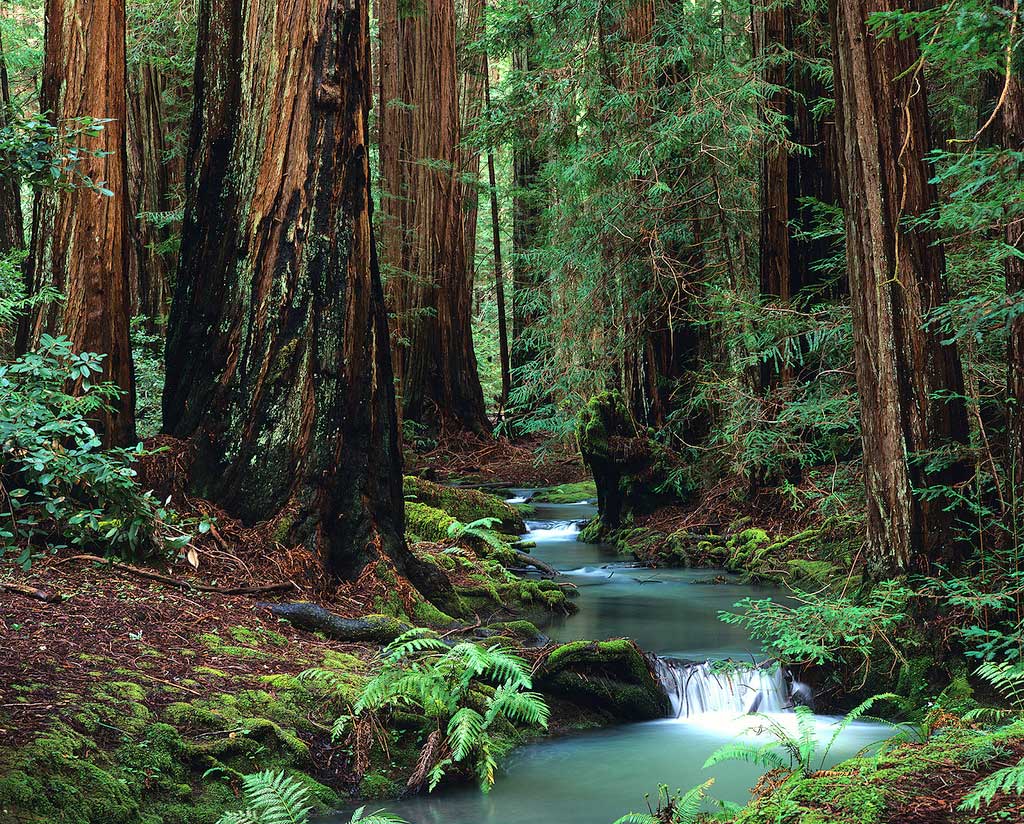
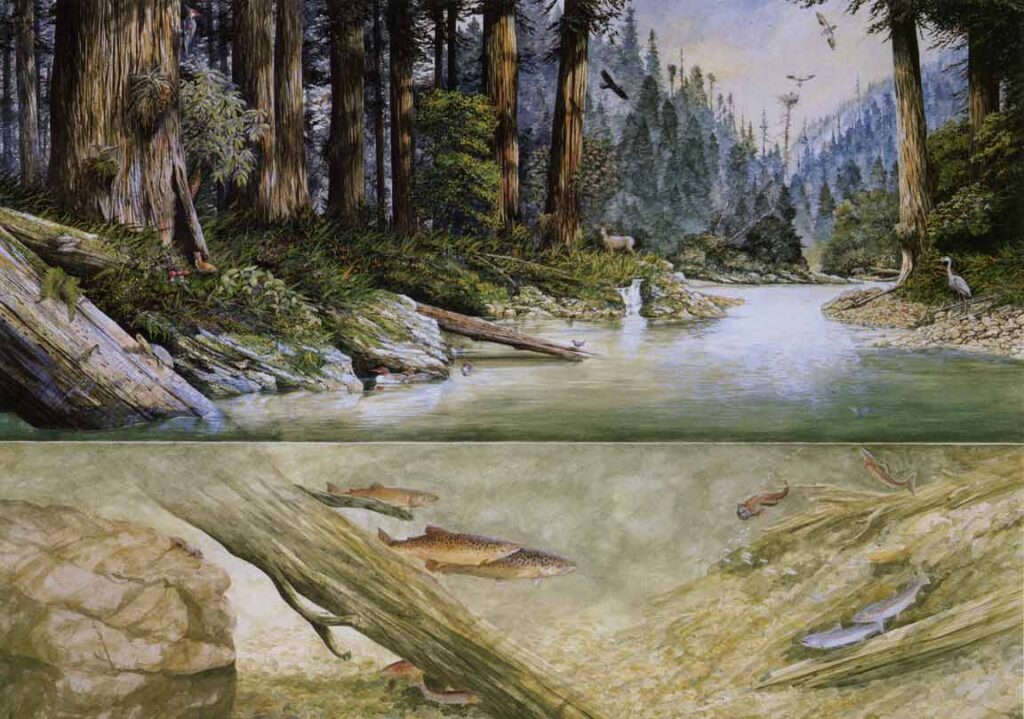
And now, some 40 years later, I was just asked to paint some more redwoods for Redwood National Park. When I did the first painting (seen at the bottom here), no one realized the importance of this area in the Mil Creek Valley of Jed Smith Redwoods State Park. Now we know it’s home to some of the tallest and biggest redwoods on the planet, the Grove of Titans. Save-the-Redwoods League has partnered with Redwood National Park to build a very impressive elevated boardwalk to save the shallow roots of the trees there, and these three new panels with my art will be on that boardwalk. It’s within a few hundred yards of the site of that first painting!
Here’s a reference photo of that grove, you can see similar elements in the big panel at the top. Thanks to the Save-the-Redwoods League for hiring me, and thanks to EDX Exhibits in Seattle for yet another chance to paint nature. Neither of these folks realized my history here, but I somehow got the job anyway! Thanks to Deborah at SRL and Beth and Michael at EDX. You guys are wonderful to work with.
Above is a photo of the Grove of Titans. You can see where I got the design for the larger forest panel.
And here’s the original painting of Mill Creek, a watercolor on a full sheet of mat board. I’ve certainly changed my style in 40 years.
And another painting from that same era of the Smith River that Mill Creek joins. I painted this for Six Rivers National Forest, my first Forest Service piece of art dated about the same time. It was painted for the Discovery Museum in Eureka, CA.
This was a very fun project for me, to go back to my park-roots and remember all these redwood paintings I did in some other life, hundreds of them – at that time, I was the struggling artist.
Thanks for reading this week. You can sign up for emails for these posts on my website at larryeifert.com.
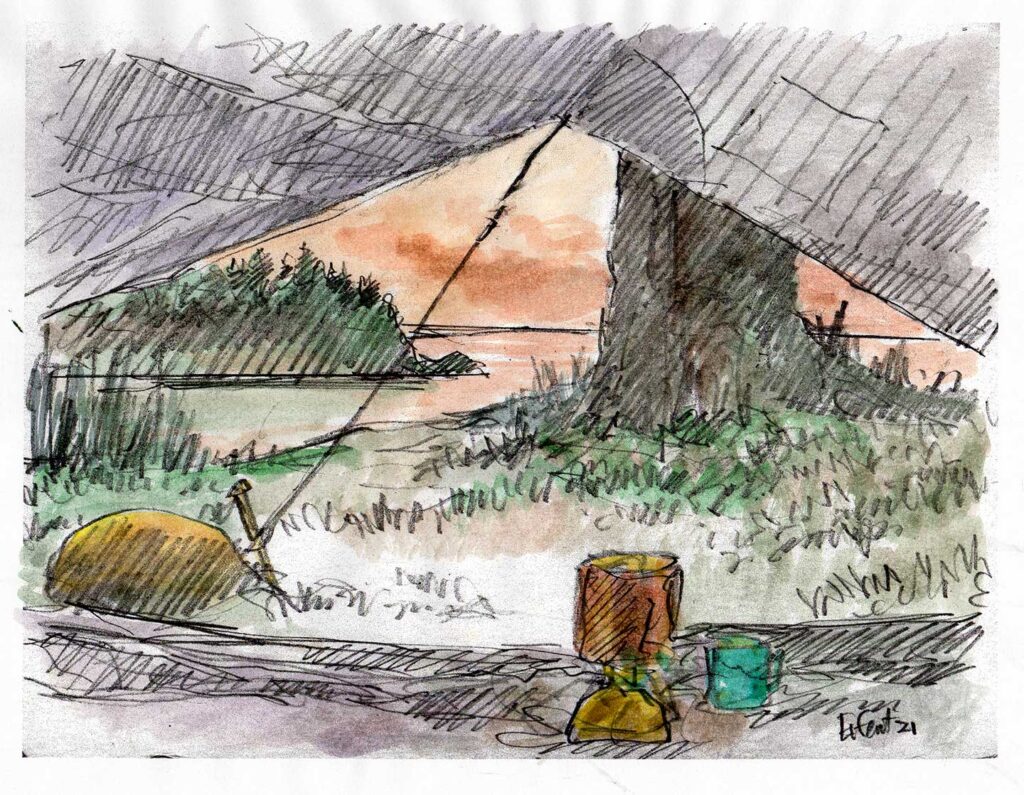
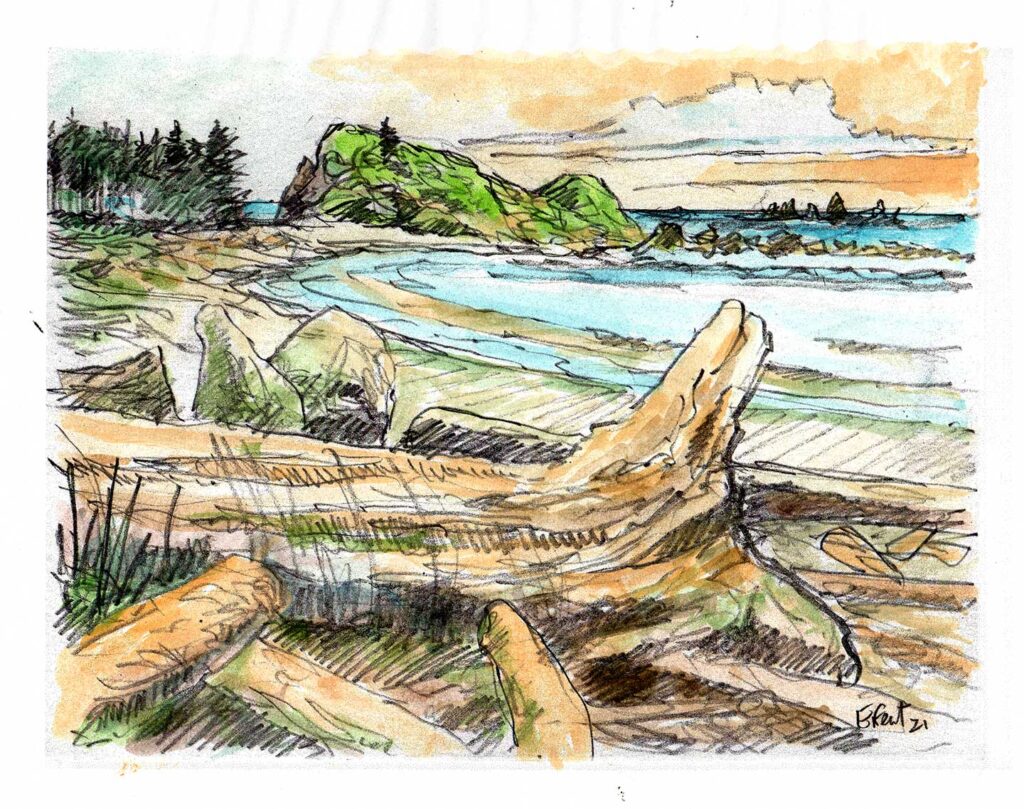
Some little paintings of my time there, inside that tent at sunset, and below, low tide watching sea otters herd the kids around the little bay. They’re simple paintings, but make good memories seeing them again here.
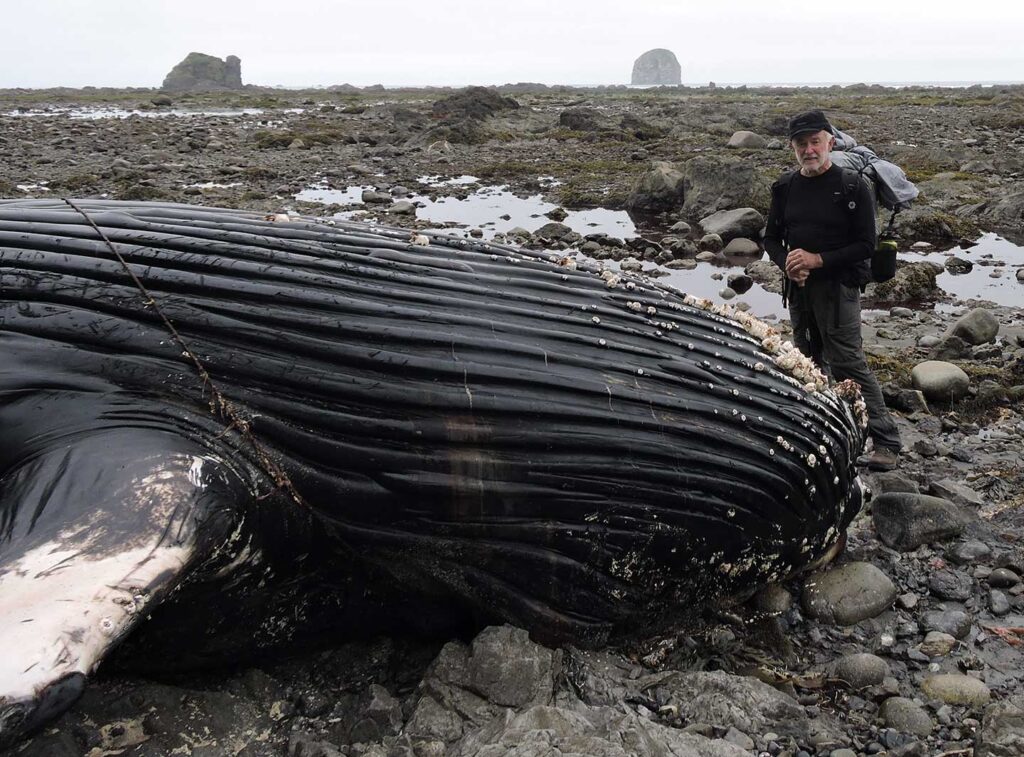
I went back to a wilderness beach hike with my little Six Moon Designs tent and my paints. I had plenty of great nature to worship, including an amazing belly-up humpback whale and a Steller’s sealion, both washed up without much injury as far as I could tell. I’m telling you, it is thrilling to walk up to a 30-foot whale on a wilderness beach, a sort of primal experience I will remember for awhile. As I walked up to it, sounds seemed to become sort of diminished, as if I were walking into a quiet room. It was a long way from the water, as you can see in the photo – a minus tide put the waves very far away and the whale seemed oddly out of place.
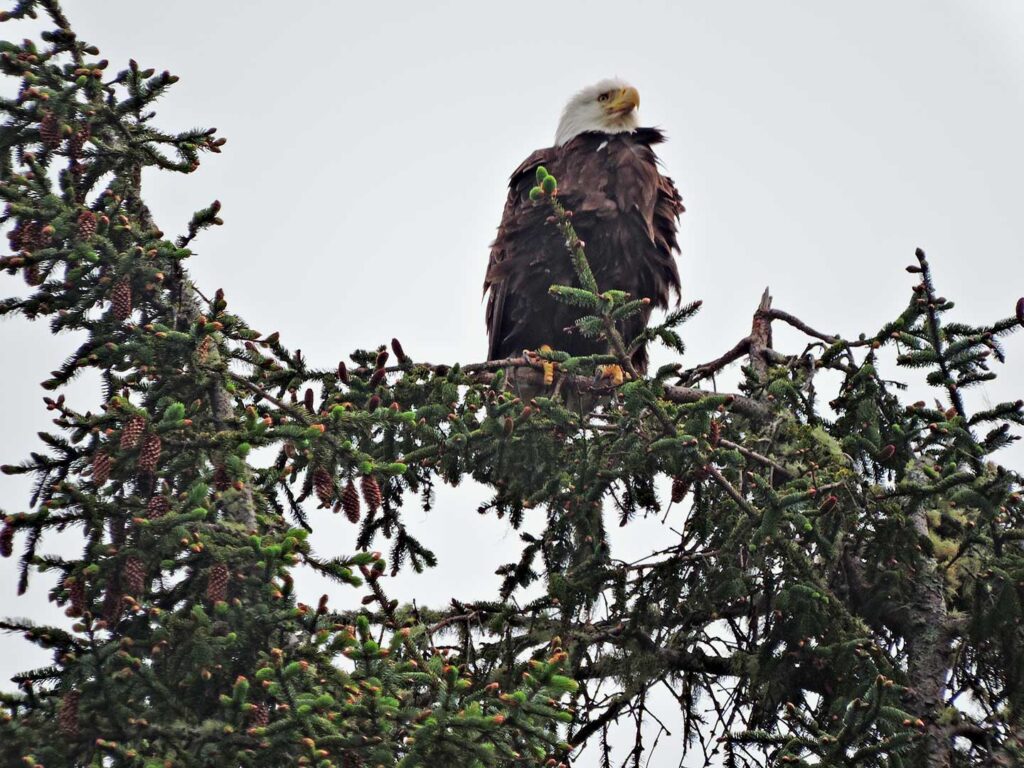
Then this guy:Exactly above my tent in the top canopy of a Sitka spruce, this bald eagle started in at about 5:30 am, broadcasting its discontent at not seeing breakfast out in the ocean I guess – or, who knows what. Soon the ravens got involved – and it was all over for a sleep-in morning. The Starbucks was made early! Later, I watched this eagle spot a fish at least 300 yards out from where it sat on a treetop, taking a long glide off the branch and catch it! How could it see that far?
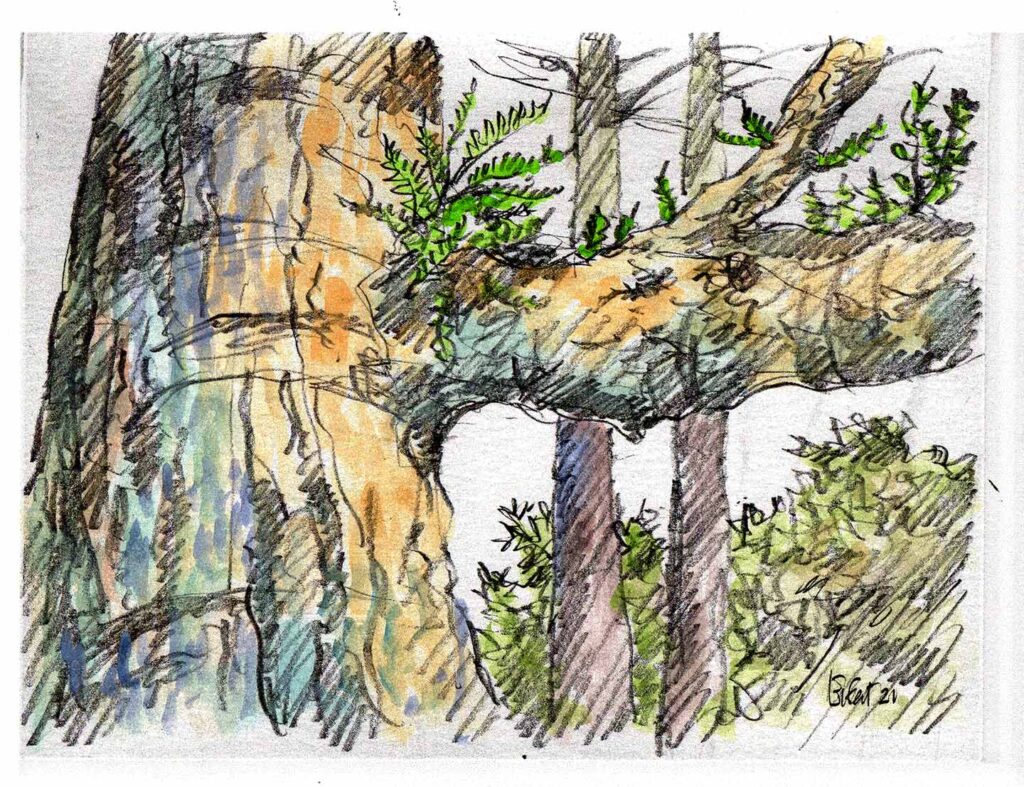
I just recently finished three large paintings for Redwood National Park through the Save-the-Redwoods League. In one, I painted the canopy fern mats that develop in ancient trees (not just redwoods) that come from centuries of needle litter building up on branches. These become pockets of leather ferns, huckleberrys and critters. The wandering salamander live generations in those mats, and marbled murrelets, an endangered sea bird, nest on them.
Walking out of the hike to the trailhead, I spotted this one on an ancient Sitka spruce, not far above my head. It had all the components, leather fern, black huckleberry and maybe some salamanders hidden away in the roots. It all seemed to tie together that my work is my play, my hiking is directly tied to my art. It’s just all one. A symbiosis, if you will, of cause and effect. Symbiosis is interaction between two different organisms living in close physical association, typically to the advantage of both. Art and nature, I am who I am, therefore it seems I have to paint and write about it, hopefully to the benefit of nature.
Thanks for reading this week. You can sign up for emails for these posts on my website at larryeifert.com.
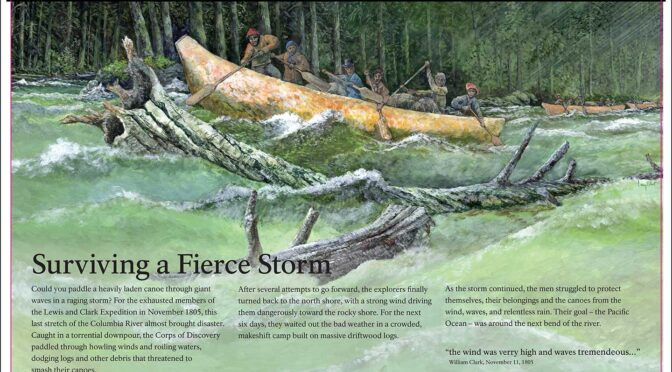
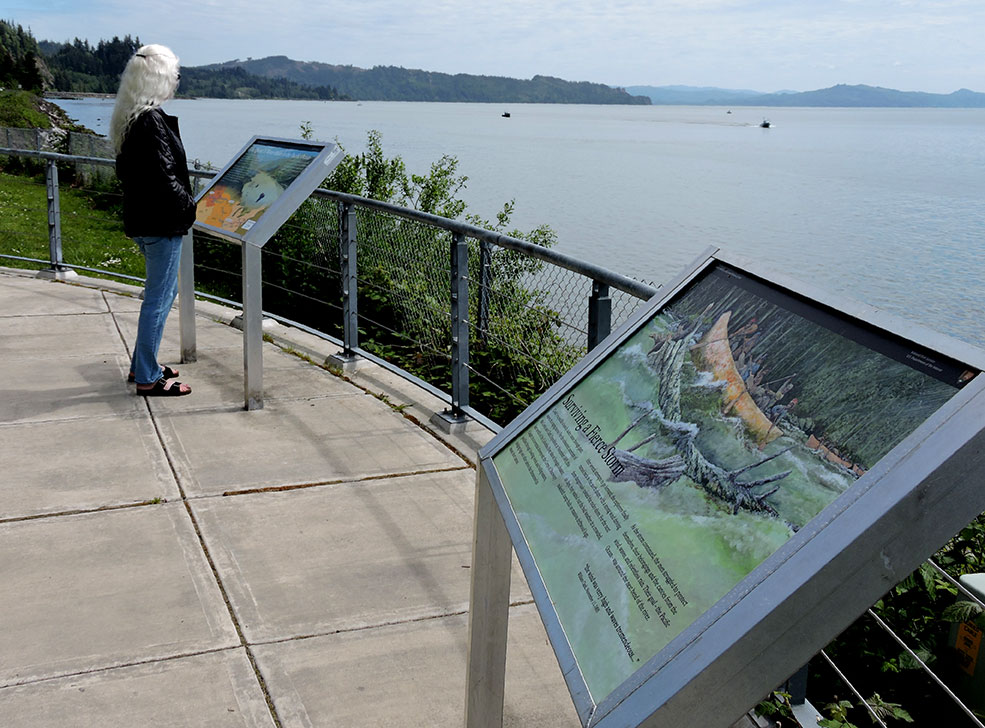
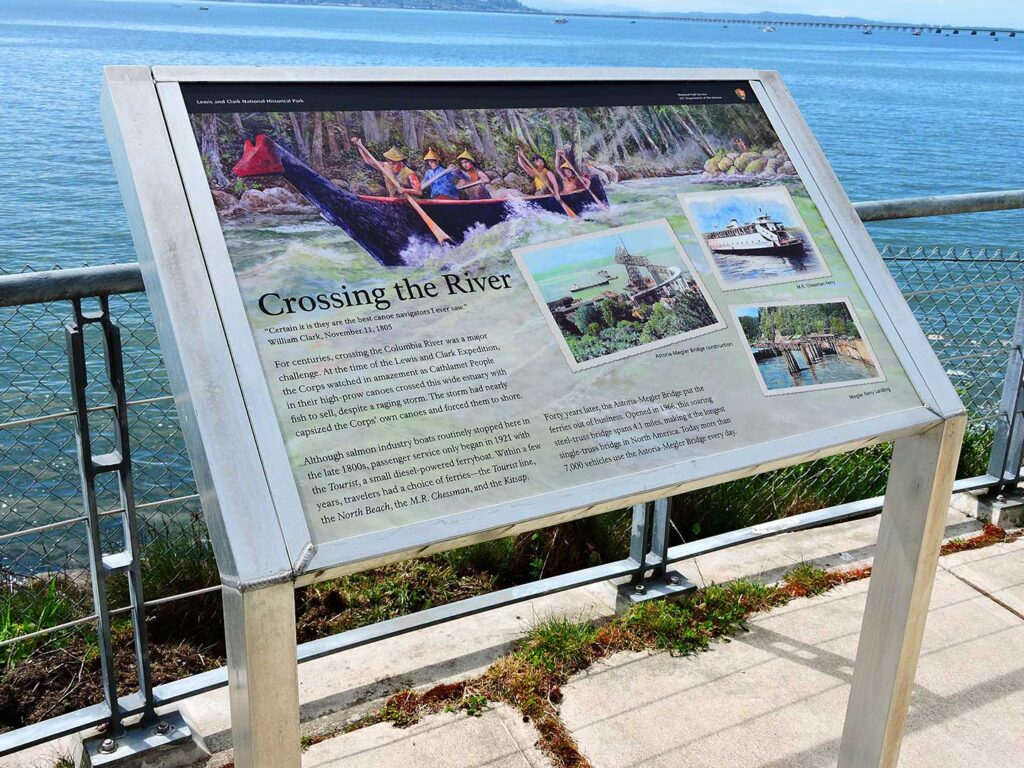
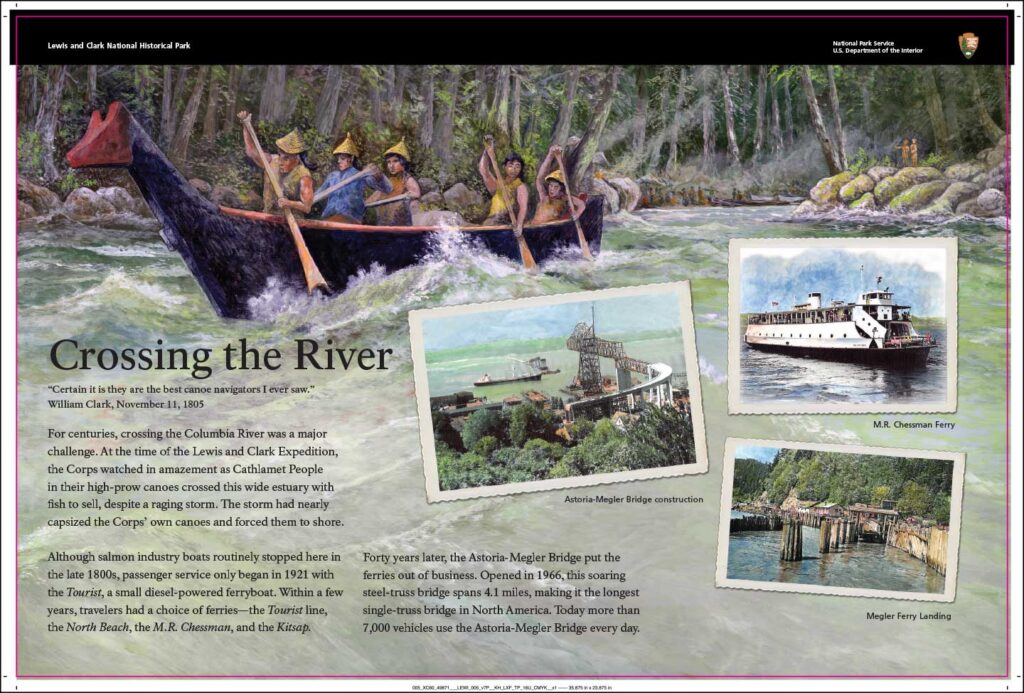
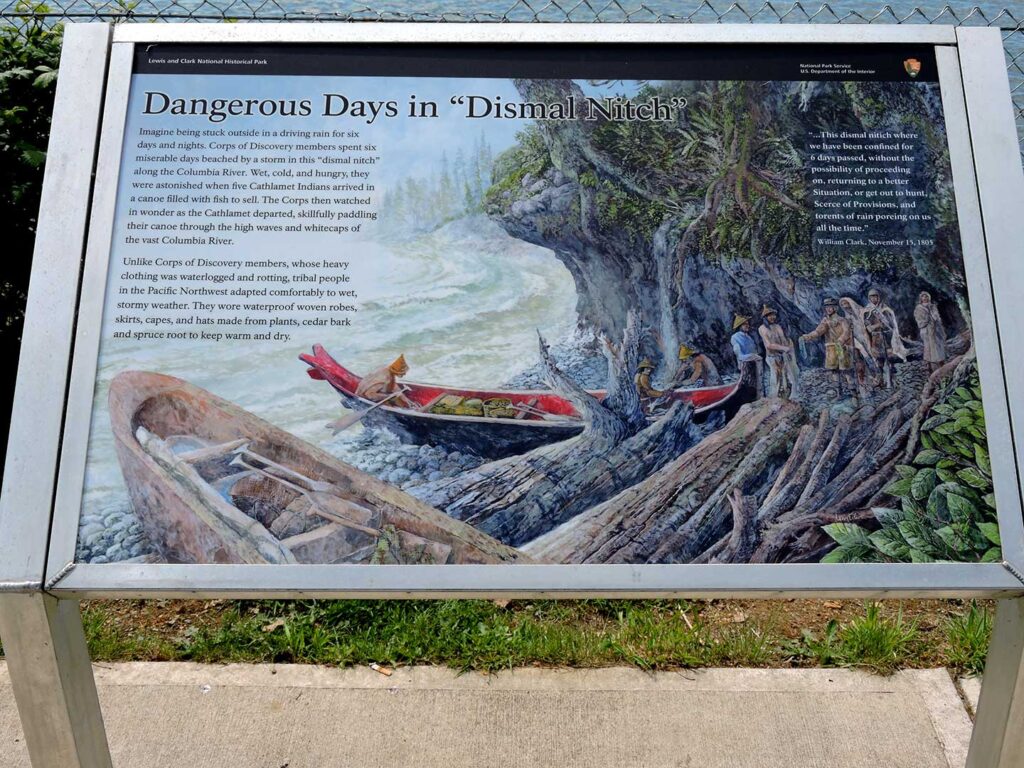
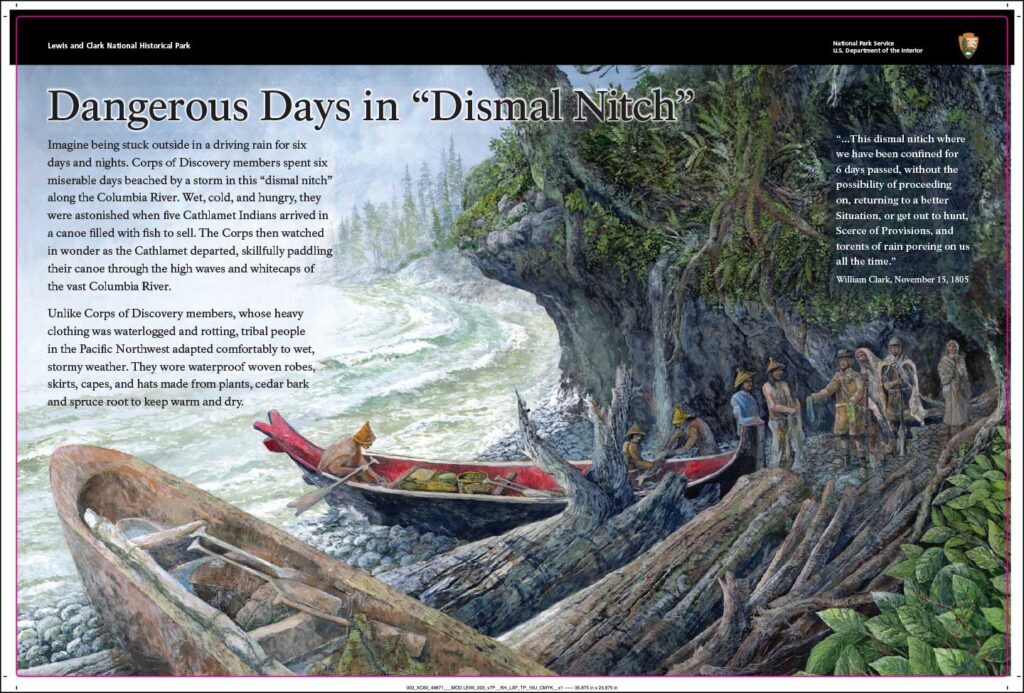
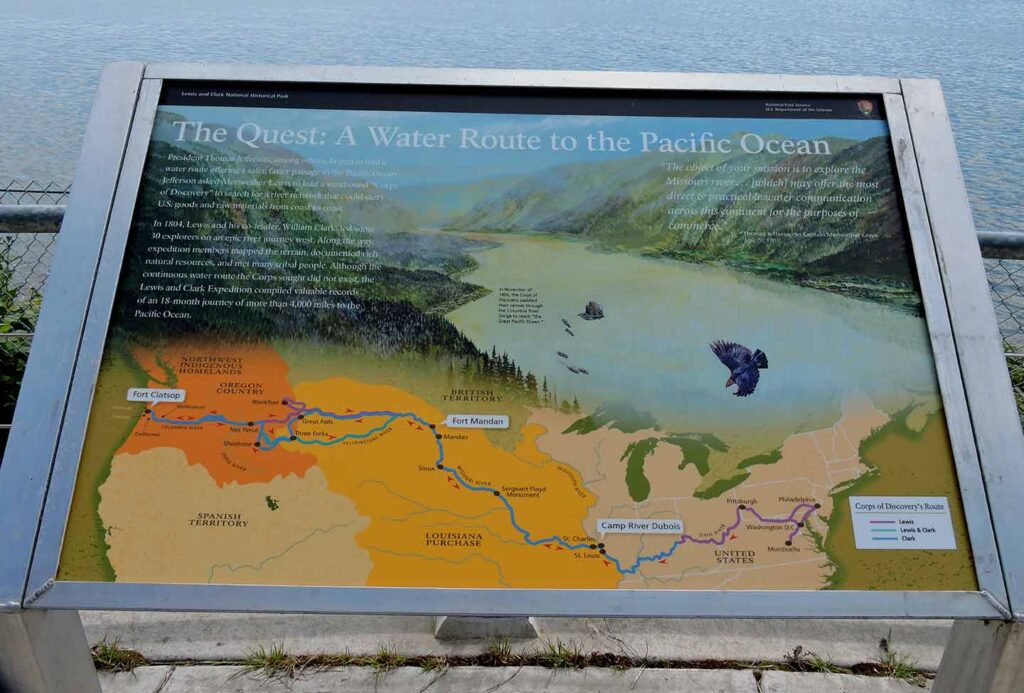
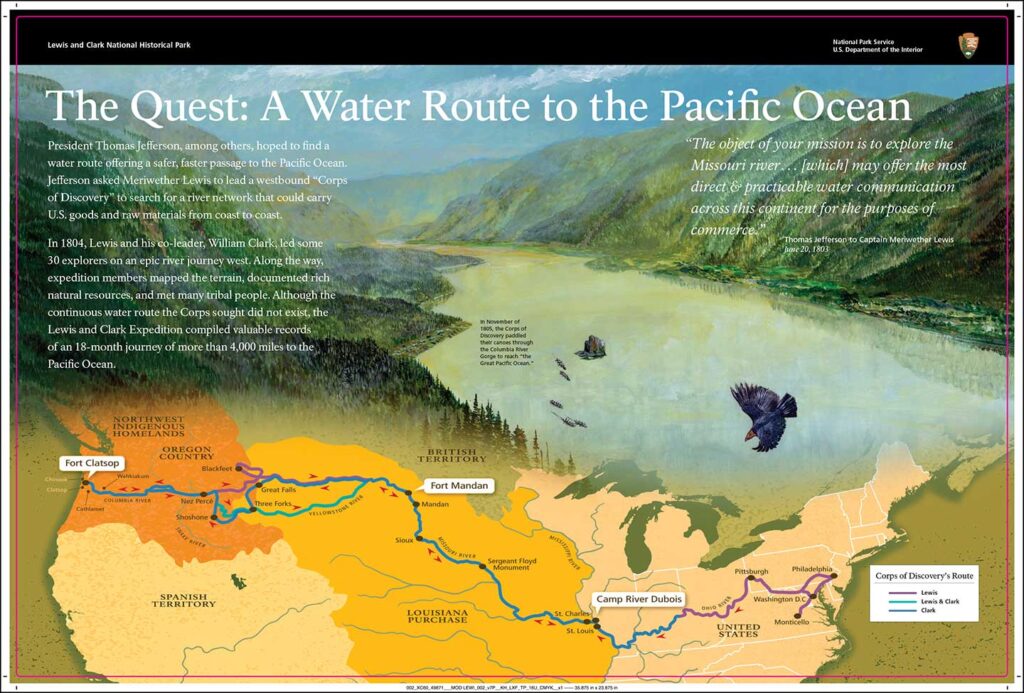
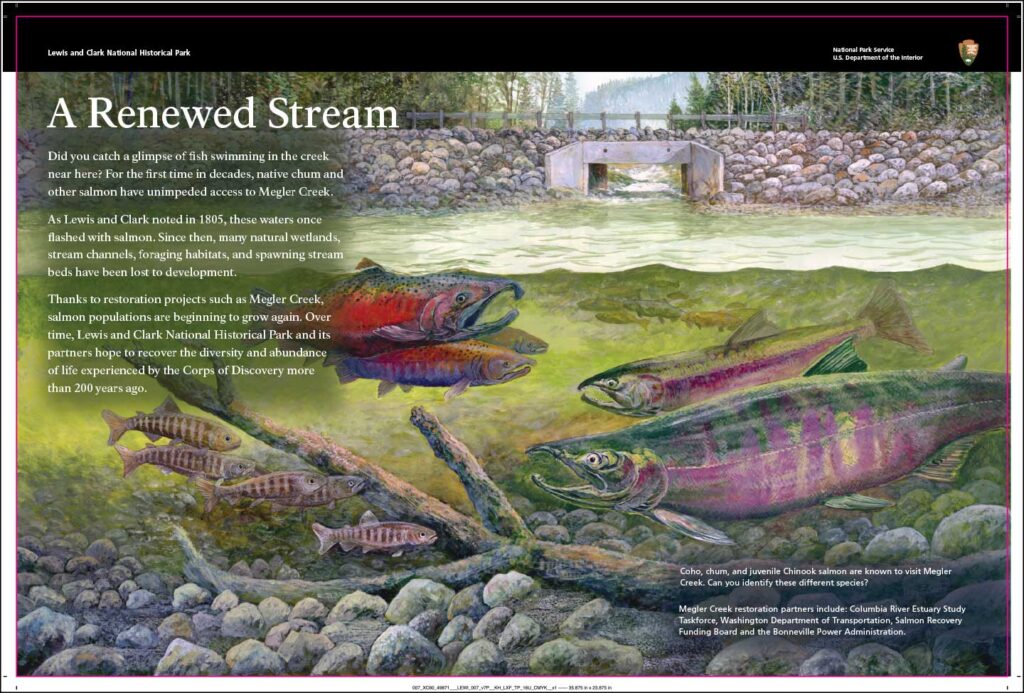
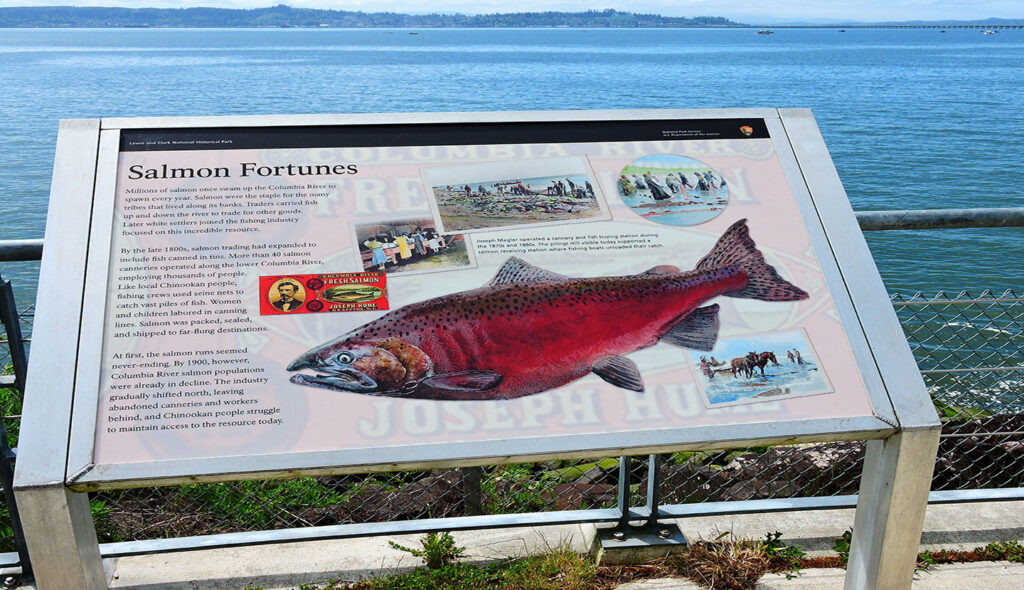
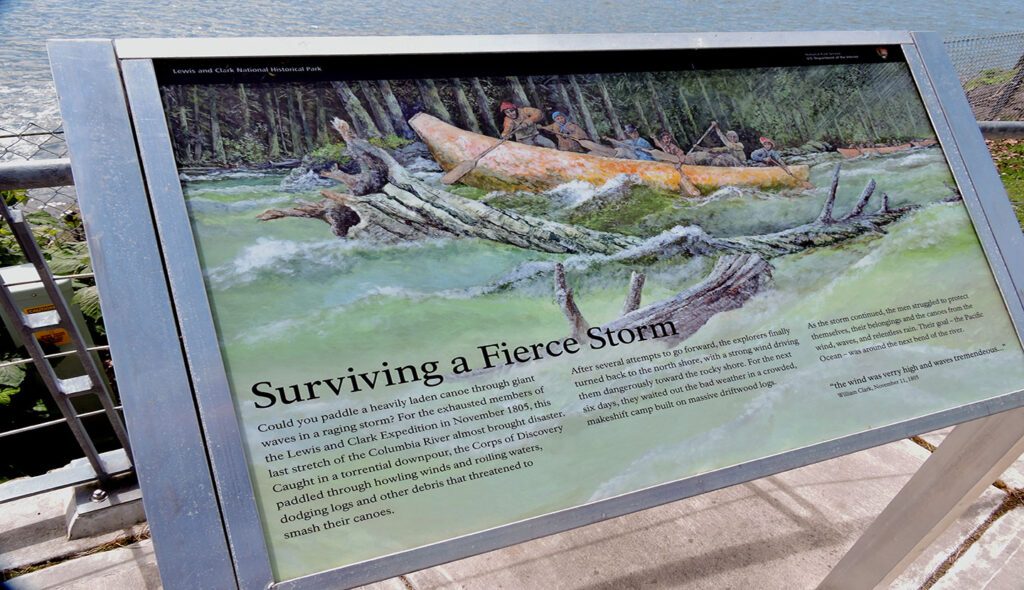
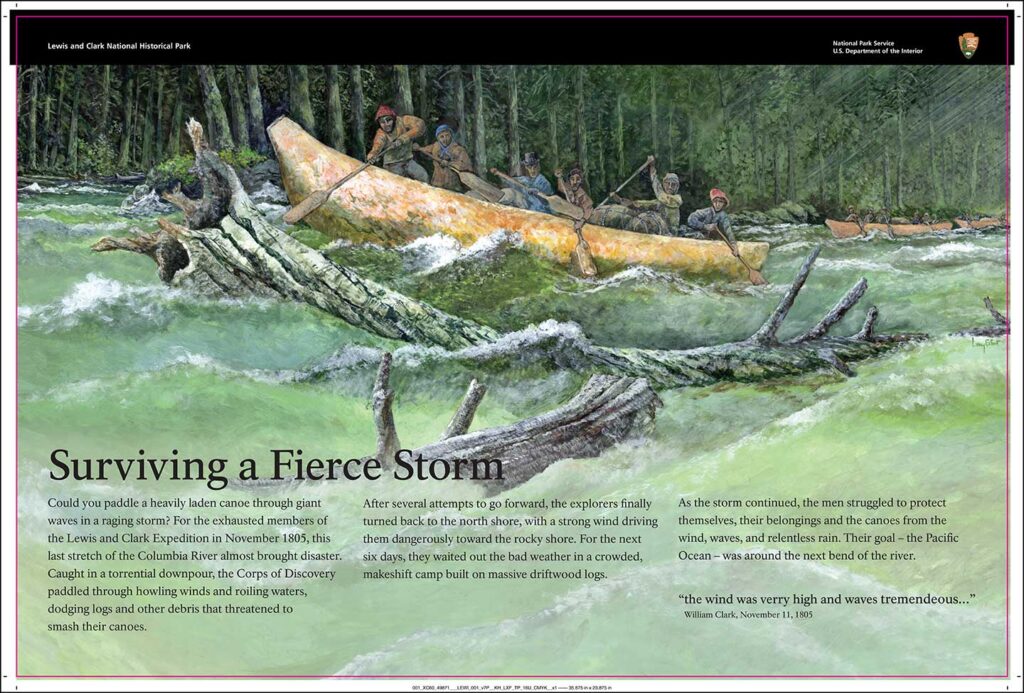
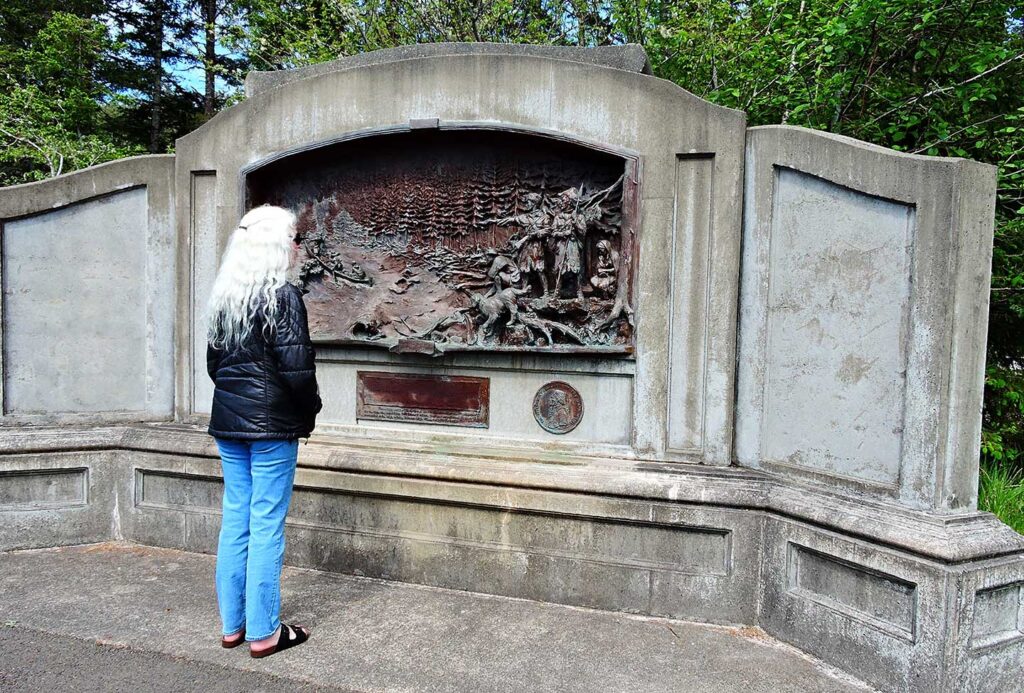
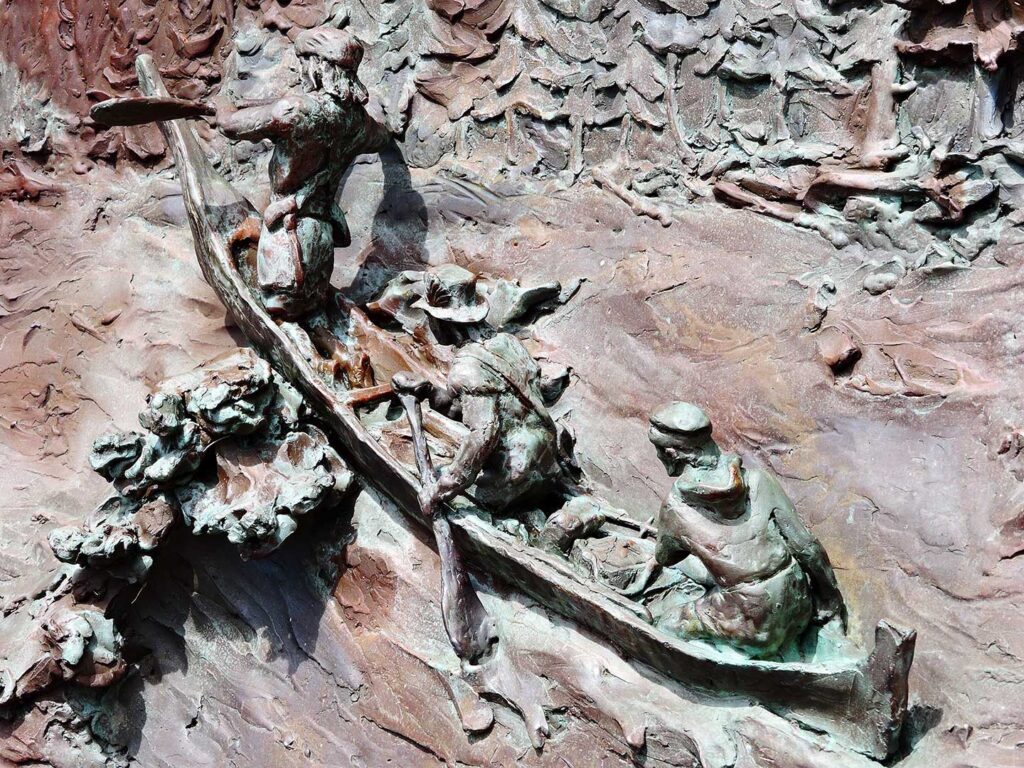
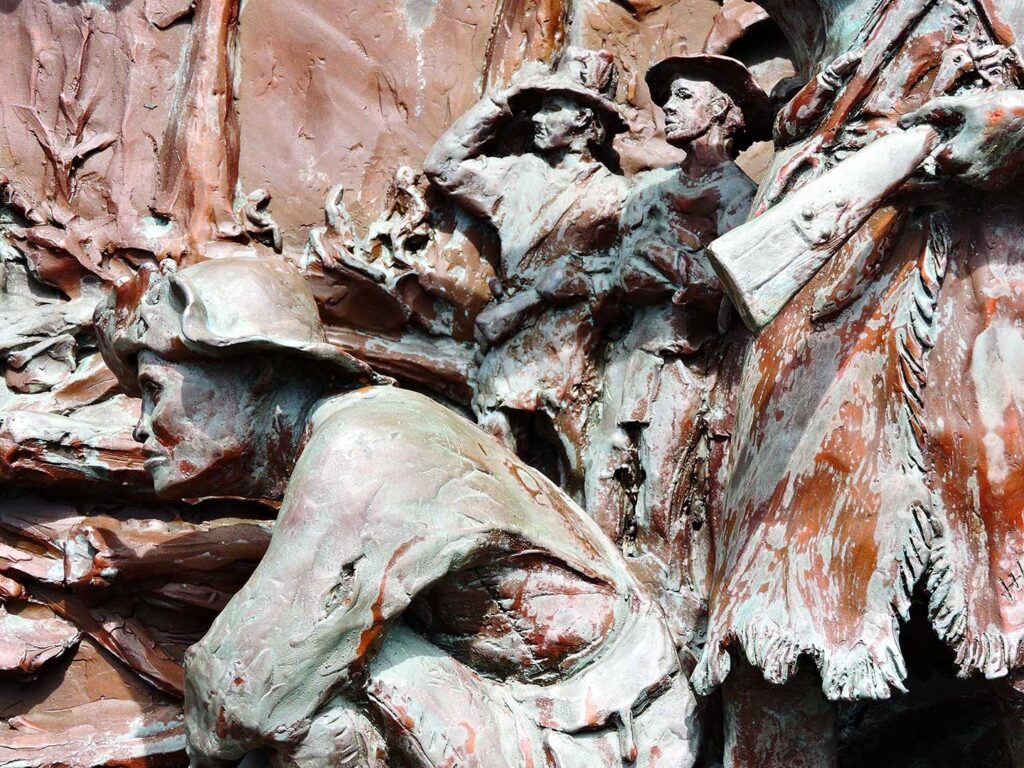
This is a long post, lots of photos, but I wanted to document this. In 2019, I was commissioned to do a series of paintings for the Dismal Nitch unit of Lewis and Clark National Park at the mouth of the Columbia River. Astoria is just across the river, the huge Megler Bridge is just to the west. We were recently there and I took some photos of the installation, along with a big bronze sculpture that’s there as well.
This is the spot where the Corps of Discovery, fighting a stormy southerly with huge waves and rain, hunkered down for days. Aptly named, Dismal Nitch, it really is just that, a little nitch in the cliffs. Giant logs were banging together, they were almost out of food, soaked and cold. Their quest, the Pacific Ocean was almost in view, but here they were fighting for their lives.
This is an important place in America’s history, just before Lewis and Clark connected our country together, east and west, in early November of 1805.
Just prior to me in 2008, artists Gareth Curtiss and Bill Clearman installed this 6′ x 4′ bronze at the site, and I fell gratified to have my stuff in the same location. It’s a stunning bit of lost wax casting. My part of this was the design and illustrations of the wayside. Giving credit also to Rosene Creative from Georgia handled the top end of it, Faye Goolrick of Atlanta did the text and Eric Kittelberger from Cleveland did the final maps. It’s how these projects go, a nationwide effort.
To make this project even sweeter to me, in 1963, my mom published a book about Lewis and Clark and The Corp or Discovery for Dodd Mead in New York, 1962. It’s the story of the Corps and all the wildlife and botany they discovered – almost daily – on their three-year journey. And here I was, a half-century later, painting the same story.
Thanks for reading this week. You can sign up for emails for these posts on my website at larryeifert.com.
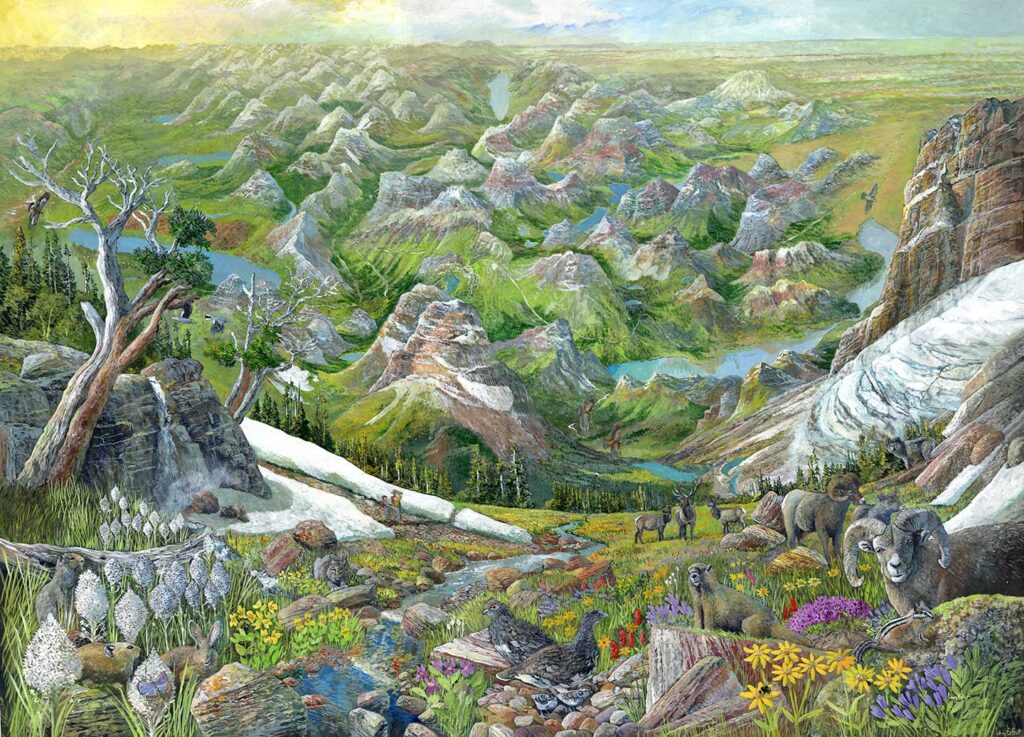
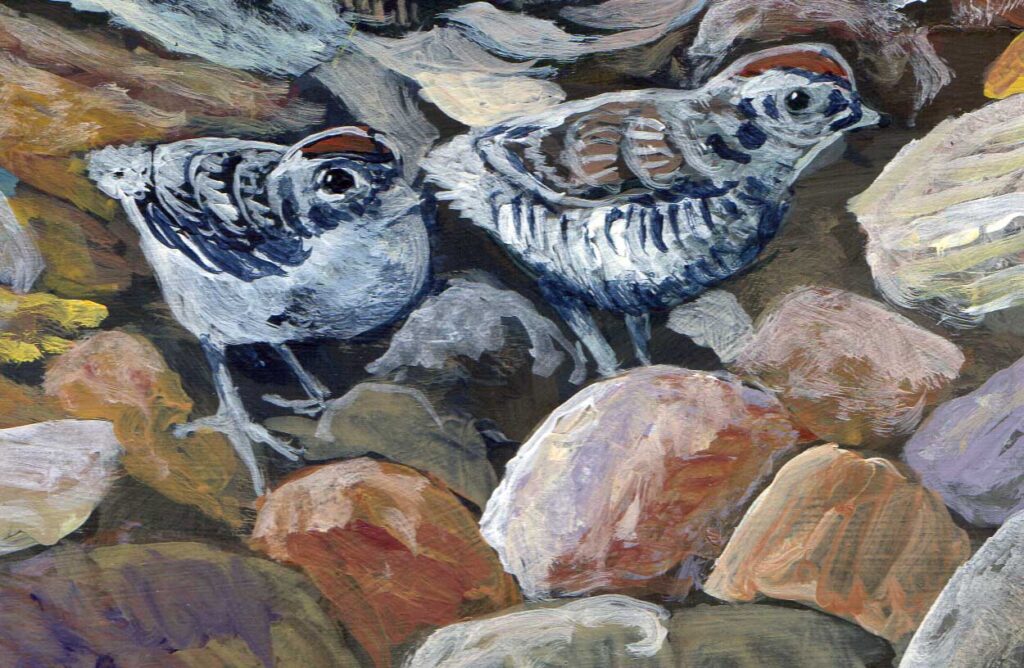
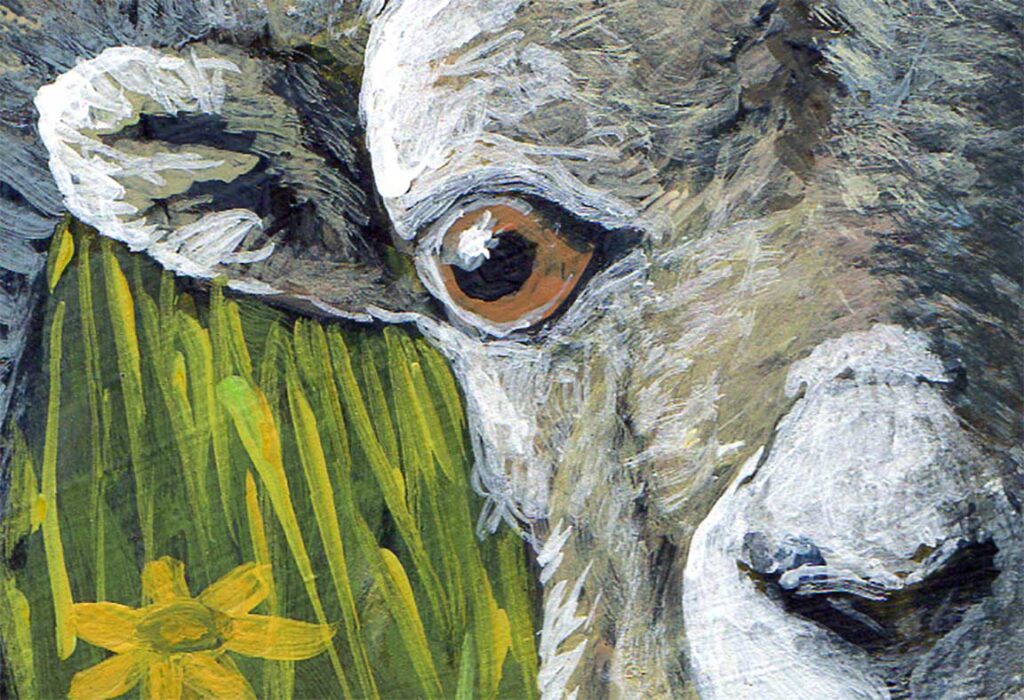
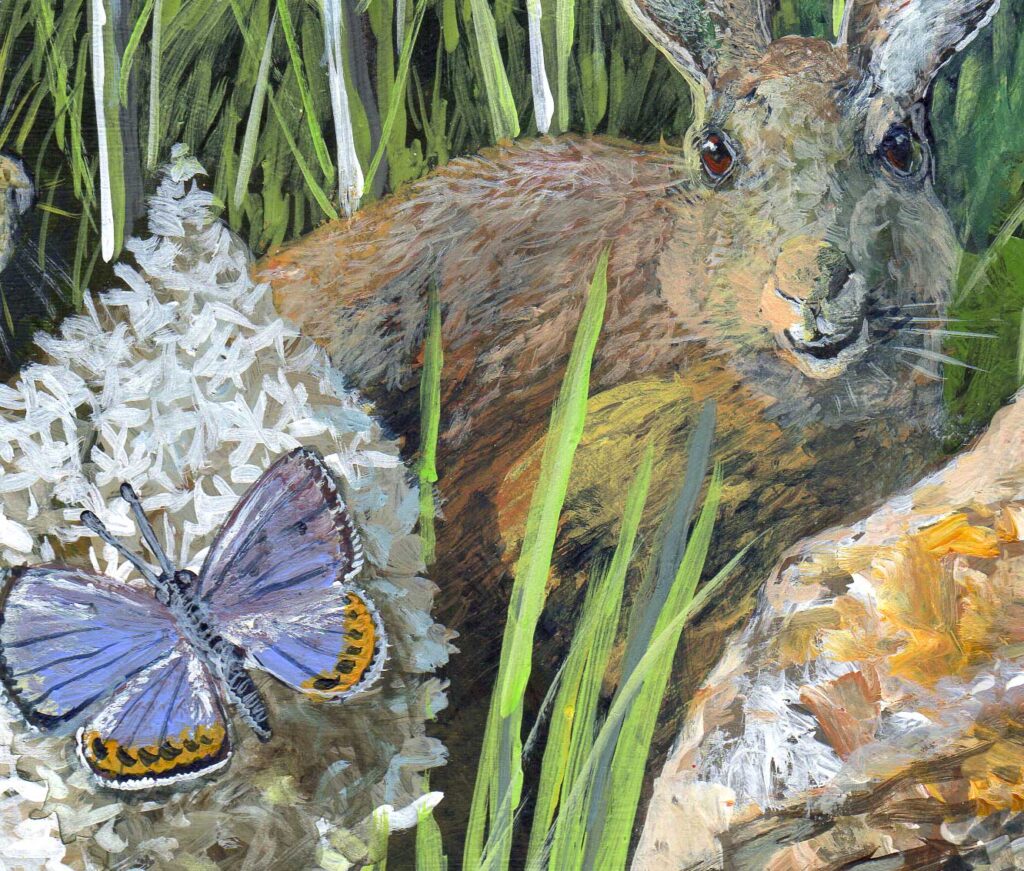
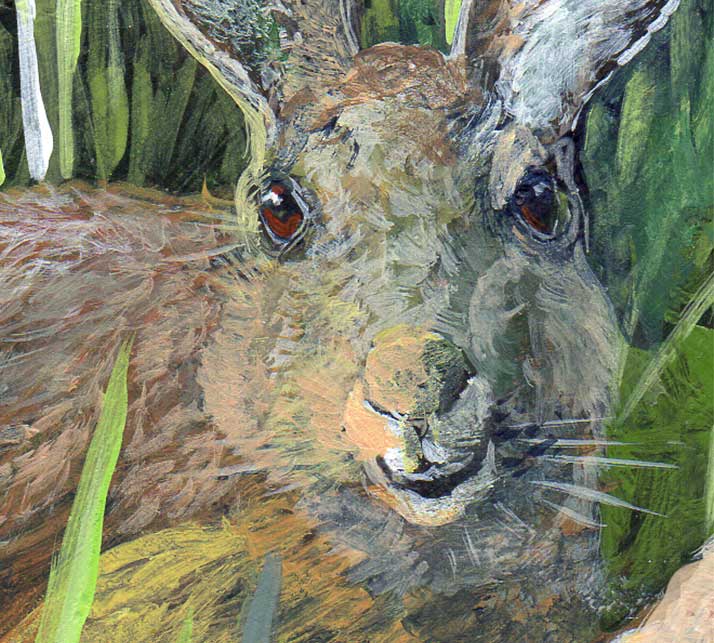
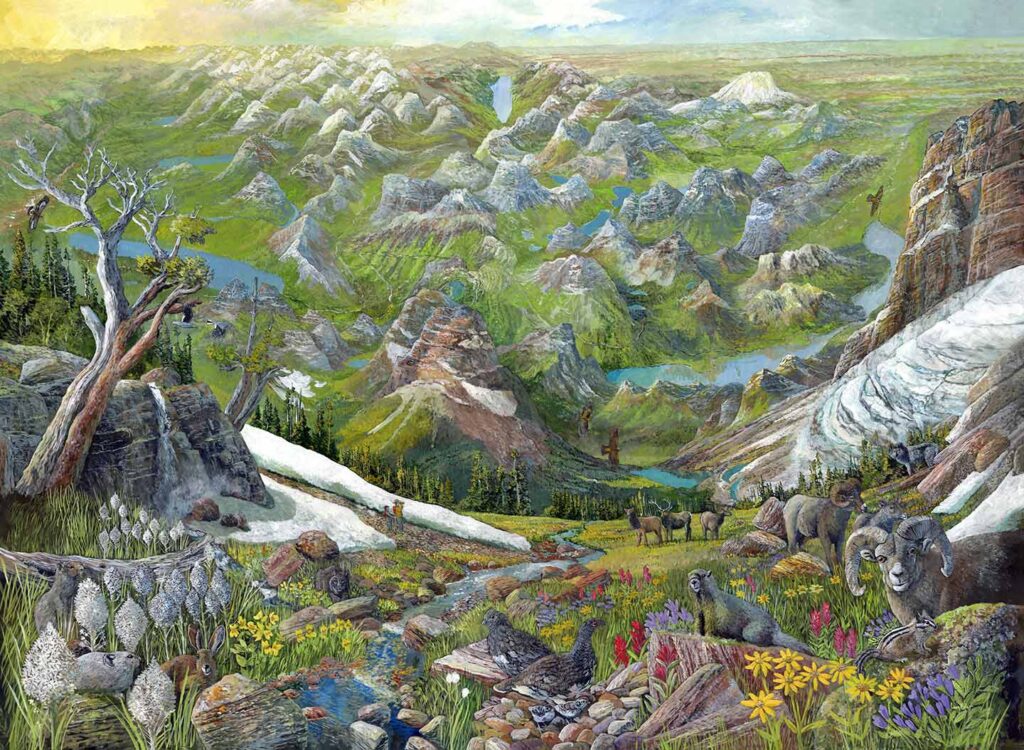
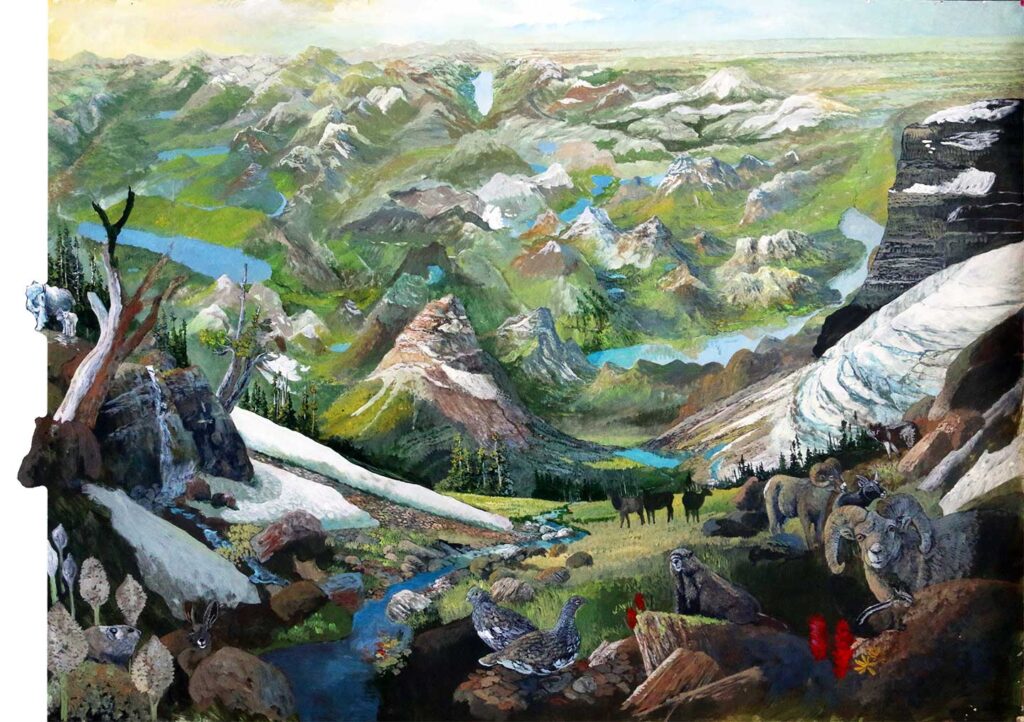
I posted about this painting of Glacier National Park recently, and now I’ve scanned it for the next step in becoming the back of the park map. As I was scanning and then cleaning up the file in Photoshop, I was struck with how loose and abstract my stuff gets when you zoom in on it. Brush strokes, smudges, finger prints, cat hair, my hair (what’s left of it) is all in here, stuck down forever. I think it’s a good view of my painting process, so here are some samples I screen-grabbed as I went.
This first one is the ptarmigan chicks in the center foreground. Notice the while lines around the heads to help bring that out from the background. And the vague indication of the rocks that are only a few brush strokes building from dark to light. Not detailed at all, none of it, but it still suffices to tell the story. Click on all these to see larger versions in your browser. It helps understand what I’m showing.
And here is the ram’s head on the painting’s right. In the closeup details on the second image, you can see it’s really just a gauzy overlay of white that makes for the final presentation, and you can see again that this entire animal was initially painted dark umber to begin with.
Lower left corner with the snowshoe hare and butterfly, it all works pretty well at this resolution, but blow it up so you can actually see the brush strokes and it’s pretty darned abstract.
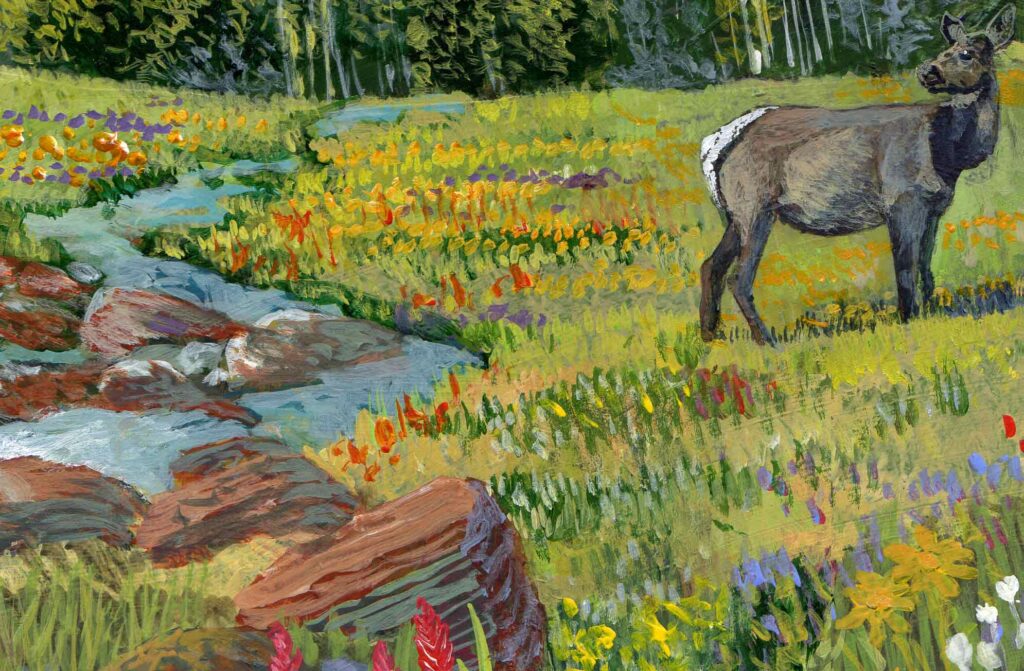
And finally, the area around the elk, flowers and sedges, alpine landscape with the stream. It looks okay at this normal resolution.
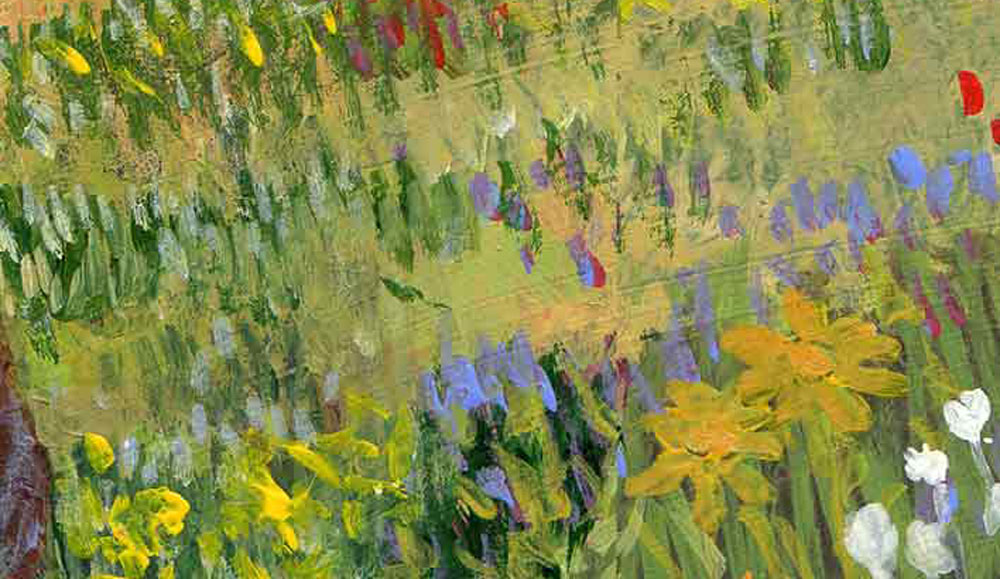
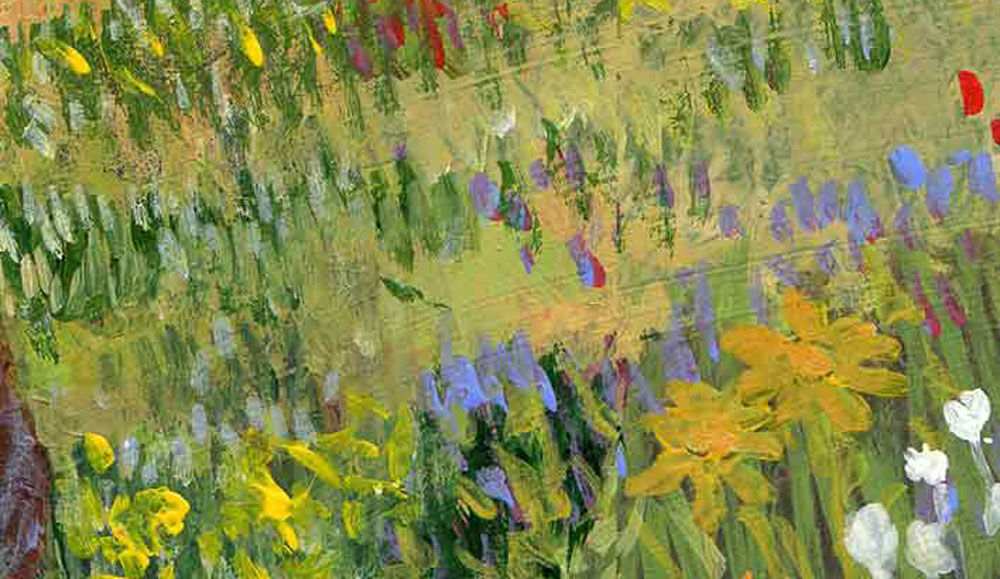
But as I zoom in on it, the thing falls apart fairly quickly.
If I presented this in a gallery situation, would it work? Probably, because people will buy anything = witness the last presidency. But there’s not much fine detail here except some dabs and dashes of paint. What I’m trying to get across here is that big paintings are really just that, dabs and dashes. I get questions about my process and I’d have to say here that it’s all just dabbing and dashing, splashing paint on a flat surface and standing back every few minutes to see how it’s going. In the end, it’s a huge finished thing that looks okay, but every moment is just abstract art in each very tiny area – then repeat over and over.
What IS this, anyway? What an abstract or maybe even non-objective piece of art.
Thanks for reading this week. You can sign up for emails for these posts on my website at larryeifert.com.
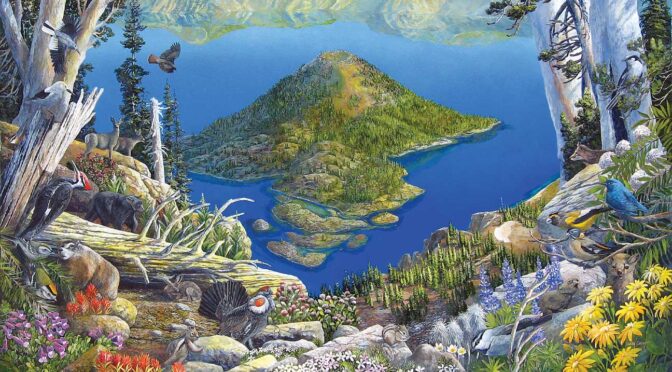
Another jigsaw puzzle arrived – Crater Lake National Park. 500 pieces, a reference poster inside, new smaller box. We printed this one a very long time ago and I’ve always liked it. So popular we’ve decided to bring it back. Now, we’ve put it in a new smaller box (easy storage and shipping), added a reference poster and on the design I scanned a piece of my hiking bandana for the bottom border.
Originally, this painting was all about those beautiful yet stark pines around the Caldera Rim. Those are whitebark pines, a high-altitude keystone species that is now about to be listed as a threatened tree. And so, we’re highlighting that event here with a new edition of the lake and whitebark pines are in peril!
So what’s the deal about whitebark pines? Why are these iconic and painterly trees in trouble? It’s a tragic combination of events that have come together in a perfect storm. An introduced fungal disease called white pine blister rust, Climate Change that has stressed the trees and allowed bark beetles to access the inner bark. Put the three factors together and it trouble for these trees. Whitebark pine has the largest distribution of any five-needle white pine in North America, but the whitebark pine’s health is deteriorating rapidly across its range, particularly in the Rocky Mountains, Pacific Northwest, and northern Sierra Nevada. In short, the forests I’ve loved my entire life are changing beyond measure and will effect not just the trees, but an entire ecosystem.
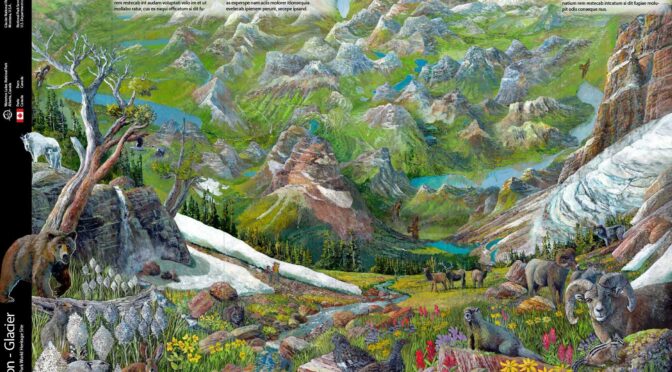
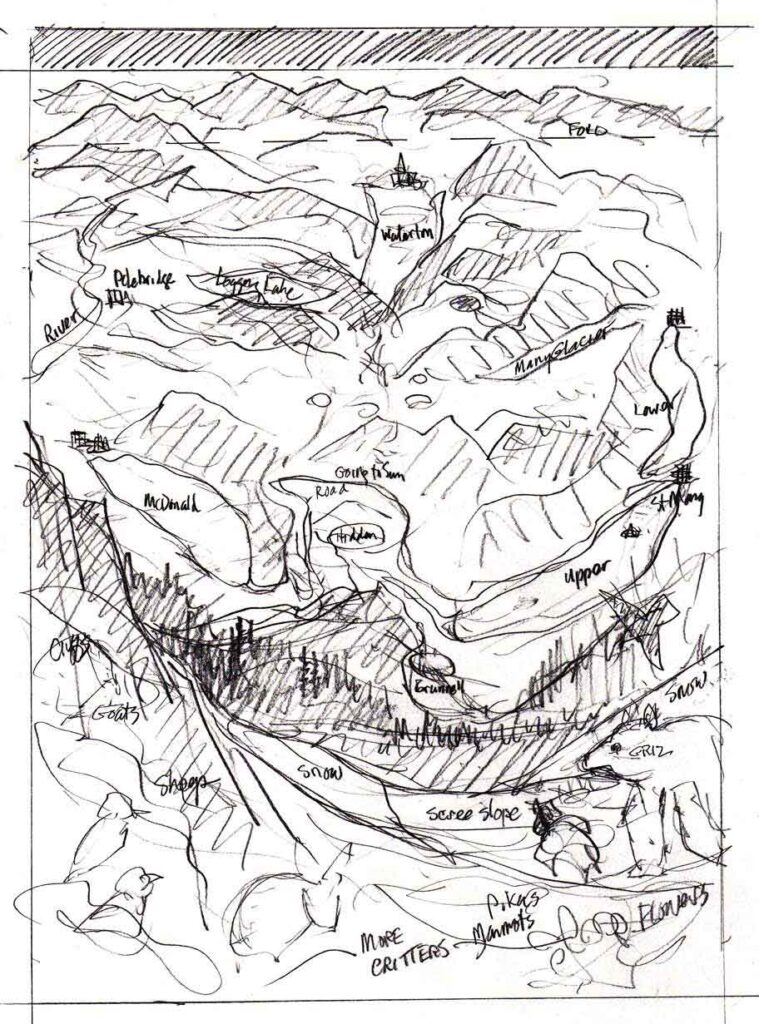
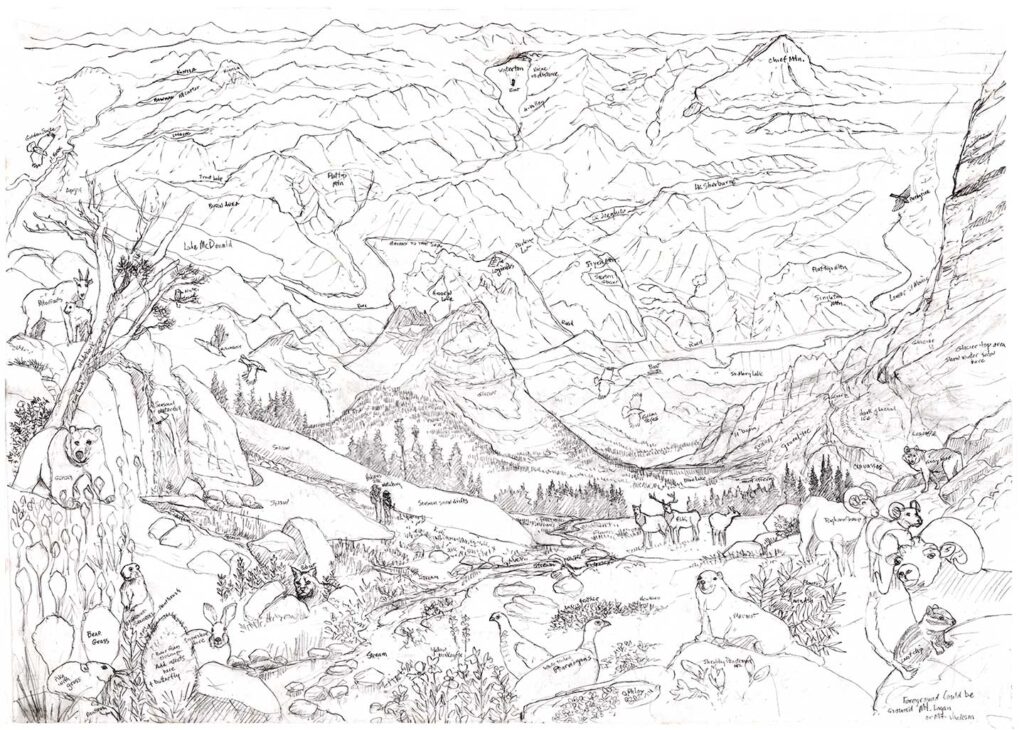
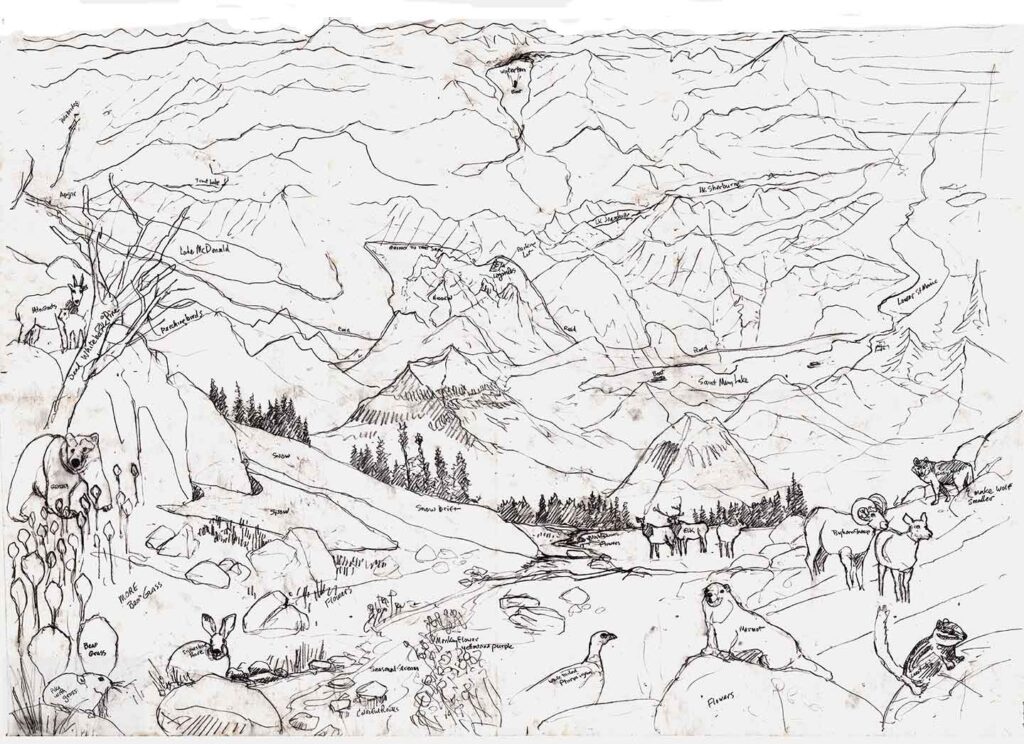
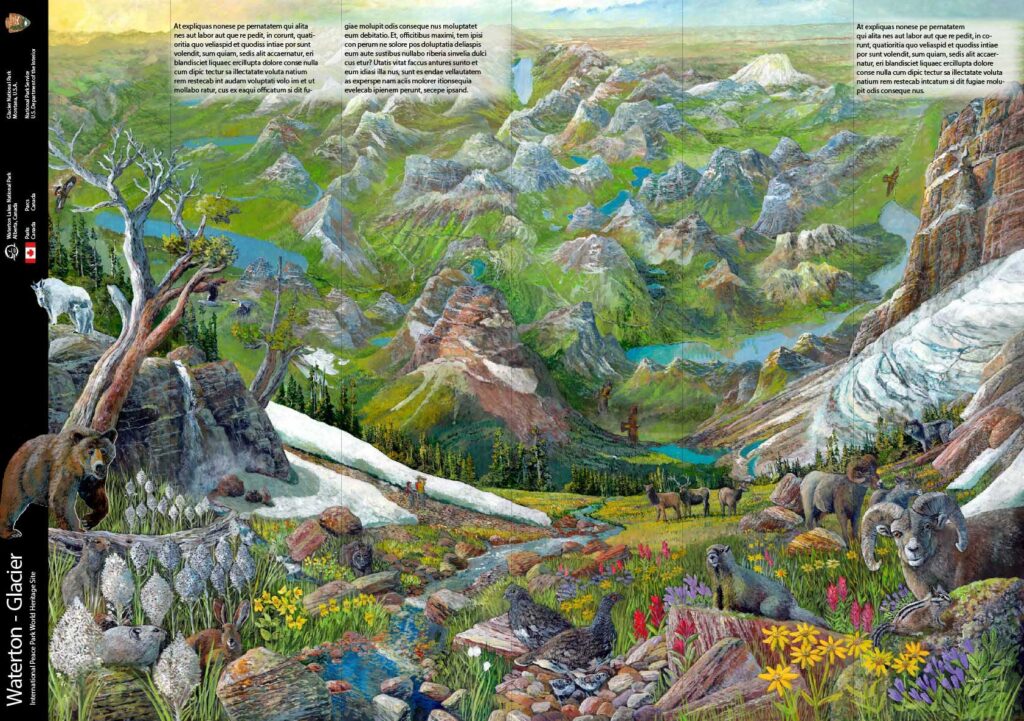
2020 seems to have been all the things I said yes to. Yes, of course I’ll do this painting for the new Glacier National Park map, even if we can’t even get to the park because Covid caused the Blackfeet Tribe to shut the entire eastern side of the park and close access to Glacier and Waterton Lake National Parks. Yes, close it for the entire year. Yes, I could paint it anyway – I know Glacier well enough, having painted and hiked there many times. They seemed unsure. And so off I went into some crazy zone of figuring out how to fit 50,000 square miles into one little painting. They wanted an alpine landscape, critters and flower, a glacier upclose, all the park features such as Lake St Mary, McDonald Lake, Waterton Lake, the Continental Divide, Going-to-the-Sun Road and some others. Sure, I can do that!!
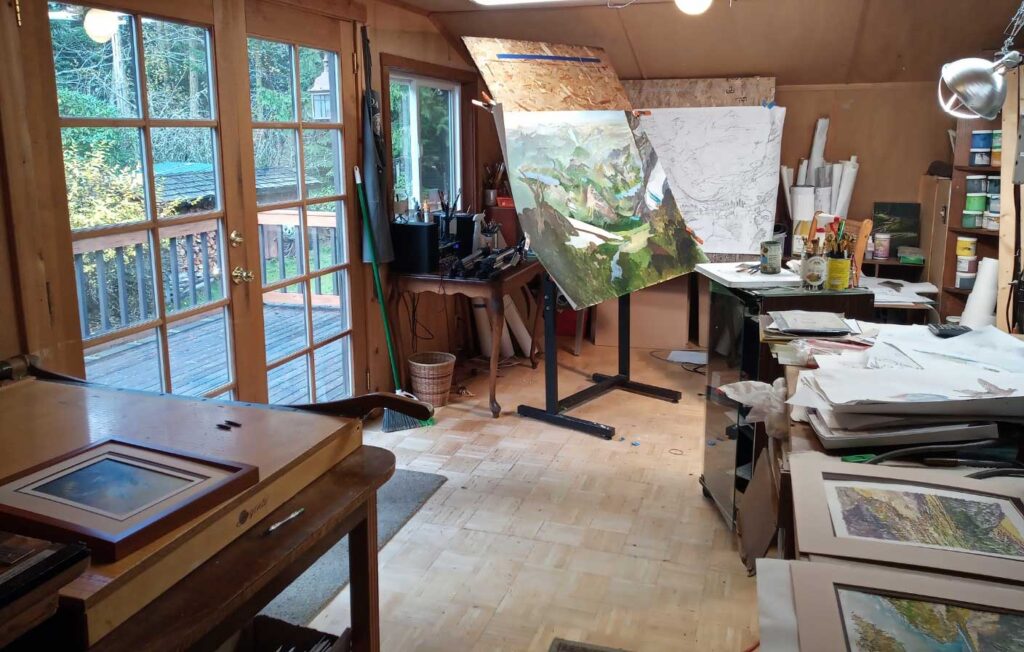
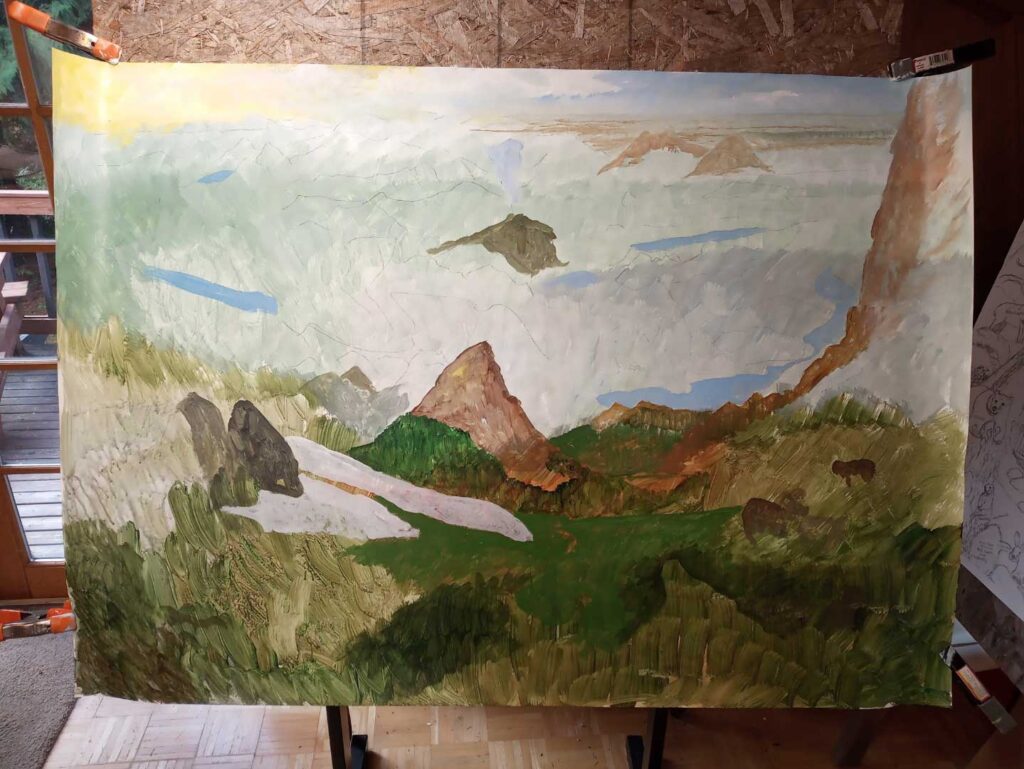
Here’s a little trip journal of “going to Glacier in Montana without really traveling”. The evolution of a mural.
I haven’t gotten final approval yet, but I think we’re close. Here’s how it will look once the map is printed – and millions of eyeballs will see it for longer than I’ll probably be here to smile about me saying yes.
And so ends 2020, one of the strangest years any of us have ever lived through. I’m just grateful to be in a town that believes in masking up and collectively staying safe. We said yes to moving here decades ago – we’re still smiling about that every day.
Yes! It takes lots of people saying yes to make it possible for me do what I do for decades and decades. Committees, sponsors, clients, governments, non-profits, customers who buy our stuff, but most importantly, an amazing partner, a woman who keeps it going. An artist simply cannot do all this singularly. Nancy’s a very skilled painter and photographer, but she also says yes in helping me every day to keep our little creative ship afloat.
Thanks for reading this week. You can sign up for emails for these posts on my website at larryeifert.com.
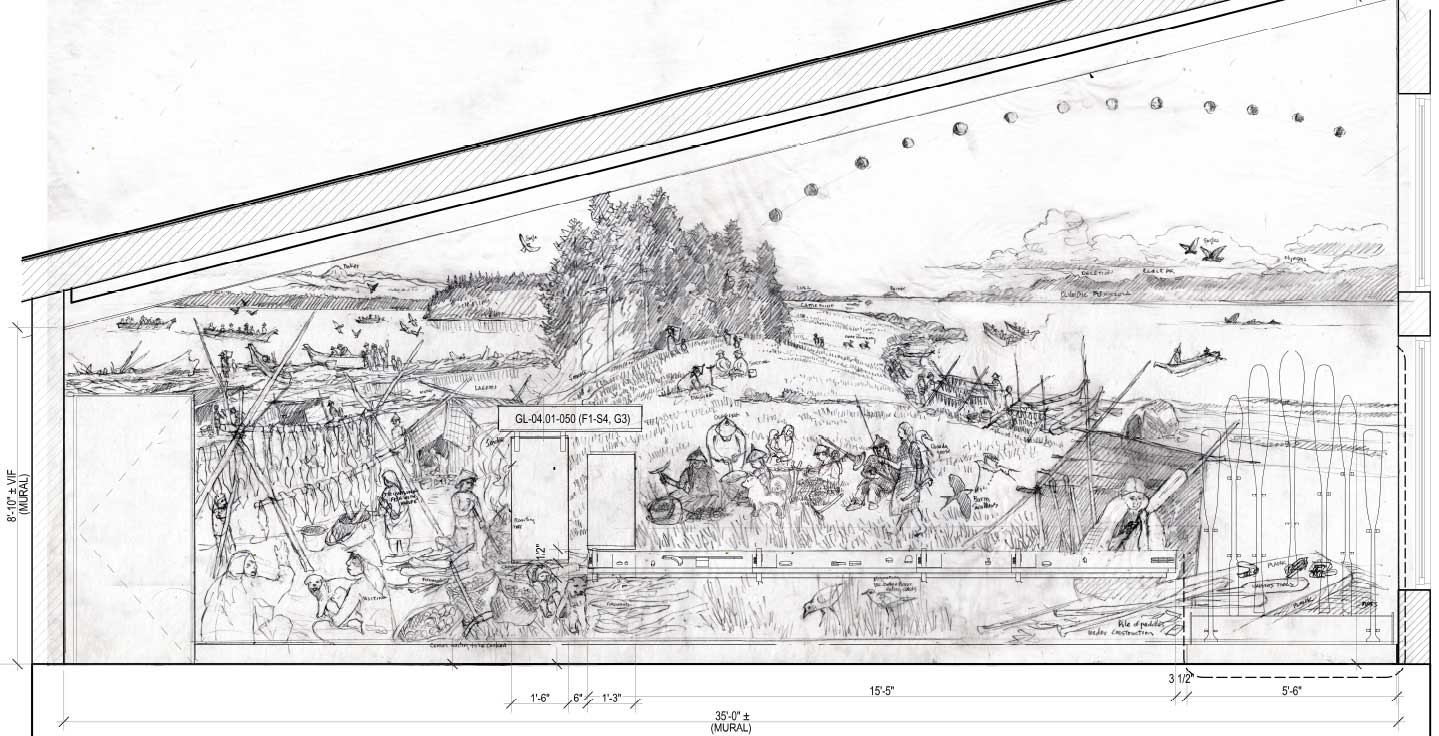
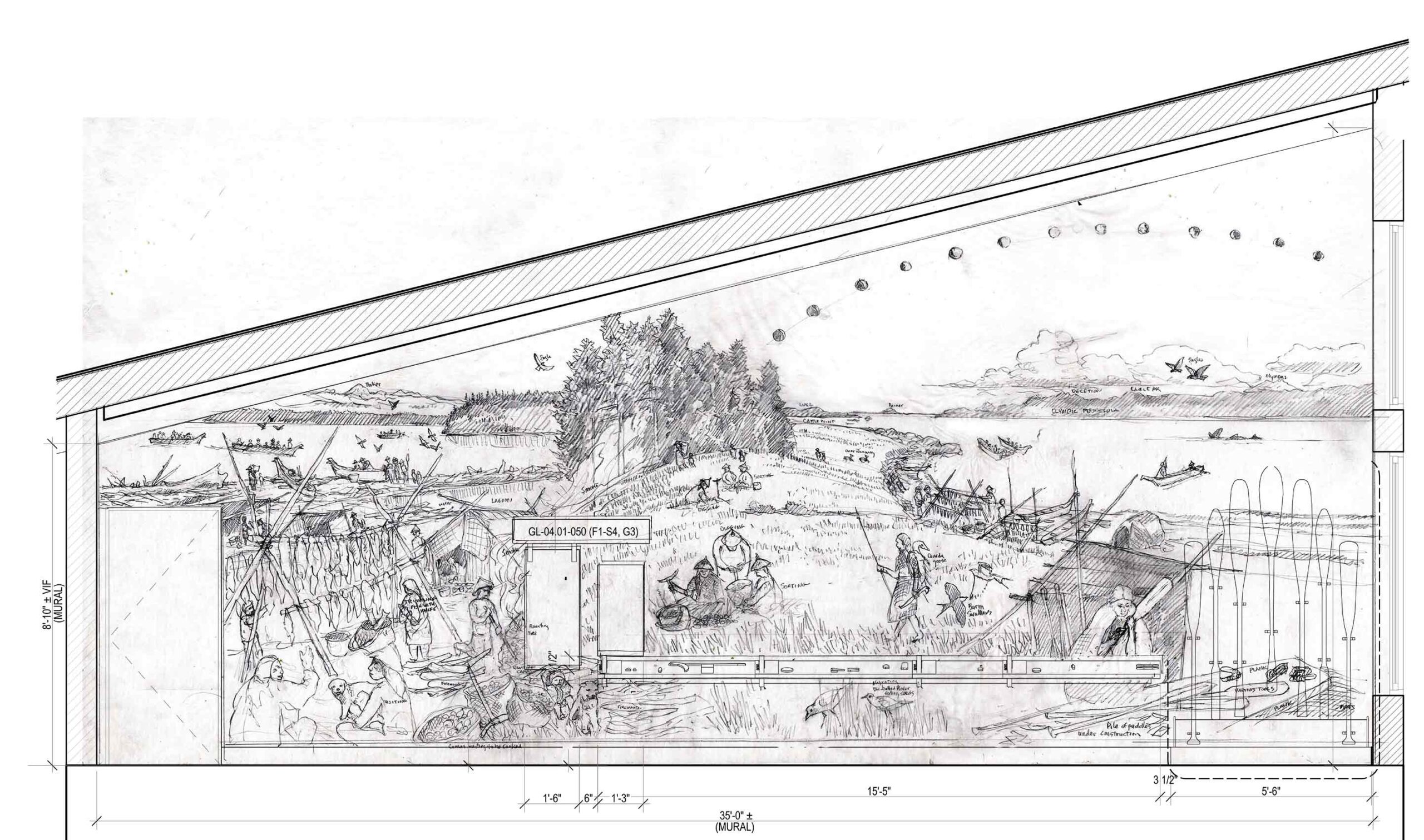
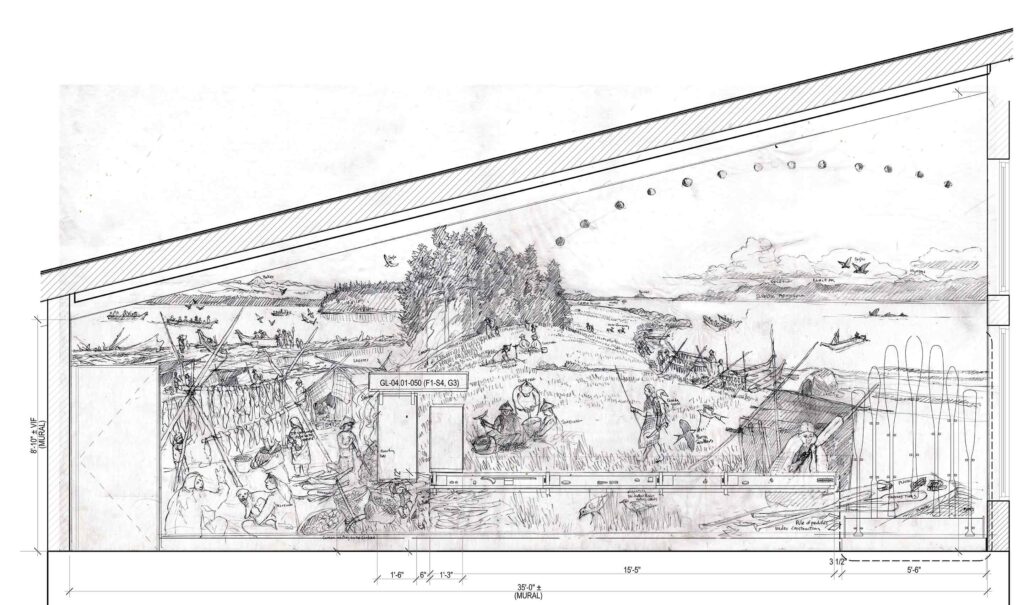
Click images to enlarge. A 35-foot long wall doesn’t shrink well to a little screen.
I finished a fun project this past week. I got to create a little world of it’s own on what will be a 35′ wall. I grew up in a museum, you see, where both my parents worked with a staff of curators and writers, artists and generally amazing people. The museum staff that made huge wall dioramas were my babysitters. And here I am, decades later still deeply passionate about this stuff.
So, I was tasked with coming up with the conceptual design for a new park visitor center, but can’t tell you where it is because this drawing hasn’t even been presented to them yet. Cart before the horse, I know, but it’s the way things work at this level. I still wanted to pass this around because who knows what will happen with potential changes – but I like it just as it is now. And this is just the concept or design phase. There’ll be another contractor doing the production phase where I hope to be the painter. It IS my drawing, after all.
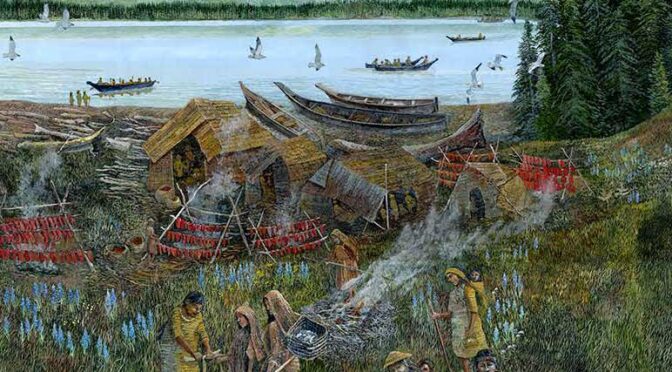
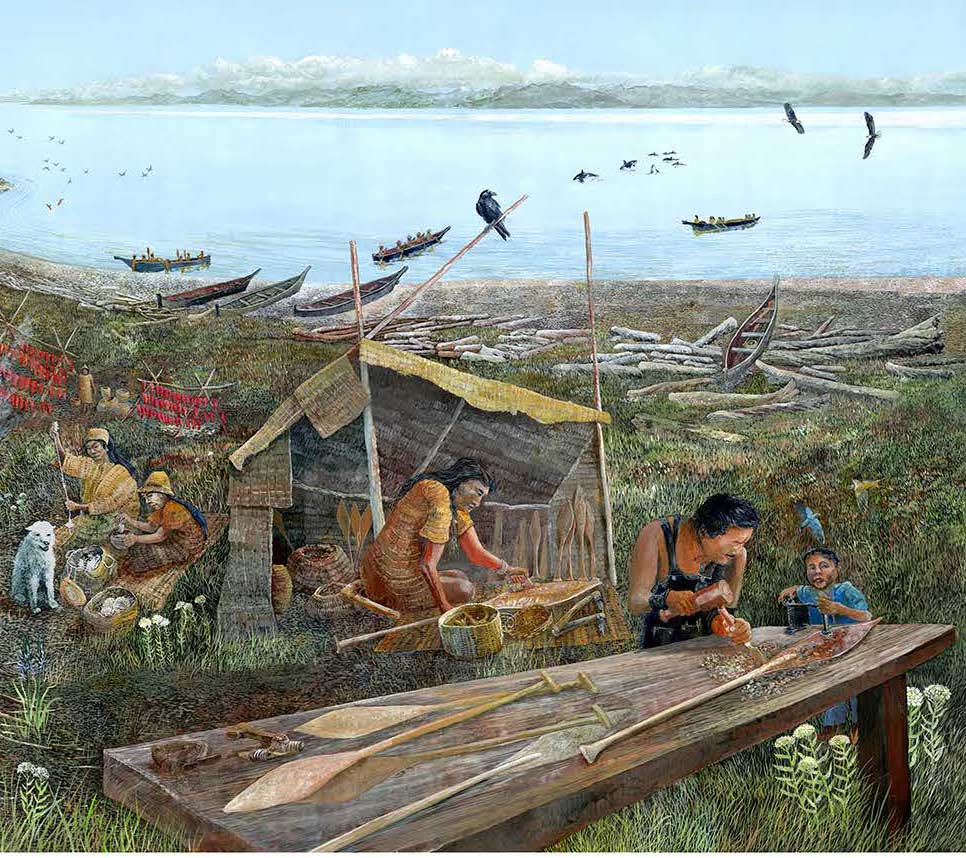
The story I was tasked to create was of a summer fishing camp on the Salish Sea some time,or ANY time within the past 8,000 years before pre-white contact – meaning before 1775.
This means no iron or steel tools, no European clothing. Tribes would have come from miles around to fish here in summer as huge salmon runs hug the shore, so there would be fishermen using reef net style techniques, drying racks on shore and baskets full of fish. Summer is also the time when camas bulbs would have been harvested, dug and then baked for later consumption. Both dried salmon and baked camas were the prime staples of life here. I’ve actually been to this exact place in the 1980’s and watched modern seiners catch tons of salmon so close to shore the wives and girlfriends would yell out the egg their men on. I have a connection here.
So, with all that in mind, I just started drawing, left to right so as not to smudge the paper:
And then all this next.
On this left side, racks of drying fish, visiting people chatting it up, wool dogs hanging out. These dogs, a breed now extinct, provided wool for weaving, and tule or cattails provided clothing and tarps for temporary summer shelters.
The rectangles are for interpretive text panels, the long horizontal thing is a reader rail with real examples of tools – matching the tools I used in the mural. I added a wool dog watching a baby strapped up in a papoose bag down low so real kids can see them at eye level. These white woolly dogs were family pets that were sung to and treated as family members. It was fun to find a few photos actually showing them.
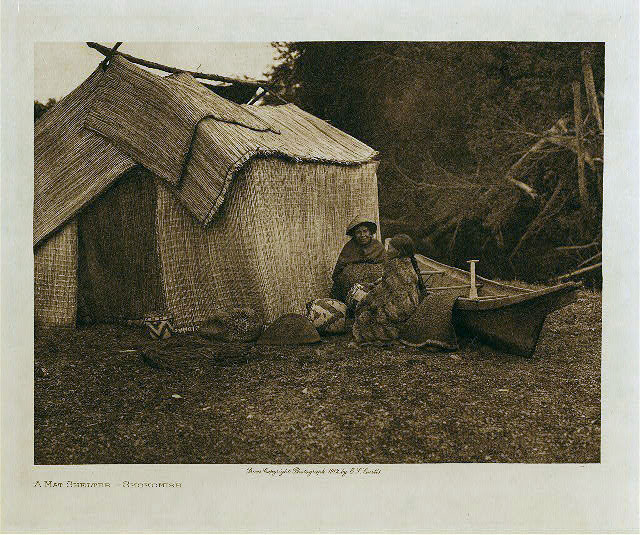
I gained valuable references online from Curtis photos, public in the Library of Congress image collections. Here’s one that shows the summer house style and canoe, clothing and baskets all in one image. I used all these parts across the wall.
In reading references for all this, I learned that black-bellied plovers begin their winter migrations from Alaska in summer and stop here to eat the drying seeds of prairie plants, so I added this below the reader rail for kids to see.
On the far right, behind the real paddles, I drew a plank showing the various wood-working tools and someone actually shaving a paddle.
And here’s the reference below for the camas processing, shown in the mural both on the center prairie and in camp showing the underground baking process.
And here’s the entire wall again, 35′ wide. Oh, those moons are the 13 Moons in much of tribal spoken history, representing each moon of the year – and providing (I hope) for a thoughtful reference to the thousands of years this scene took place, again and again during the 8,000 years of tribal life here in the Northwest.
Thanks for reading this week. It was a fun project, probably more fun than actually painting the darned thing.
I freely admit it, I can’t make big mileages hiking if I stop to do these paintings. I’m fast, but not THAT fast, so, I’ve learned to shorten my goals, keep it realistic – and enjoy myself. For this, I get art to take home, my old body thanks me for slowing down, and by taking care I get to come back again and again to do this. And one more perk that is the difference between hiking and making art. I get to actually LOOK at the landscape, see how it’s built and has evolved. I see and understand how the flowers grow beside that dainty little brook where it spills out of the lake. Or how the trail crews have built a little path of rocks hauled over from a scree pile possibly 50 years ago. Putting in mileage sure doesn’t get you this close connection – but making trail art does.
Fleabane-beside-the-creek
These paintings represent places that moved me enough to stop and draw. On this trip, fourth of the season, I didn’t take my paints, but instead just a pencil, long point pencil sharpener and some water color paper. The color was added back in my studio, and I loved reliving the trip in this way. It took less art-making time on the trail, yet provided a ‘second adventure’ for me here at home reliving the same places again. I recommend it, really!
Sunset-trail-toward-the-peak
In this painting, I liked the way the soft light from distant fires softened up the sky, made companion colors in the willows fit perfectly as they yellowed for fall. The fleabane flowers beside the creek were about spent, with only a few yellow and white petals remaining – but it was a beautiful little place with water gurgling by. Willows, their leaves chomped on here and there by the black-tailed deer, were sporting galls and little caterpillar cocoons awaiting first freeze so they could spend their winter safe under snow on the ground. The place looked felt very soft and settled. Both these paintings were created at places where I was also tired of walking, so it was good timing to take time, calm down, make some art.
As I hiked along and came into a big meadow, the vertical peaks of the Olympics really contrasted my view. Flat and stable, then vertical and jagged, rising fast and steep. That’s what these Olympic Mountains are, really steep. The Dungeness River starts up here and drops 7600 feet in only 28 miles to the Pacific Ocean, one of the steepest watersheds in the country. Ah, but those first dozen miles at the top, they’re just pure magic. One of the side secondary rivers begins here in this valley, surrounded by snowy peaks and a chain of lakes. Not a single lowland trail comes here, they’re all high subalpine or high-elevation trails that drop down into this magic place, giving it a Shangri-La feeling bounded by barriers on all sides.
Mountain-Gentian
Gentian : gen shenGentians are fall-blooming plants of subalpine wet meadows. They’re one of my favorite flowers because they start blooming as summer is fading, being downright gutsy about their timing. They grow in clusters from a solitary root, and are at first tightly zipped up, a dark midnight blue that is truly rare in color. I don’t know another alpine flower with this amazingly vibrant blue. As they open, the insides begin to show lighter shades of cobalt, and again this is color not often seen in the wild, anywhere. They’re spectacular, to say the least I can about a plant that’s learned to flower just before first frost. What timing!
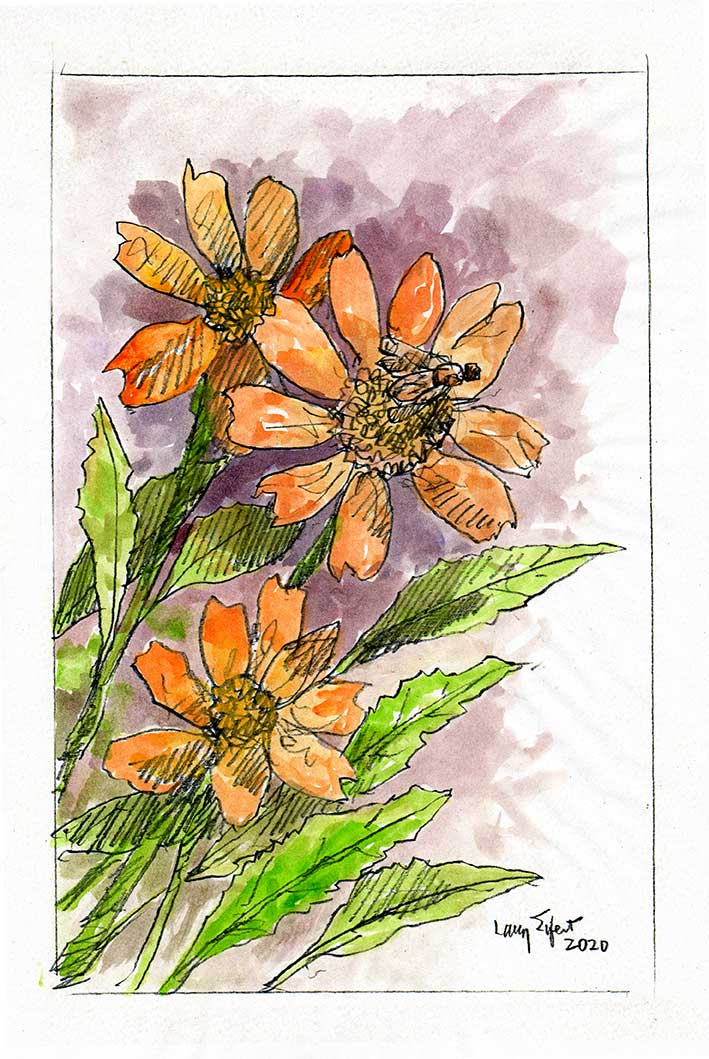
Orange Mountain-dandelion
On the other side of the color spectrum, a nose-up look at these plants that were upslope and out in the open from the gentians showed an orange mixed with white, just a tad of white to tone it down. And a little bee getting a meal. This was an upclose and personal painting – the flowers are only two inches wide, max. Orange mountain-dandelion has a hyphen, meaning it’s not a real dandelion, but one that looks similar to it’s backyard relatives. I found these in a much drier place than the gentian but still beside the trail. Both give great color to a drying meadow in late August.
My Six Moon Designs Lunar Duo was a bit too spacious for just me, but I luxuriously lounged in it, spread my stuff all over the place like I lived there. I guess I did. It’s an amazingly big tent for its 45 ounces of weight. This tent, and the other ultralight gear is what’s getting me into these places these days, and allowing me to do it in comfort.
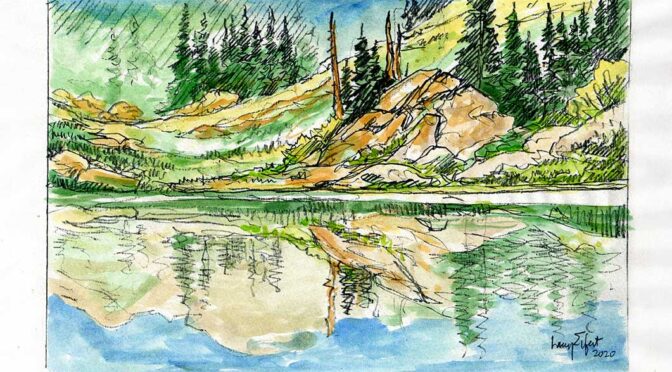
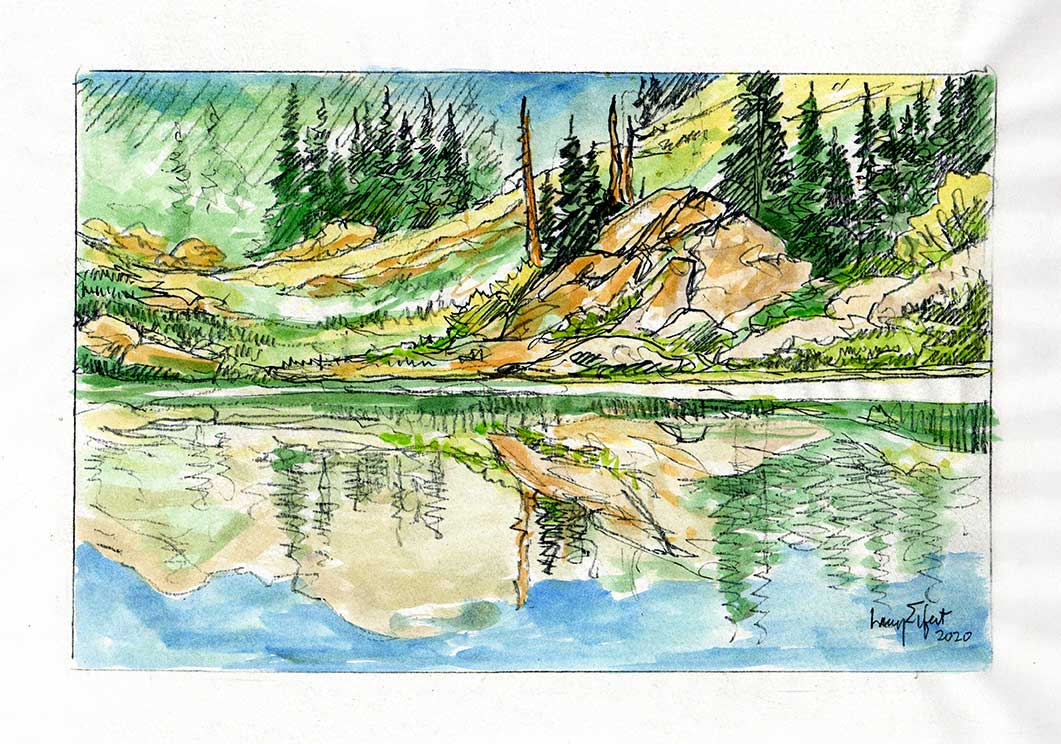
At this campsite, an outcropping of boulders provided some really good reflections in the little lake, and so a painting was needed. Oh, I could have just turned the paper upside down and drawn it a second time, but that’s cheating, and not very accurate. Beside me while I drew, this Olympic chipmunk joined me. The Olympic Peninsula has several endemic mammals that live only here. This is one, and possibly my favorite. It’s small, even looks small with its short nose. This moment, with the chippy and me, my pencil and paper, are what makes my hiking complete – close connections with nature that will remain in my mind throughout the winter.
Thanks for reading this week. You can sign up for emails for these posts on my website at larryeifert.com.