Category Archives: Nature Art

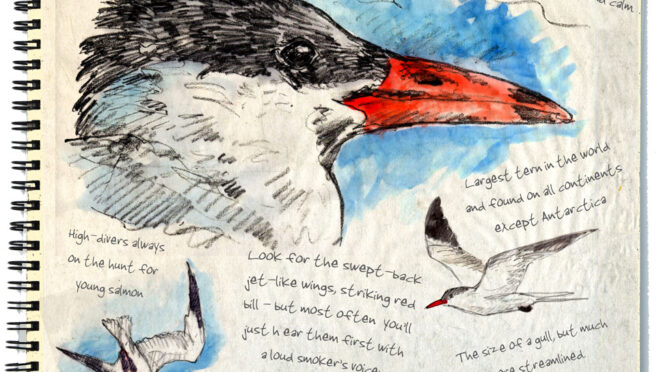
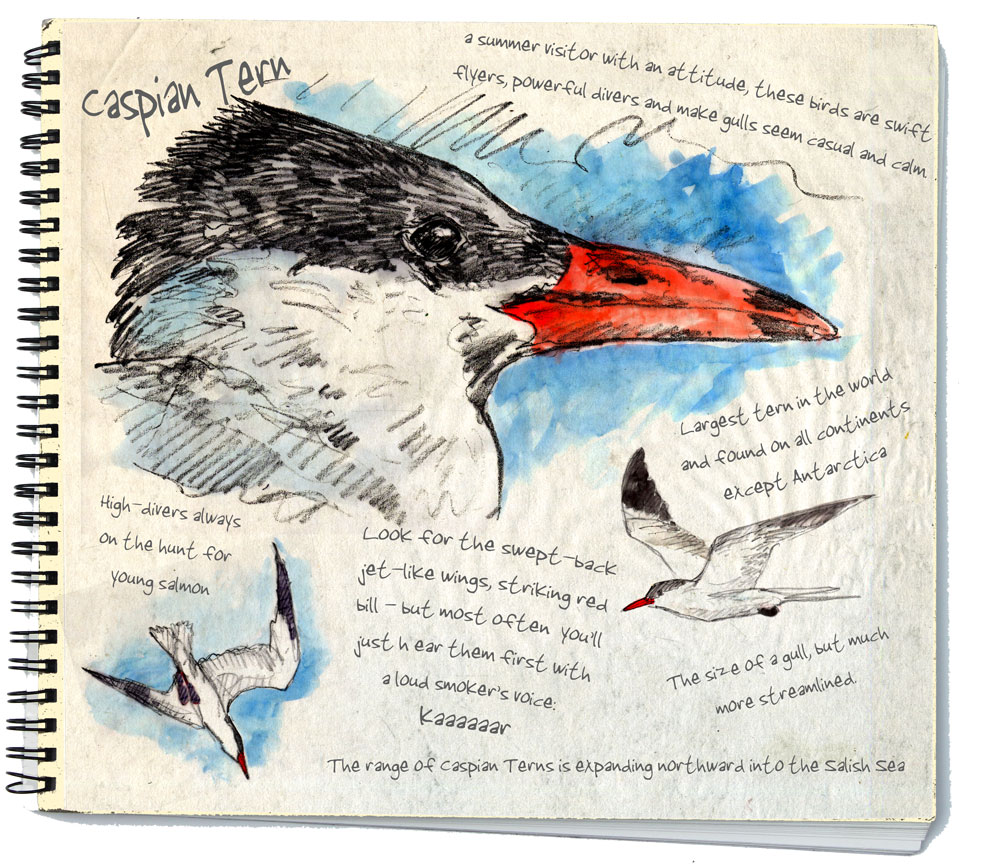
Caspian Tern – My 48-North Story for August 2015

This month’s sketchbook and published story in 48 North magazine is about Caspian Terns. These few summer weeks are the only times I see these birds while I’m sailing about Port Townsend Bay. Actually, I almost always hear them first, then spot these big guys, and since I try to paint what I see, this was an easy choice for August.

Here’s the story:

This is a sound I hear often on quiet summer sails. Kaaaaarr – like a smoker attempting to clear a raspy throat. I instantly know that sound, and always turn and look up to find the hacker. Then, here it comes, flying fast and high, head down studying the water for a vague shape that indicates dinner. Seeing this, I know two things: it’s summer, and the Caspian Terns are back! I watch as the fast and effortless white bird glides past. Then, fish spotted, it goes into a corkscrew spiral, then into a dive and fully submerges – out the tern comes and quickly takes off with young salmon in mouth (unlike similarly sized gulls that are unable to truly dive).

Most Caspian Terns in Washington nest at the Columbia River estuary, and after family duties are over, both young and parents spread out to spend the summer fishing along the coast and into the Salish Sea. Their numbers are expanding, mainly due to dredged materials that offer new nesting islands, and since terns have a fondness for young salmon – well, you see the problem. Dredge the Columbia River estuary and suddenly you get more birds, the birds eat the salmon, we’re spending millions trying to save salmon. Some Caspian Terns in Washington are medium-distance migrants, wintering on the coast of California, while others travel greater distances, wintering as far south as Colombia and Venezuela. But between now and October when these elegant birds head south, I’ll enjoy them here very much indeed.

Larry Eifert paints and writes about wild places. His work is in many national parks across America – and at larryeifert.com.

Direct link to the article

Larry

Thanks for reading this week. Send this to someone who might appreciate what I’m painting and tell them to sign up. An email will work.
Larry Eifert

Here’s the blog on the web. And here’s my Facebook fan page. I post lots of other stuff there.

Click here to go to our main website – with jigsaw puzzles, prints, interpretive portfolios and lots of other stuff.

Nancy’s web portfolio of beautiful photographs

And Click here to go to Virginia Eifert’s website. Her books are now becoming available as Amazon Kindle books.
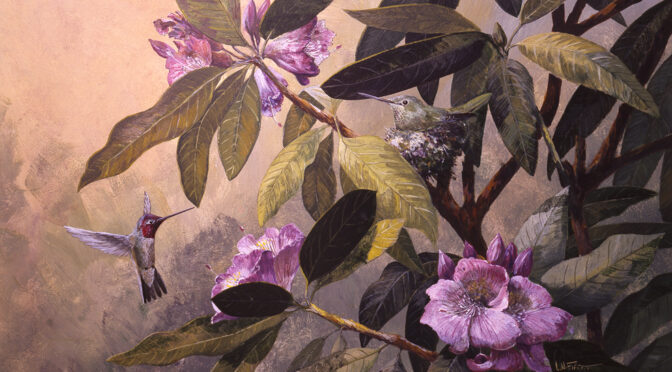
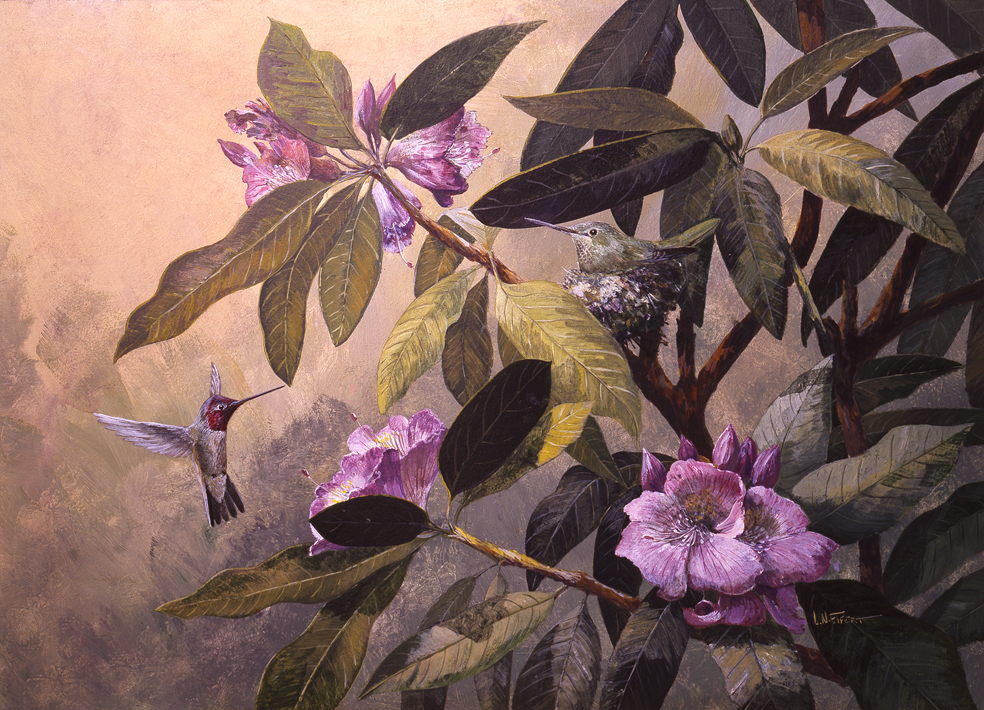
Anna’s Hummingbirds and the December Deep Freeze

This is an older painting of mine, and the rhododendrons certainly in bloom, but I felt compelled to write about this week’s freeze and the little birds in our meadow.

From coast to coast, I know we’ve all had amazing weather this past week. The southern storms drove a giant blast of Canadian air down and west over the Cascades, and here we’ve had record lows for a week. Temps haven’t gotten out of the twenties, with nights down into the lower teens, weather we just don’t ever get in Puget Sound. None of us have clothes for this stuff. And while we’ve all been suffering, that can’t be anything compared to what our two wintering-over Anna’s hummingbirds must be experiencing. For all my decades around the Northwest, I’ve never seen hummers here in winter, but last year we had one stay all season, and we’ve heard we’re not alone with this. We put out a feeder when we spotted him, but it wasn’t because of the sugar water that he was here, because we put it out AFTER we spotted him. This year we have an adult and a juvie, and we were ready with a feeder (and a 150w flood lamp on it 24 hours a day after the freeze hit). So far it’s working.

I wrote about hummers a few years ago, and learned that they have ways to cope with this cold stuff. They have normal body temps of about 105-108F, with a sitting heart rate of about 250 beats per minute. However, at night they sleep normally, or, they can go into a turbid state where they actually drop their body temp to between 30 and 65 degrees (depending on need), and drop their metabolic rate to one-fifteenth of normal. In this way, they can maybe make it through a very long night of 15 degrees.

Before nightfall, they make one extra smart move. They find and remember where breakfast is going to be. Then, in the morning it takes upwards of an hour to fully wake up before flying. This requires a huge energy drain on this thumb-sized bird, and if that feeder is frozen when it gets to it, the bird is in big trouble (like a car on empty that gets to the gas station and the pumps are locked).

Temperatures are warming up now, but we’ve felt a great privilege to keep tabs on these two intrepid birds this week. Snow and hummingbirds just don’t go together, but if this is a sign of Climate Change, I’m happy with it.

Thanks for reading this week.
Larry Eifert

Click here to go to our main website – packed with jigsaw puzzles, prints and other stuff. We’re still shipping Christmas puzzles.

Click here to check out what Nancy’s currently doing with her photography.

Or, send us an email to opt in or out of our emailings – or just ‘talk’ with us.

Comments are good. Every little bit helps me understand how to be a better painter.