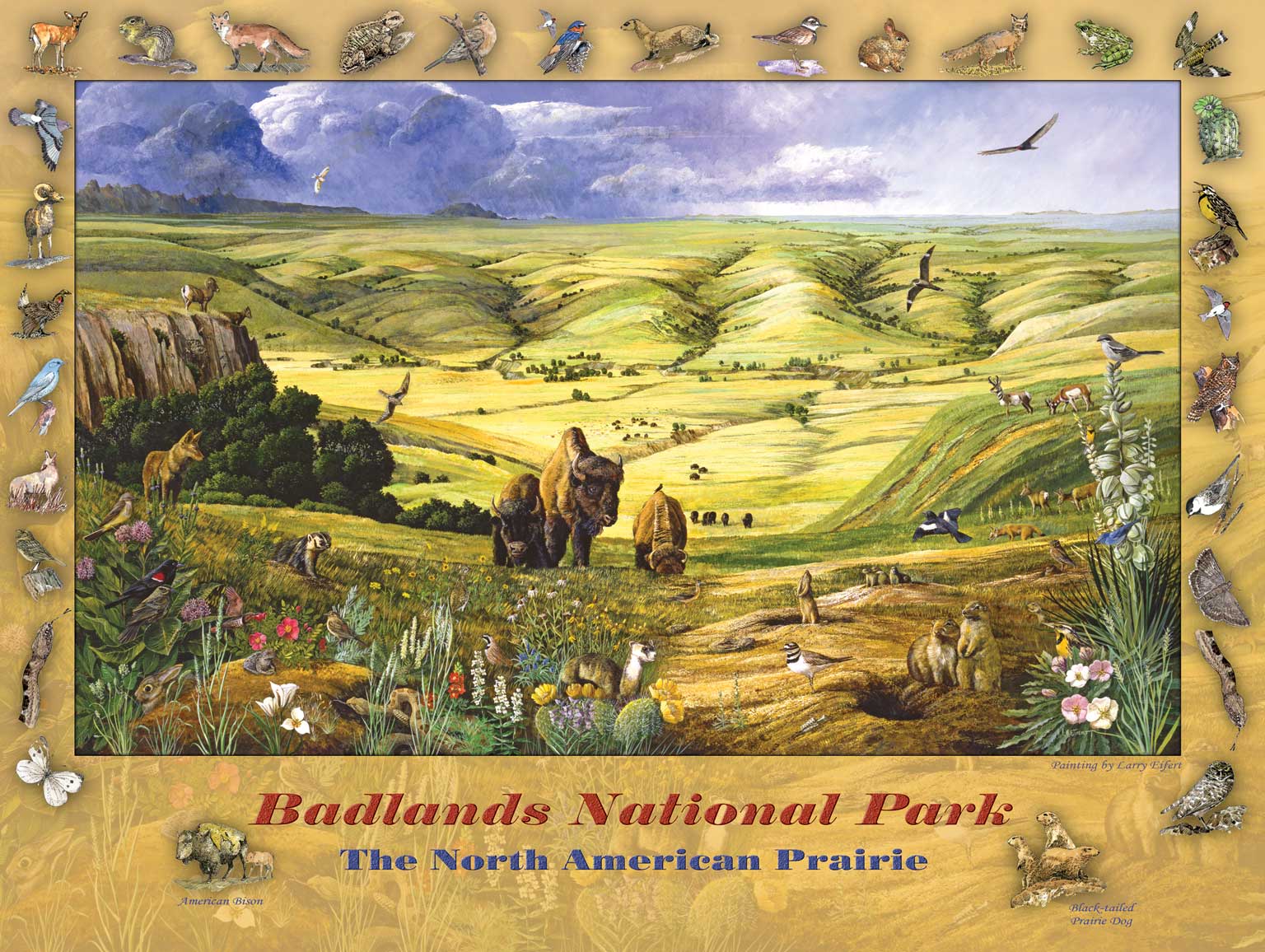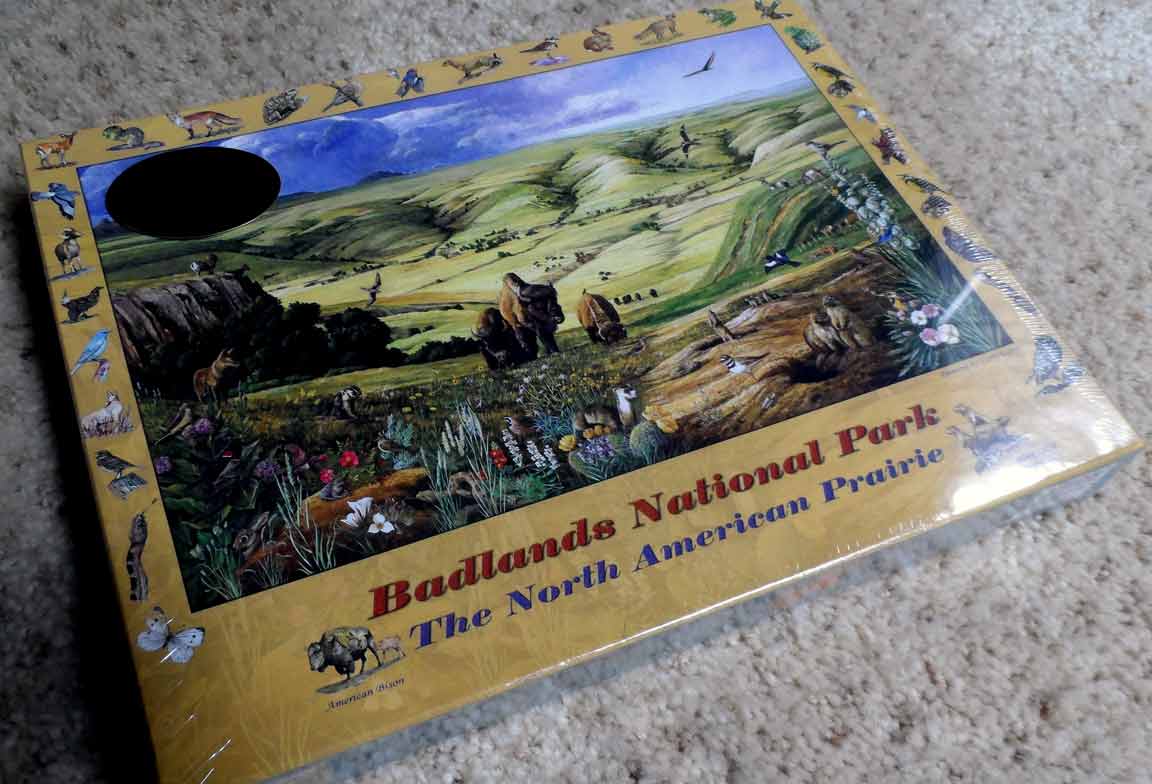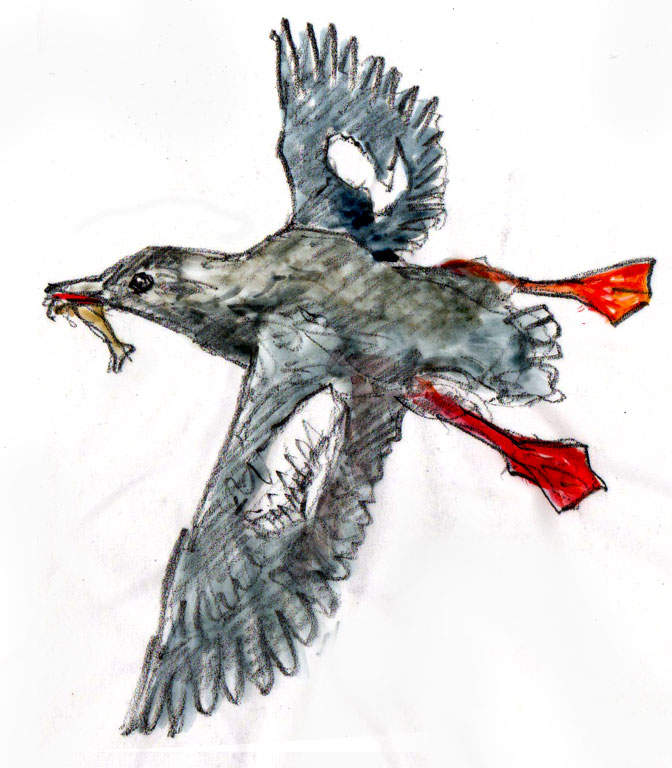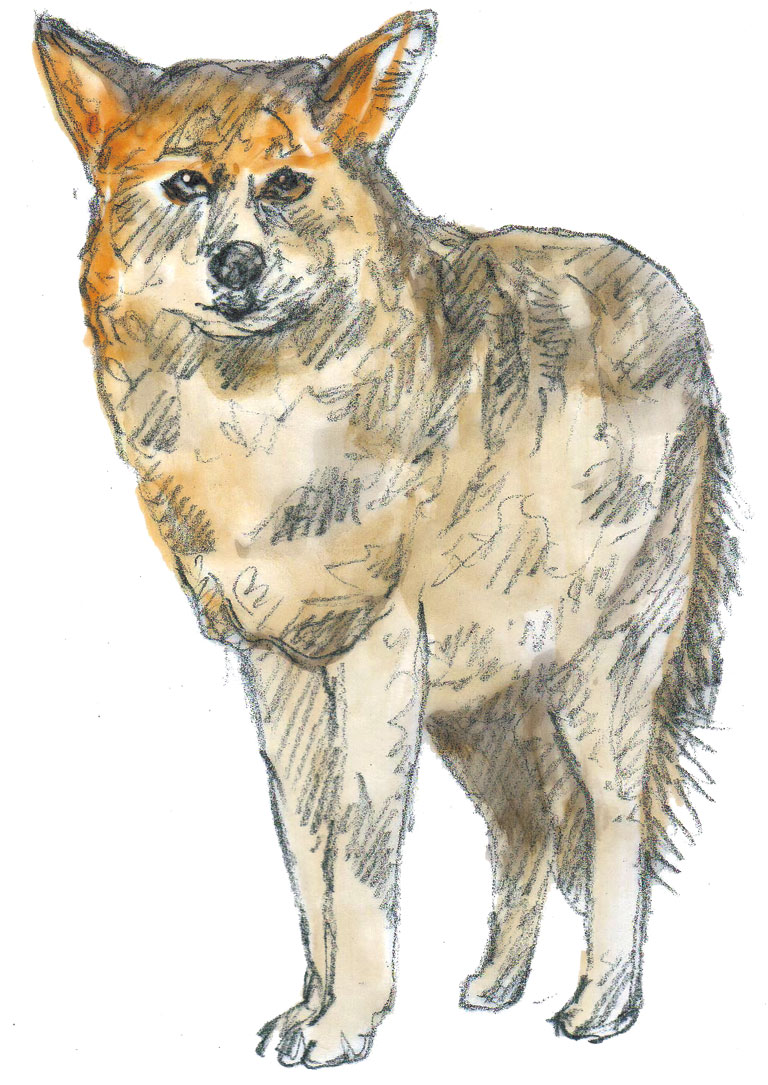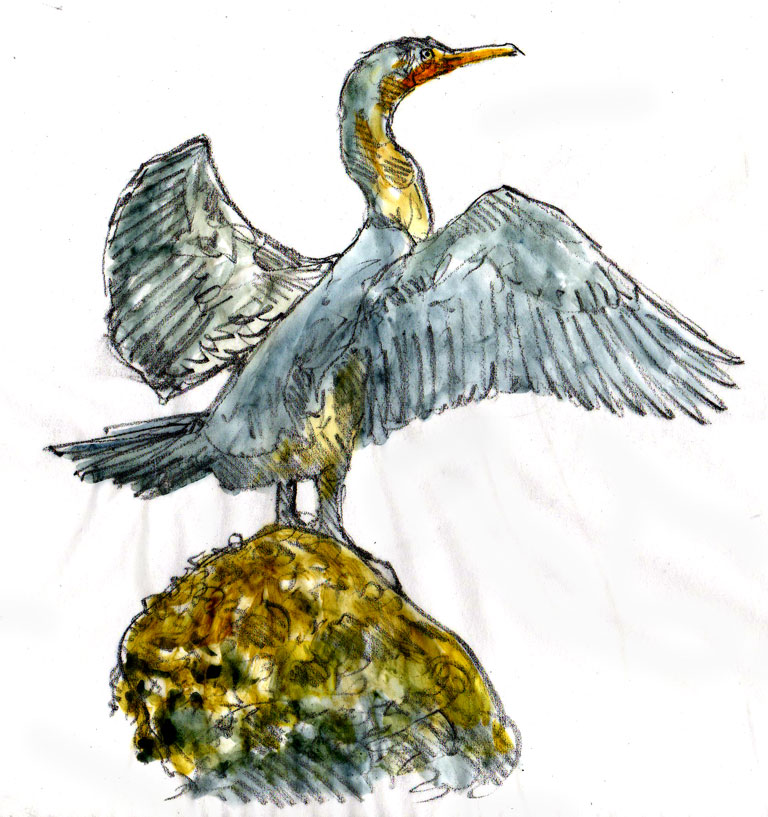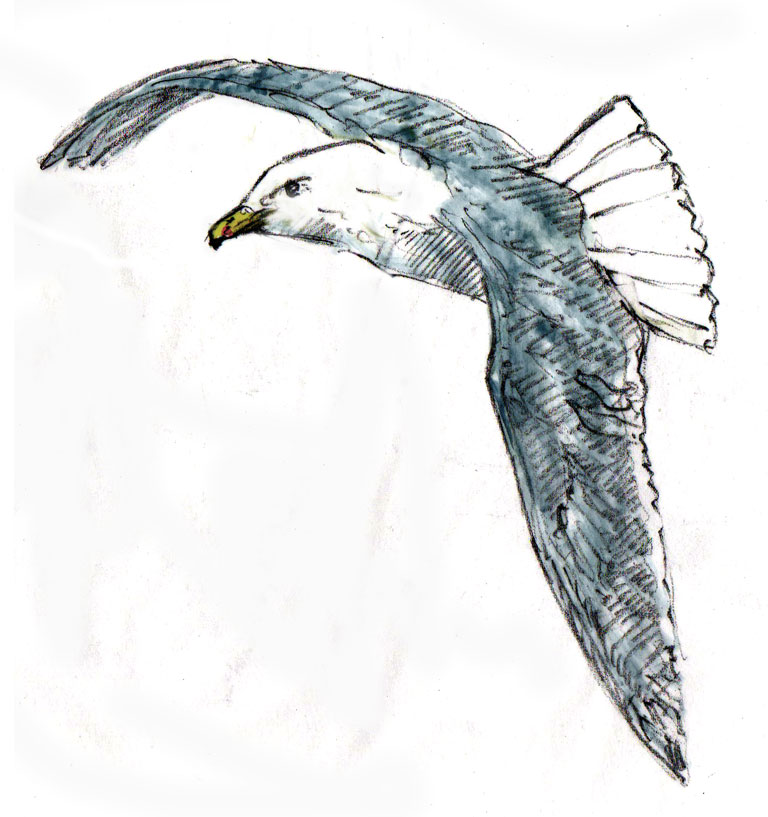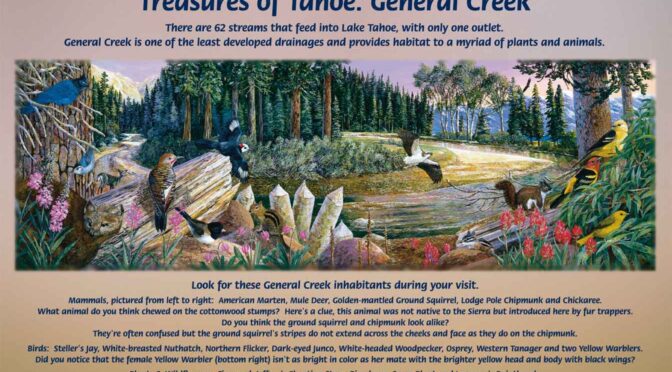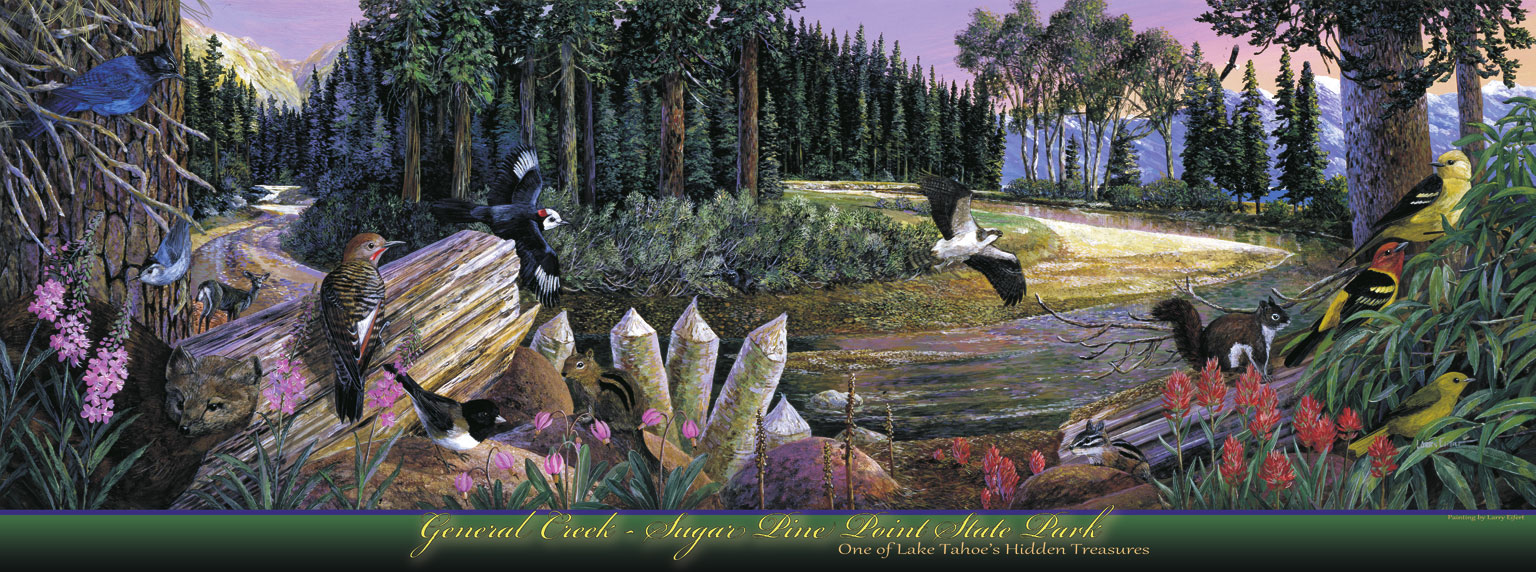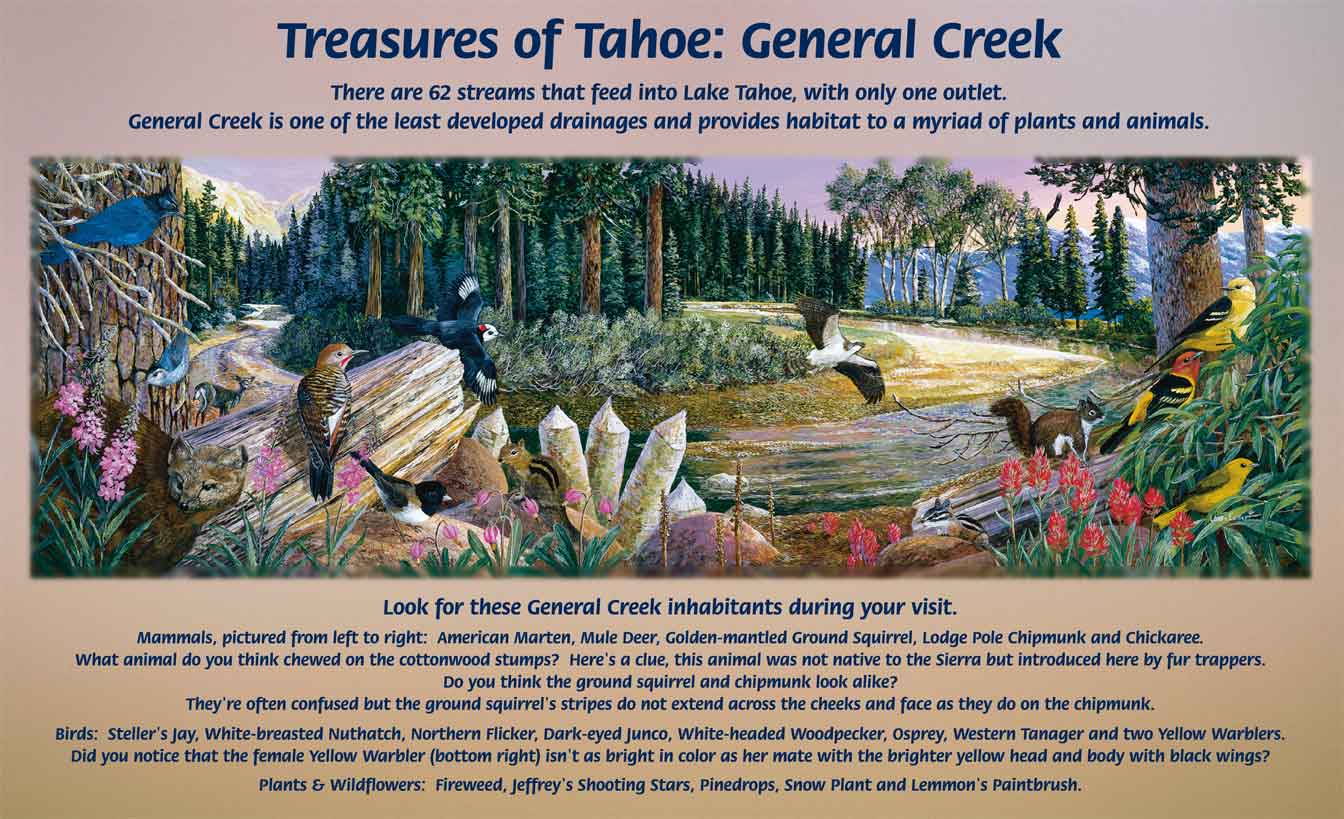
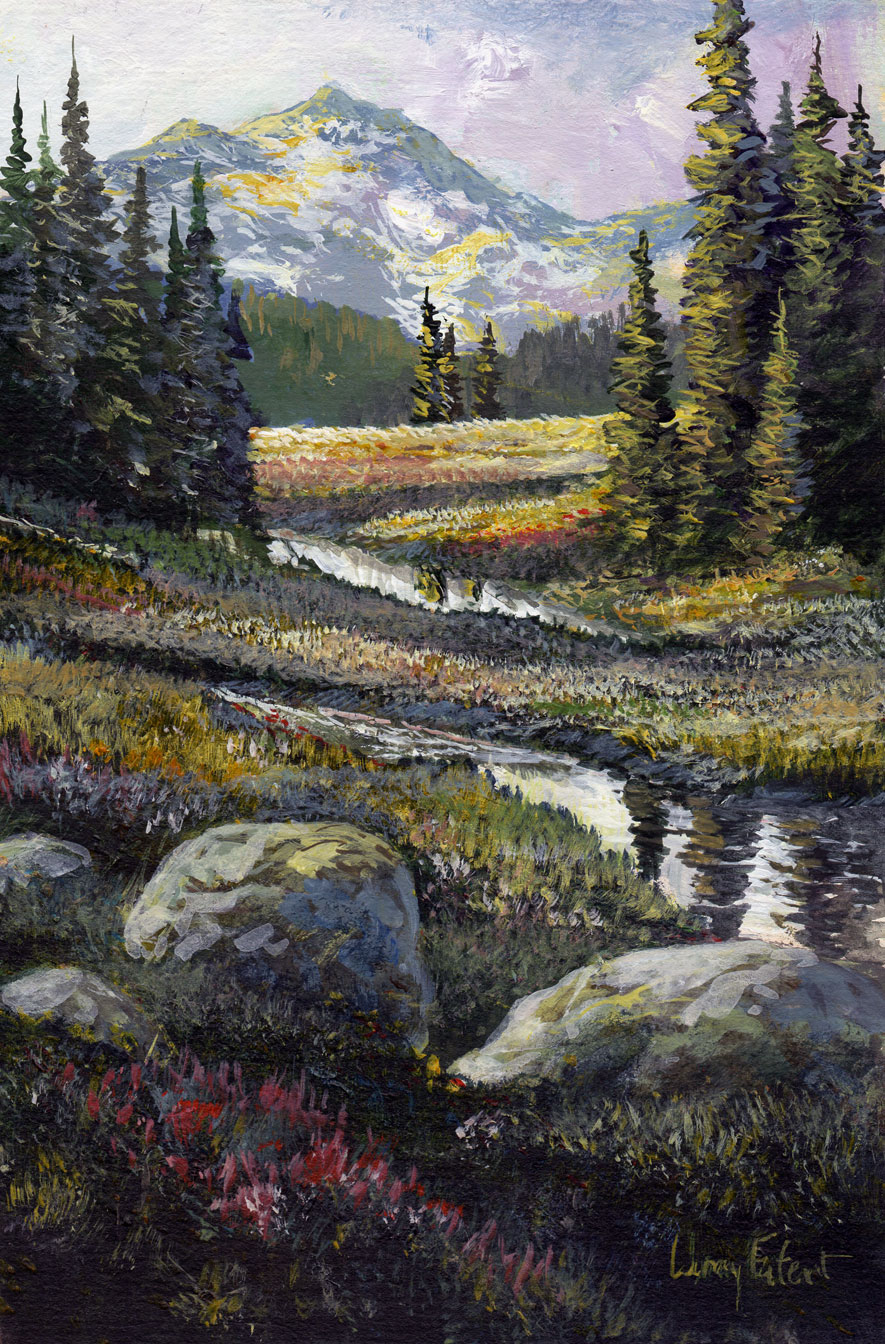
Yesterday we received a shipment of new puzzles for spring. This is the first 1000-piece puzzle we’ve produced in years, and it’s fun for us to see the bigger image, bigger box, bigger everything. Finished size is 20″x 28″, it has an interlocking border, and it includes a reference poster inside. You can order it here.
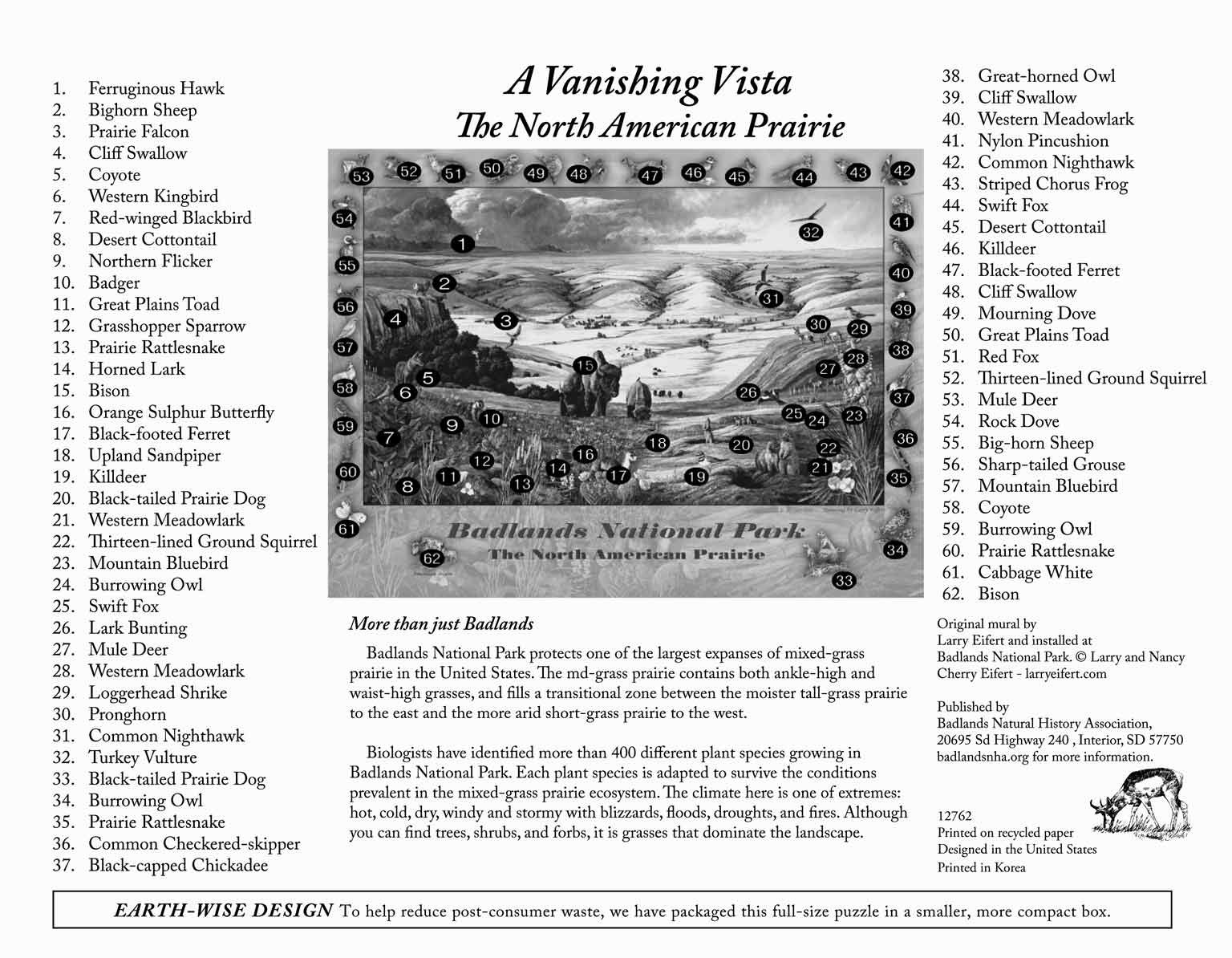
The box back, with lots of great info and species key.
We’ve also included a free poster with reference key and a bunch of information about the whitebark pines at Crater Lake that are in serious trouble due to Climate Change, an introduced pathogen and the ravages of bark beetles. It’s our way to cram some great interpretation and nature into one product – and it should also be a fun one to put together. Below is the poster that comes with it.
Thousands upon thousands of the original poster “Events in the Life of a Coast Redwood” have gone out the door over the past twenty years. Originally commissioned as a museum exhibit for Redwood National and State Parks, the painting lives it’s life in Prairie Creek, just the best redwood forest I’ve ever known. There’s a lot of art and photography here in our studio, and many of these past images go out of print, out of our lives – but we felt this one deserved a continued present, so this week I redesigned it to look more like an old botanical poster someone might have created 200 years ago when redwoods hadn’t even been discovered by Europeans yet. You’ll see this in a month or so after the printer does his job.
The story of how this originally came to be is somewhat fun – at least for me. In the 1990’s I was living in Ferndale, Cal just north of one of the biggest redwood parks. I always tried to be a thorn in the side of a local timber-killing company, always looking for ways to counteract their lying press releases ranting on about how wonderful they were in eliminating the world’s tallest trees – our heritage being made into hot tubs. (My real thorn was the fact I had hired the wife of the CEO to work for me in my gallery, and he thought we were having an affair – used to sneak around in the alley watching her.) Anyway, that company put out a poster much like this – tree in the center, but instead of nature they showed little images of subjects like Joan of Arc, Hitler, the atom bomb, Christ on the cross – stuff completely unrelated to redwoods.
So, I was dared to challenge it with a poster of my own – and got Redwood National Park to pay for it, and off we went. My poster was meant to show the rich diversity in redwood forests, something the redwood choppers denied (we need to get rid of those old, stagnant forests), and put them in a context with humanity as well as ecological history (something they also denied the existence of). Fast forward: the company crashed, people are now out of work, I get mail thanking me for standing up for something few believed in at the time. Ah, it’s all in a day’s work for the naturalist-artist!
I’ll let you know when this is available in most large redwood parks – from Redwood National to Muir Woods – and on our website.
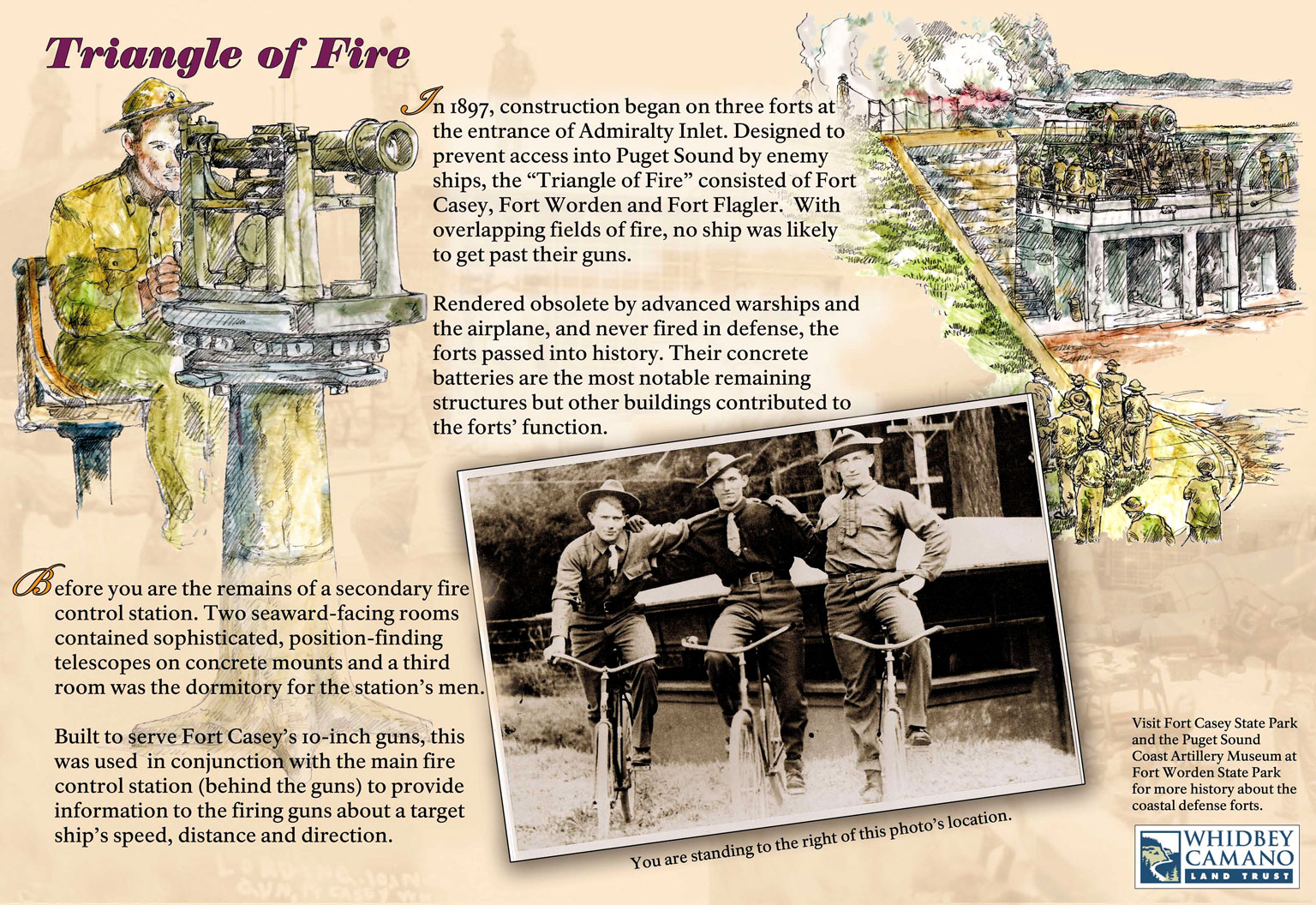
A new painting for the Whidbey Camano Land Trust project at the Admiralty Inlet Natural Area Preserve. In case you missed the last several posts of this, here’s the last painting before this. I think I’m about 75% to completion on this new one. It speaks to the windy extreme weather on the bluff tops of Whidbey Island, Washington, how that weather shapes these 350-year-old trees, how the forest changes farther inland, how, one gnarly branch at a time, it’s slowly grown here over centuries. A rare forest indeed.
Great changes occurred in this design, logs moved, an entire underground section vanished – it was evolution right before my eyes.
You can see some of the design changes in the lower right of this third photo. Compare this with the newest photo at the top.
Dark shapes help me focus on overall design. I sometimes stand back 25 feet to look at these 4′ paintings.
And here it is initially laid out, sky and ground, warm and cool. A free and fanciful non-objective painting just waiting to be hung in an art gallery somewhere. But these paintings don’t exist anymore. After I photographed it at each stage, it’s as if I’m then throwing away the image – because soon after it’s gone for ever under the progression to the next stage.
And here’s the original sketch showing the underground sections that are now gone from the painting.
By next week, I’ll have this finished up for a show-and-tell. Thanks for the interest in these images of the progression of a complex painting. Fun for me to see too.
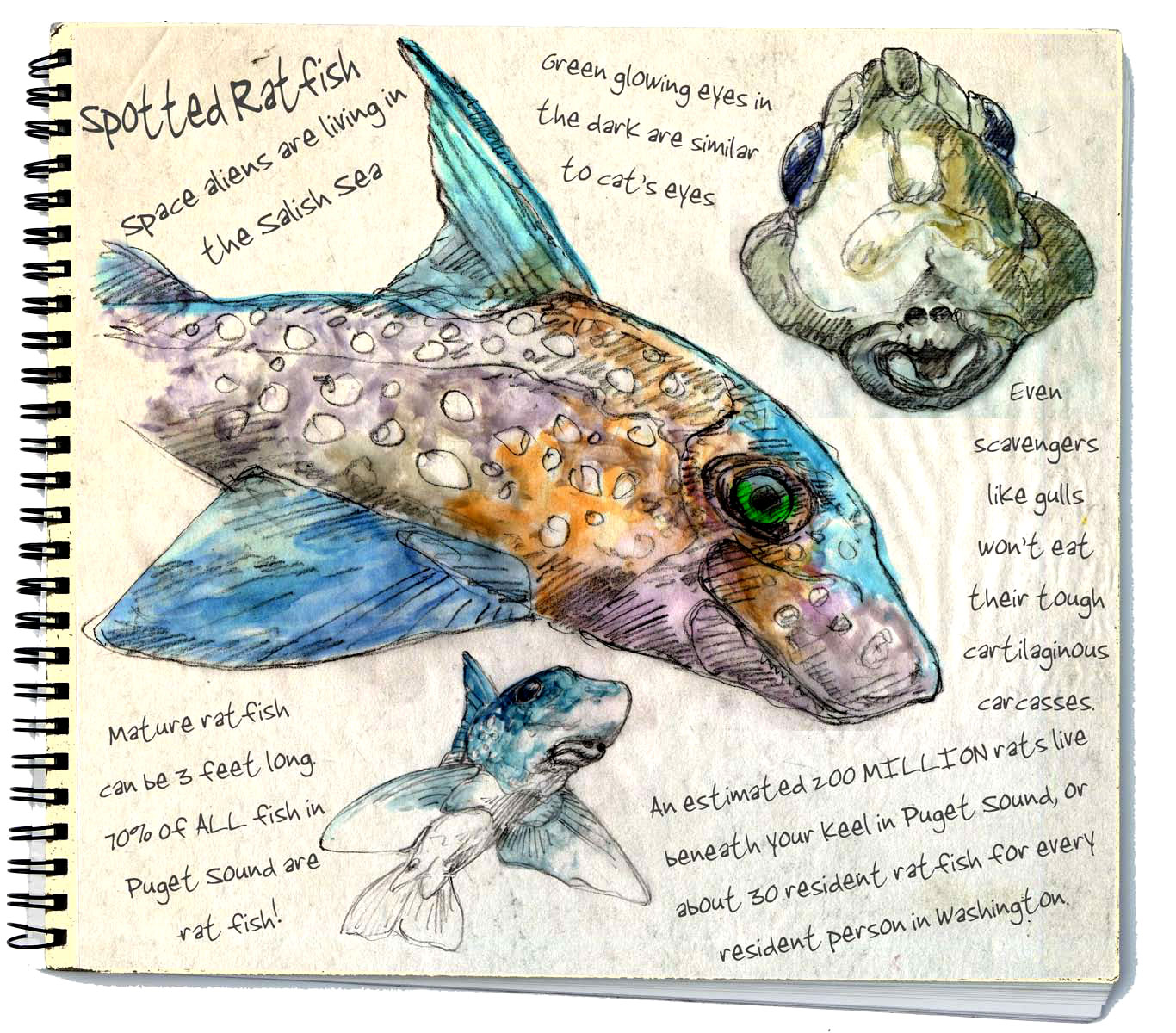
Here’s my article in 48 North magazine for April, 2014. I almost forgot to toss this into my blog until I received my copy in the mail a few days ago. You can see this on page 48 on their website. This sketchbook was all about diving and dabbling ducks, the interesting differences between them, and how each makes their living. And, it was just a chance to make sure I knew all this stuff without looking it up.
I’ve discovered that the best pages I write and draw have big eyeballs. What, you say? The tube worm story didn’t have huge ratings? Well, it’s just that we humans are drawn to those with big eyes – like Nancy and our deer herd here in the meadow that keep looking in the windows, eyeball to eyeball with the big-eyed house cat that we won’t let outside. Big moon last night and there was a coyote-chorus right below our windows. The local bobcat has come gaping in my studio window before, looking right at me as if to say: where’s the cat?
But here’s the thing. The neighborhood is littered with ‘missing fluffy signs written by names the likes of Tiffany and Heather, neighbors who let their cats roam free to murder wild birds that have a hard enough time of life as it is. Hey, I look at it as nature attempting to maintain a healthy situation. House cats kill over a BILLION wild birds each year and the predators take care of a few of the cats. It’s obvious to me that cat-owners who allow their pets outside are people who (lazily or egotistically?) could care less about nature. They’re targets of my unending quest to open their eyes, one eyeball-painting at a time.
This is the second painting for the Whidbey Camano Land Trust project at the Admiralty Inlet Natural Area Preserve just a few miles north of Port Townsend. Missed the first painting? Click here. This time it’s less about the critters and more about showing this rare and diverse forest, a remnant lowland bit of old-growth hugging a bluff-top. This place gets the full unfettered west wind coming right down the Straits, so the trees on the edge are wildly “flagged” from centuries of being blasted by the Westerlies. Eagles and hawks patrol this bluff edge, riding these updrafts that also increase the wind’s velocity. Weeesheeeh, can you hear it? Then there’s the trail snaking along, a left-over from when this was part of Fort Casey where they watched and waited for an enemy that never showed up. Farther inland, the trees are huge and less flagged, but still very gnarly. In fact, they have some of the gnarliest branches I’ve seen around Puget Sound. They’re trees you’d expect on the western beaches at Kalaloch or La Push instead of here, 100 miles to the east. Trees and wind, trees and wind. It’s a fun painting for me so far.
And here’s my progress so far. An old friend wrote last week to say he thought when my larger paintings reach this stage, it was about as good as it gets – free and dramatic, non-objective nirvana. I completely agree. It’s not that the finished paintings are less good, just a different good. I could end it here, show it in some gallery for a month and maybe it’d be hung in some rich-guys house. But if I continue to paint it, thousands upon thousands will see it for decades to come – so I paint on.
Here’s some structure appearing – blocking out trees and distant horizon, the Olympic Peninsula in the distance.
And now the trail is defined, some parts are refined a bit so I can judge how it’s going to come together. Background horizon is finished enough that I can understand how much atmosphere there might be to make it appear distant. Painters out there: see how light that is! Just saying. Stay tuned, because given some time, by next week this should be well along – oh, but then there’s the magazine page I have to write, a new puzzle that needs proofing, a web site to build for Crater Lake Institute – and a spring to enjoy.
Click the image and it will enlarge in your browser.
Feeling pretty good about this painting, and that’s saying something for me (who’s usually a real curmudgeon about my own stuff). With several more paintings right behind this one, I didn’t hesitate to finish it up this week. Some details need to be refined, a couple of minor changes I can already see, but we’re close – very close.
This is all about wildlife in the forest, so I designed it to show the actual trail meandering down and around the viewer. It’s as if YOU were back in the woods with all the critters, watching hikers come and go, come and go. The coyote shares the trail with people as I often see them doing (they can cover a lot of ground that way), a Douglas squirrel shucks a Douglas-fir cone, a chickadee lands on an old uprooted snag. I enjoy piecing this together, one critter at a time, and hopefully in the end it all makes sense. The critters should all be sized relative to each other, spaced in such ways that might really be true. I still need to alter the rose color, fix the shine on the squirrel, a couple of other things – and, well, what do you know, just this moment I realized I forgot the deer mouse in the old stump. Back to the easel! Next time you see this painting, look for it.
And here’s the sketch again, finished just 13 days ago. I’m telling you, I’m on fire! Can you see the deer mouse?
I often get emails about blogging progress reports of these larger paintings. Someday I’ll set my camera up and do a little film of it, start to finish. This painting has some degree of pressure with the calendar, in other words, no time to mess around. So here’s a little progress report in a couple of photos.
Click the images to enlarge them in your browser.
Top image is how it’s looking this morning. Many things get in the way of painting the hours I need to put in, like new spring printed projects, puzzle redesigns, trying to find resource material for the other four paintings – but it’s moving along well. Last week I blogged about the sketch and an overview of the entire project here.
And here’s a couple of days ago. Background’s in place so I can begin defining the foreground’s details, critters, closeups that take the time. There have already been major changes in that area, but only I will know.
And here’s the original sketch I showed last week. Thanks, Mark and Jessica at the Whidbey Camano Land Trust for making this a very fun project. I don’t often get the chance to paint these complex murals of my backyard forest, but this project comes close.
Click the image and it will enlarge in your browser.
A new project unfolds! Rarely do I get to do a bunch of paintings of something I truly love and know already. Or do it for a local park and do it for a group as tasty as this. I’m painting some small murals, doing design and handling fabrication for trail exhibits for the Whidbey Camano Land Trust – just to the north of us. It’s actually part of the Ebey’s Landing National Historical Reserve, and, in fact, I often sail over to Whidbey Island right under the bluff where these installations will soon be installed in the Admiralty Inlet Natural Area Preserve. Here’s the location -right on the bluff-top to the left. Port Townsend is to the right just across the channel.
Photo thanks to Mark Sheehan, WCLT
Above is the first sketch, already underway as a painting. Four other paintings come as soon as possible – and that’s the catch. All five plus fabrication and installation have to be finished up and installed in three months – a daunting task for some, but not the manic me. I’m just a slave to my paintbrush! This first painting is about the forest on the ridgetop, a very rare coastal old-growth forest. Being on a bluff at the downwind end of the Straits of Juan de Fuca, this forest sees some pretty violent weather, so the bluff-top trees have grown very gnarly and wind-flagged. But, back in the quieter part, a more normal forest shelters a marvelous bunch of critters, and that’s what this painting is all about. It’s also an island that was under ice until just 8.000 years ago, so there are some wildly odd critters missing, like native rabbits, moles, bobcats and others normally found around here but not on Whidbey. No moles? Humm. This is the part of my job I dearly love, that of learning all this stuff from people who love it, like Mark, Ida and Jessica and Janelle, Whidbey Islanders who are helping me figure it out. And I, in turn, hope I’m helping them create something that will effect people for years to come.
And I just have to share this. An old friend and fellow artist, John Sturgeon, who teaches video at the University of Maryland recently contacted me, or maybe it was the other way around. There were four of us in the same year, same high school art classes that went on to life-long art careers – a rather high percentage, I think. John told me something I’ve suspected, but never heard from anyone who might know: “The general consensus is… that by five years out of art school about 10% are still practicing, and by 10 years out it drops to 5% . . . then more or less stays there. However, those that make a living from it [making art instead of teaching art] . . . less than .05%, which is astounding. You are among that small % my friend. Pretty damn cool. ” Trouble is, I never really went to art school to learn how to do this stuff.
And Click here to go to Virginia Eifert’s website. Her books are now becoming available as Amazon Kindle books. I currently have five up, with 15 more coming.
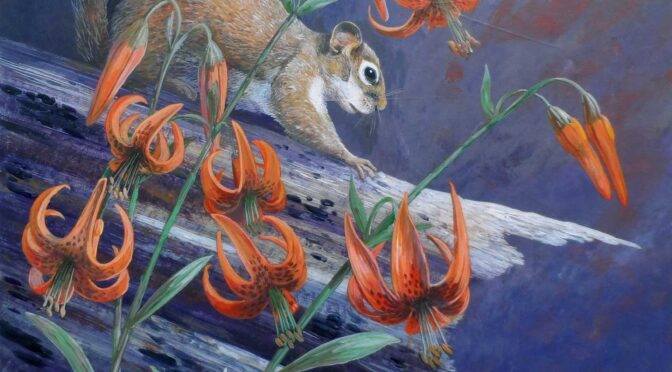
Click the image and read it bigger in your browser.
Okay, okay, I’m not normally into any sort of spectator sports. Can’t see wasting time watching someone else run around when I could be doing it myself – even if it’s far less successful. However, as with everyone else around this part of the country, we got somewhat carried away with the local team that actually won something last month, and so I did sort of an explanatory story on the team’s name. I’d like it better if they called themselves the ospreys, but you’ll have to admit the play on words with Sea – Seattle – Seahawks is pretty good. And,”Go Spreys” doesn’t have much of a magical sound to it anyway.
And, a football team allowed me to paint one of my favorite birds again – and then do a story about it. Almost worth buying a ticket next year if I wasn’t off in the mountains somewhere doing my own ‘sport’. See the story on the web at 48north.com during March, 2013. At my count, it’s my 38th article for them – almost enough for a book.
Click the image and it should enlarge in your browser window.
I recently painted another small dipper painting for a very nice client in California. What, another dipper? Yes, and then looking at my dipper reference photos I turned right around and painted this one.
I seem to be evolving into a real dipper-connoisseur. What’s not to like? This little bird lives only by the cleanest and wildest of mountain streams, walks and flies underwater and builds its nest behind waterfalls. Dippers are equipped with an extra eyelid that allows them to see underwater, and sports scales that close nostrils tight when submerged. Dippers also produce more oil than most birds, which may help keep them warmer when they’re walking around underwater. If they migrate, it’s usually just downslope to open water so they can dive into icy creeks, and given a choice of flying the long way around or over a narrow bend, dippers will always take the long way to stay directly over their beloved stream. I was reminded that another name for them is the water ouzel. My mom called them that, and was known to drive 1200 miles west of Illinois to see one.
And here’s the reference photo I worked from. You guys always say you like to see how a painting evolves, so here’s the beginning – a photo taken with my little point-and-shoot last year about 3 miles up the Tunnel Creek Trail just near the shelter. This little guy was sitting on ‘his’ rock enjoying some sun, and stayed long enough for both Nancy and I to get some very tasty shots. Did I get the values close enough?
This ORIGINAL painting is varnished acrylic on linen canvas, 11″ x 14″ and $140 unframed. A custom wood frame makes it a total of $170 and shipping adds just a bit more depending on your zone or if you take the frame. This is the original painting, NOT a print. Email us for details.
And Click here to go to Virginia Eifert’s website. Her books are now becoming available as Amazon Kindle books. She now has her own web domain name at virginiaeifert.com. What would she have thought about THAT?
with more art in America's national parks than any other artist