Category Archives: Wildlife

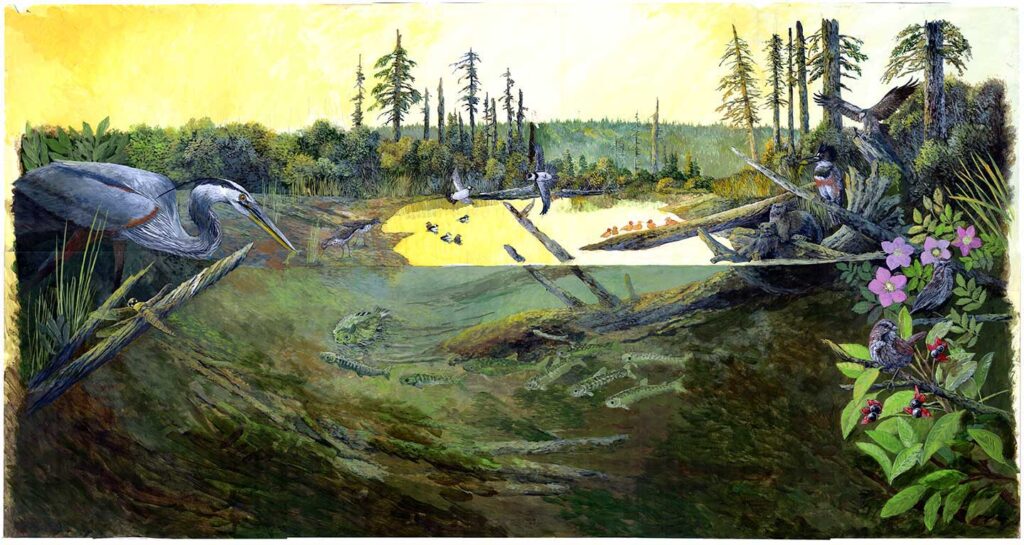
Smith Island Estuary painting

All these images should enlarge in our browser, so please click to see the details.

Making Art – Part of Salmon Restoration

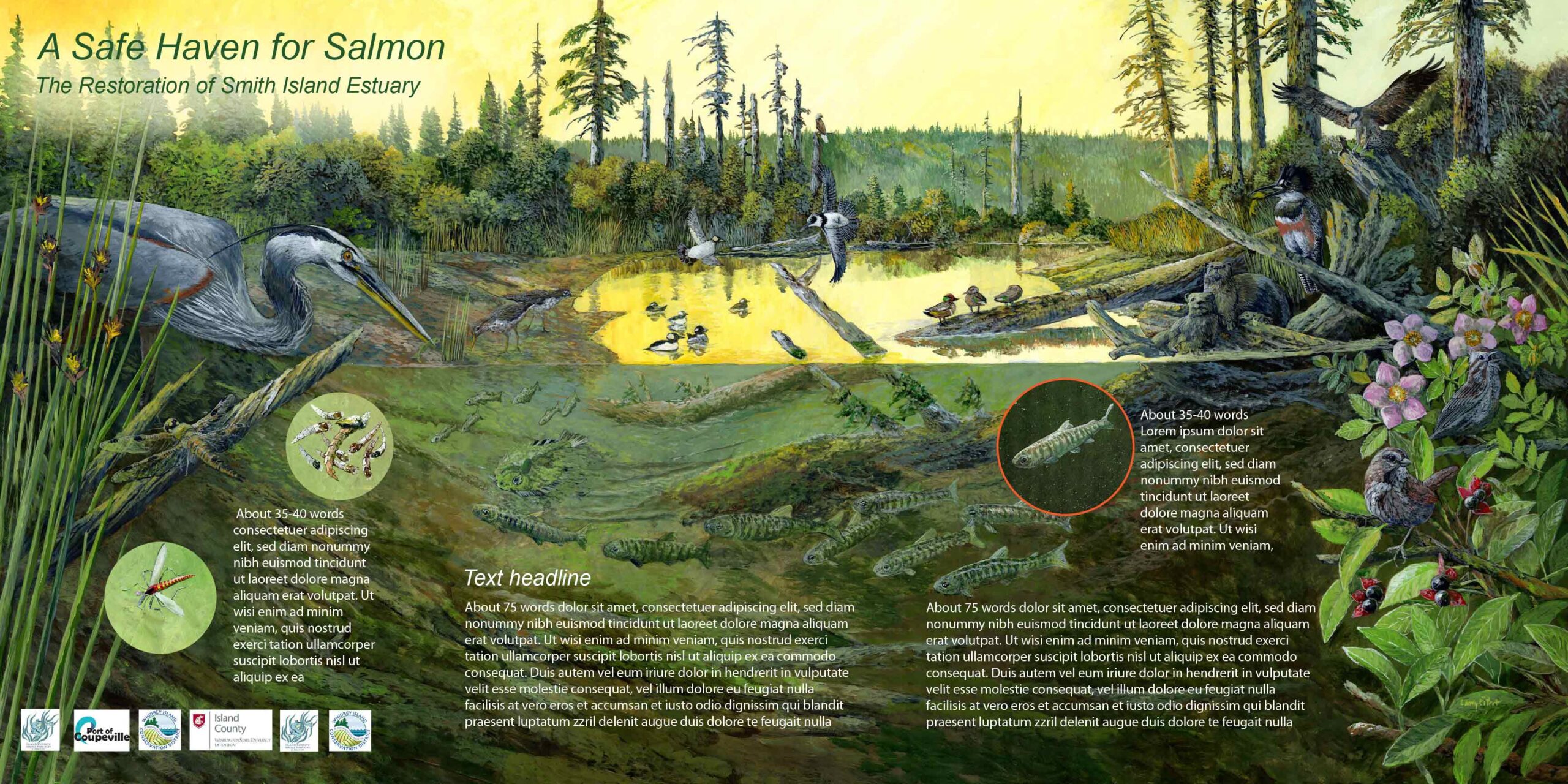
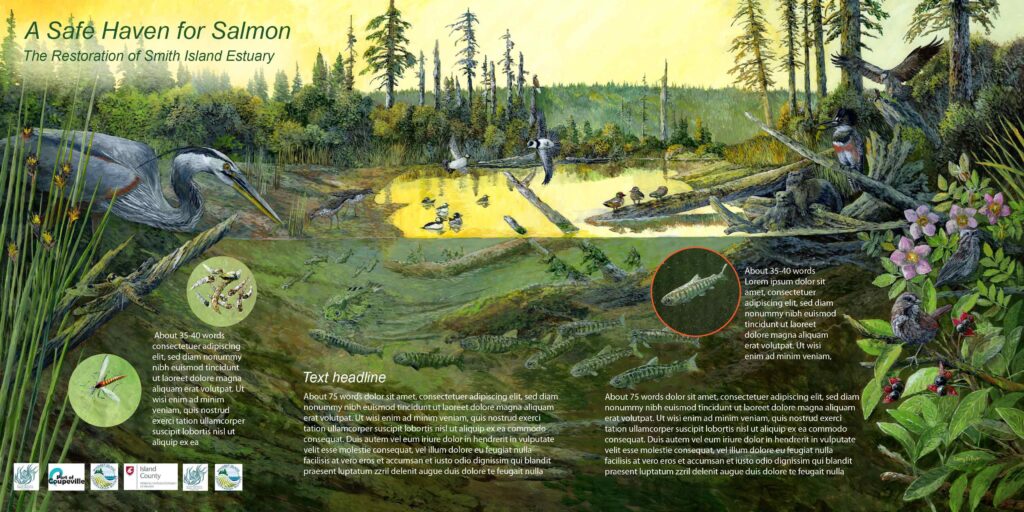
While the words are only in placeholder form, I wanted to show off this new painting. It’s going to be installed as a public wayside exhibit at the Smith Island Restoration Project on the Snohomish River Estuary, north of Seattle. This project has been going of for years, heavy equipment removing old dikes, building others and generally restoring a vast area of junk yards and farmlands to wetlands so that it becomes salmon habitat. It cost over a billion dollars and I’m proud to have been involved in a tiny way with my painting.

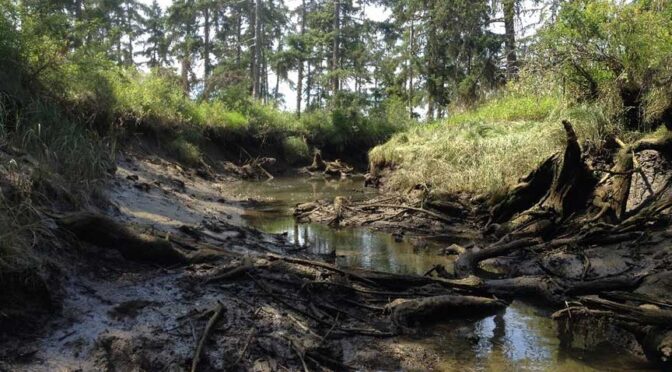
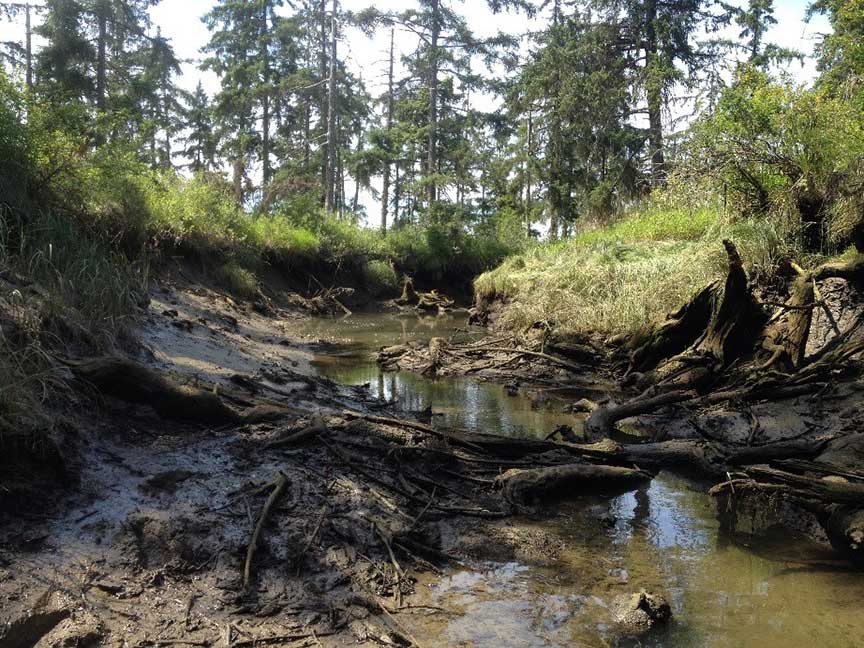
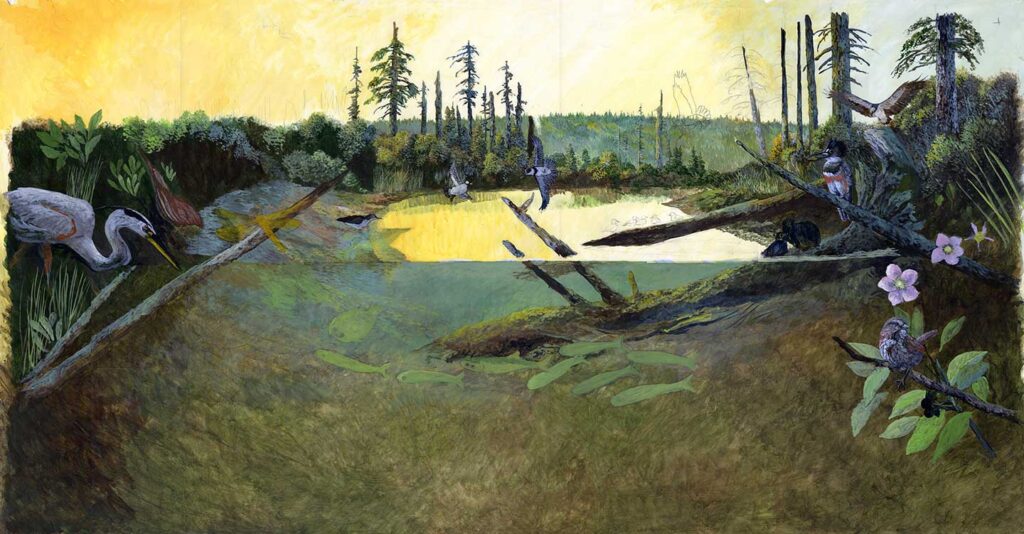
Here’s how it started on this painting. I had photo references that showed me how it looks at low tide. They gave me much latitude on my design and how it looks and feels, so I made it more of a dramatic sunset image. Below is how a corner of the place actually looks, a brackish slough, perfect for young salmon. I made some basic sketches and just started painting. I imagined a mid-tide level so I could show the fish.

Smith Island Slough

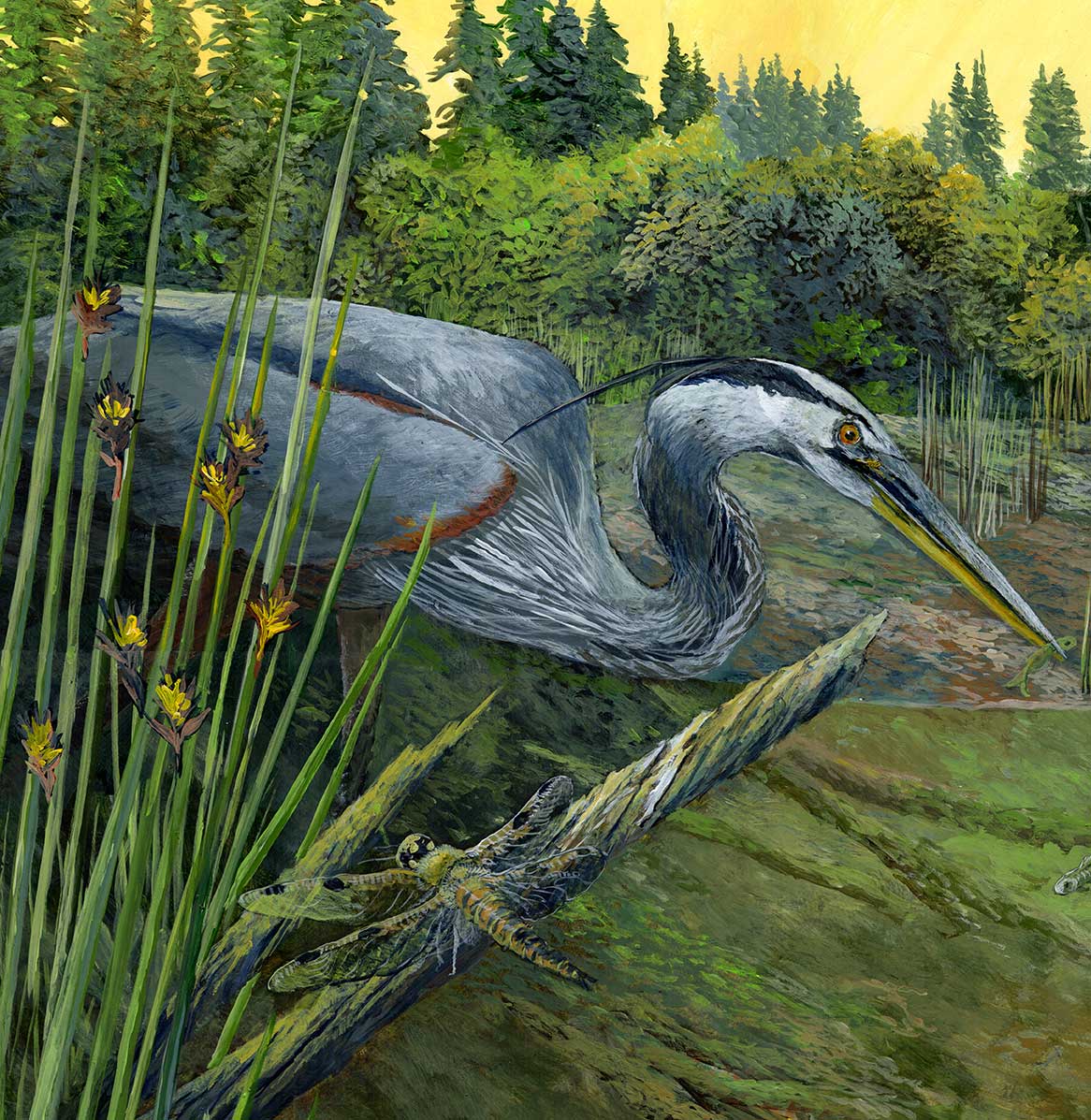
You’ll notice the great-blue heron on the left suddenly got bigger as it gained a more important place in the story.

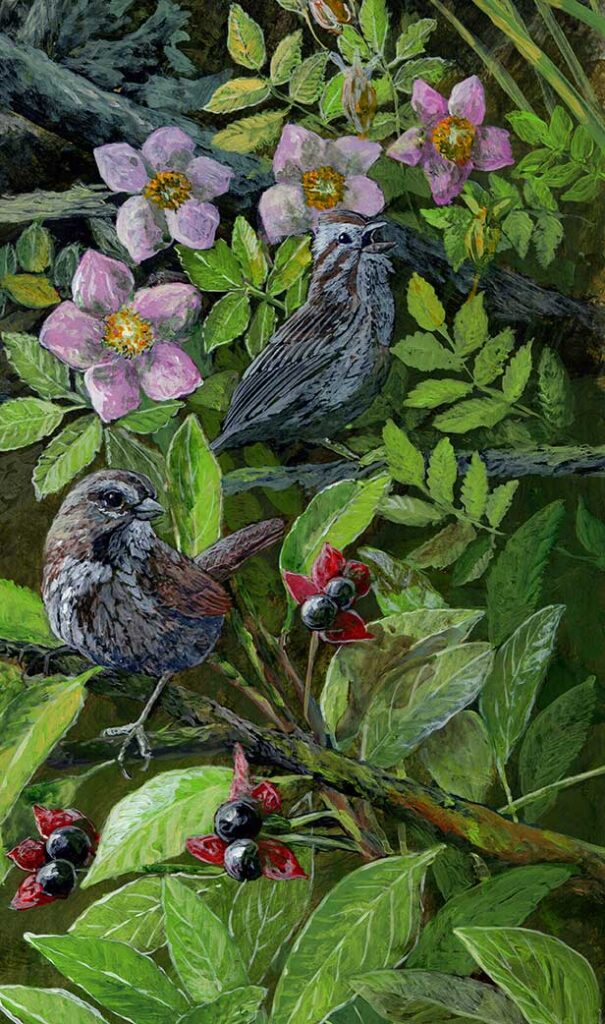
Closeup scans of the left and right sides show the level of detail.

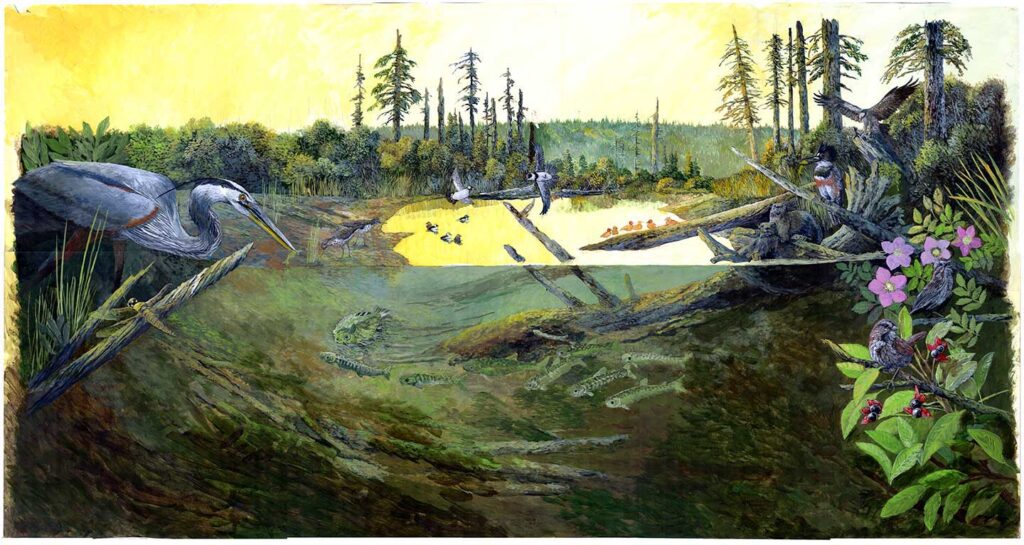
Below, I’m closing in on the final painting before I added the insets and text blocks.

The final installation will be 48″ x 24″. I pleased that people will be looking at this for decades as the place grows into itself again. A few years ago it was a landscape that’s unrecognizable now. I remember part of it was a junkyard and tire dump that caught fire awhile ago, burning for weeks. I could see the smoke miles away. The absolutely lowest level of what we can do to wreck a natural place – it’s no wonder salmon are in trouble. Now, there are salmon and herons, kingfishers and Nootka roses in bloom (or soon will be).

Thanks for this commission go to Snohomish County, WA and Gretchen Glaub who worked with me to make it happen.

Thanks for reading this week. You can sign up for emails for these posts on my website at larryeifert.com, down the right side of the home page.

Larry Eifert

Here’s my Facebook fan page. I post lots of other stuff there.

And Instagram is here.

Click here to go to our main website – with jigsaw puzzles, prints, interpretive portfolios and lots of other stuff.

Nancy’s web portfolio of stunning photography and paintings

And here to go to Virginia Eifert’s website.
Backpacking and Making Art


Making art on the trail – it’s my way of taking home some souvenirs.  The very act of making art means I have to slow down, stop forward motion and actually see nature around me. I often pass hikers so intent on the trail coming up before them they don’t even see me standing beside there, watching them and wondering if they’ll even notice me. Some don’t! I suspect it’s the same for the deer and bears they pass too. I imagine them saying “many people come here looking, but there are so few actually seeing”.

I’m an older hiker now in my mid-70’s, but I’m still passionate about continuing this odd sort of primitive act of strapping a bag on my back and walking up a mountain. I’ve done it for a very long time now, and I never feel so close to life as I do out when I’m out there. It seems important, and I want to continue to do this as long as I’m able. So, some changes had to be made a few years ago – lighter equipment, a lighter me, a healthier lifestyle, regular exercise and being more careful how I walk. I’m now much more aware of being safe, and I’m facing the fact that just one stupid stumble and it might be the last step of trail I ever do. So I’ve slowed my pace, shorten goals and buy new boots more often. This means there are some new perks, like going slow enough to inspect how nature works, see the vibrancy of nature and how it goes on in the wild without us messing with it.

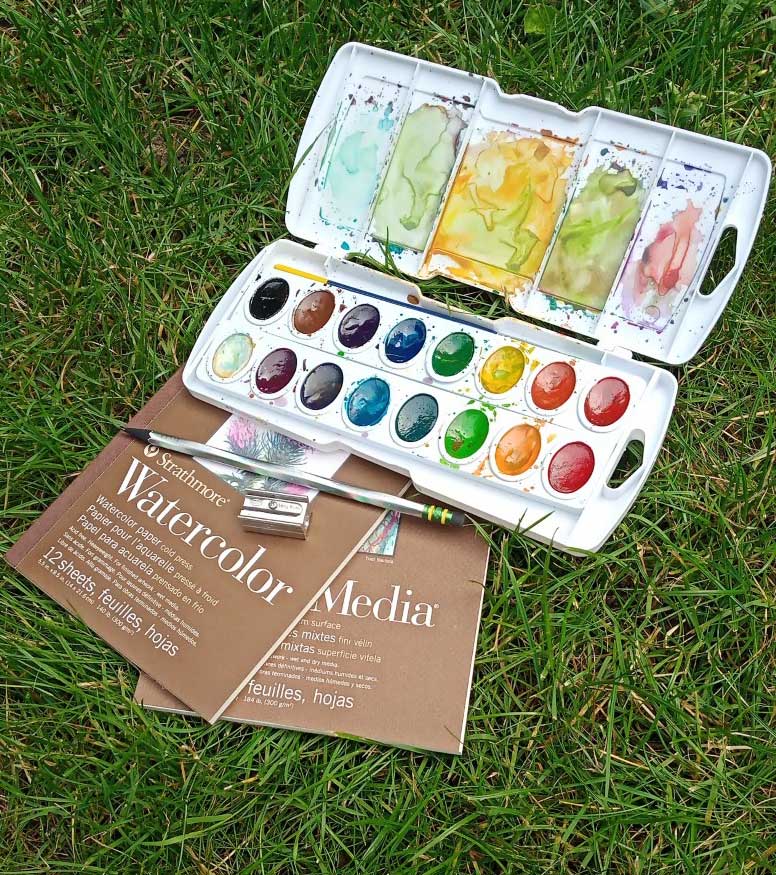
My paint kit, paints, paper, pencil and sharpener weighs in at about 12 ounces.
This is a cheap way to have fun.

Slowing down means I can make art while I’m out there, although I’ve always done this in some form – even when I was running down the trails.  There are lots of ways to do this, and I fool around with several processes. One is to draw out the sketches while on the trail, refine them at home and add color there. That way I don’t have to carry the paints and mess with water or the sun, and it takes less time. Other trips I take the entire kit of paints, pencil, paper and sharpener and a brush, sit down in a meadow in the morning or evening after hiking, and paint with it all on my lap. This way I can match the colors I see instead of translating information from memory or photos later at home – or just making it up. It’s a more authentic painting, I think, to do it all on the spot.

Equipment: I really like, am almost passionate about, Noir black wood HB#2 pencils from Ticonderoga, and I carry a tiny little pencil sharpener called a “Long Point”. This little thing keeps the pencil sharper far longer than normal sharpeners, important when I’m in the flow of seeing and drawing.

While there are far better papers, the 5.5″ x 8.5″  400 Series Strathmore Watercolor blocks ($5 for 12 sheets) are cheap, hold up well with scrubbing out goofs and provide a way to store finished paintings on the trail.  Keep the paper small and paintings go quicker.  Prang double set of watercolors ($11.50) provide a closed kit for hiking and yet opens to a nice set of paints opposite lots of mixing trays. It comes with a nice brush, big enough for wash work, small enough for details – and it stores in the pallet.

You don’t need more. For under $20, the entire painting kit weighs about 12 ounces and can be tucked into my pack, just waiting, tantalizing me, offering to make my hike a far better memory. It’s saying, “take me out, open me up”. Want proof, you’re reading this, aren’t you?

This is how I work

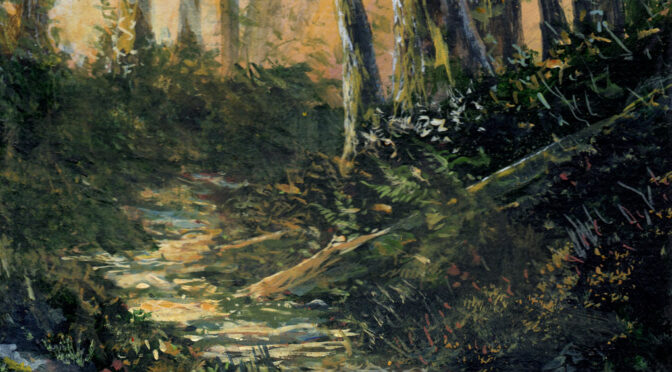
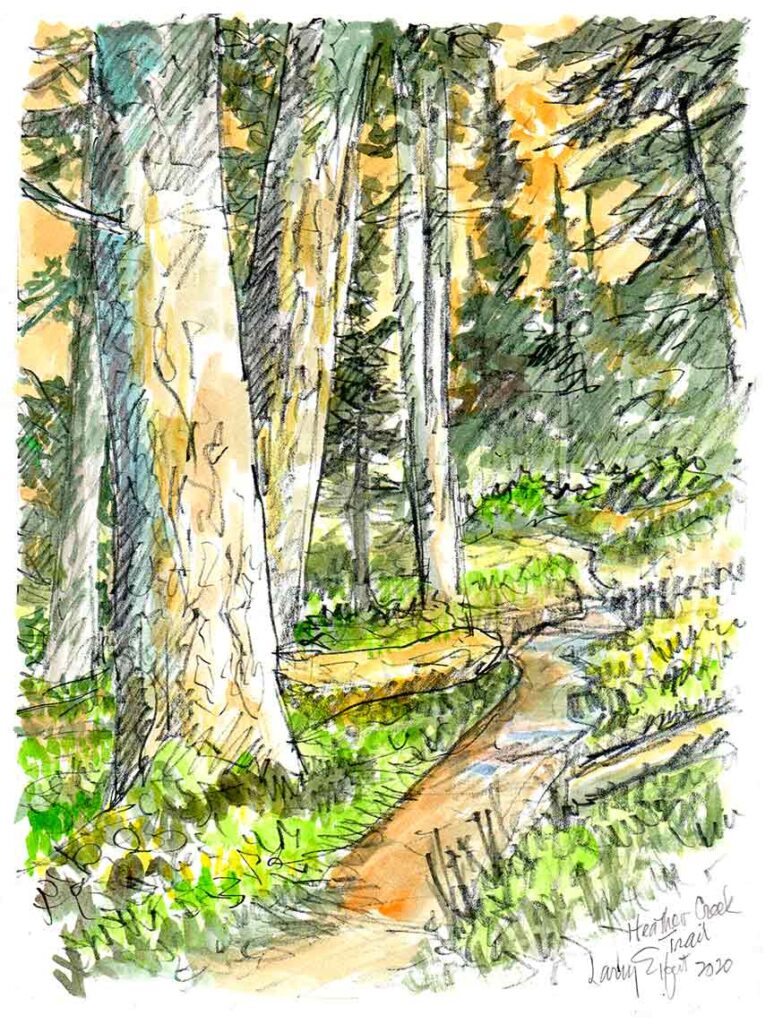
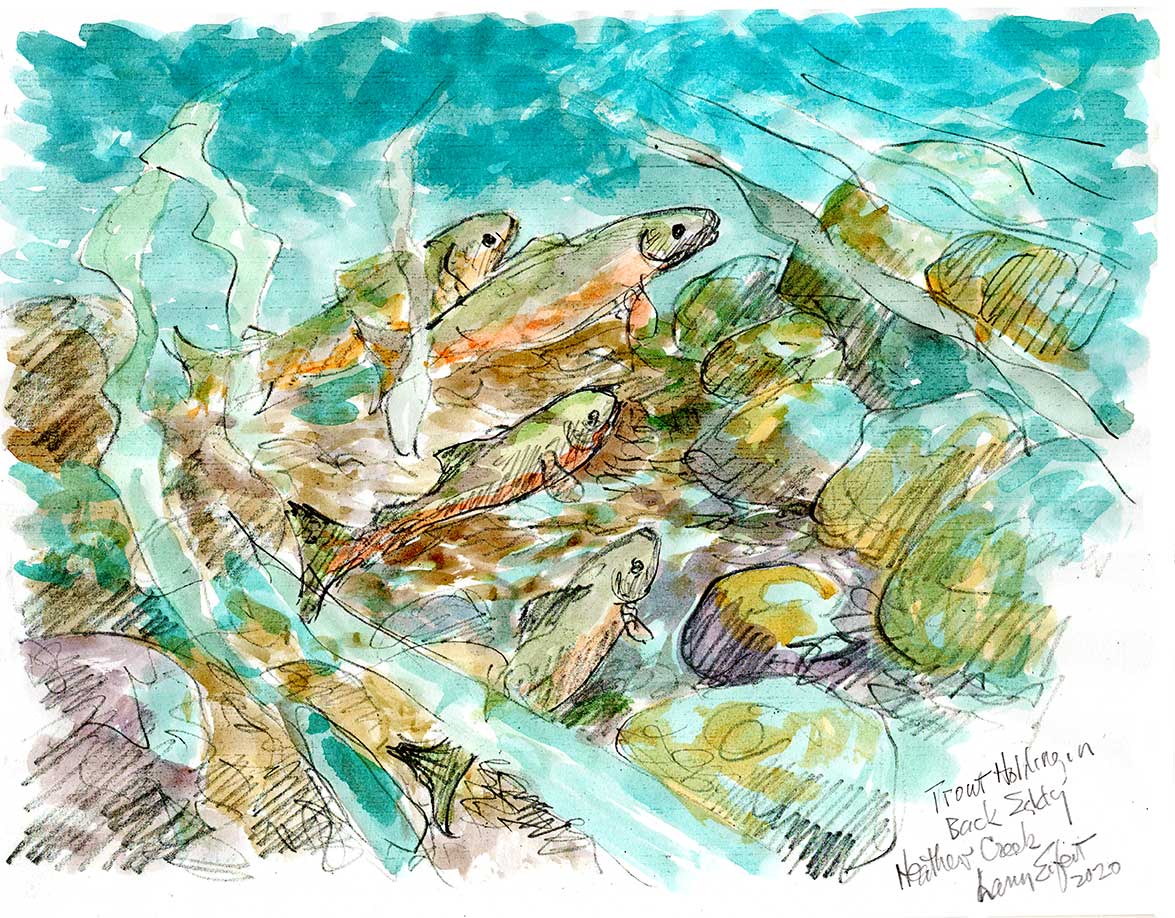
On a lunch break, I was standing beside a back eddy on Heather Creek. The stream was high and quick, running fast with a warm day’s runoff from the melting  snows upslope. Suddenly, I noticed a flash in the water, then movement, then more. Half a dozen brook trout were holding in the back eddy, facing downstream. Occasionally, a fish would break rank, dart out into the opposite-flowing current and snatch up an insect floating by.

These fish were perfectly color matched with their rocky surroundings, and the slight reddish pectoral fin was all that gave them away. That fin, just behind the eye, the one that often lays flat so it shows from above was what told me which trout species I was seeing. That slight bit of warm red was only occasionally visible, or I’d have missed seeing them altogether. So, now here’s the best part of this experience. I did this piece of art standing right in front of them, and now, as I write this, I realized those fish are most likely still there, still going about their business in that bit of stream. I may be gone from there, but this bit of nature is probably not. I have a good memory, but it will always maintained by this painting of them. This gives me great satisfaction, some small token of this trip that I can conger up later to remember what I thought was a superior moment.

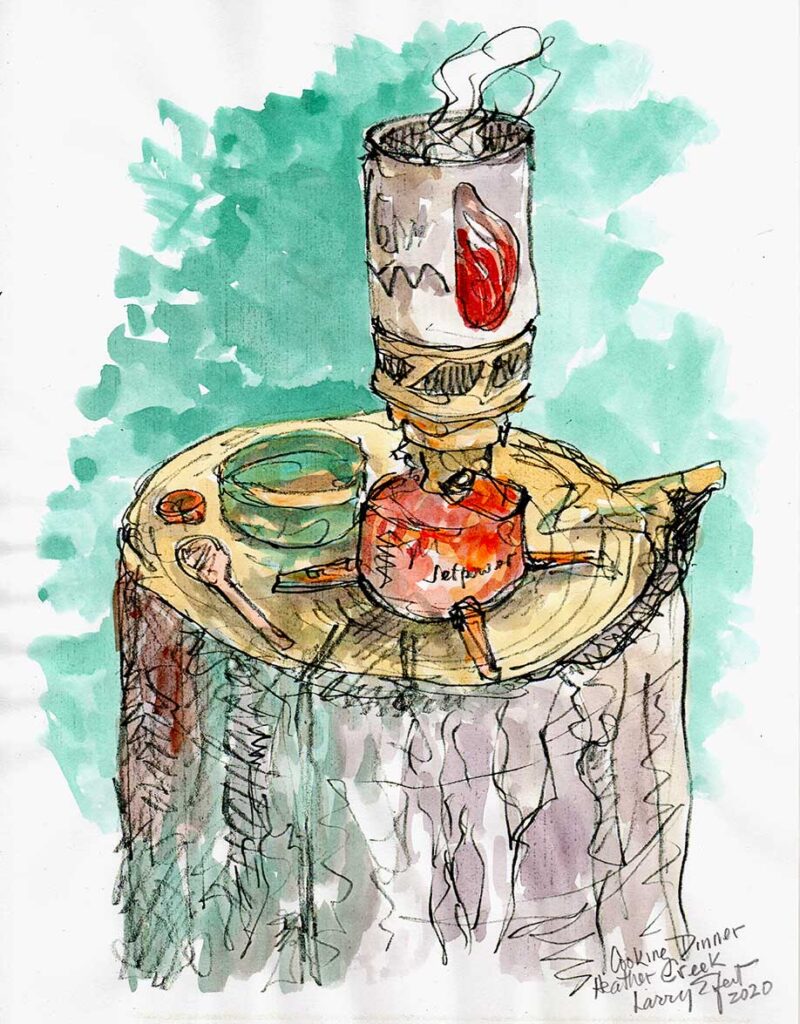
I was waiting for dinner

Like many solo hikers, I use a JetBoil stove that gives me a liter of boiling water in 100 seconds. It’s light, stores all its  parts inside the pot, and I can have morning Starbucks coffee in one minute flat. Think of that! I started camping in a time when a wood fire was all I had, all anyone had to get a hot cup of coffee or a warm meal. It was a true ordeal, scratching up raw dirt for a fire pit so I wouldn’t burn the place down, scrounging around under bigger trees for small dry twigs and then bigger branches, finding dry duff for tinder – then hoping the darned thing actually started. I still makes fires occasionally, but the urgency in the past is past. Instead, I can paint a little picture of what I saw, the kitchen – or the open meadows before me, clouds breaking off the peaks above Royal Basin to the west. I used the two ancient Douglas-firs snags for the center of interest and two matching little firs just starting life for the foreground.

It may not seem apparent from these little watercolor paintings, but I’m really not that abstract all the time. I paint bigger stuff, I mean BIGGER stuff, often for the National Park Service for parks around the country.

I recently used my knowledge of the Olympic Mountains to paint 500 sq feet of murals for the Hoh Rain Forest Visitor Center, and the process wasn’t really much different than hiking up a trail and learning what the place looks like. Yes, it’s the same guy doing both the trail paintings and these huge wall paintings. Me.

Also for Olympic National Park, I’ve painted several large wall murals of the Elwha Dam deconstruction, the largest dam removal in US history. The murals showed how the river would look after nature heals and was used for community outreach in libraries, visitor centers and schools. These were painted using day hikes to gain references, and again it was the process of studying nature and then just putting it down on a huge canvas. To tell you the truth, while I like doing these big paintings – standing by a river and drawing fish in the back country is much more fun.

Finally, about the Tent

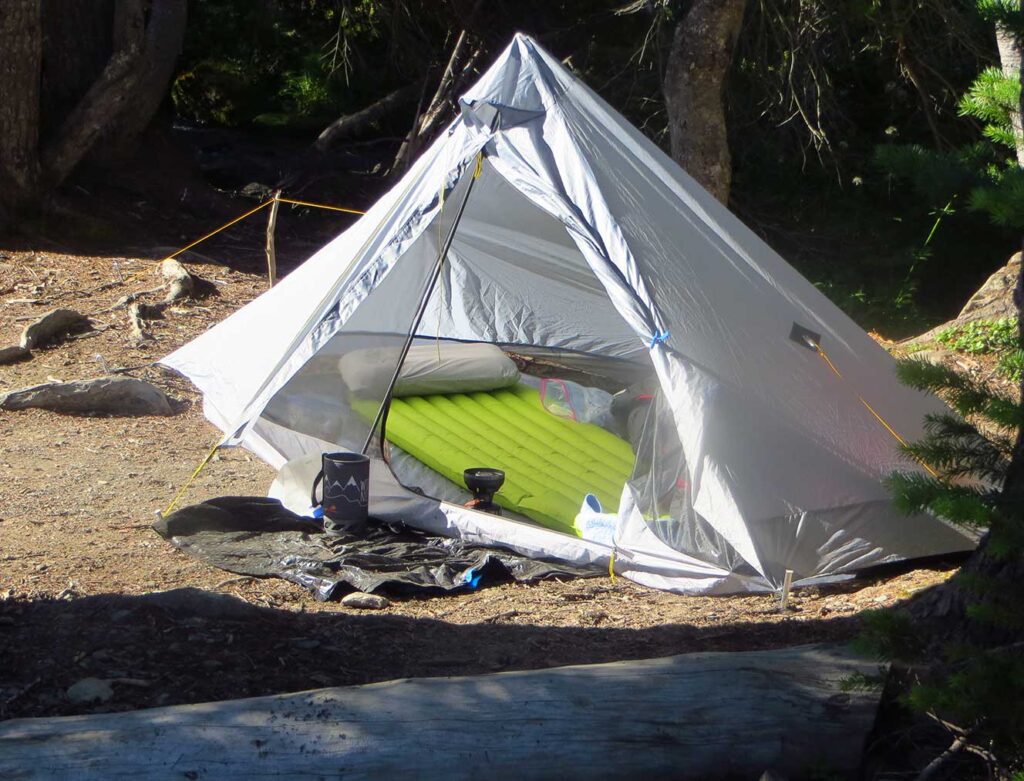
You can see my sketch pad in the foreground, in front of my camp, the tent set up for the evening. This is my routine, set it up, make water for the night with my filter down by the creek or lake, then settle in and make some art while there’s still light. Because I’m not carrying 40+ lbs any more, I can paint instead of licking my wounds. I feel good, and this tent is helping. It’s a Six Moon Designs Lunar Solo from a small company in the Portland, Oregon area. They sent me this to use, and my packed tent weight went from 6 lbs to 1 lb 10 ounces. It’s an amazing shelter, I think, that uses my single hiking stick as the pole. No tent poles means an even lighter tent.

This brings me back to how I started this story, about older people getting out, experiencing nature and bringing back memories. It’s a subtle hint that, if you like what I’m writing about here, you can do this too. Get some cheap or used gear to start, do some short hikes, sleep under the stars and find some real happiness in these strange times.

Go to the mountains, it will heal your soul.

Thanks for reading this week. You can sign up for emails for these posts on my website at larryeifert.com, down the right side of the home page.

Larry Eifert

Here’s my Facebook fan page. I post lots of other stuff there.

And Instagram is here.

Click here to go to our main website – with jigsaw puzzles, prints, interpretive portfolios and lots of other stuff.

Nancy’s web portfolio of stunning photography and paintings

And here to go to Virginia Eifert’s website.
A Yellow-billed Loon Story

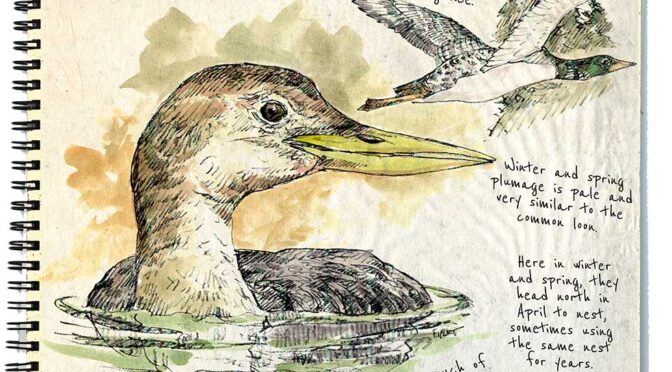
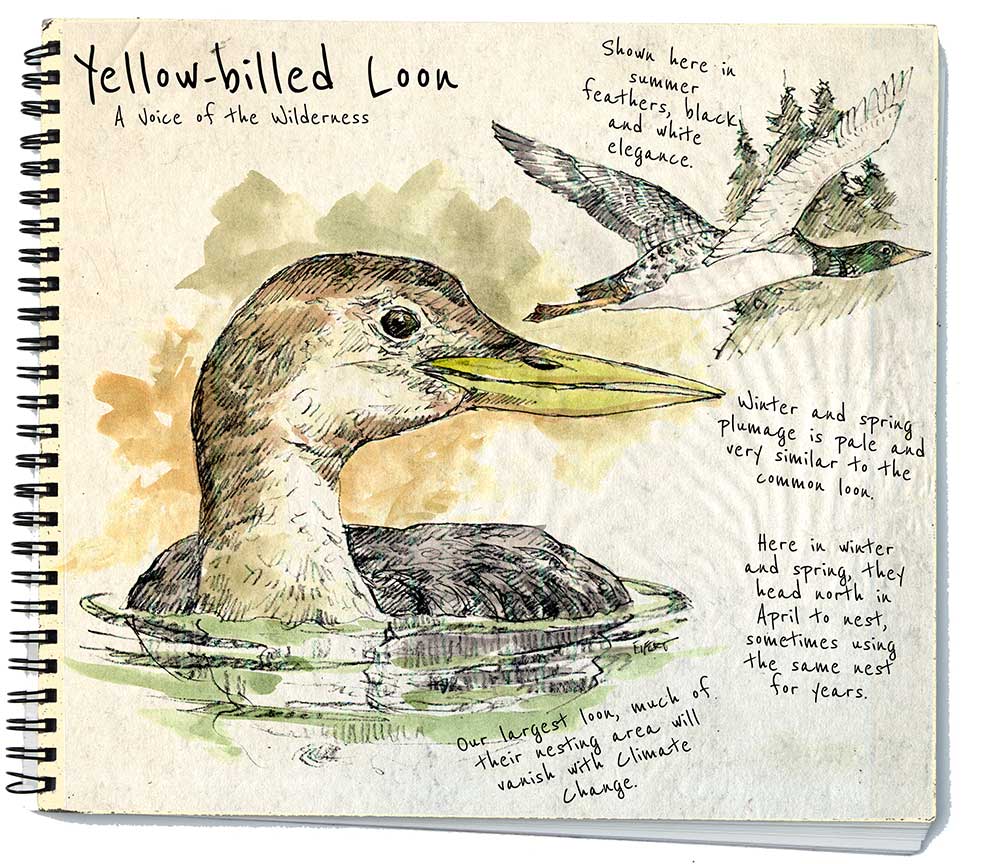
This was published in 48 North magazine last month. I thought the watercolor finished up nicely. This is the illustration part, below is the text that went with it. It was sort of a personal story for me.

“Growing up deep in ‘civilization’, I spent much time wishing to be in a wilderness somewhere, anywhere, and hearing the sounds of loons, owls and ravens. I still do that, but at least now I can get out there on a regular schedule. It’s important to me, and as life continues, the thrill of immersing myself in wildness is heightened by learning about it – and painting it. For me, loons are the embodiment of wild places, even if they aren’t exactly there when I see them. I saw one of these yellow-billed beauties recently off Port Townsend and was mentally transported, instantly, to a deep cove in Northern British Columbia, complete with grizzly tracks along the shoreline as they were being filled by a rising tide. I breathed the salt-saturated air, heard the peepers along the shore in a marsh, heard the loon’s mate calling out their ‘crazy laugh’, a tremolo no one never forgets. “

“Yellow-billed loons are the largest and heaviest loon, and difficult to identify in winter. Don’t use my painting to decide if what you’re seeing is a common loon or not. None are here in summer, but during winter and spring, these birds come to escape the harsh winters before returning in April to nest in the high arctic. There, both parents build a floating nest mound of muddy tundra vegetation along a lake’s shoreline and both incubate the eggs. The two chicks sometimes ride on their parent’s backs, even while diving for fish. Summer plumage changes them to dramatic black and white patterns that look like a broken diamond necklace that has been tossed at the bird, scattering all over its neck and back. They can be seen around the Salish Sea during April as they prepare to fly north for the summer.”

Just a few days ago I saw one of these birds on our daily 3-miles on the Pacific Northwest Trail. That’s right, I was hiking on a National Scenic Trail, except this one runs right through town and is only a mile away!

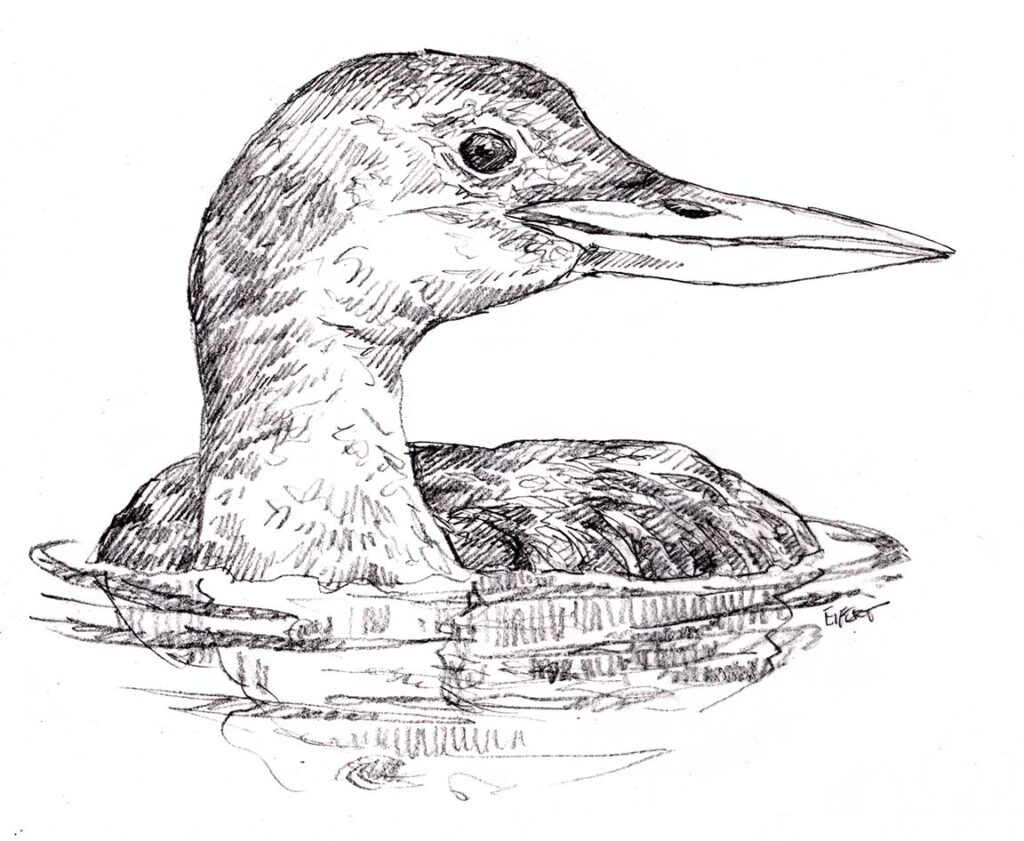
And here’s the original pencil drawing, pushed up just a bit with more contrast to make it pop better in a printed magazine. The watercolor was laid over it later.

Thanks for reading this week. You can sign up for emails for these posts on my website at larryeifert.com, down the right side of the home page.

Larry Eifert

Here’s my Facebook fan page. I post lots of other stuff there.

And Instagram is here.

Click here to go to our main website – with jigsaw puzzles, prints, interpretive portfolios and lots of other stuff.

Nancy’s web portfolio of stunning photography and paintings

And here to go to Virginia Eifert’s website.
Eifert Painting on the Ferry

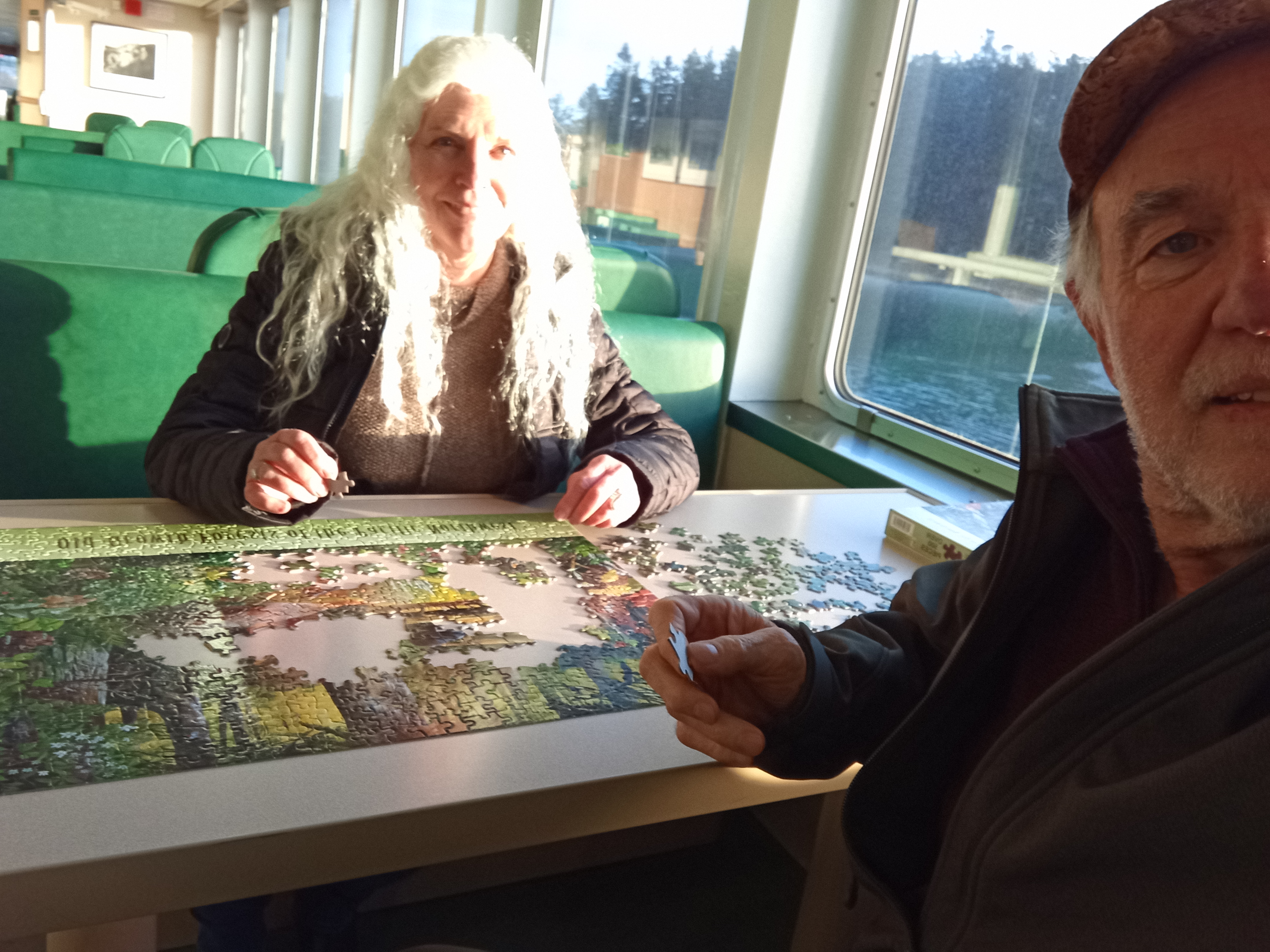
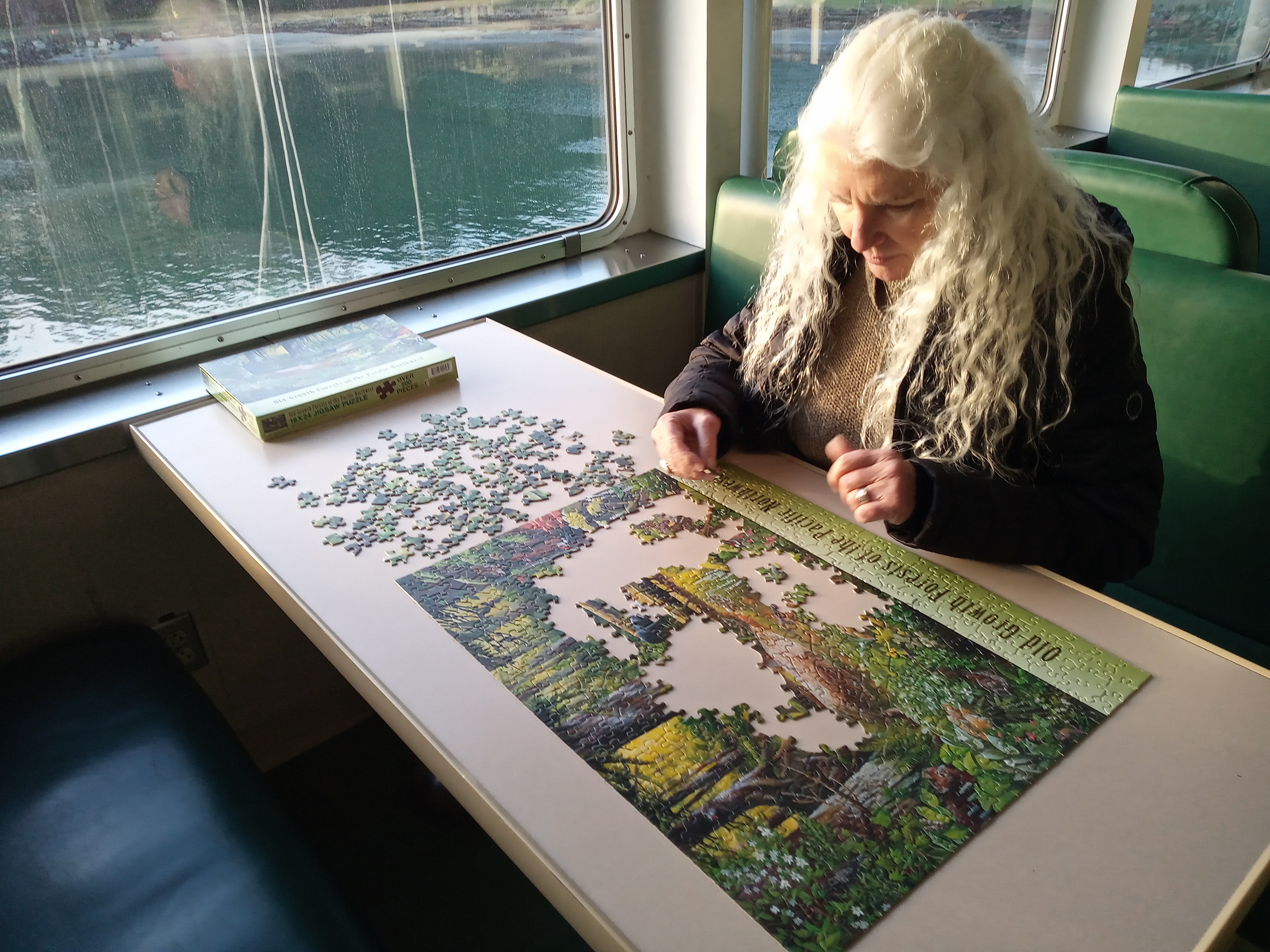
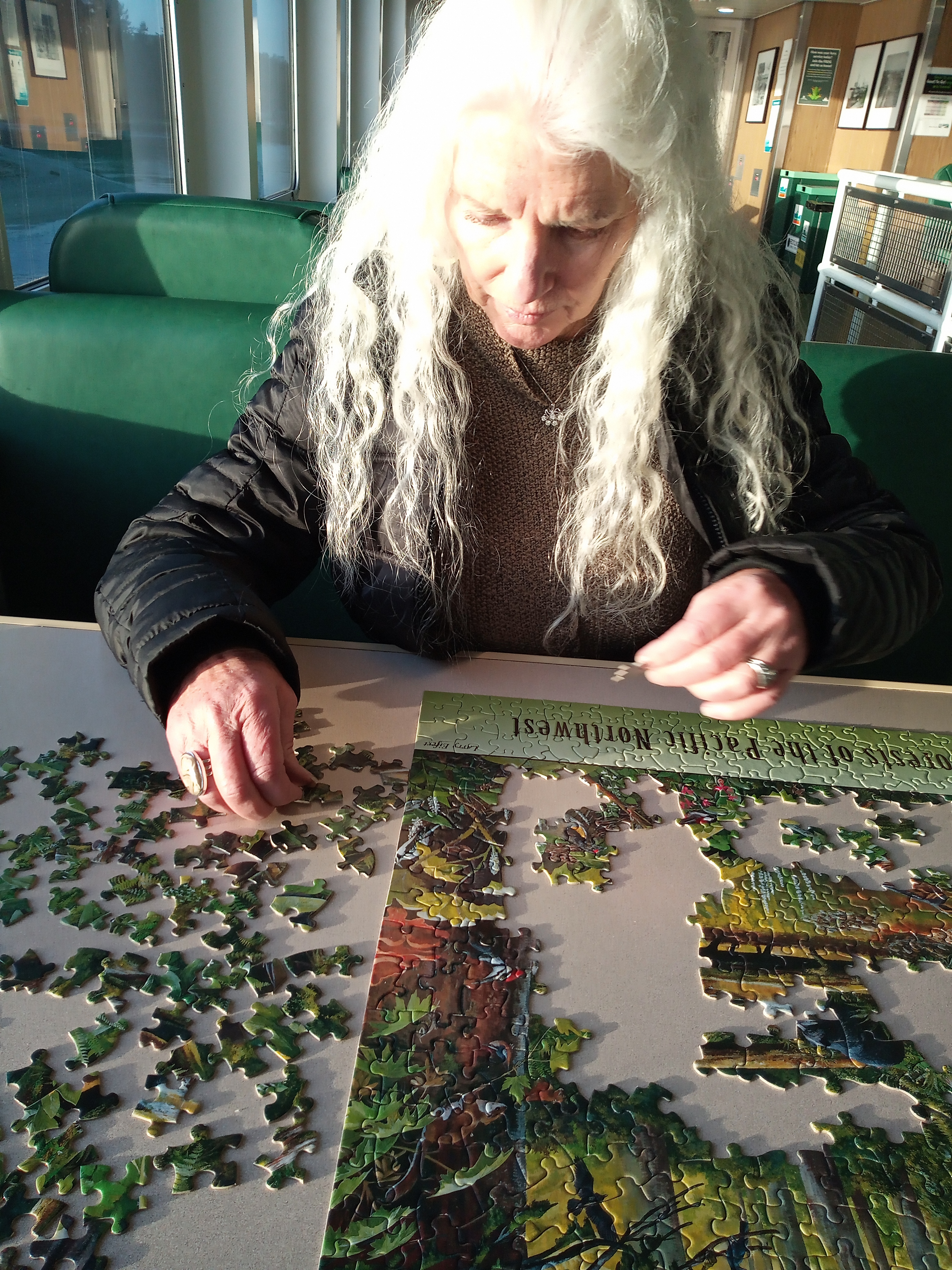
Yesterday we were coming home to Port Townsend on our little ferry. Parked on the car deck and walked up to confront one of my paintings in jigsaw puzzle form right on the table in front of us. Perfect, said Nancy and proceeded to put the thing together.  I mostly watched a gloriously calm sunset after a big blow in the morning that shut the boat down, but still added a few pieces to the effort. This is a painting I did for Mount Rainier National  Park years ago and is still installed there, the main attraction to the Ohanapecosh Visitor Center. It’s also still a puzzle – and who knows how many of these things are floating around the world. Thousands.

Now, I know it’s a bit of a stretch to say this is actually ‘public art’, but bear with me. I first figured out how to put my better National Park art on puzzles in the 1990’s, first with a company from Germany, then we did it ourselves through a great group called Impact Photographics. It takes a pile of doubt or at least a credit score. Various others have made puzzles, too, and I’m guessing we’ve published over 80 different images. Currently, Nautilus Puzzles from California is actually making them out of real laser-cut wood that cost as much as some of my early paintings did!

These days, we’re not as aggressive with this, but still supply them to parks and stores. We once found one in Hawaii at the Pahoa Farmer’s Market under a pile of used clothes and books.

I’m not here to advertise buying puzzles, but instead to just say that this sure has been a wide and complex life. I have painting projects going on right now about restoring Northwest salmon, a bison mural in South Dakota, a Florida project involving dolphins and octopus, nesting terns and sharks. I’m proud to say I’m sponsored by a great backpacking equipment company called Six Moon Designs that help get me out there in comfort, and by a truly wonderful partner. Nancy keeps it all running behind the scenes as well as on the road – or on the ferry.

I guess what this post is all about is for me to just say thanks to everyone for all of this. It takes an amazing number of consistently interested people to keep our little lifestyle going for all these decades. I wish I could give back, but with the next paintings in progress, maybe I am.

You can also see this post and all the rest coming up by simply adding your email to our list here – right side, down a bit.

Thanks for reading this week.

Larry Eifert

Here’s my Facebook fan page. I post lots of other stuff there.

And Instagram is here.

Click here to go to our main website – with jigsaw puzzles, prints, interpretive portfolios and lots of other stuff.

Nancy’s web portfolio of stunning photography and paintings

And here to go to Virginia Eifert’s website.
Wind Cave National Park

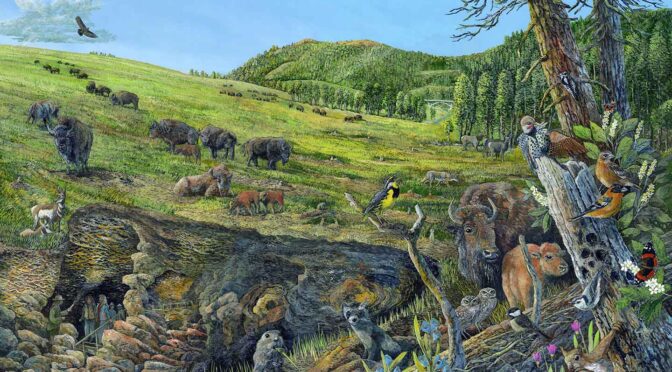
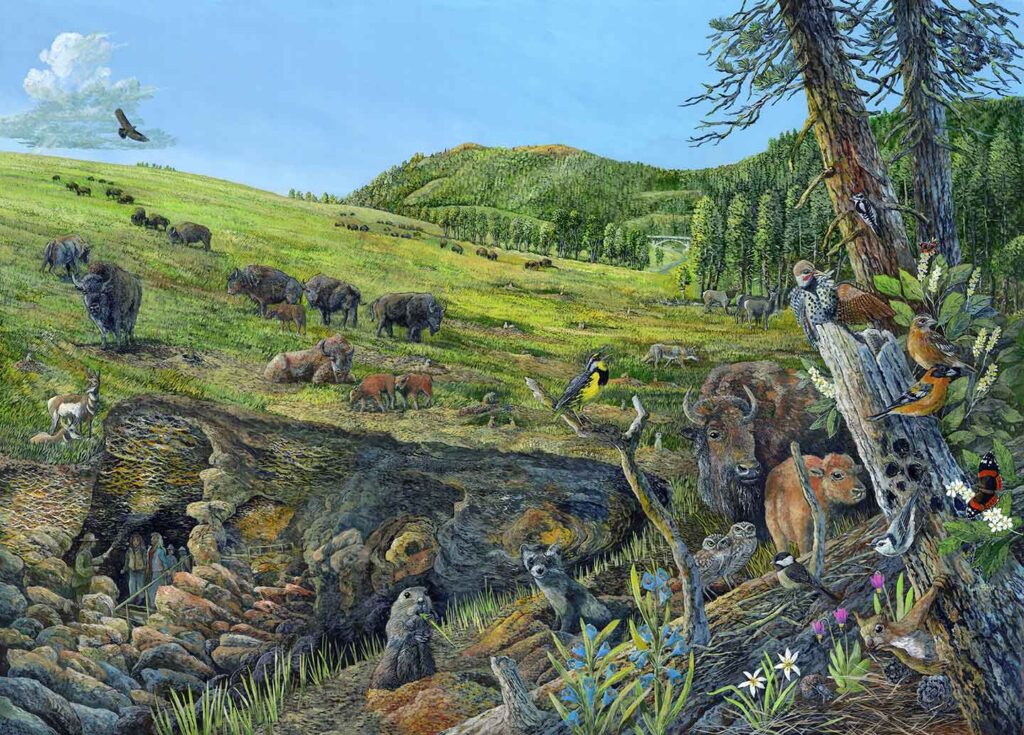
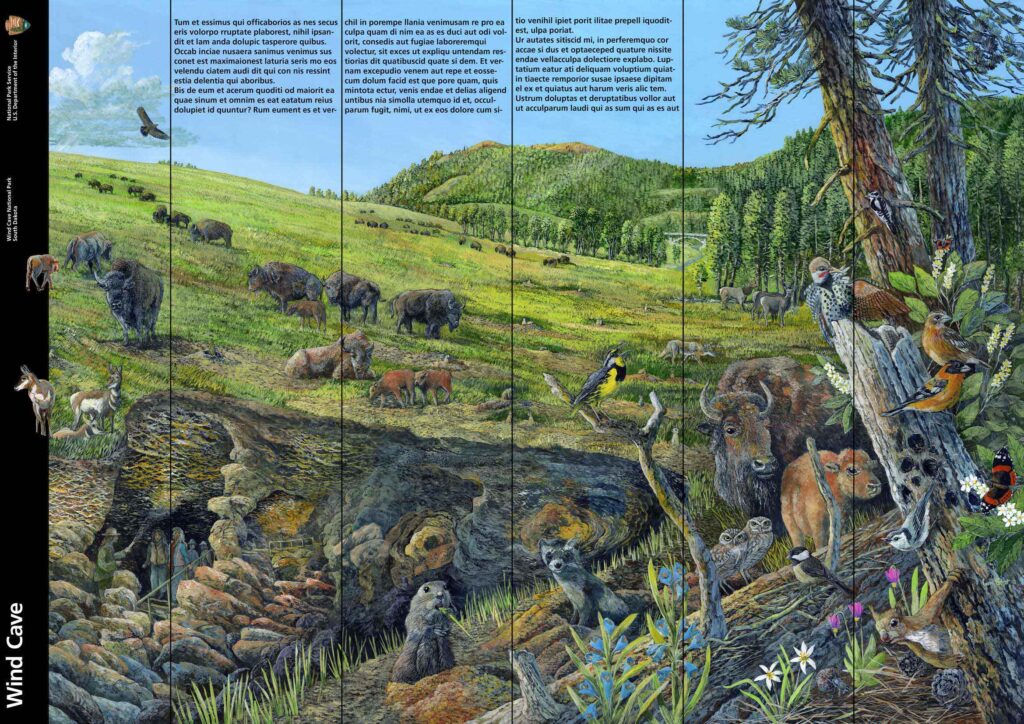
I submitted this painting a few days ago – I think it’s close to finished and thought I’d show it off here. Wind Cave National Park is in the Black Hills of South Dakota, a fantastic place with patches of prairie, rolling tree-covered hills and an amazing cave network. Somehow it all had to be jammed into one painting, along with the bison, prairie dogs and all the rest of the amazing wildlife most see there when they visit. This bit of art is going on the back of the new park map, meaning an Eifert painting gets to go home with most of the 650,000 people who come each year.

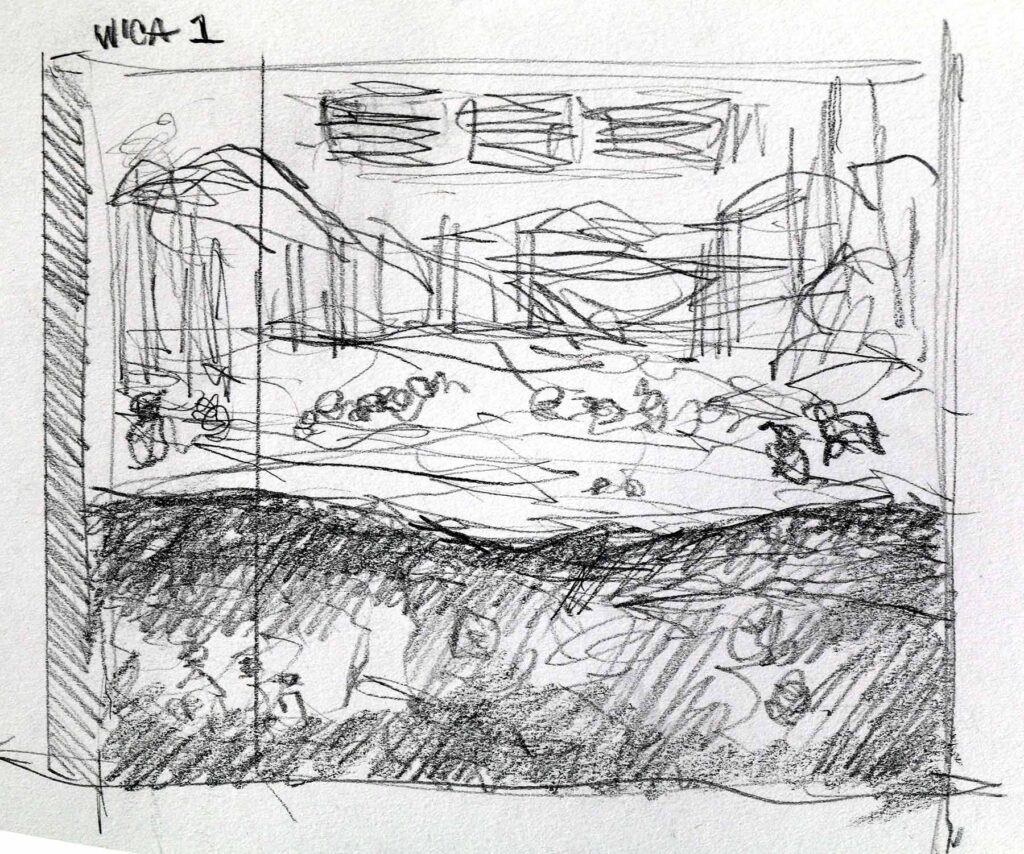
This is the map publication with art in place. I like the way the critters overflow the black NPS band on the left. And below is the original first draft concept sketch I did on location, one of seven. Quite a difference from the final art.

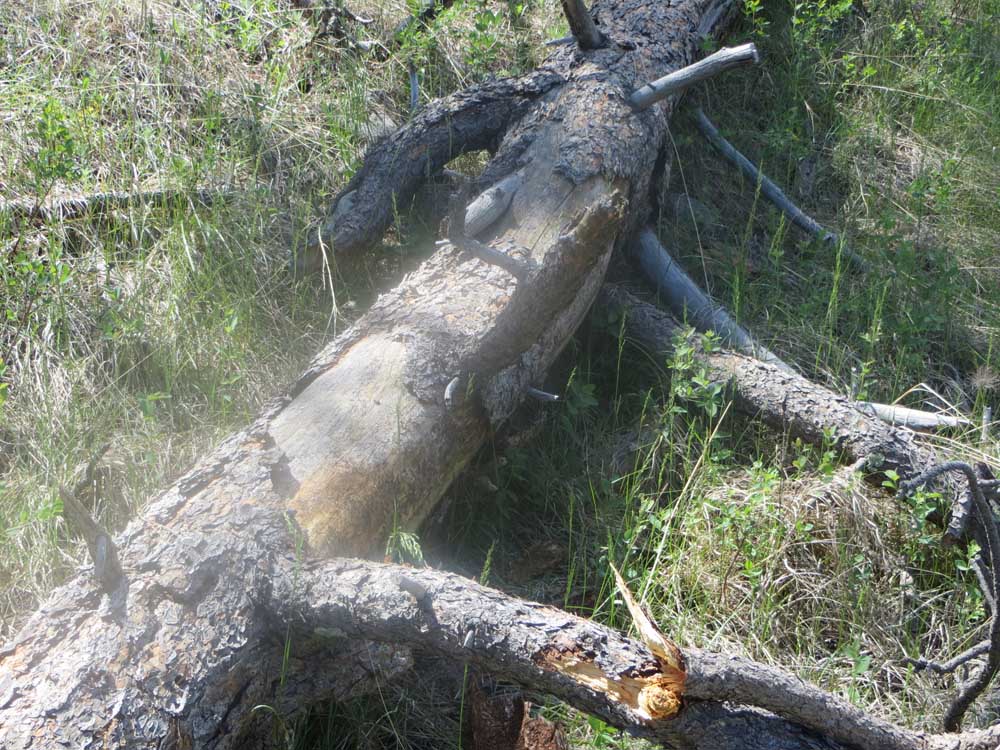
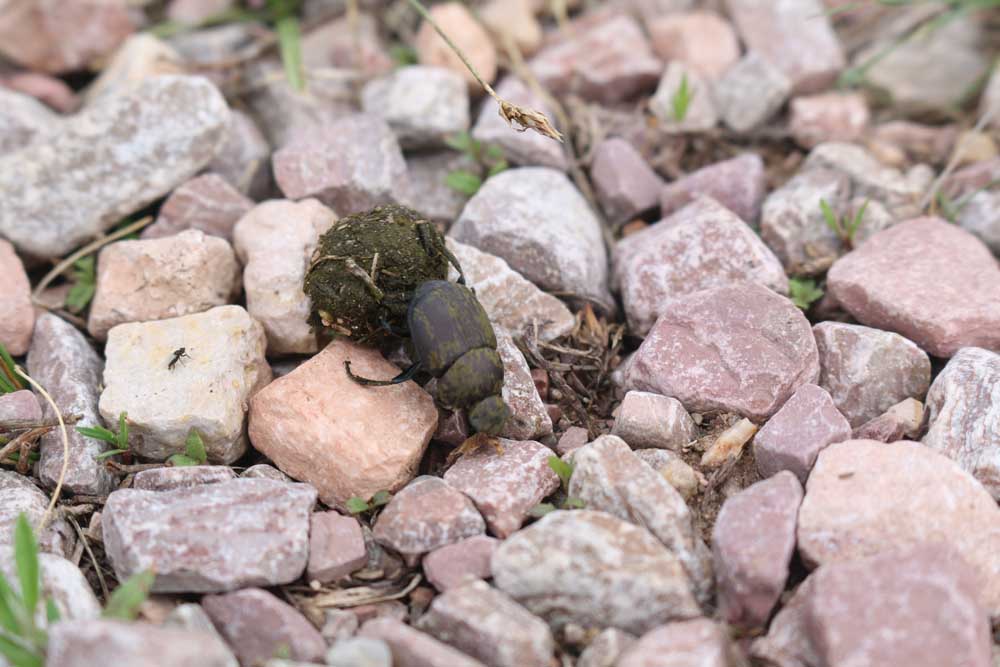
So, how does this all happen? While there on the site visit, I tend to take photos while drawing, LOTS of photos. I don’t really know how the painting is going to evolve, so I take ground shots, close-up details like the two below. That little dung beetle was working hard and eventually made it into the final art. These little guys roll up the bison poo and then just continue on to who-knows-where, rolling their little ball along. The ponderosa was the one I used for the main feature on the entire right side of the painting, as well as the foreground reference to the forest duff.

There may be more small changes as the park takes a look, but I think I’m about there on this effort. I have art is many nearby parks near here, Badlands and Devils Tower, but this one beautiful place has eluded me until now. Yahhh.

If you would like to sign up for my periodic blogs as emails, you can do it here.

Thanks for reading this week.

Larry Eifert

Here’s my Facebook fan page. I post lots of other stuff there.

And Instagram is here.

Click here to go to our main website – with jigsaw puzzles, prints, interpretive portfolios and lots of other stuff.

Nancy’s web portfolio of stunning photography and paintings

And here to go to Virginia Eifert’s website.
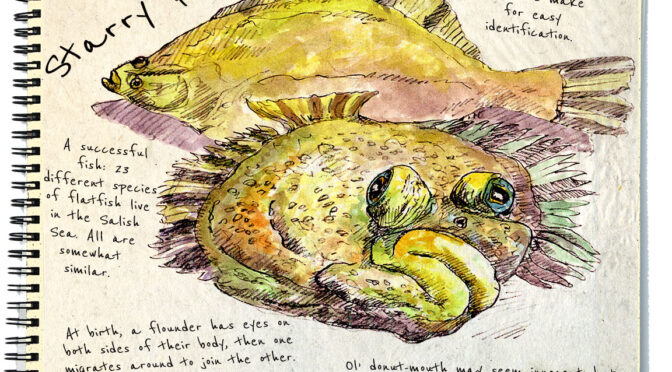
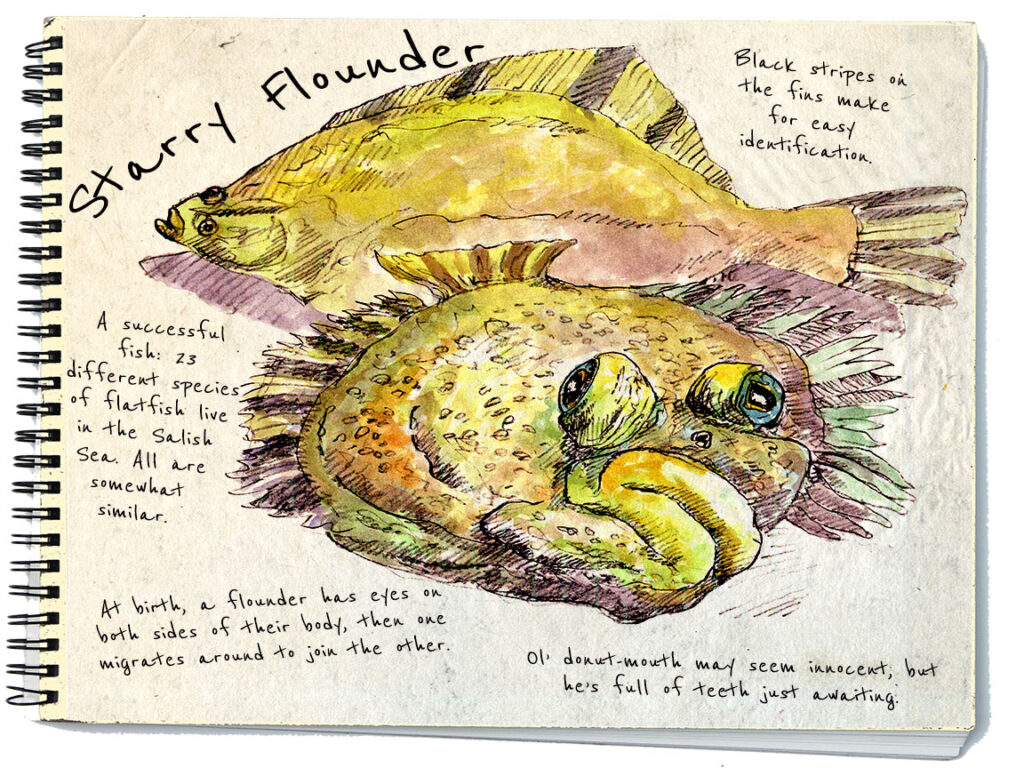
Starry Flounder in 48 North

Yesterday I received my copy of 48 North magazine in the mail, and here is my page. Always amazed when the greens print nicely, and they did this time, subtle shades that aren’t easy to reproduce. For some reason, that color hates me in print. Flounders, flatfish, are always favorites of mine to paint. These fish begin life swimming upright like normal fish, eyes on both sides, then later they get lazy and settle onto the seafloor to await food that swims by. Since predators need good vision to catch prey, the eye that faces downward migrates around to the other side. I’m not kidding, but if you’re a flatfish fisherman, you will have seen this most every time you catch one. I find them fascinating.

So here’s my story that went with the art:

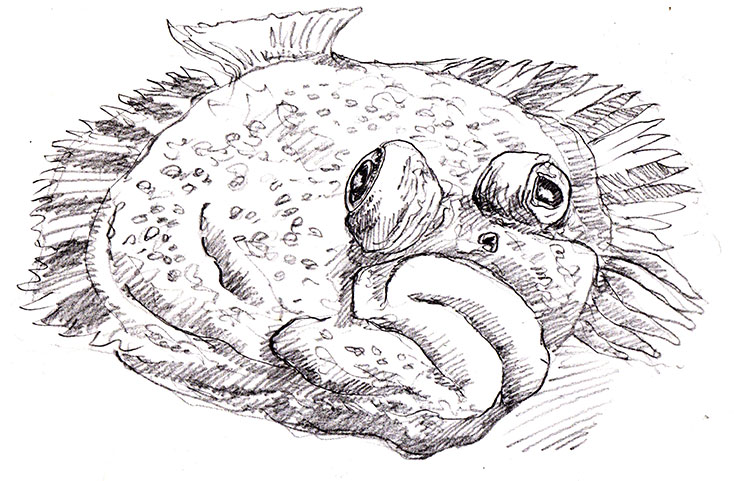
A face only a mother could love. Starry flounders are just one species of 23 local ‘flatfish’. Flat because they tend to spend their time lying flat on the bottom, on either their right or left sides. Beginning life, they’re just a ‘normal’ fish that swim upright, an eye on each side of a vertical body. As they age, they spend more time laying sideways on the bottom, lying prone and just waiting for pry to swim close enough to grab. Soon, strange things happen with the growing juveniles, and it’s not just hormones. It’s a major anatomical change. One of their eyes actually migrates around their head to the other side, stopping just short of the other one. Now, the upside view has a pair of eyes looking for the next meal. These are hunters, after all, and they need binocular vision to assess distance. So, the flounder then has its same two eyes, but now they’re on the upper side of the body, like two little periscopes.

Starry flounders can grow to 36” long, or bigger than the size of a garbage can lid. At this size, they’re approaching 20 lbs and they can live upwards of 20 years. They’re often found near shore in bays or even fresh water and throughout the coastal North Pacific. They sport namesake star-like scales on both the lighter downside and darker upper side. The distinctive black bands on outer fins make it an easy flatfish to identify, and they can alter their colors to match surroundings. As predators, they often settle on a sandy bottom and wiggle their fins to cover themselves with sand and debris to hide. With only eyes showing as they move independently gazing about, and a mouth just waiting to go to work, they wait for a hapless crab or small fish to wander by, and then ‘wham’. Look for these fish as you bring your skiff through shallow water towards the beach. The fish’s outline is usually obvious from above.

I’m going to be expanding this blog a bit, adding more art from my partner in crime, Nancy Cherry Eifert, and essays on hiking and seeking wildness. This blog seems to be growing into something bigger than just art and it’s evolving. So I should too.

This next hiking season, I’m being sponsored by Six Moon Designs, an ultra-light backpacking gear company from Oregon. After hiking for decades in heavy old gear, and trying desperately to lighten my load, here’s an example of what they’re letting me try out. My tent weight just went from 6 lbs to less then 2! This is the Six Moon Lunar Solo tent. Check it out here. Or, I’ll see  you on the trail in a couple of months with a smile on my face.

If you want to sign up for my periodic blogs as emails, you can do it here.

Thanks for reading this week.

Larry Eifert

Here’s my Facebook fan page. I post lots of other stuff there.

And Instagram is here.

Click here to go to our main website – with jigsaw puzzles, prints, interpretive portfolios and lots of other stuff.

Nancy’s web portfolio of stunning photography and paintings

And here to go to Virginia Eifert’s website.
Malheur Refuge Wildlife Painting

This is another painting I did for Malheur National Wildlife Refuge in eastern Oregon – remember the hostile take-over by the Bundy Clan? This was that place!

I was given some nice leeway on these efforts, so I could add some mental candy, a soft sunset coming to mind here. They were fun paintings to do, because I just plan likw painting wildlife. Below is a detailed version of a section.

It can get very crowded at Malheur, as you can see below. This is one of Nancy’s photos, an amazing mass of wildlife that proves, yes, you still CAN see this sort of thing in America, but only if we pay taxes to keep it this way. Want to see this? Go to Malheur in March or April, get a room in the one-and-only decent motel – and go geese watching. You won’t forget it easily. By the way, these birds are ALL talking while they’re doing this!

Below is the reference painting I worked from, certainly not copying it, but just a ‘feeling’ reference. I did this one for The Nature Conservancy a couple of years ago at the Carson River Project in Nevada. I always liked the softness of this landscape, backed up against the High Sierra. Lake Tahoe is just over the ridge. I think the painting holds together nicely.

And below is the original refined sketch, after the rough concept drawing. This is the step before painting begins, and while it’s certainly not like the final, it comes close enough to call it good at this stage.

I’m going to be expanding this blog in the next few weeks, adding more art from my partner in crime, Nancy Cherry Eifert, and essays on hiking and seeking wilderness. This blog seems to be growing into something bigger than just art and it’s evolving. So I should too.

Thanks for reading this week.

Larry Eifert

Here’s my Facebook fan page. I post lots of other stuff there.

And Instagram is here.

Click here to go to our main website – with jigsaw puzzles, prints, interpretive portfolios and lots of other stuff.

Nancy’s web portfolio of stunning photography and paintings

And here to go to Virginia Eifert’s website.
Art for Orcas – A Trail for the Mind

A second painting of the current five, funded by the Orca Recovery Plan for Washington State. This one is about the same watershed in Everett, WA as the last painting, but focuses on the way this little forest cleaned the water that runs through it. Just a 100 yards west from this location, the creek flows into Puget Sound, cleaner than when it was up in the urban city above it. Clean water helps orcas, salmon and the entire ecosystem, the the forest does this naturally, no help from us except to leave it alone.

And here’s the initial sketch, showing some of the areas where text will go. It’s simply a way to get started. I’ll show you the other three soon.

Change of pace: Fall  hiking and finding wildness.

While painting is my passion, so is hiking wild places. Always has been, all the way back to when I had to hold someone else’s hand to stay upright. So, that’s 70 years of looking for wild nature, and it’s still as important as it’s always been for my life, spirituality and sense of being who I am. We hiked a 5-mile out and back yesterday and returned feeling refreshed and with memories that stayed with me through the night – and right here on this page.

This collection of big-leaf maple leaves and probably one of the Psilocybe mushrooms is, for me, what a wild place is all about. It doesn’t have to be way out there (but that helps), alpine scree or giant mountains, but it’s more about finding places that haven’t been recently altered by humans. Just a small place will do, where leaves and the fall crop of fungi can make the place very special for me.

I may be in my 70’s, but these places just don’t get stale, don’t loose their thrill of absorbing the peace and well-being that nature brings. I’d like it very much if this short little essay resulted in a few more people out there, but if the trail is lonely, so much the better for us!

Thanks for reading this week.

Larry Eifert

Here’s my Facebook fan page. I post lots of other stuff there.

And Instagram is here.

Click here to go to our main website – with jigsaw puzzles, prints, interpretive portfolios and lots of other stuff.

Nancy’s web portfolio of stunning photography and paintings

And here to go to Virginia Eifert’s website.
Orca Recovery – Pigeon Creek

I’m now painting a bunch of art for 5 new wayside panels to be installed around  Puget Sound. Recently, Washington State decided to help the remaining 80-some iconic Southern Pod in a big way, and a tiny part of that effort is going to me for some wayside panel art for outreach at some of the locations. Rain gardens and stream restoration – and my art telling about it. I’m happy and proud to be involved.

The Southern Resident orcas – or killer whales, are a large extended family, actually a clan, comprised of three pods hereabouts. Within each pod, families form into sub-pods centered around older females, usually grandmothers or great-grandmothers – I like this structuring a lot – we could learn a few things here. They live in Puget Sound and the Salish Sea in Washington State and British Columbia and primarily eat salmon, that are also in dire straits. I’m not new to painting orca or salmon as I just finished a bunch of others at Lime Kiln Point in the San Juan Islands, so this was an easy transition.

Above is the first panel almost finished. Pigeon Creek is in Everett, Washington and the water comes from urban neighborhoods and flows down into this green lush valley where the forest slows and purifies the water before it hits the bay. People think it’s just a place to walk their dogs, but this shows it’s more, a strainer for pollutants heading for orcas and salmon.

Here are the sketches, concept first. Then below is the enhanced version showing details. It’s actually fairly true to the final art.

It’s a pretty messy riparian forest, but I made a painting out of it anyway – including Bob who showed me around on a very rainy day. I got what I needed, as you can see up top – and even put in this little bridge. I’ll show more of these panels soon.

Thanks for reading this week. Now, get out there and take a hike in your nearby forest – and tell them I sent you.

Larry Eifert

Here’s my Facebook fan page. I post lots of other stuff there.

And Instagram is here.

Click here to go to our main website – with jigsaw puzzles, prints, interpretive portfolios and lots of other stuff.

Nancy’s web portfolio of stunning photography and paintings

And here to go to Virginia Eifert’s website.
Sol Duc Falls art and salmon

Each Fall, lots of people come here to Salmon Cascades on the Sol Duc River to see salmon jump. They take a million pictures, some paint. I can now say I’m the only one that did both (with an underwater camera, too), and my art stayed behind. Here we were just out for a look at salmon, and of course saw some, but we hadn’t been here since this wayside panel was installed. Fun to see my stuff here and I thought it turned out pretty well.

Below is one of my  underwater shots, much different than what I’d imagined it would look like down there. Colorful rocks, some organic color on the big stones. This is what the salmon see as they circle preparing to make the jump.
Below is the original sketch, the third design that the park eventually approved. That bottom fish is about life-sized in the final panel.

And here’s a little backstory about all this. In the 80’s, I was visiting parks to paint them for my gallery and others I was represented by, sold all I could produce, and then one day a collector of mine who also ran Redwood National Park told me in casual conversation: “Listen, you come to my park, you paint her, and then you take the art away. Why not keep the art in the park for others to enjoy?” It changed my life and was one of those few life-moments I can point to as a turning point. I did what he suggested, and it’s been a meaningful ride for me ever since doing just that. On the Sol Duc Road alone you can see 25 of my paintings along the way in the 17 miles up to Sol Duc Trailhead. 300 in the California redwoods. And it’s an amazing bunch of memories of working for and with people who only want to do what’s best for nature, not their own pocketbook. From Alaska to Florida – it’s a legacy I don’t take lightly.

Here’s the salmon cascades, but without the salmon. Just didn’t time the photo at the right time. It’s a good jump, but they all seem to make it eventually.

And at the end of the road and a short hike to the falls, but here’s the rebuilt cabin, the 1939 Canyon Creek Shelter at Sol Duc Falls. It’s on the National Register of Historic Places.  And the falls that stop all fish from getting to the upper reaches of the Sol Duc River.

Thanks for reading this week.

Larry Eifert

Here’s my Facebook fan page. I post lots of other stuff there.

Click here to go to our main website – with jigsaw puzzles, prints, interpretive portfolios and lots of other stuff.

Nancy’s web portfolio of stunning photography and paintings

And here to go to Virginia Eifert’s website.