Category Archives: Wildlife

Dugualla Flats Preserve

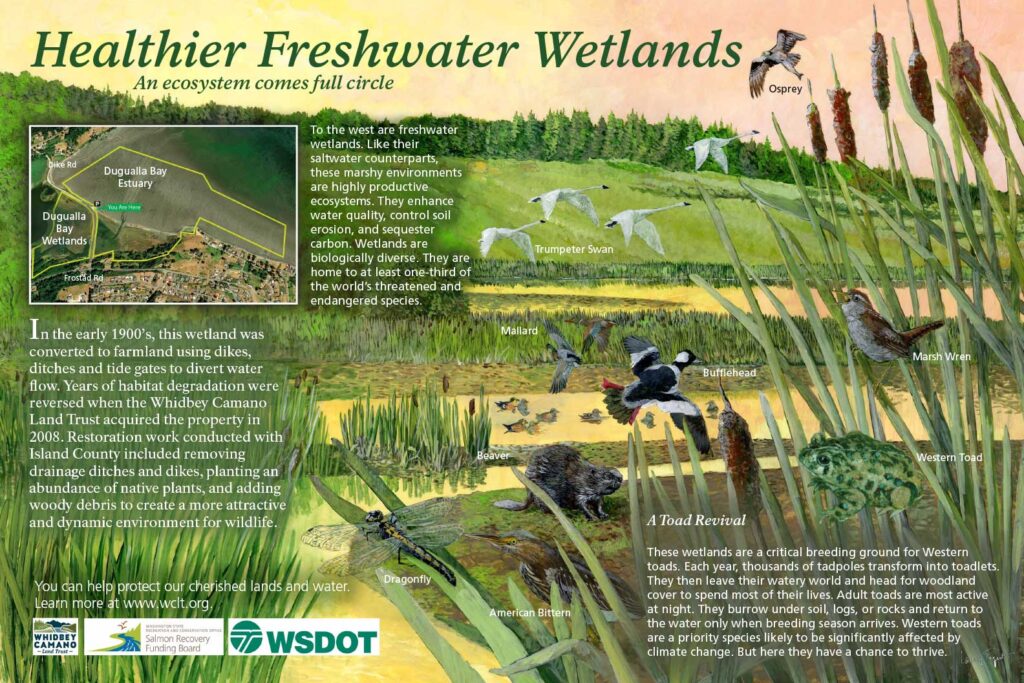
Just finishing up two new paintings for outdoor wayside exhibits at Whitbey Island’s Dugualla Bay Preserve.  This is another project for the Whidbey Camano Island Land Trust and, as always, it was a pleasure to paint for them.

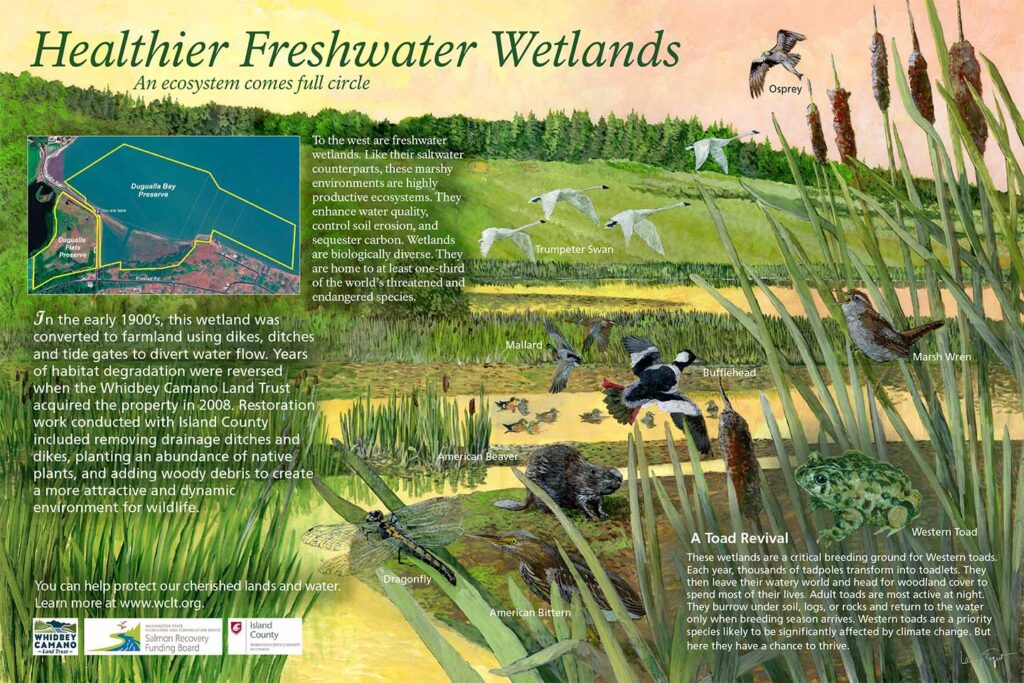
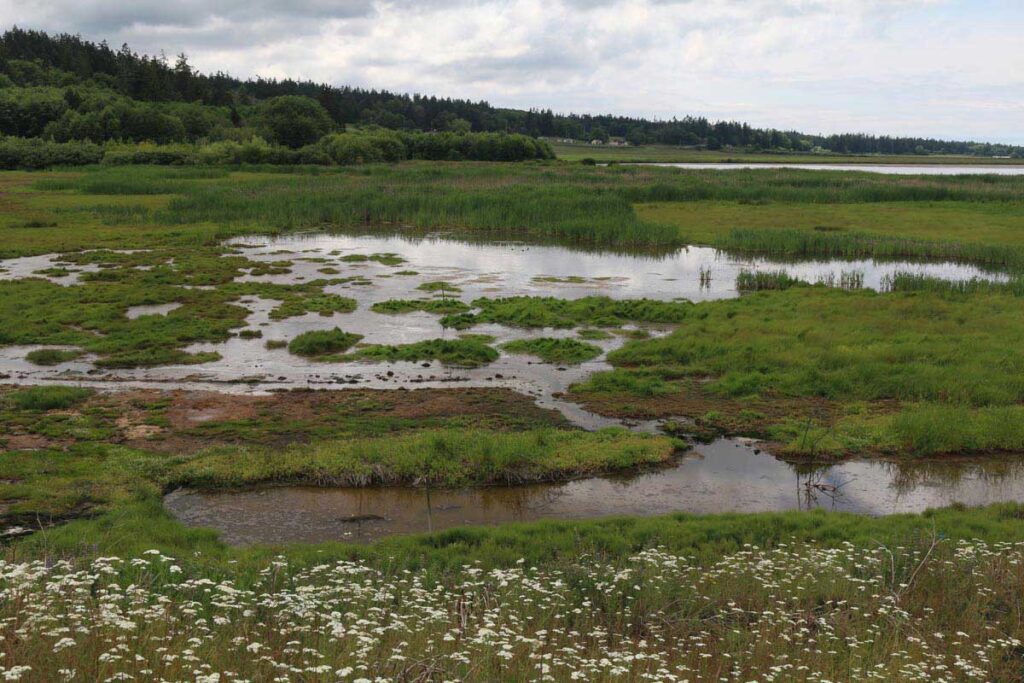
This recently restored wetland is on both sides of a dike road a few miles north of Oak Bay. One side is fresh water, the other is a salt marsh salmon habitat area. First it was bay, then farmland with nature shut out. Now it’s back to nature. The bay side is very good forage fish and salmon habitat.

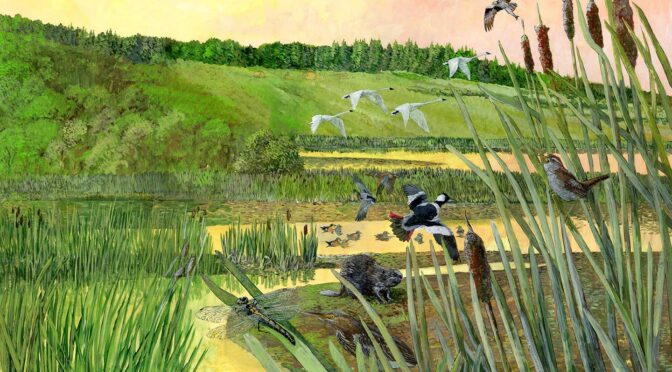
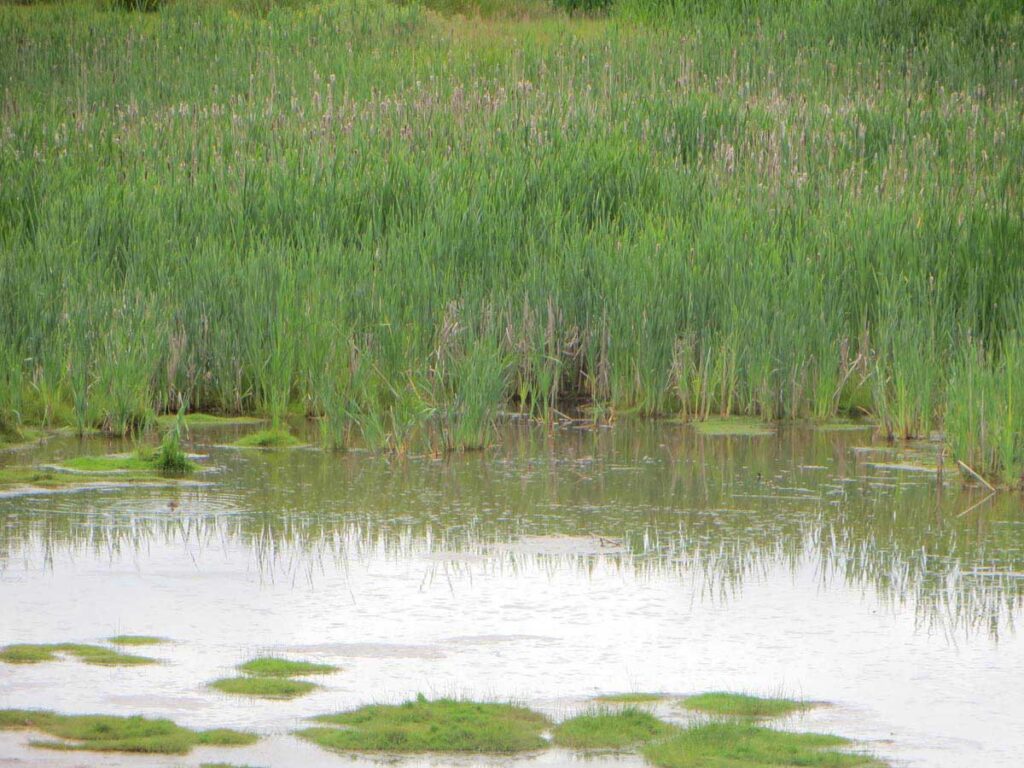
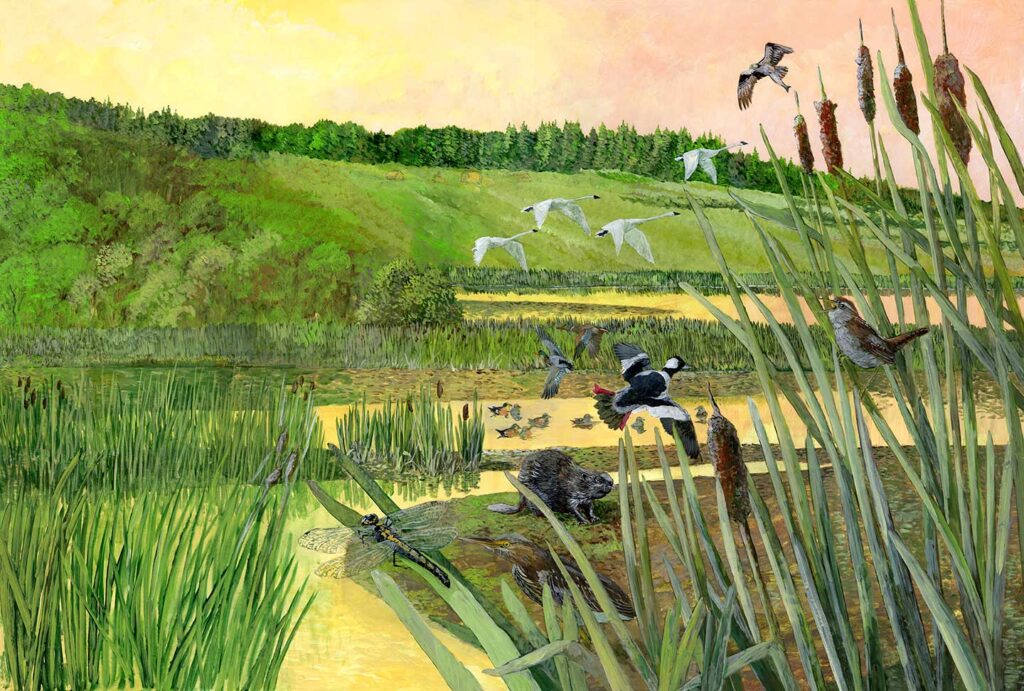
This first painting is the freshwater side, a rich habitat of cattails and critters from western toads to trumpeter swan – and I can’t say I’ve ever painted THOSE two in one painting before! The wetlands have water levels that rise and fall with the seasons and on a site visit a few months ago I took some reference shots, not very good as you can see, but somehow I built an interesting painting with what I had.

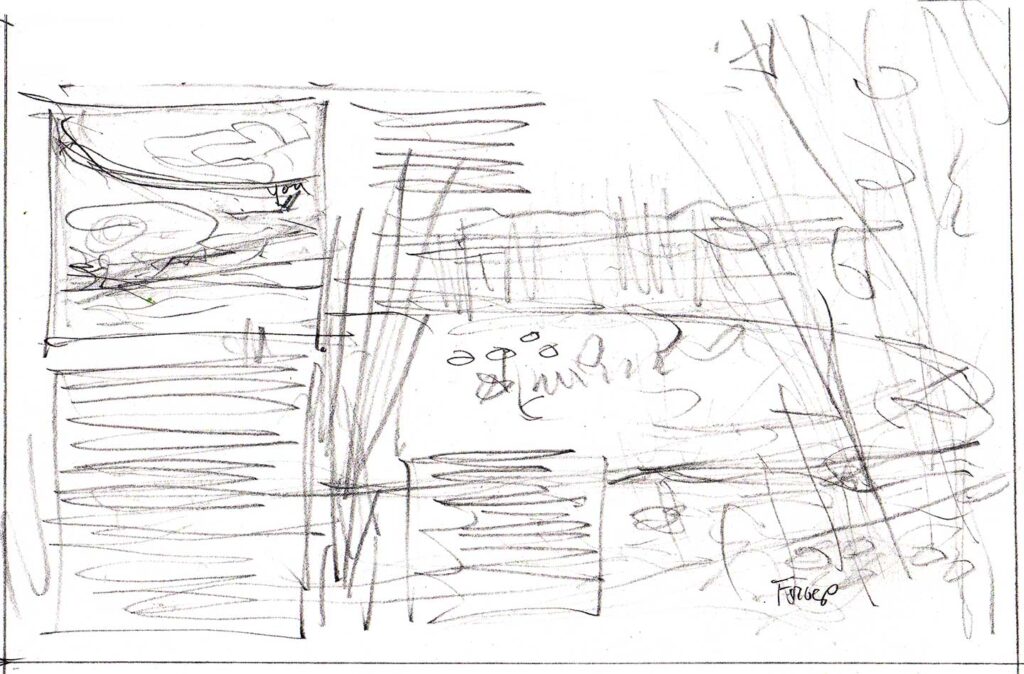
I started with a quick gesture drawing, a concept sketch showing cattails on the right, map and text on the left, maybe wildlife in the center. It’s sort of amazing to me that the final painting was very close to this.

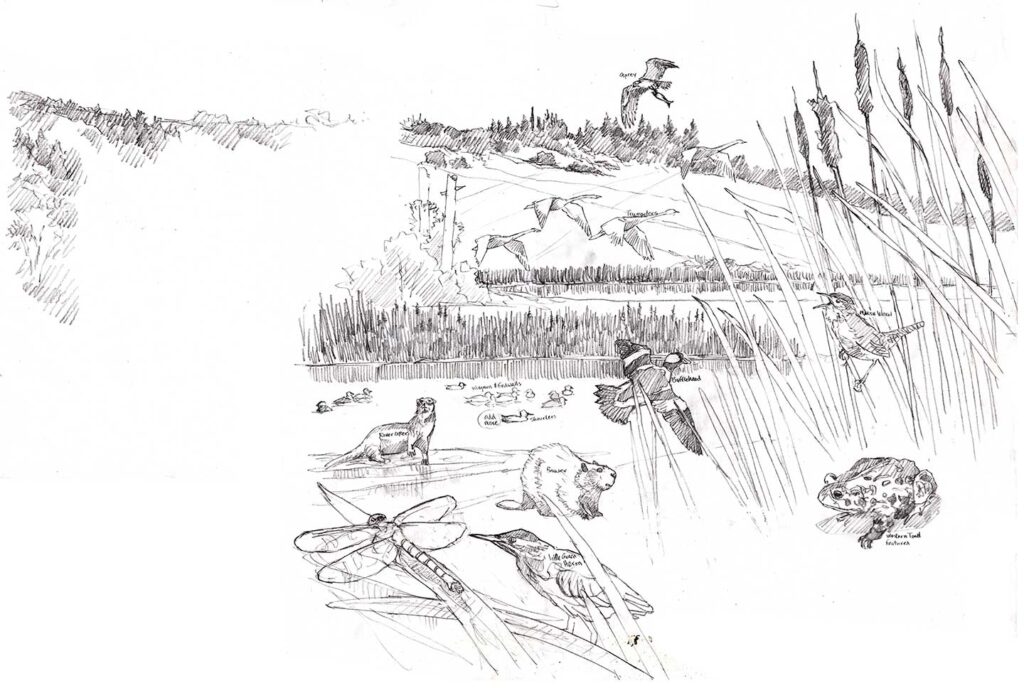
Then a more refined drawing came with a better understanding how the wildlife fits in, getting their sizes and spatial separations set for a good piece of art. The toad couldn’t be down with the rest of them in the marsh since they’re up in the drier meadows, so I just floated it in midair – a toady blimp.

And this is how the final painting looks. Click on it to enlarge in your browser. These things are certainly not just a nice painting like my days of gallery painting. It takes a bunch of planning to get the other components to all fit.

It all came together with the text, a map I did in Illustrator using the National Park Service’s map software – and the text the Land Trust supplied me. Very skilled efforts go into doing text for these panels and these are really well written. Too many words it becomes a ‘book on a stick’ and no one reads it. Too few words and no one learns anything. And this type of art is all about learning something – which I hope you did with this blog. I hope you liked it.

Thanks for reading this week.

Larry Eifert

Here’s my Facebook fan page. I post lots of other stuff there.

Click here to go to our main website – with jigsaw puzzles, prints, interpretive portfolios and lots of other stuff.

Nancy’s web portfolio of stunning photography and paintings

And here to go to Virginia Eifert’s website.

Swainson’s Thrush portrait

Sorry, this painting is now sold.

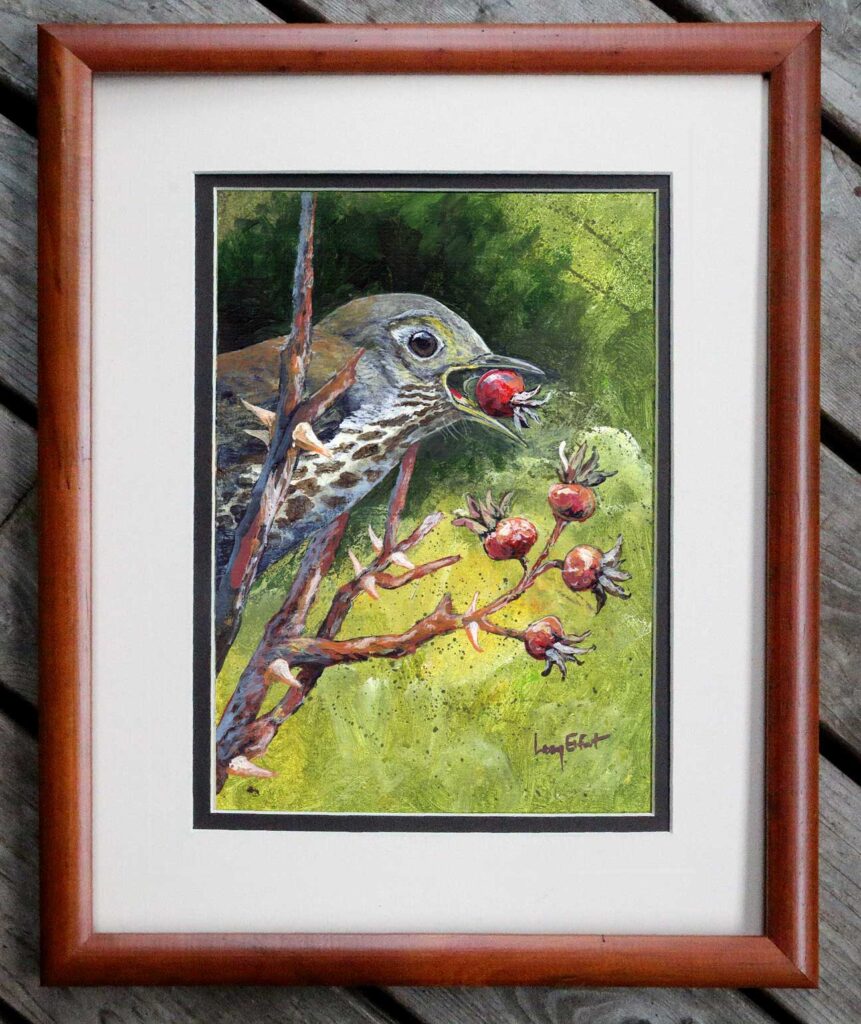
This painting is available and is part of my current series of wildlife portraits. Getting up close and personal with some of my friends around here.

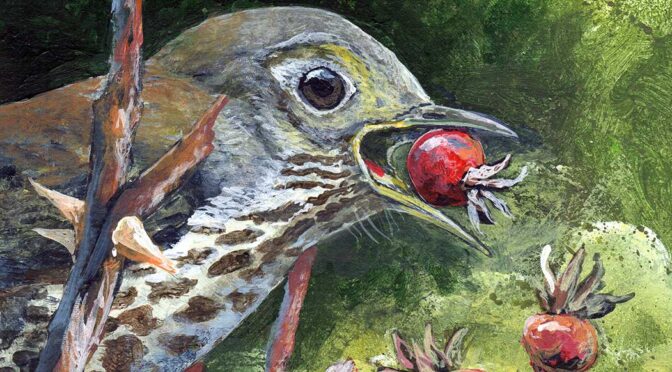
Rose hips from Nootka roses are seemingly everywhere right now. It’s an important winter food for many birds during the colder winter months. Swainson’s thrushes are favorite birds here, but usually only in the summer. Here’s the thing: Swainson’s aren’t supposed to be here in winter, but I saw one around our little pond recently – which fits the fact that we haven’t had winter yet. Birds are opportunistic, and why endanger oneself flying south if it’s not really necessary. So here it was, staying put and deserving of a little portrait.

This is a framed acrylic original painting, 11″ x 14″ frame and painted on paper board. The painting itself is 7″ x 10″ and we’re offering it for $195, including the frame – plus a bit of UPS Priority shipping costs depending on your postal zone.

Thanks for reading this week. Just send me an email at larry@larryeifert.com if you’re interested in the painting.

Larry Eifert

Here’s my Facebook fan page. I post lots of other stuff there.

Click here to go to our main website – with jigsaw puzzles, prints, interpretive portfolios and lots of other stuff.

Nancy’s web portfolio of stunning photography and paintings

And here to go to Virginia Eifert’s website.

Great Salt Lake – a new jigsaw puzzle

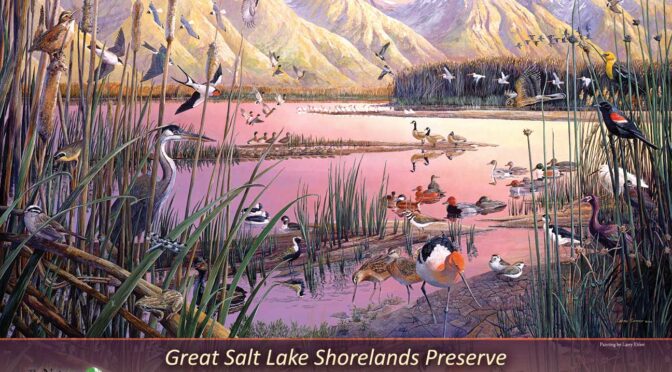
A pallet full of new jigsaw puzzles arrived yesterday. This painting was commissioned by The Nature Conservancy for the Great Salt Lake Shorelands Preserve in Utah, and now we’ve partnered with them to produce a puzzle of the image. The finished puzzle above is the very first one put together by Kody in Salt Lake City and the printing looks very good indeed.

Below is the box back has a species key like all the rest of our puzzles, and now there’s a reference poster inside the box. These are the new smaller boxes for easy storage and shipping.

This is the fifth new puzzle for us in the past few months, a serious leap of faith of the future. We could have bought a new car, but what the heck! We’re investing in us instead.

Thanks for reading.

Larry Eifert

Here’s my Facebook fan page. I post lots of other stuff there.

Click here to go to our main website – with jigsaw puzzles, prints, interpretive portfolios and lots of other stuff.

Nancy’s web portfolio of stunning photography and paintings

And here to go to Virginia Eifert’s website.

Varied Thrush portrait

This painting is sold.

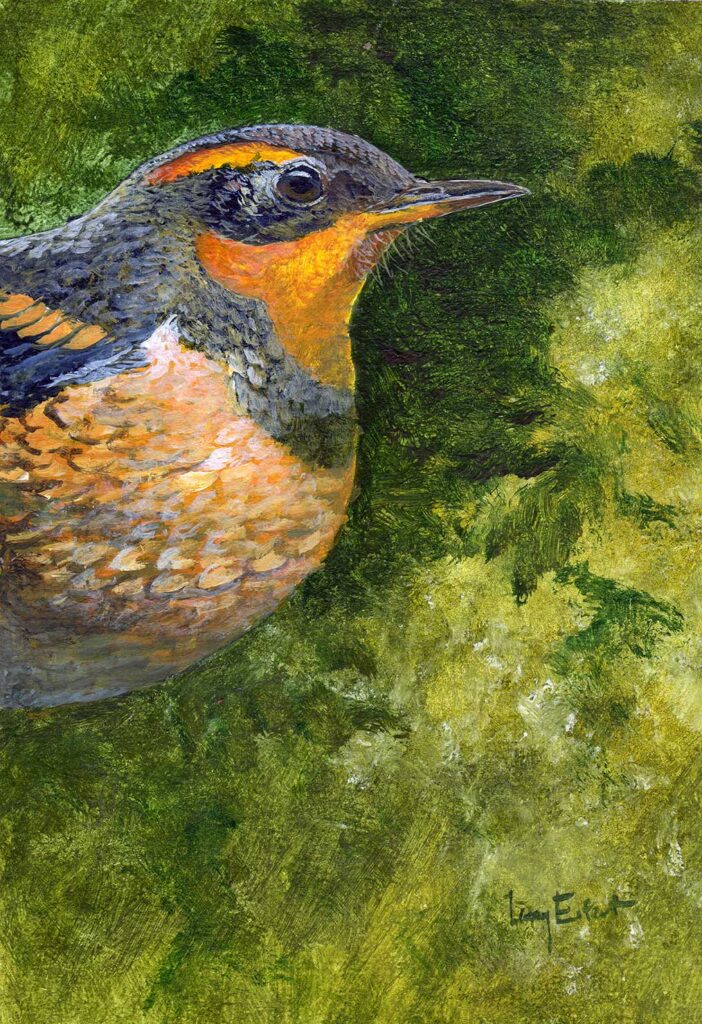
Click on the painting to enlarge it. I like the textures on this one.

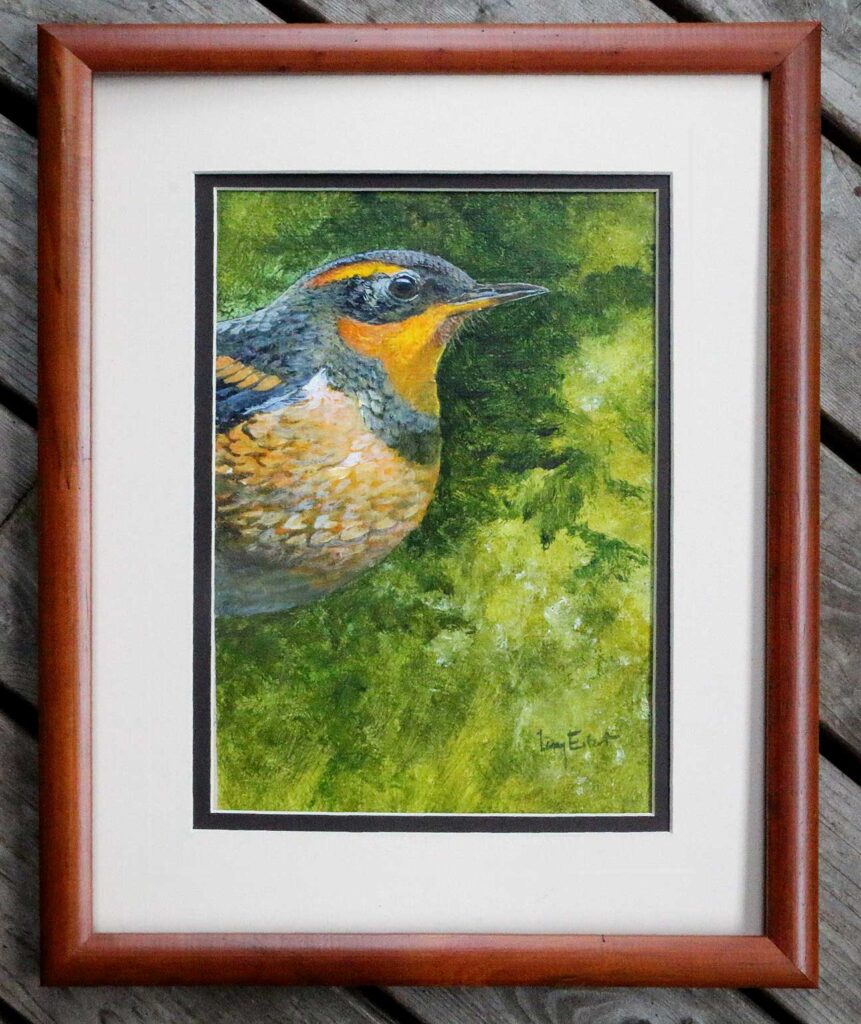
A little songster portrait today. This varied thrush painting is framed as you see it below in an 11″ x 14″ frame with acrylic plexiglass for easy shipping and less reflection than glass. The painting itself is 7 ” x 10″ on paper board and is $395 framed plus a bit of Priority Mail shipping depending on your zone.

We’ve watched countless families of varied thrushes raise their young here along our meadow’s edge. Varied thrushes are in the same family as robins, another singer of great ability, but the varied has a song like it came from a flute – as if Pan is out there drawing you to him with a tempting tune not yet played. There are other, lesser little notes you can hear if close enough, but it’s that single loud note that gets me every time. We hear them singing just at dusk in our patch of forest, and see them coming to the feeder near our pond. They’re what birds should look like, colorful and yet blending in with the forest bark and dark shadows. Once they land in the duff, they seem to just disappear.

Here it is matted and framed, definitely not invisible.

Thanks for reading this week. Just send me an email at larry@larryeifert.com if you’re interested in a nice Christmas present.

Larry Eifert

Here’s my Facebook fan page. I post lots of other stuff there.

Click here to go to our main website – with jigsaw puzzles, prints, interpretive portfolios and lots of other stuff.

Nancy’s web portfolio of stunning photography and paintings

And here to go to Virginia Eifert’s website.

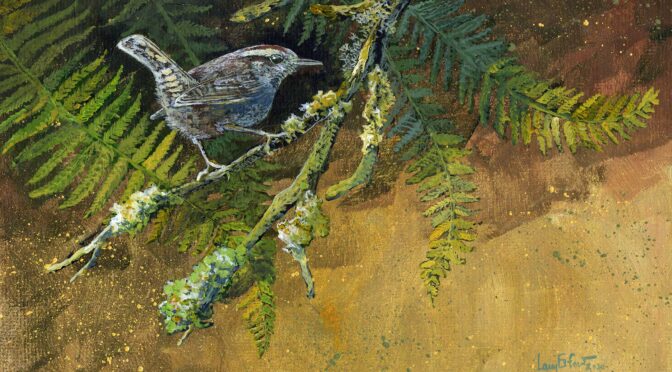
Bewick’s Wren beside our porch

This is a new painting, and it’s sold.

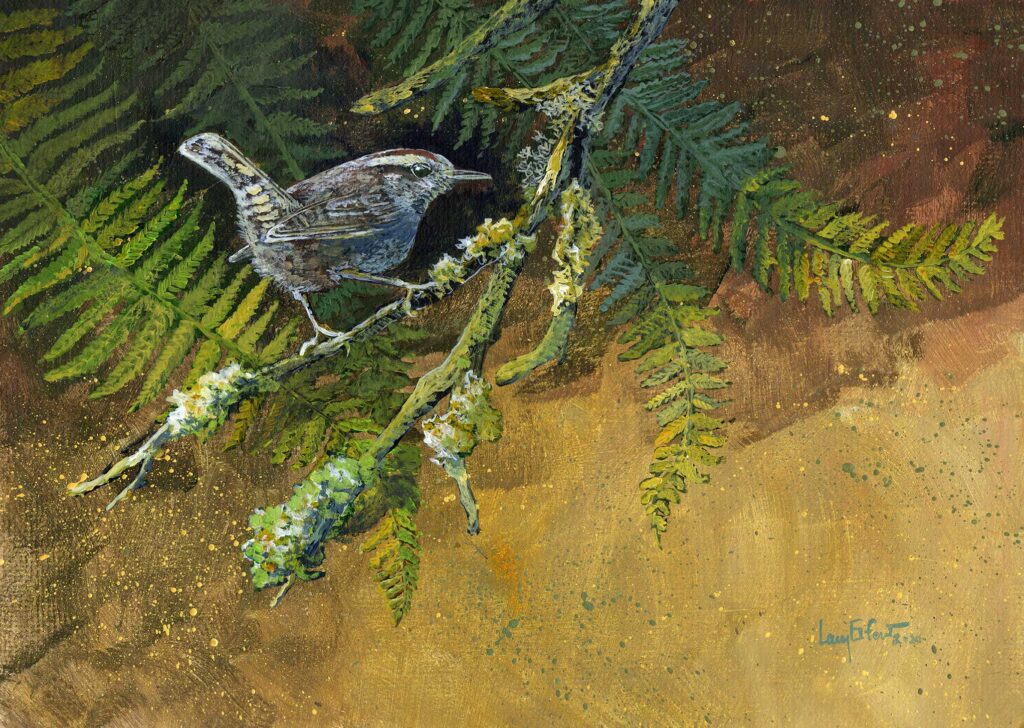
We live in a forest, beside a meadow. Every time I leave the house, go down the back steps on my way to the studio, I see a little flash of tail scurry by – swish, and it’s gone. It’s like a mouse, but with wings. I think this little Bewick’s is a pretty good reason to live here and I’ve painted images of them often. After getting bird drawn, I simply went a few feet from my studio steps, snatched up a fern frond and grabbed a bit of branch the last storm blew off one of the alders. Right there, the makings of ‘still life with little bird’, a painting was born.

I’ve always painted this way, taking careful notice of what’s around me, piecing together a design and putting it down on paper. I can do this at my home or in some alpine meadow, and it always seems to give me a thrill to see it come to life.

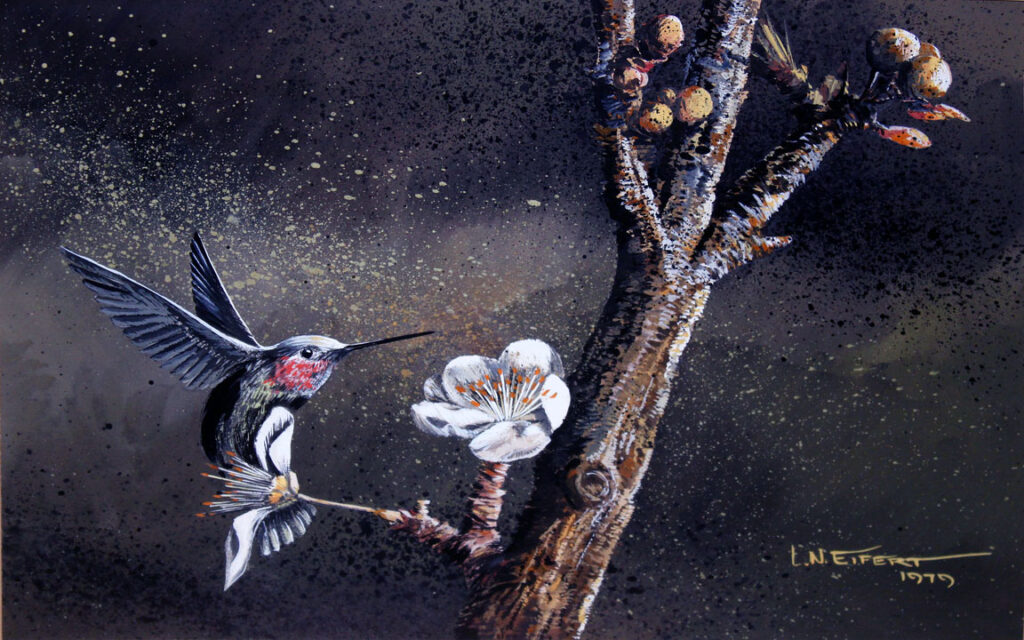
Here’s one of the oldest efforts I have record of doing this routine. Someone sent me this painting from 1979. What was with all that black? I don’t even own a tube of black paint today. I don’t have the foggiest idea, but this has been a long journey of trying things out, refining my efforts and trying to make each one better. This little hummingbird painting is 41 years old now! It was painted in opaque watercolor, a paint I worked with for a couple of years while trying to figure out how to use this stuff most call kid’s poster paint.

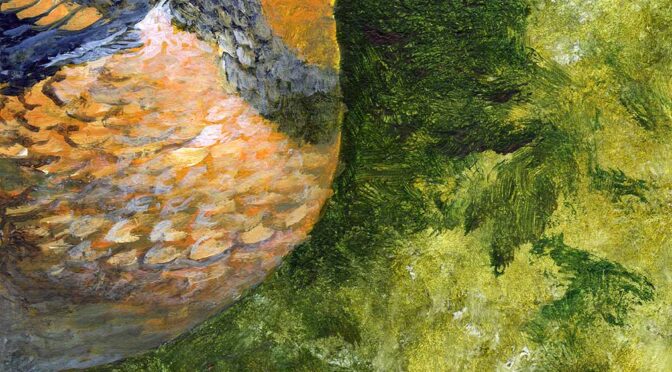
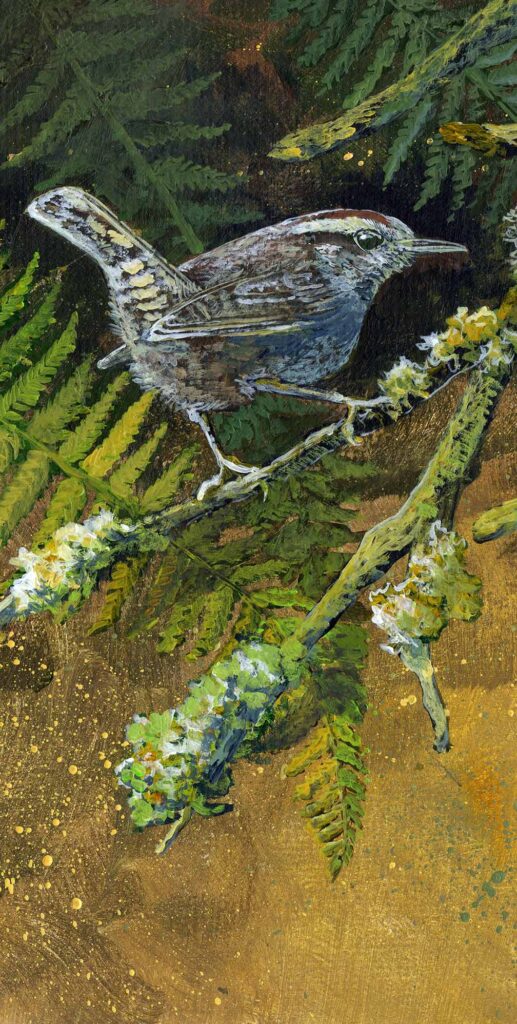
And just one more showing a section of this new painting – I have improved a bit. Maybe.

Thanks for reading this week.

Larry Eifert

Here’s my Facebook fan page. I post lots of other stuff there.

Click here to go to our main website – with jigsaw puzzles, prints, interpretive portfolios and lots of other stuff.

Nancy’s web portfolio of stunning photography and paintings

And here to go to Virginia Eifert’s website.

Harlequin Ducks – Dark Pool

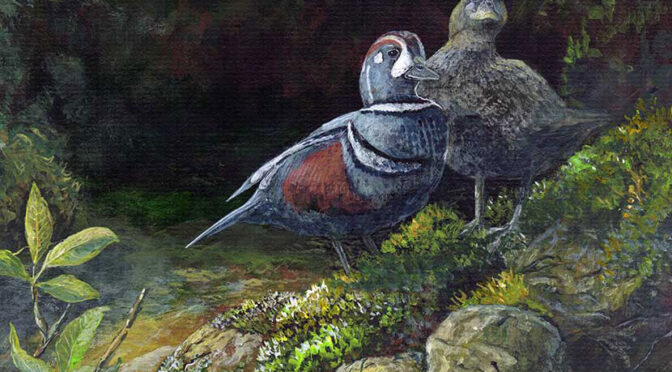
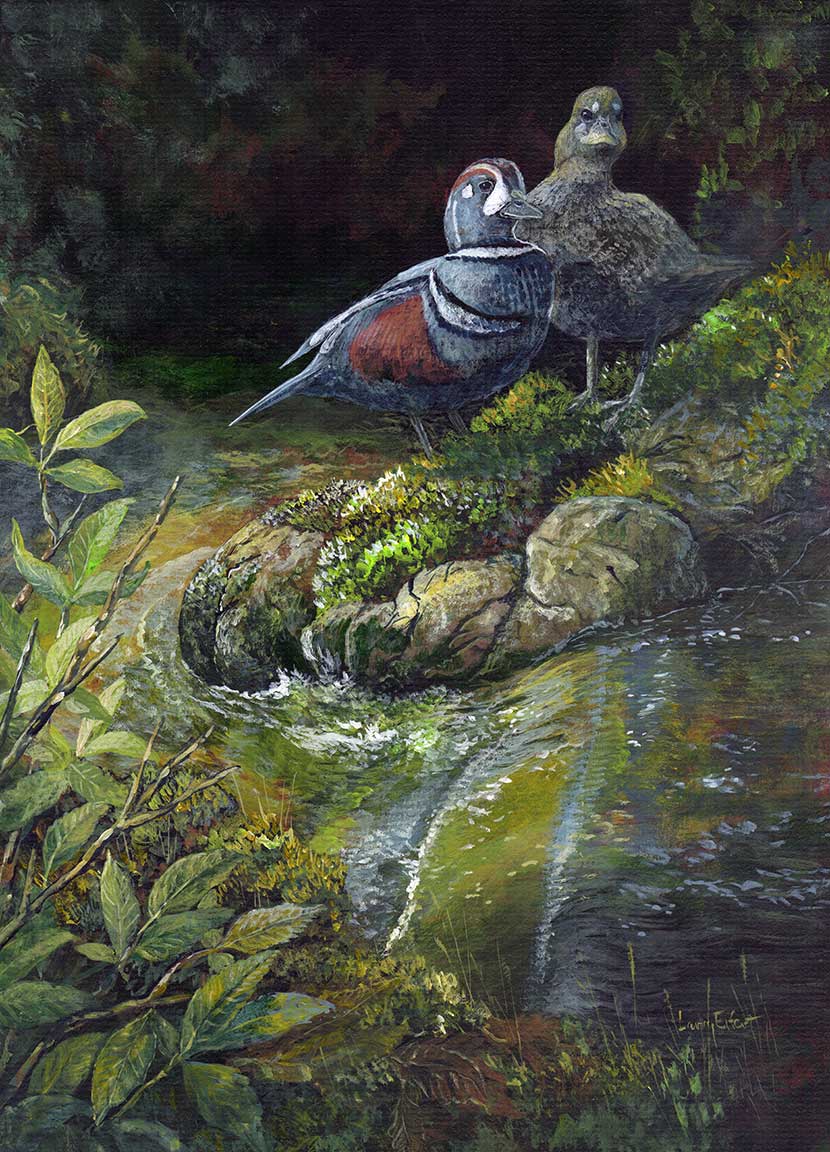
You’ll see I enjoy painting water, figuring out how motion looks in a stop-action moment as it falls over a rock or crashing onto a shoreline. Harlequin ducks evidently like it too, because you’ll never see these guys anywhere but around water. In winter they’re on saltwater, in summer they migrate up into the mountains to nest in streamside tree cavities. In the Olympic Mountains near where we live, I’ve seen them sleeping on river rocks, the water roaring around them. They seem to enjoy the most whitewater available, because I’ve often seen them riding the waves downstream. I’ve read that Harlequins often break bones doing this, and they often heal in badly misshapen ways – but they still do it.

I last saw one of these beautiful ducks up Heather Creek, a fork of the Olympic’s Dungeness River at a stream crossing. The duck was next to my ‘bridge’, a log jamming up the river’s passage. She was sitting on the bank under some willows, and I blundered out of the forest right next to her.  I stopped, grabbed my point-and-shoot. She looked up at me, then just ignored my presence as she studied the stream for small fish. 

What really got to me was the seeming frailty of this little creature, a small duck the size of a shoebox, alone here,  by herself in the wilderness and intent on making a living. Here I was, an old guy intent on staying alive so I could come back to these places as many more times in my remaining years as possible, just happy to be standing right next to this beautiful animal. She had no idea, of course, of her importance – which continues here.

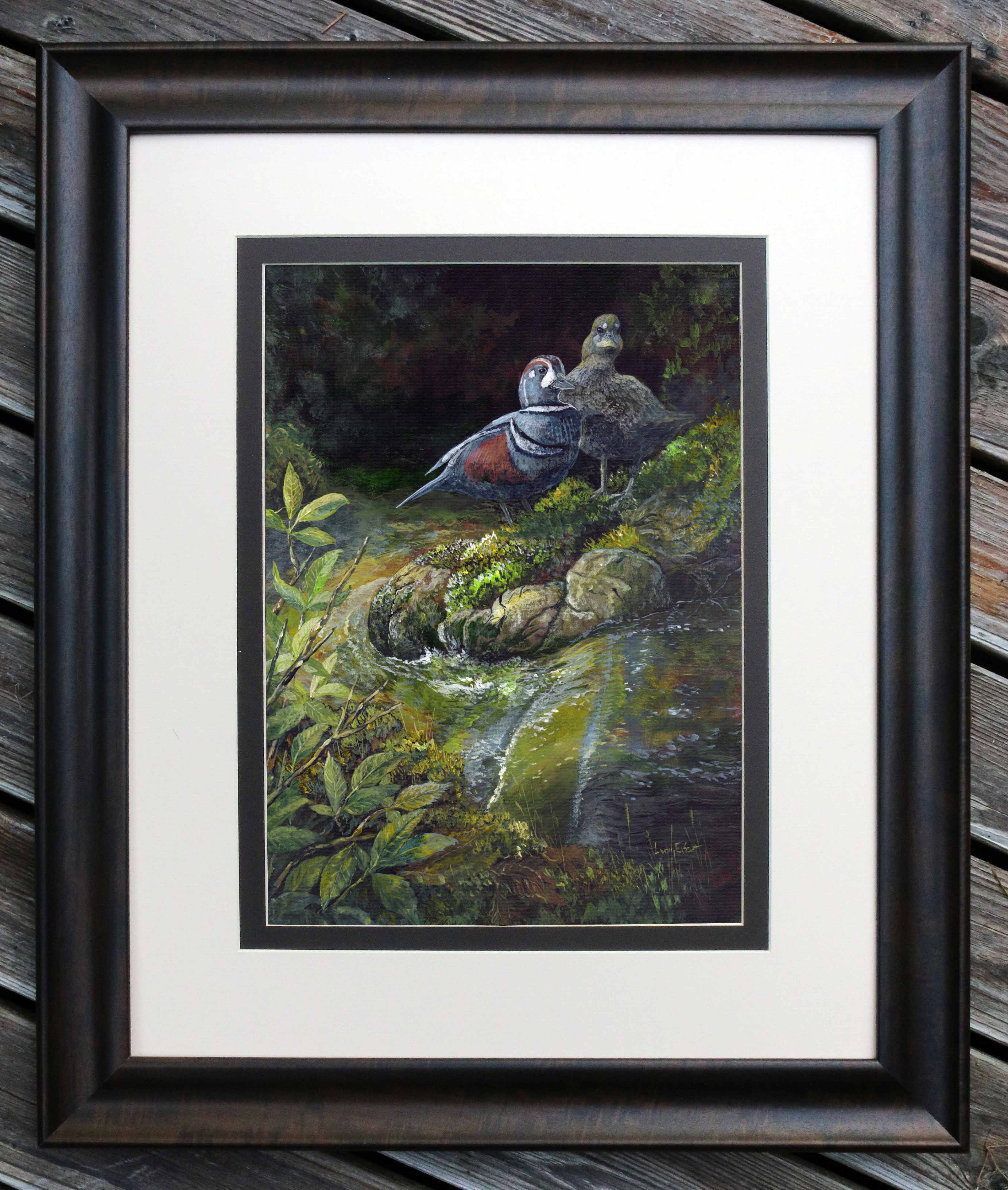
This painting is now for sale. It’s framed and the outside measurements are about 20″ x 24″ matted and under glass for $3450 total for both frame and painting. The acrylic painting is on board and is 10″x14″, the glass is 16″x 20″. We have this frame on it now, but others are available. Shipping is a bit more. Let me know if you’re interested with an email at larry@larryeifert.com

Thanks for reading this week. Oh little duck, where are you today?

Larry Eifert

Here’s my Facebook fan page. I post lots of other stuff there.

Click here to go to our main website – with jigsaw puzzles, prints, interpretive portfolios and lots of other stuff.

Nancy’s web portfolio of stunning photography and paintings

And here to go to Virginia Eifert’s website.

Canary Rockfish and Tube-dwelling Anemones

Two new published stories, both in 48 North magazine a couple of months ago, the summer of 2020. This first story was about possibly the showiest and most colorful rockfish in the Pacific Northwest. It is sort of rockfish heaven here, with 17 different species, all somewhat different.

Here’s my sketch before the color version.

My story was about rockfish that can live to be over one hundred and how conservation can actually work using science. Imagine that, using science! BELIEVE IN SCIENCE! By the way, DID YOU VOTE?

Just as their name suggests, these guys prefer to live around rocks. 28 species of rockfish live in the Salish Sea, from 3-inch tide pool dwellers to 3-foot lunkers that live in deeper water and weigh in at 25 pounds. Most are slow-growing and long-lived, some live to be more than a century old. They have a completely different lifestyle from live-fast and die-young salmon. Foraging for other fish, they may swim only a few hundred miles in their lifetime. Rockfish tend to hang out together in groups around rock pinnacles or cliffs, places with lots of tidal current (which helps bring meals to them and not the other way around). Canary rockfish usually have three stripes angling down and backwards on the head, the middle one often runs across the eye. This is a very bright and distinctive fish.

The conservation of this fish is a real success story, and one that shows how science and government work together to make our lives, and the fish’s lives better. After discovering how good rockfish tastes, a definite over-exploitation of these tasty fish began in the 1800’s until canary rockfish were declared overfished in 2000 when it was discovered that rockfish had declined 70% since the 1960’s. Fish and Wildlife submitted a petition to have 14 rockfish species listed under the Endangered Species Act (eventually, all these were not listed). Enter science-based studies of them, plus just plain asking fishermen “where are you catching canary rockfish so we can have you fish elsewhere”. Fishing rules were changed, different gear was introduced and suddenly, in half the time it was thought it hopefully might happen, we have plenty of rockfish.


My second story was about another Northwest creature, one that has adapted to its environment in a beautiful way, but hiding underground from its predators.

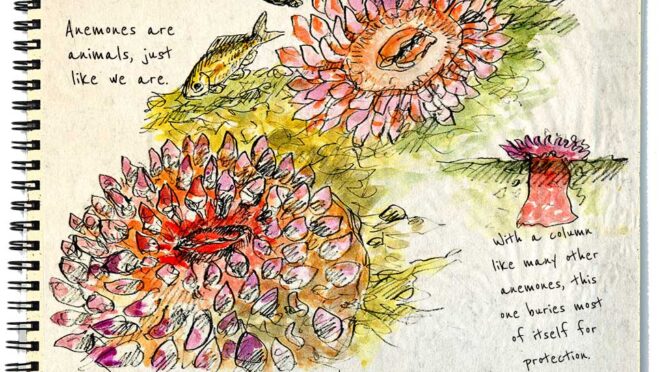
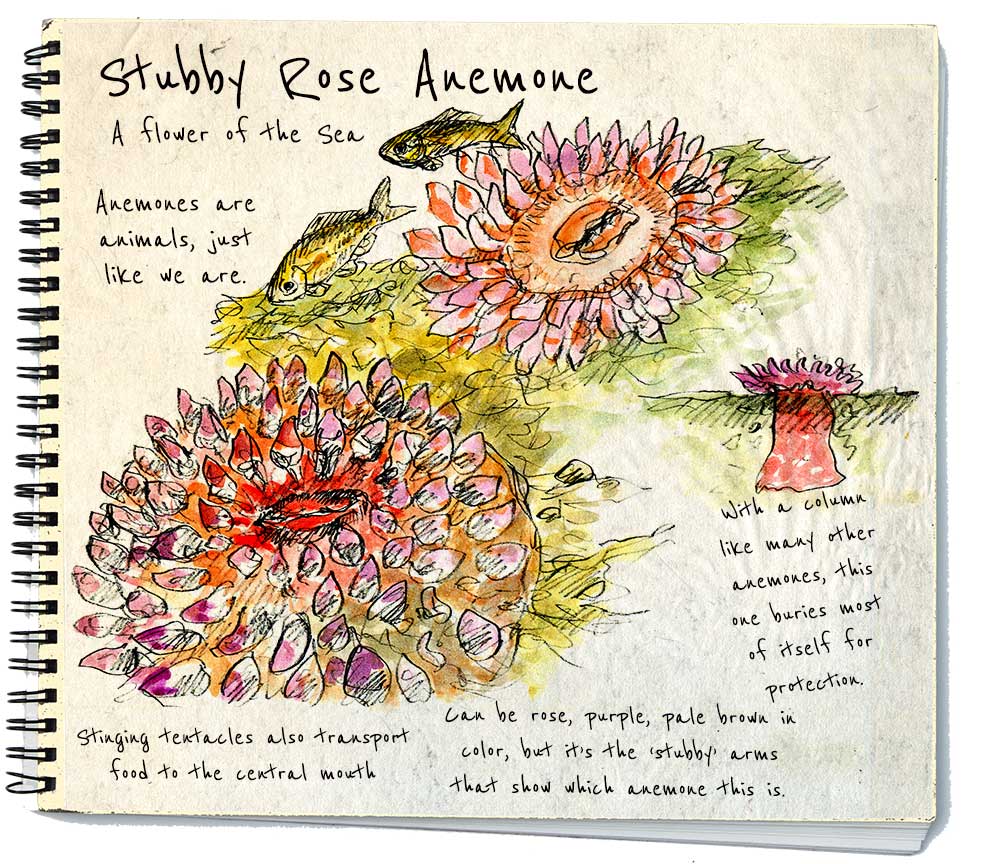
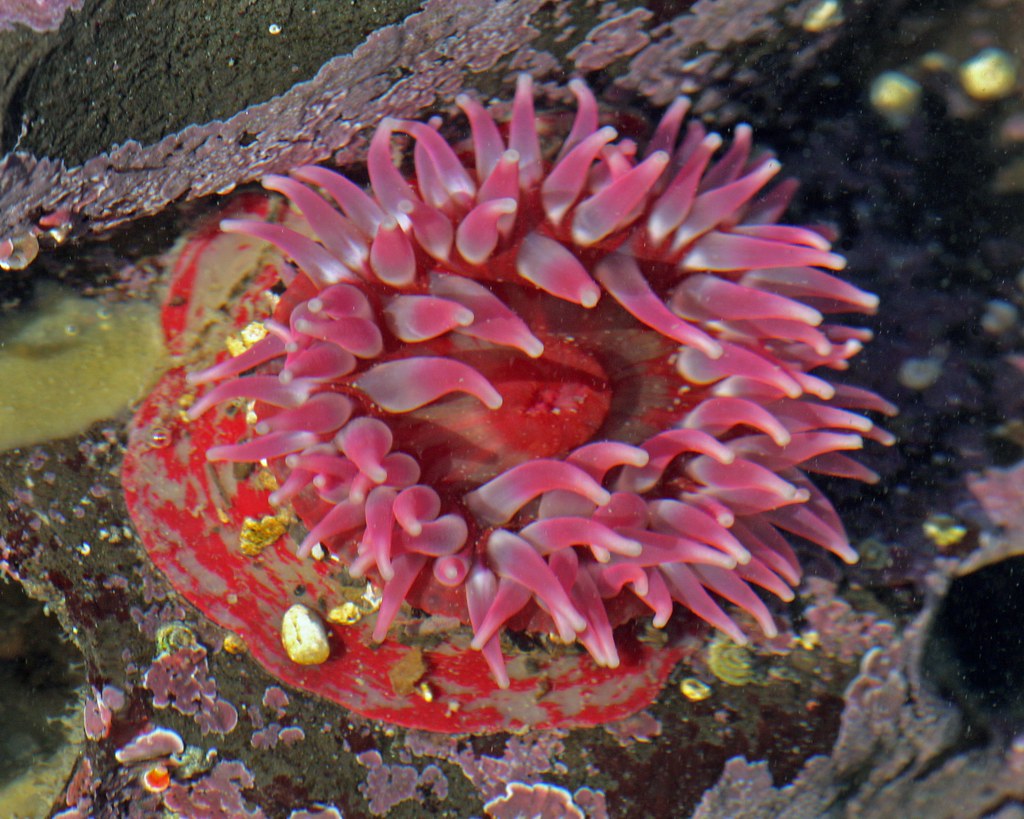
A delicate flower-like anemone that is actually an animal. Yes, an animal that you’ll find just beneath your keel in sheltered mud-bottomed bays. While it looks more like a tube worm, this creature is actually related to jellyfish. Confusing, but to me it just shows the complexity of the underwater world we rarely see, and why I enjoy writing this page. These animals appear to have stout tubes below their tentacles waving in currents as they search for bits of food to snag, but they are actually soft and vulnerable. To protect themselves, they burrow into the mud and generate a fibrous string-like material they weave around themselves, almost like they’re knitting a sock. This can extend from above the surface down beside them into the mud as deep as three feet, a woven structure they live in, safe from predators. When one threatens, the anemone quickly pulls itself down into the protective tube.

While many anemones have stout fans of tentacles and large bodies holding them up into the current, this species relies on the mud substrate and a house of its own making. When its main predator, the giant nudibranch, grazes on the anemone’s tentacles, it also lays its eggs right on the outside of the anemone’s tube, putting the young’s first meal close at hand. You might think this would be the end of the anemone, but nature has evolved tentacles aplenty so both species survive. The anemone commonly lives up to 10 years and often congregates in colonies that resemble flower-filled meadows, the tenticles waving as blossoms in a gentle breeze. Flowers they are definitely not, animals are certainly are.

And here’s my original sketch before the color was added. Notice the unfinished part on the right, just part of the process.

I’ve written for this magazine for over a decade now. When it was a sailing journal, they used my art on the covers and published many of my longer stories. It’s a broader publication now, trying to a bigger audience, and it still gives me pleasure to contribute. It was sold to the Port Townsend Northwest Maritime Center a couple of years ago, bringing it closer to my home port where I continue to sail and kayak. It’s a meaningful bit of life to me, experiencing nature here at home and then writing and painting it for others to enjoy.

Thanks for reading this week. You can sign up for emails for these posts on my website at larryeifert.com.

Larry Eifert

Here’s my Facebook fan page. I post lots of other stuff there.

And Instagram is here.

Click here to go to our main website – with jigsaw puzzles, prints, interpretive portfolios and lots of other stuff.

Nancy’s web portfolio of stunning photography and paintings.

And here to go to Virginia Eifert’s website.
Moran State Park – Orcas Island

Please click the image so it enlarges in your browser. The painting is 12 feet wide, the deer life-sized, so it’ll take a bigger screen than your phone to see it.

This is soon to be installed at Moran State Park on Orcas Island in the San Juan Islands of Puget Sound. It’s going to be high atop Mount Constitution, almost 2400 feet above the sea level. A new visitor center there will feature this large set of paintings as the main exhibit. I painted the background, all the art in the circles and deer separately. It’s all being fabricated in high-pressure laminate so it’s tourist-proof. EDX, the fine exhibit company I work with in Seattle did the design, text and all the rest for Washington State Parks, and Beth Gibson at EDX handled me – never an easy thing.

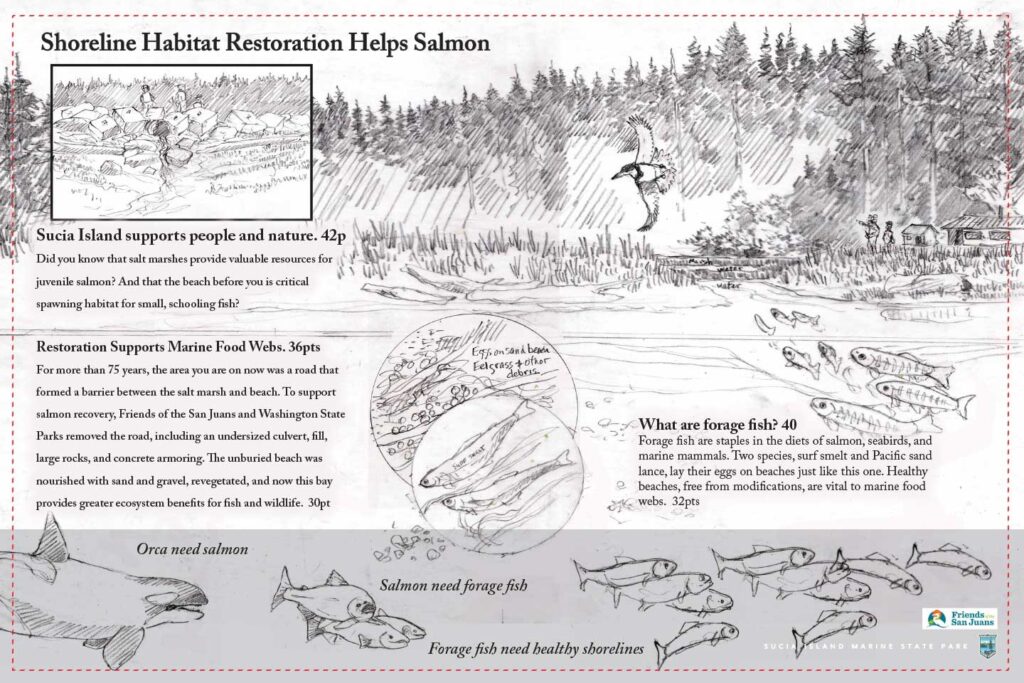
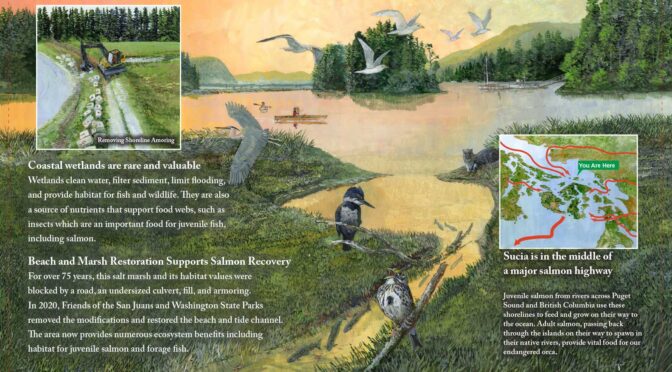
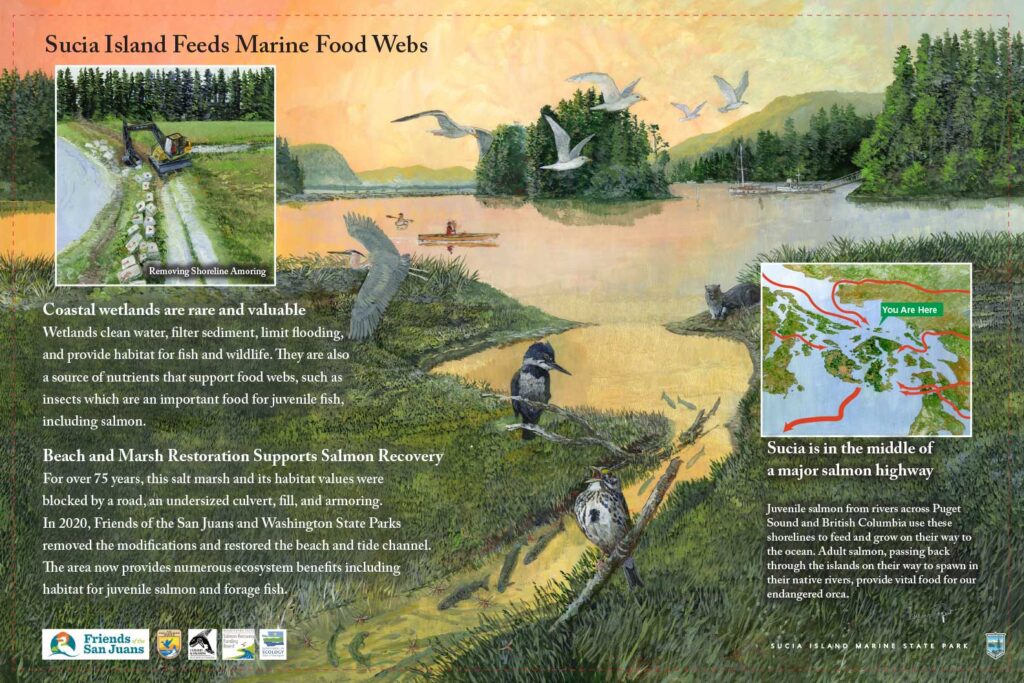
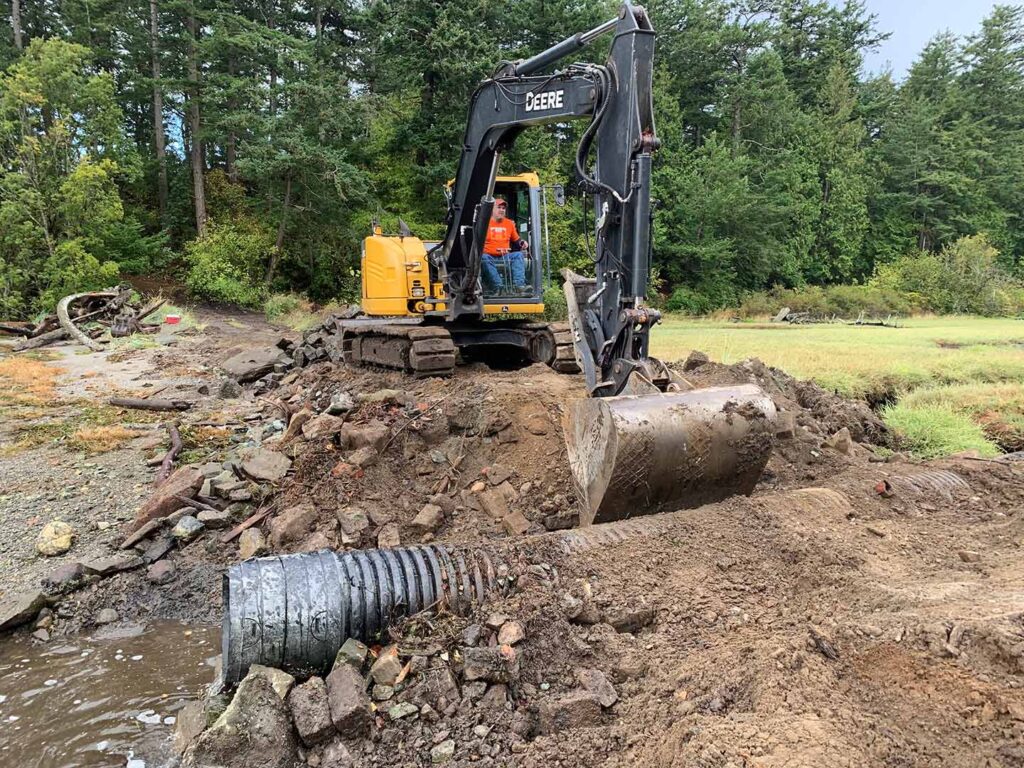
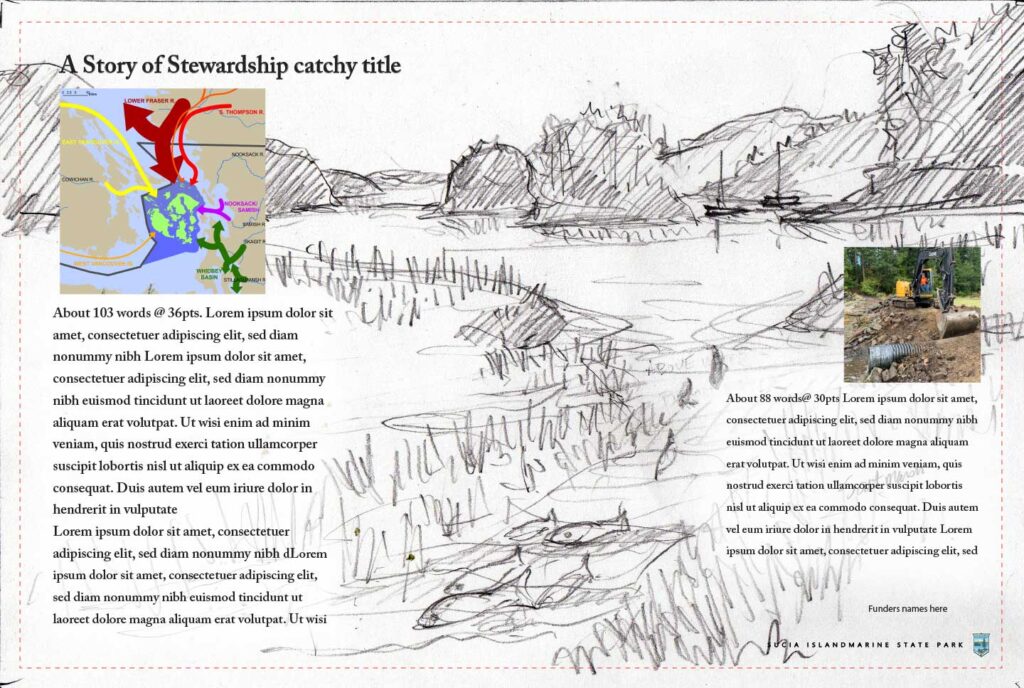
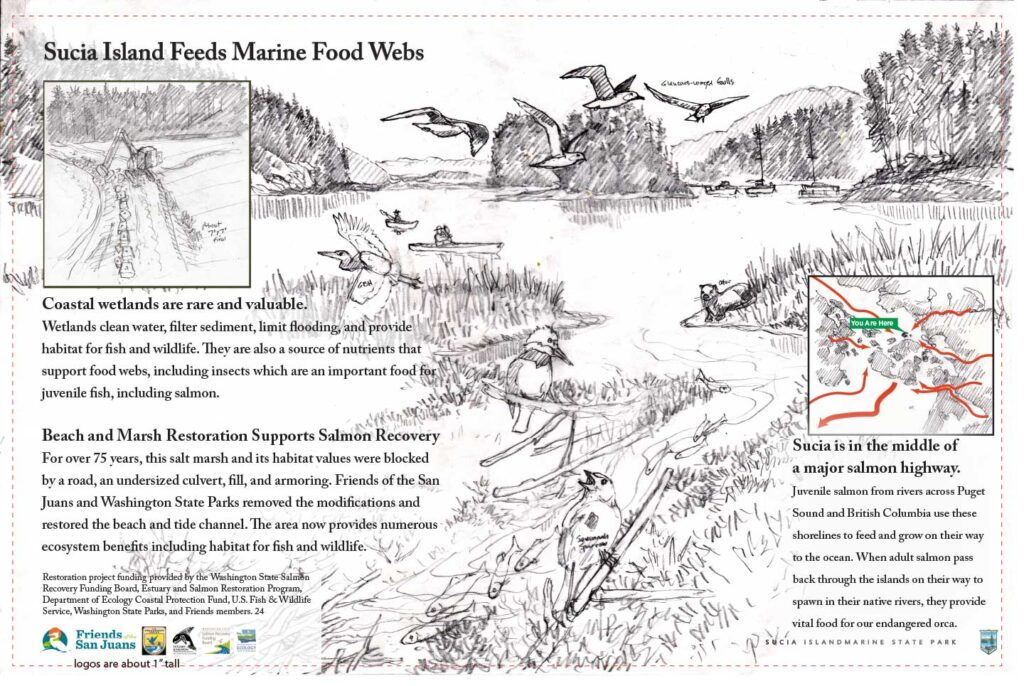
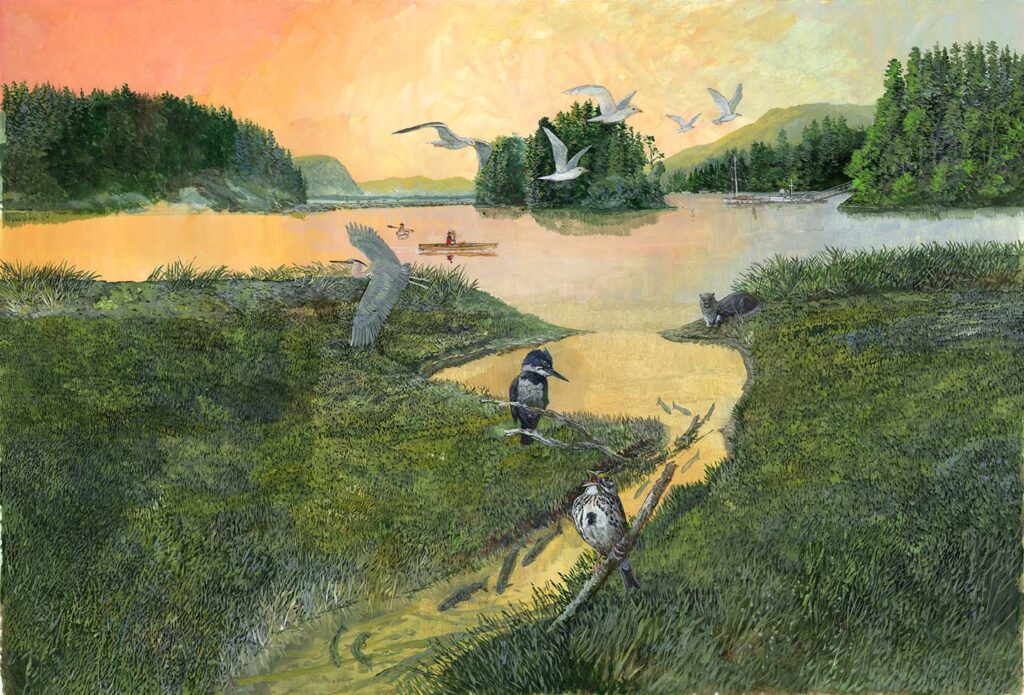
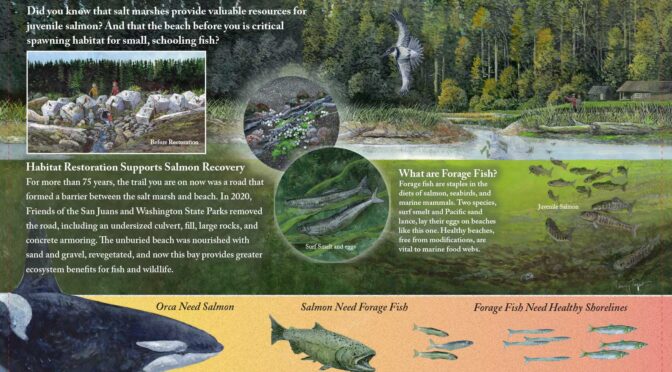
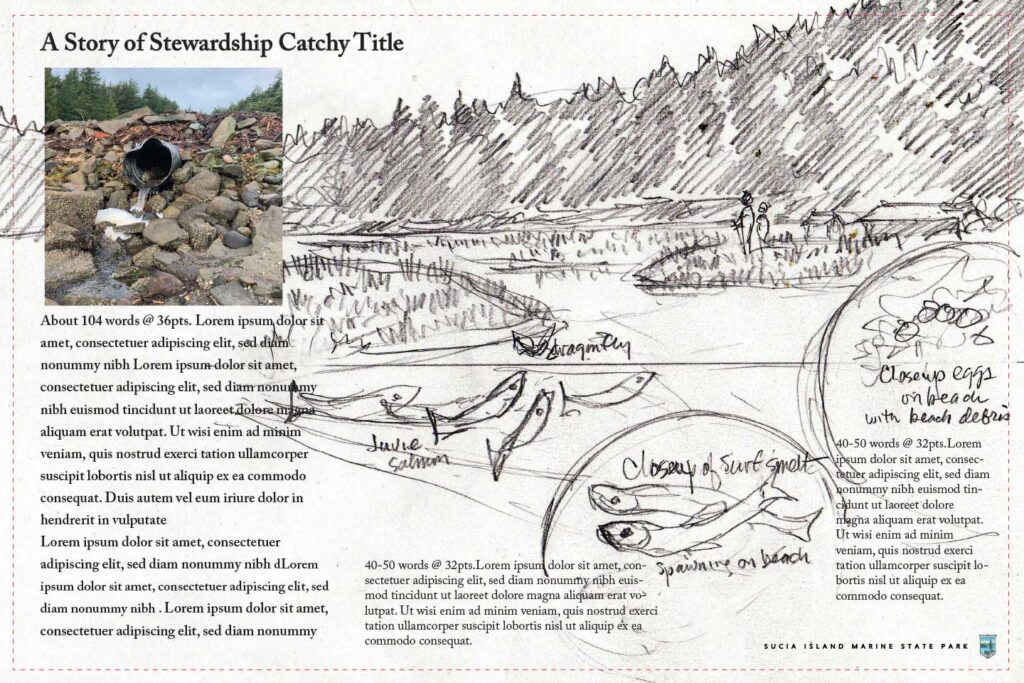
With this installation, I’ll soon have 18 exhibit paintings on or near Orcas Island. Another five are on San Juan Island next door, and two are soon to be installed on Sucia Island, a remote offshore park just to the north – wayside panels about salmon recovery. I’m thrilled with all this, because I spent much of the 1980’s living aboard my little boat right here and know the place well. It’s like I’m giving back for some very fine life experiences I had in that area, and especially Sucia Island, a really special place.

The strange deer! Because of the isolation of Orcas Island, the Columbian Black-tailed Deer that live there have a closed genetic pool (it’s an island), and so have evolved into what’s called a pie-bald form. These deer feature odd unpigmented skin areas, white skin and fur, but they are also smaller and somewhat oddly shaped. It wasn’t an easy subject to paint, but this little guy will be life-sized in the final installation. I took the most interesting features of several and stuck them together.

Spread across the background of Mount Constitution are a dozen smaller circle paintings with the real interpretation, stories about the geology, orca whales, forests and marshes. These had to be interesting paintings but not too complex as to be confusing. This one is about the mountain ‘balds’, areas of open prairie, gacial boulders and few trees.

All this was great fun for me. I love the challenge of painting big walls with lots of details all having various stories packed into one wall.

Plan a trip to Orcas next summer and see it for yourselves. Say hi to the piebald deer. 

Thanks for reading this week. You can sign up for emails for these posts on my website at larryeifert.com.

Larry Eifert

Here’s my Facebook fan page. I post lots of other stuff there.

And Instagram is here.

Click here to go to our main website – with jigsaw puzzles, prints, interpretive portfolios and lots of other stuff.

Nancy’s web portfolio of stunning photography and paintings.

And here to go to Virginia Eifert’s website.
Shearwaters and Otters

These two stories were published back in early summer in 48 North magazine. I always give the magazine first showing, wait a bit and then publish here, too. This first story was about a rather amazing little bird that migrates 38,000 miles each year, circumnavigating the Pacific, and in early summer they stop by here. Take a minute and read the brief little story after the paintings. Times are tough for wildlife, but this guy makes me want to make sure they continue their solitary lives in a healthy way. I know I’m preaching to the choir here, but this means: VOTE! All of us, you and me, and these little birds will have a better chance if you do. For the first time in my long life, I see an election that is truly critical to our continued existence.

Published in a magazine that has sailing stories, I wrote about what you’d see offshore west of my home in Port Townsend, Washington. I’ve been out there and seen these little birds myself.

I hear you’re voyaging to Barkley Sound or Down-the-Outside this summer! When you’re out there, keep a sharp watch for this little crow-sized bird soaring past, sailing along like a miniature albatross. If you see one, you’ll be getting to know a REAL voyager. These small birds fly with quick stiff wingbeats and soar low over waves, using the uplifting power of air coming off the swells to expend little energy to keep aloft. They need that, because these oceanic aviators go astounding distances. Each year, they fly from nesting burrows or rock crevices on islands around New Zealand, Australia and South America, and head north, following a figure-8 pattern. Passing Japan in April, they head to the arctic and then pass us in the Northwest on their way back home.

In all, that’s 38,000 miles, or 1.5times the distance around the Earth. (Only arctic terns make a longer flight each year.) While doing this, they only rarely meet other shearwaters, and yet there are 20 -30 million of them doing this – and there’s a second race in the Atlantic flying a similar route. Imagine! When they all get back home for nesting season in the Southern Hemisphere, they get together, sometimes in massive flocks (probably to catch up on things). Watch for the silver wing flashes and a dull brown coloration – stiff wings and a plump body. Shearwaters are proof to me that, while we’re generally busy goofing things up, there are creatures out there that are pretty much oblivious to our presence.


Tracks in the Sand

This second story, published this summer, isn’t about the wildlife as much as it’s about the tracks left by them. You don’t need to ‘see’ the otter to know it was just there, ambling down the same beach you’re on now. And, if you know what you’re looking at, you realize it might not be an otter, but something else. The tracks in the illustration were life-size.

Here’s the story that went with the paintings:

Land your boat on a sandy beach and you’ll probably soon see animal tracks in the sand. The most common are dog, bobcat, mountain lion, river otter and people. If you’re lucky, it’s a mix of all four. River otters remind me of an extremely hairy dachshund, same size (to 30 pounds and 3 to 4 feet including tail. Their fur is long and thick, keeping them warm swimming in our cold waters. The long and strong trail helps propel them like a sculling oar, but they are also at home on land and can run up to 15 miles an hour. I’ve been cornered in a parking lot by an entire family of them.

The tracks in the sand you see could very well be river otters, but not sea otters that rarely come ashore and aren’t common in the Salish Sea anyway. Look for details. The hind feet show a single claw apart from the other four. Front feet show all five like a dog. All will show front claws and you might even see the connecting web between the toes. Dogs show claws, but not the separated hind toe. Cougars have huge prints like big dogs, but don’t show claws. Bobcat track: only 1.5” across and only four toes show. Here’s the thing to remember. It matters little that you actually SAW the critter that made the track, because you saw proof it was here. I’d say that’s good enough.


I have a long history with 48 North magazine and their parent organization, The Northwest Maritime Center, based in Port Townsend, WA. In the 90’s and early 2000s, I was on the board of the Wooden Boat Foundation, Nancy was store chandler selling all manner of wooden boat equipment – and now here I am, still plugging away at making art for the same group – but these days it’s published in their magazine. I enjoy these brief monthly forays into aquatic nature. I learn a lot.

Thanks for reading this week. You can sign up for emails for these posts on my website at larryeifert.com.

Larry Eifert

Here’s my Facebook fan page. I post lots of other stuff there.

And Instagram is here.

Click here to go to our main website – with jigsaw puzzles, prints, interpretive portfolios and lots of other stuff.

Nancy’s web portfolio of stunning photography and paintings.

And here to go to Virginia Eifert’s website.
Dipper and Misty Waterfall Painting

This painting has been a work in progress for long enough, so  I thought I should offer it here to end my fussing with it.

These little seasonal streams are everywhere in the Northwest, and you can’t hike too far without seeing a few. I like them, each one different, and American Dippers also like them possibly because they’re less dangerous than big and more powerful waterfalls that can crush little birds. I read that harlequin ducks who share these same habitats have been found to have many healed broken bones from crashing about underwater in these streams. It’s probably the same for smaller dippers.

I like the textures in this painting, so maybe that’s why I kept it around, making it more textural, then less, then – oh just sell it. Like the painting process, nature is messy, until you understand it, and in this case the way ferns and saxifrige leaves all jumble together, each staking claim on a momentary bit of sunlight streaming through the canopy. When the light finally does penetrate all the way to the forest floor, it’s like a brilliant spotlight is highlighting an actor in a play.

This painting is acrylic on board and is 11″ x 14″.

I have a scan that can make a high-quality print up to 32″ x 42″ on canvas. 

And currently, it’s framed as you see it here under glass in a wood frame. Outside dimensions are 20″ x 24″. It’s acrylic on board, so it might not need the glass.
Dipper-Misty-Waterfal-framed

Price for this painting FRAMED as you see it is $295, about 40% less than gallery price. Shipping would add a bit more. 

Email us at larry@larryeifert.com

Thanks for reading this week. You can sign up for emails for these posts on my website at larryeifert.com, down the right side of the home page.

Larry Eifert

Here’s my Facebook fan page. I post lots of other stuff there.

And Instagram is here.

Click here to go to our main website – with jigsaw puzzles, prints, interpretive portfolios and lots of other stuff.

Nancy’s web portfolio of stunning photography and paintings.

And here to go to Virginia Eifert’s website.