Tag Archives: Easel Paintings

A Show at Gallery Nine in Port Townsend


For the month of November, Gallery Nine, 1012 Water Street in Port  Townsend features the paintings of Larry Eifert and Chuck (CW) Stern’s wood turning in a show about the Craftsmanship of Art.

Both Nancy and I are represented by this peninsula gallery, and I so rarely do any shows I thought I’d post the event here. For this, I’m partnering with Chuck Stern, a wood turner and carver whose work I consider to be of the highest quality. It’s a nice mix because I tend to paint wood in the form of forests and trees – Chuck uses wood to create his art.

(Here is a part of the press release) Chuck Stern turns both functional bowls and vases as well as carving unique burl wood into beautiful, sometimes whimsical sculptures. His love and close knowledge of wood comes from a lifetime on the Olympic Peninsula working in many facets of the wood industry, and it’s clear that Stern knows wood in a way that is not simple or superficial. “It’s taken decades to understand that once-living wood has a history buried within it. Each year, each growth ring, each winter storm or injury creates an internal change I need to recognize, understand and try to incorporate into my finished piece. It’s not just slamming it on the lathe and turning out a bowl, but more a conversation with an ancient once-living soul.” 

 Join the artists for conversations about their work during November’s Gallery Walk, 5:30 to 8 pm, Saturday, November 5.

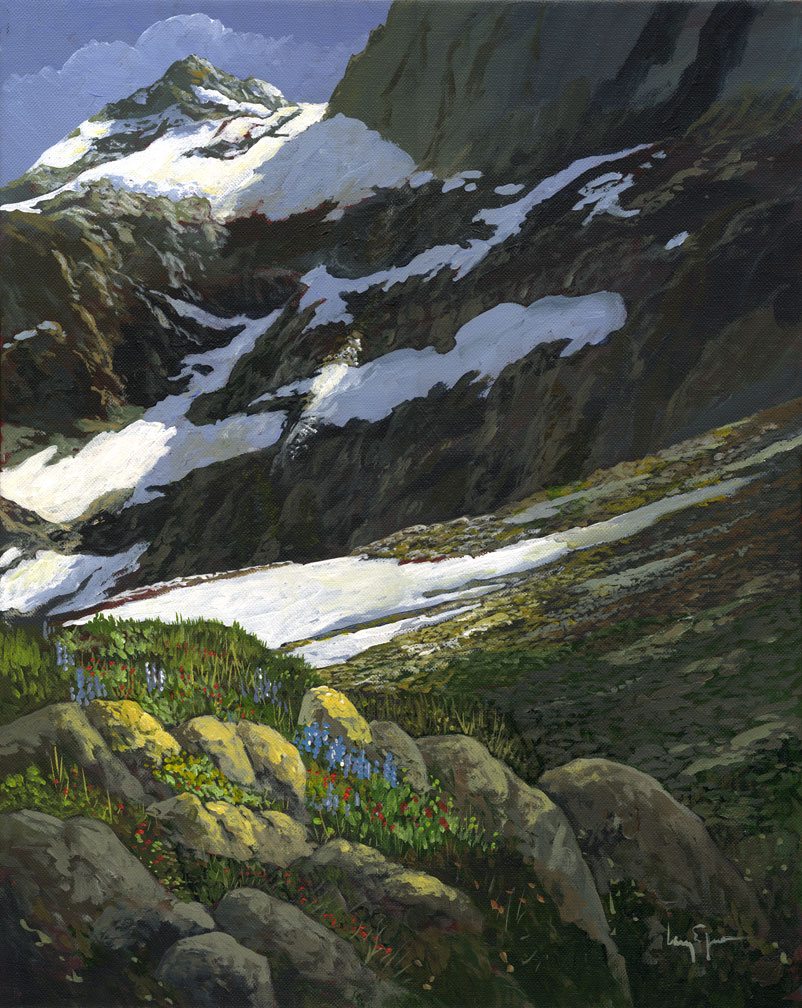
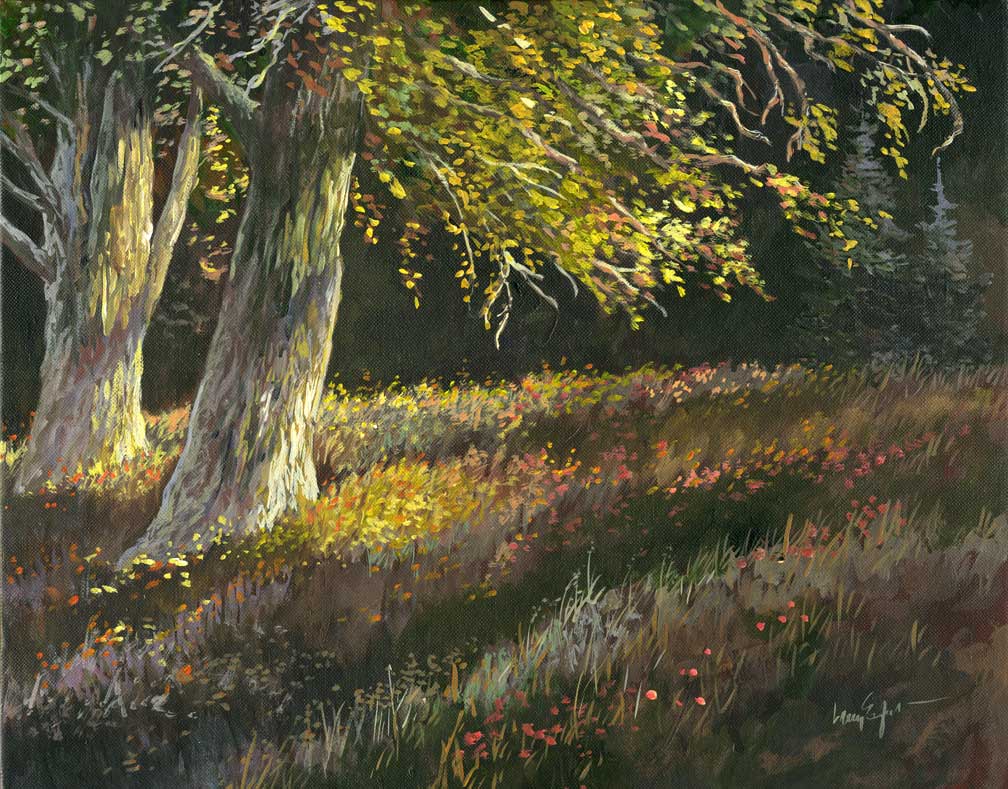
For my part of the show I’ve worked up 20 new paintings (these, besides the three big murals I’m currently involved with that aren’t finished yet means I’ve been busy). If you’re interested in the painting shown here, as of this posting it’s still available. “Heather Meadows ” is 11″ x 14″ on canvas. It’s available for $140 without a frame. A nice custom wood frame makes it $165 and shipping adds a bit more depending on your zone. If you’re interested, email me and I’ll put a hold on it.

Thanks for reading this week, and if you’re here on Saturday, please stop by Gallery Nine. Larry Eifert

Click here to go to the online blog this was to. And here’s the link to Gallery Nine’s website.

Click here to go to our main website – packed with jigsaw puzzles, prints, interpretive portfolios and lots of other stuff.

Click here to check out what Nancy’s currently working on with her photography.
Cutthroat Creek Meadows

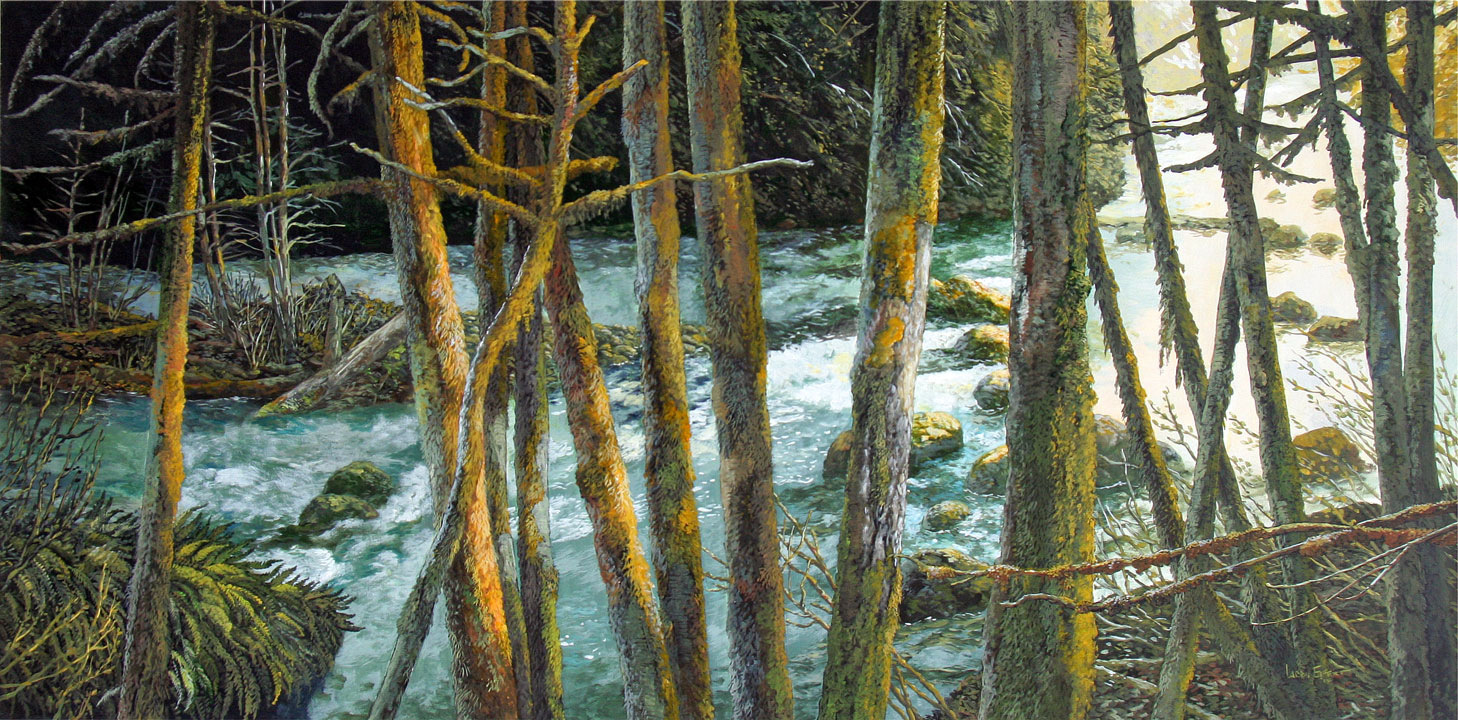
This painting and about 20 others are destined for a November show I’m having at Gallery Nine in Port Townsend. If sold here on the blog, I hope I can still hang it there for a week or so. While only about 5% of my mailing list is from Port Townsend, I’ll be hanging the show on Monday if you’d like a pre-show preview before Saturday Gallery Walk.

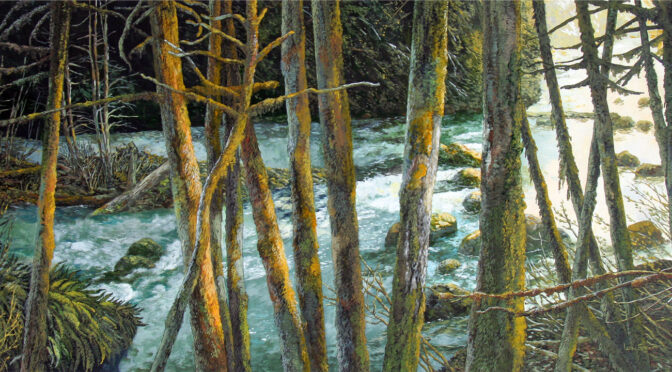
Cutthroat Lake is on the east side of the North Cascades, but just barely. Where the snowmelt runs out of the lake, it braids itself through some very pretty mosquito-filled meadows, then comes together to plunge down into Early Winters Creek towards the Methow Valley in eastern Washington. We were there a few months ago and I was interested in the way the light was streaming through the trees and onto the creek. It made for a very interesting and complex set of light patterns around the jumble of islands, downed trees and moving water. From this location, we turned around and walked a few hundred feet, and this was the spectacular scene that awaited us. (Clicking on both these images will enlarge them.)

This ORIGINAL painting is varnished acrylic on linen canvas, 11″ x 14″ and $140 unframed.
The custom wood frame makes it a total of $165 and shipping adds just a bit more depending on your zone or if you take the frame. This is the original painting, NOT a print.

Email us here for details or just hit reply.

Thanks for reading this week.
Larry Eifert

Click here to go to the online blog this was to.

Click here to go to our main website – packed with jigsaw puzzles, prints, interpretive portfolios and lots of other stuff.

Click here to check out what Nancy’s currently working on with her photography.
Tern Lake – Kenai Peninsula

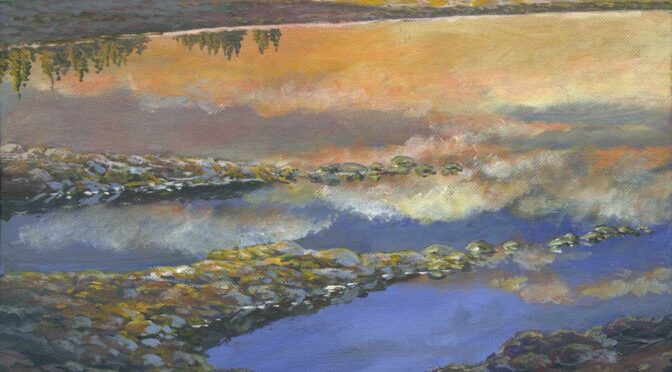
While on Alaska’s Kenai Peninsula recently I did some preliminary stuff for a few paintings when I returned home to the studio. Here’s the second one, inspired when the late afternoon light was streaming through a mountain notch and lighting up this marshy lake. The golden atmosphere made the air really glow. These mountains were so high and steep I just couldn’t get their tops in the painting, but the blue atmosphere up there gives you a hint of what’s high above. We saw mountain goats in the upper meadows up there, tundra swans and green-winged teals on the lake. It was a soft environment just holding its breath for winter to begin.

What always strikes me about Alaska every time  I’m here is the pure enormity of it all. I live next to Olympic National Park, and it’s a big park – but if you took the time to walk across it, you’d eventually come out and find towns, streets and stores on the other side. It’s like an island of wilderness in the midst of civilization. But Alaska isn’t like that at all. If you walked into THAT wilderness, you simply wouldn’t ever come out the other side. Civilization is a small island within nature. One trail we were on there had a wildlife sightings list at the trail head. It said:eight bears, one moose and calf. So, as we started down the trail Nancy noted that we were 9th on the food chain. It made for a much more heightened and self-aware hike.

This ORIGINAL painting is varnished acrylic on linen canvas, 11″ x 14″ and $140 unframed. Now click on the framed image and it should enlarge. Notice this version doesn’t have the trees on the left. I added those today, so the painting below no longer exists exactly like this. Notice the difference? No, you don’t get it without the trees!

This mahogany frame with a custom linen liner makes it a total of $165 (and we have other frames) and shipping adds just a bit more depending on your zone or if you take the frame. This is the original painting, NOT a print.
Email us for details. SOLD, SORRY

Thanks for reading this week.
Larry Eifert

Click here to go to the online blog this was to.

Click here to go to our main website – packed with jigsaw puzzles, prints, interpretive portfolios and lots of other stuff.

Click here to check out what Nancy’s currently working on with her photography.
Alpine Painting for the Schulman Grove

(both these images should enlarge if you click them)

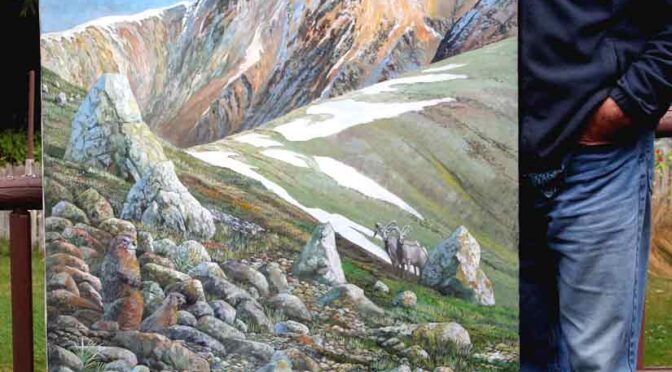
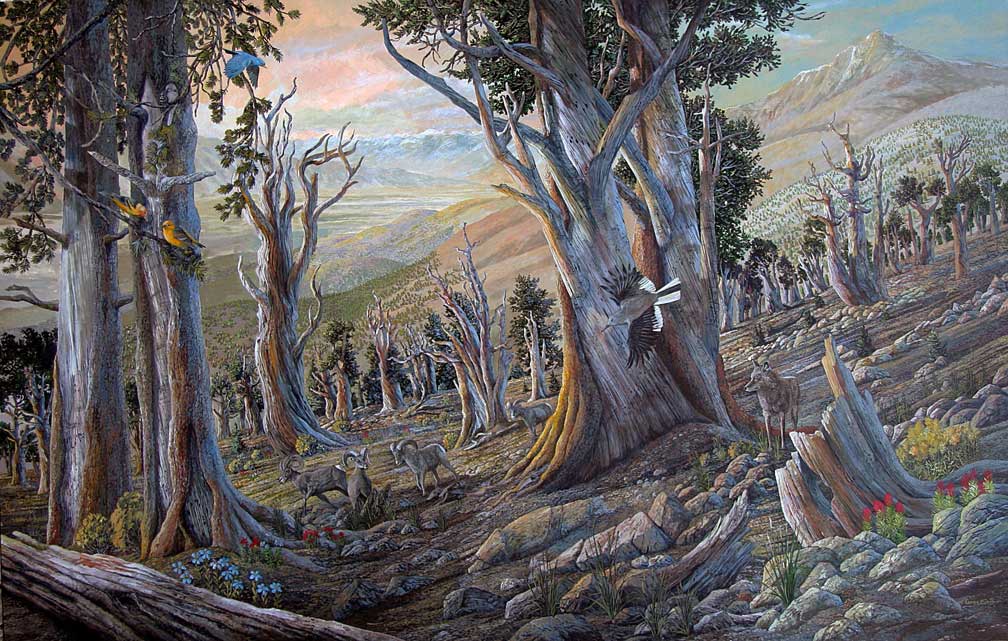
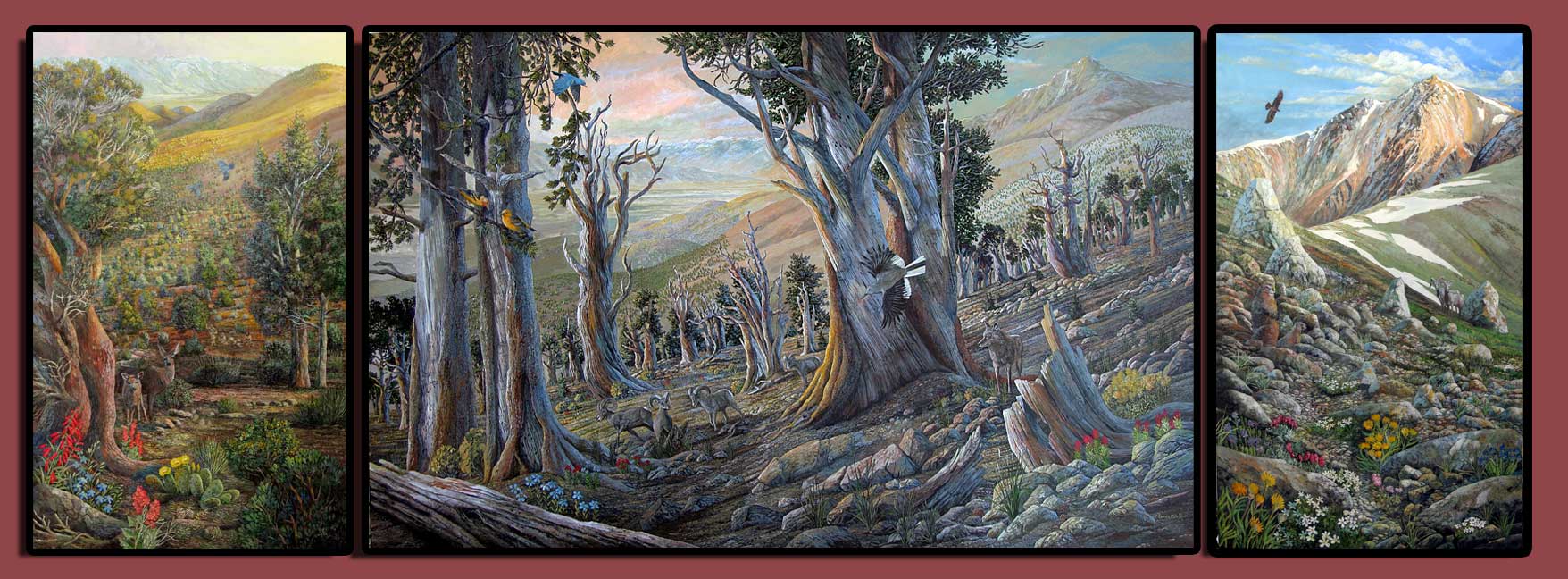
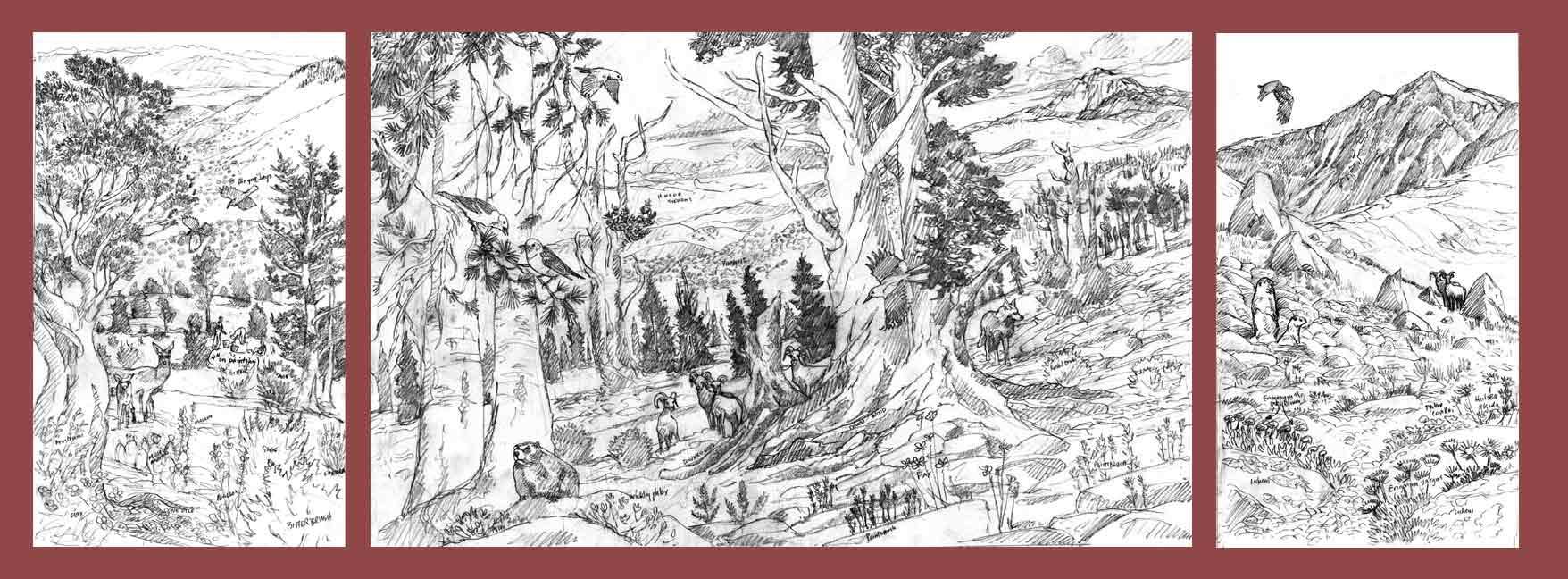
This week I finished the first of three paintings for the new Schulman Grove Visitor Center near Bishop California. Below are the sketches, pinyon forest on the left, bristlecone forest in the middle and the alpine goes on the right. Together they take up an entire wall of the new building and both doors are lined up to showcase the paintings when you walk in the place, a beautiful new off-grid summer visitor center located in the Schulman Grove at about 10,000′ elevation. The alpine painting shows 14,252′ White Mountain in the background, only about 250 feet shy of Mt Rainier and Mt Whitney. The painting’s location is placed several thousand feet lower in a land of belly-plants, marmots and bighorn sheep, but still a landscape of stark light. It was not easy to pull this off, as there are very few resources telling me what grows at this high, dry and inhospitable place. With this one behind me, I look forward to the other two coming next along with a series of ink and watercolor images for the other exhibits.

As you all know by now, I tend to paint trees. I’m very pleased the Forest Service chose me for this project as Great Basin bristlecone pines are the oldest trees on our planet. I also love these high mountain tree forests, especially this famous grove. To walk among these ancient and gnarled artistic sculptures we call trees is to walk with nature far beyond what I can understand. There’s a stark quiet here that sustains my thoughts of these living wonders far beyond the initial visit. One of them here at Schulman has been cored to 4750 years of age, a thousand years older than any other known tree species. Other downed bits of wood, branches and trunks long dead, have extended these dates back over twice that far and have actually helped rewrite climate history knowledge. But those are just numbers. How do you truly understand any of this when I will be lucky to live less than 1/50th of that?  And here I am at this brief moment of my life trying to create something that will educate some of us about all this. Daunting.

Thanks for reading this week.
Larry Eifert

Click here to go to the online blog this was to.

Click here to go to our main website – packed with jigsaw puzzles, prints, interpretive portfolios and lots of other stuff.

Click here to check out what Nancy’s currently working on with her photography.
Red-legged Kittiwakes

I’ve never painted this bird species, and in Seward Alaska recently there were lots of them at the SeaLife Center, so, I just had to take a stab at a painting. We heard someone trying to describe the white on kittiwakes as “the whitest white.” I’d go farther. To me it is so white as to be a void, as if touching one would put your hand into a cosmic hole so deep and profound is that lack of color. They’re a very localized species, nesting on offshore islands of Alaska and spending winters in the Bering Sea, and their populations are down by about a third in recent decades as are most pelagic birds and sea animals around there. Black-legged kittiwakes were there as well, and we saw them on rocks just like this out out in Resurrection Sound with the Stellers sealions near the caving glaciers.

It’s always thrilling for me to see a creature as soft and vulnerable as this making a home in such a forbidding and harsh place. I tried to show that in the colors. Glacier-sculptured rock, windblown and water-blasted cliffs are this creature’s life, never mind the winters of driving snow, ice and hurricane-force winds. And we complain about so many unimportant  and casual things. What do they complain about?

 This ORIGINAL painting is varnished acrylic on linen canvas, 11″ x 14″ and $160 unframed.
A mahogany frame with linen liner makes it a total of $180 and shipping adds just a bit more depending on your zone or if you take the frame. This is the original painting, NOT a print, but prints will be available soon.
Email us for details.

Thanks for reading this week.
Larry Eifert

Click here to go to the online blog this was to.

Click here to go to our main website – packed with jigsaw puzzles, prints, interpretive portfolios and lots of other stuff.

Click here to check out what Nancy’s currently working on with her photography.
Clipchuck

We somehow managed a couple of partial weeks of hiking in the North Cascades – known as the American Alps and for good reason. When driving over the North Cascades Highway just south of the Canadian border and drop down off Rainy and Washington Passes, there are several USFS campgrounds before you hit the summer heat of Winthrop. Our favorite is at Clipchuck. Each day we’d drive up the dozen or so miles to the cool alpine and hike the lake and pass trails, then return to our campsite high over Early Winters Creek – and this painting is from the picnic table in Site 28. Just walk a few feet upslope and a glorious view of that crashing creek emerges. Walk another step and you’re over the cliff and probably in the creek 100 feet below.

And, yes, the name Early Winters should ring a bell with some older hikers. In the 70’s, it was the first outdoor equipment company that sold products made of Goretex.

One of the hikes here is an 8-mile loop gaining over 2000 vertical feet. Half way around we came to the North Cascades NP boundary and this sign is firmly planted in a snowdrift on Horsefly Pass (click to enlarge it so you can see). I’d love to know who thought it necessary to state in 5-inch letters that hunting isn’t allowed here. Am I missing something? Who would do this climb equivalent to two Empire State Buildings to kill something and then carry it (and the gun) back down the 2000 feet?  But then I’ve never understood the concept of killing wild animals anyway.

This ORIGINAL painting (not the photo) is varnished acrylic on linen canvas, 8″ x 10″ and $125 unframed.
We have some custom wood frames that makes it a total of $140 and shipping adds just a bit more depending on your zone or if you take the frame. This is the original painting, NOT a print.
Email us for details.

Thanks for reading this week.
Larry Eifert

Click here to go to the online blog this was to.

Click here to go to our main website – packed with jigsaw puzzles, prints, interpretive portfolios and lots of other stuff.

Click here to check out what Nancy’s currently working on with her photography.
2011 Olympic NP Bugler cover

Summer’s almost over and I almost forgot to post this while it’s still current.

On September 17, the official ceremony for the removal of the Elwha River dams will kickoff, but I’ve been involved with this for several years now. I was pleased when the park’s summer newspaper (the handout at the park gates) featured a section of one of the two murals I painted showing what this big river might look like a few years from now. In the upper left corner you can see what will remain of the upper Glines Canyon dam when the river will hopefully become one of the largest salmon producing streams (again) on the peninsula.

My task for these paintings was to show how the river and its salmon influence everything else there. Many plants and animals rely on a healthy salmon runs for nutrients. It’s not just the bears and raccoons, herons and jays that eat the spawned-out fish, but as they drag the fish into the forests, this soon becomes ‘fish emulsion’ for the big trees too. The forests provide a stable environment for a new generation of fish, while the fish give back fertilizer when they return. This cycle has been stopped for a full century by the two dams that will soon be gone.

And I’m affected too. Learning this stuff is the best part of painting nature for a living. It’s not just a painting, but more knowledge I get to cram under that size-8 1/4 hat.

Thanks for reading this week.
Larry Eifert

Click here to go to the online blog this was to.

Click here to go to our main website – packed with jigsaw puzzles, prints, interpretive portfolios and lots of other stuff.

Click here to check out what Nancy’s currently working on with her photography.
Acres of Glacial Lilies – It’s Finally Summer

On August 6th, the park finally opened the road out to Olympic National Park’s Obstruction Pass. From the acres of cars and people at tourist-center Hurricane Ridge, as soon as we hit the dirt road we transended into acres of glacial lilies and almost no cars or people. It’s amazing how park visitors all clump together in herds.

With the drifts still melting on one of the largest snowpacks on record, neither of us have ever seen such an amazing display of alpine flowers. It’s not just summer August flowers, but spring glacier and fawn lilies to mid-summer tiger lilies. The place is awash in perfume, and as we sat on the edge of this field of color I watched a big bumblebee slowly weaving around like it was drunk, going from one bisort bloom to the next, completely ignoring all the other species. So, was this bisort Sunday, followed by lily Monday and paintbrush Tuesday?

Click to enlarge both images.

This ORIGINAL painting is varnished acrylic on linen canvas, 8″ x 10″ and $120 unframed.
The nice wooden frame makes it a total of $145 and shipping adds just a bit more depending on your zone or if you take the frame. This is the original painting, NOT a print.
Email us for details.

Thanks for reading this week.
Larry Eifert

Click here to go to the online blog this was to.

Click here to go to our main website – packed with jigsaw puzzles, prints, interpretive portfolios and lots of other stuff.

Click here to check out what Nancy’s currently working on with her photography.
Cedar Falls Trail – A Picnic Table Painting

A traditional watercolor painting for today. We spent last week hiking on the east side of the North Cascades and each evening I painted on the picnic table in Site 38, Pearrygin Lake State Park. Like everyone else in the West, they’ve experienced record snowpack and with temperatures in the 80’s, the snow is wasting no time getting out of there. And with spring pushed into summer, the flowers were just amazing. All the alpine lakes are still iced up, but these lower trails along the rivers were stunning, with lupine, paintbrush, calypso orchids, chocolate lilies, mountain ash, balsamroot – all of it in bloom at once. So, back in camp I got out the paints to relive the same experience twice.

While on this trail, I did a short little soundscape recording. I’m trying to figure out a way to easily add sound clips to paintings of these blog trail paintings, so here goes.

If you’re reading this from an email, try this: Cedar-falls-soundscape

If you’re reading this on the internet blog, click this:  Cedar-Falls.amr

Pearrygin Lake is downslope of the North Cascades Highway and south of the Pasayton Wilderness, some of the wildest and most pristine country I know. With over a half million acres, the Pasayton is the northern terminus of the Pacific Crest Trail. It’s one of the few places in the Lower 48 where trailhead signs have notices for BOTH grizzlies and wolves. This one was on the South Fork of the Twisp River coming down from North Cascades National Park and caught our eyes. It states hunters need to make sure the dog-species they’re killing is a coyote instead of a wolf. So, why would anyone climb up these steep trails to pull the trigger on a coyote when they’re in most everyone’s backyards – but then hunting anything at all has always baffled me. Doesn’t it seem like we as the now-dominant and planet caretaker species should be beyond that sort of mayhem?

Thanks for reading this week. This painting isn’t for sale just yet. The memories are too good to let it go.
Larry Eifert

Click here to go to the online blog this was to.

Click here to go to our main website – packed with jigsaw puzzles, prints, interpretive portfolios and lots of other stuff.

Click here to check out what Nancy’s currently working on with her photography.
Hole-In-The-Wall at Rialto Beach

We were on the road to Moab, Utah for some business and sunny hiking on the slick-rock. Then – the updated weather report said it was going to be in the mid-90’s, and, not wanting to just be normal people, we turned right instead and went out to the cool, wild and always delightful Olympic Coast. Saved a grand in camping and gas, and how could this be any less amazing than where we were originally going? We’ll get to Utah sooner or later, just not this week. And being able to do these things really is what being an artist is all about.

While sitting on the beach between hikes I did a couple of watercolors. This one was on a partially overcast day, so I kept it to only two colors. This is low tide at Hole-In-the-Wall at Rialto Beach – rated #2 in Olympic National Park sights to see. There were only two other people on the beach!

We continued past this area, past the shipwreck stuff, the eagle’s nest and possible Quileute werewolves left over from the Twilight movies that were filmed here, and in about a mile we came to an amazing place. Most hikers on Rialto Beach only go as far as where the painting was created – a couple of miles through often very soft gravel. But if you go another mile around the next point (low tide only and you’d better plan your escape accordingly), you’ll come to a rocky flat tideland “meadow.” I can only call it a meadow because that’s what it appeared to be, like an absolutely flat (not inclining like a beach) alpine meadow below the high-tide line. (click the photo, it should enlarge so you can see it better) This place was an acre at least, and so full of sea life you couldn’t move without squashing a turban shell, or a turban filled with hermit crab. Eel grass and rockweed covered almost every surface which was interesting because eel grass is normally a sand-thing, certainly not on a rocky headland. We couldn’t count the number of seastars, limpets and mussels. Why this area is so rich we could only imagine. At high tide, it has to be only be a few feet deep, so maybe it’s the extra light, slightly warmer water, who knows – but it was hard Olympic bedrock that was flat. From Cabo to Homer, we’ve never seen anything like it in all our tramping around West Coast beaches.

The original watercolor and ink painting of Hole-in-the-Wall is 8″ x 10″ and $100 unframed.
The double mat with custom wood frame makes it a total of $125 and shipping adds just a bit more depending on your zone or if you take the frame. This is the original painting, NOT a print – and you get the saltwater smudge on the bottom of the paper (not on the painting) for free.
Email us for details.

Thanks for reading this week.
Larry Eifert

Click here to go to the online blog this was to.

Click here to go to our main website – packed with jigsaw puzzles, prints, interpretive portfolios and lots of other stuff.

Click here to check out what Nancy’s currently working on with her photography.