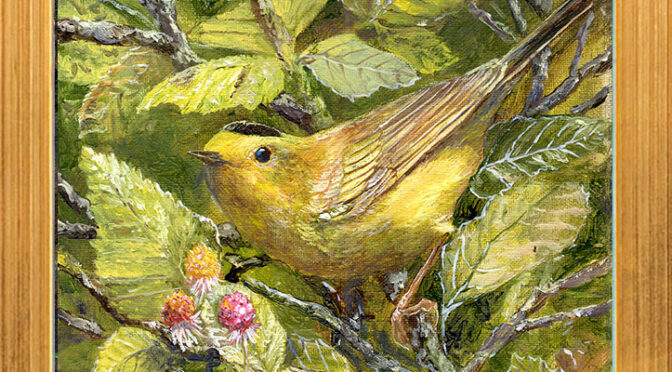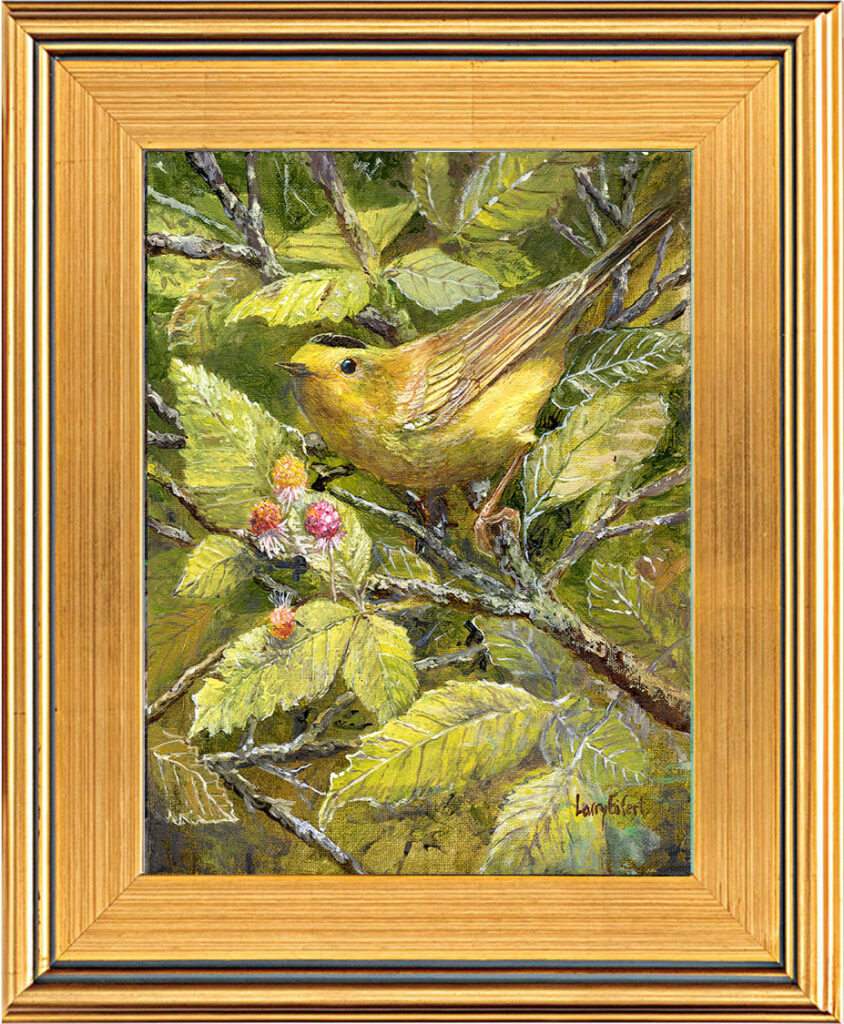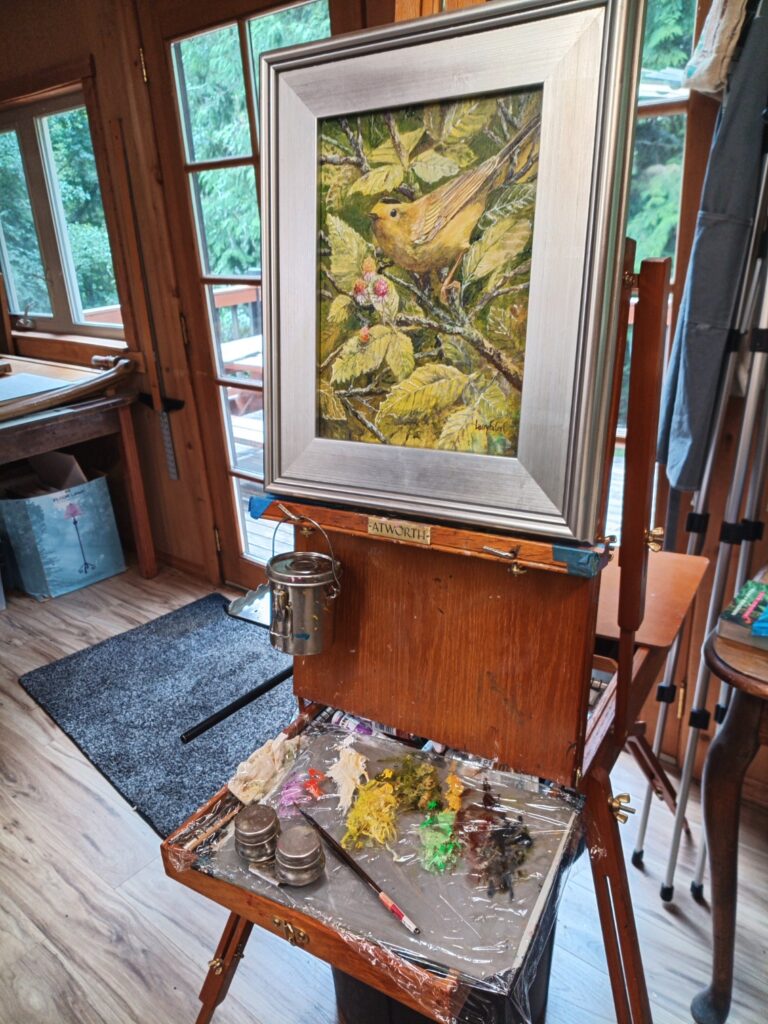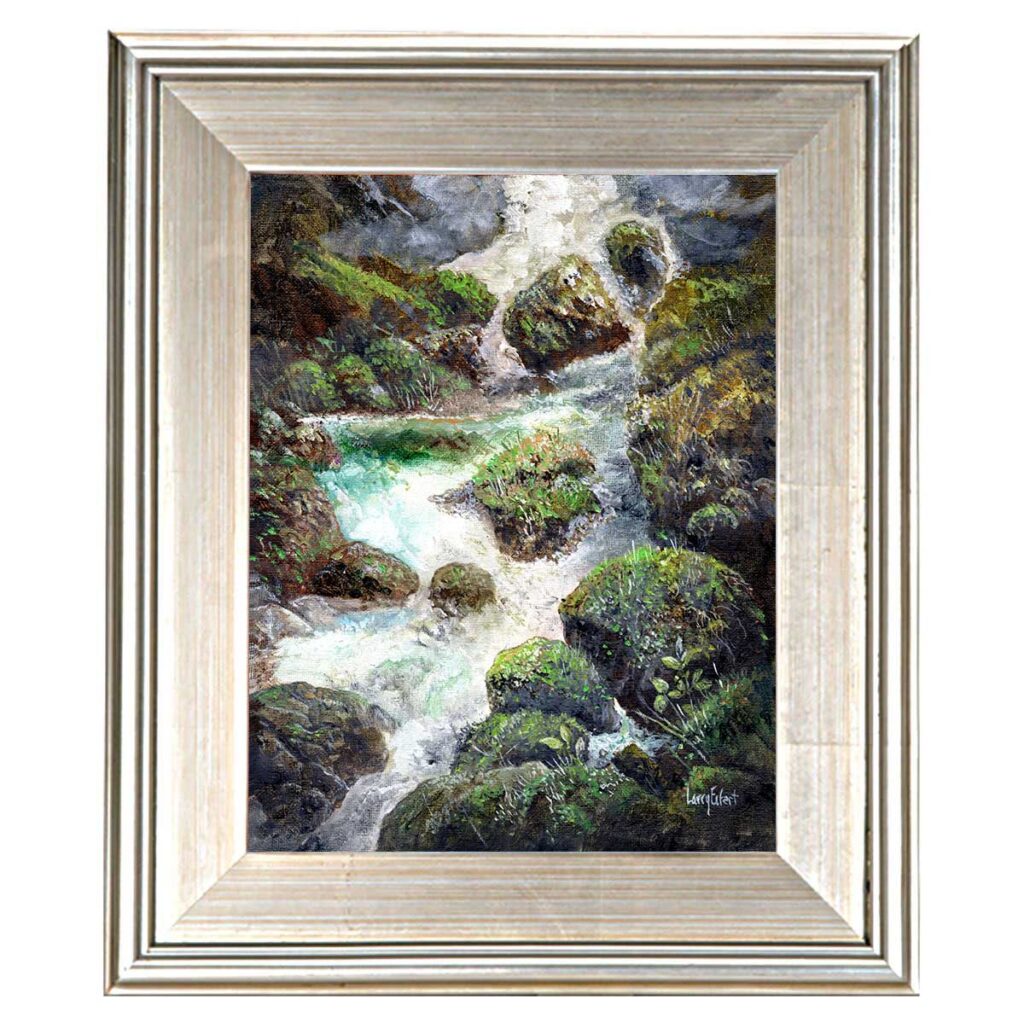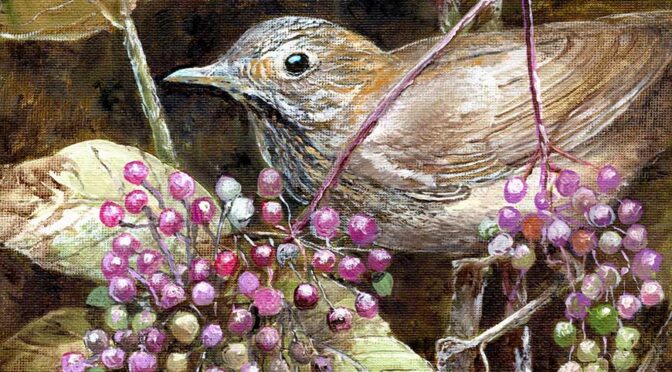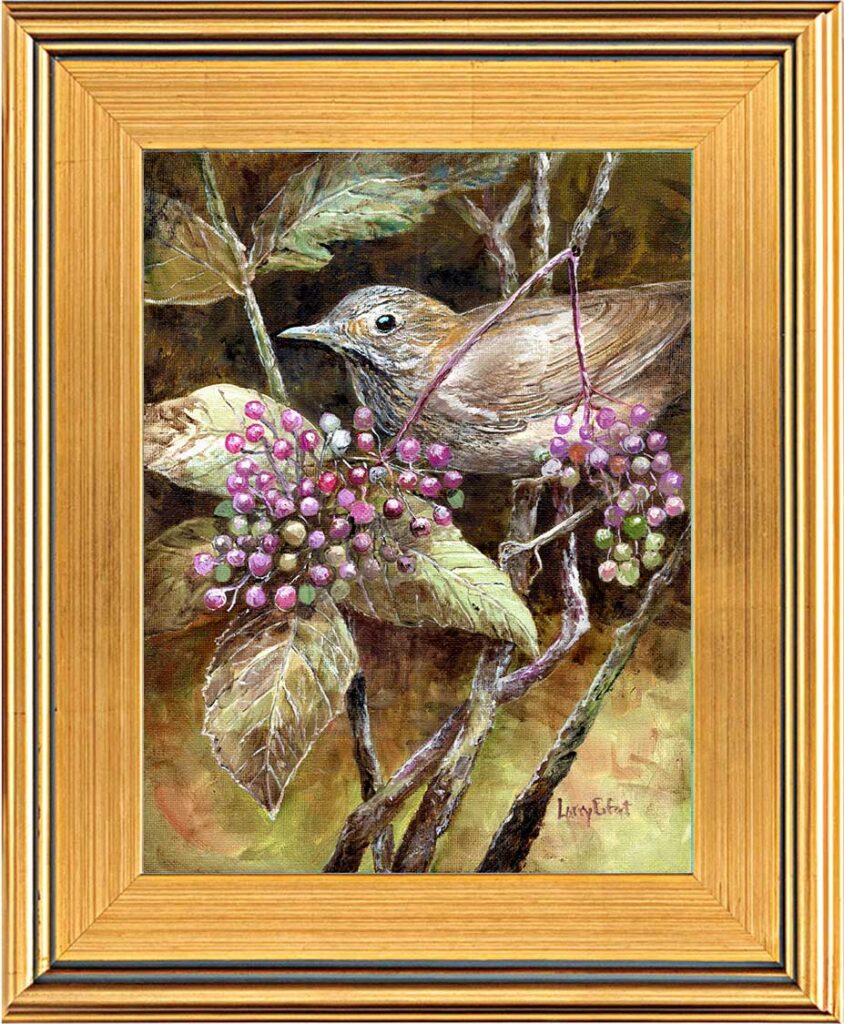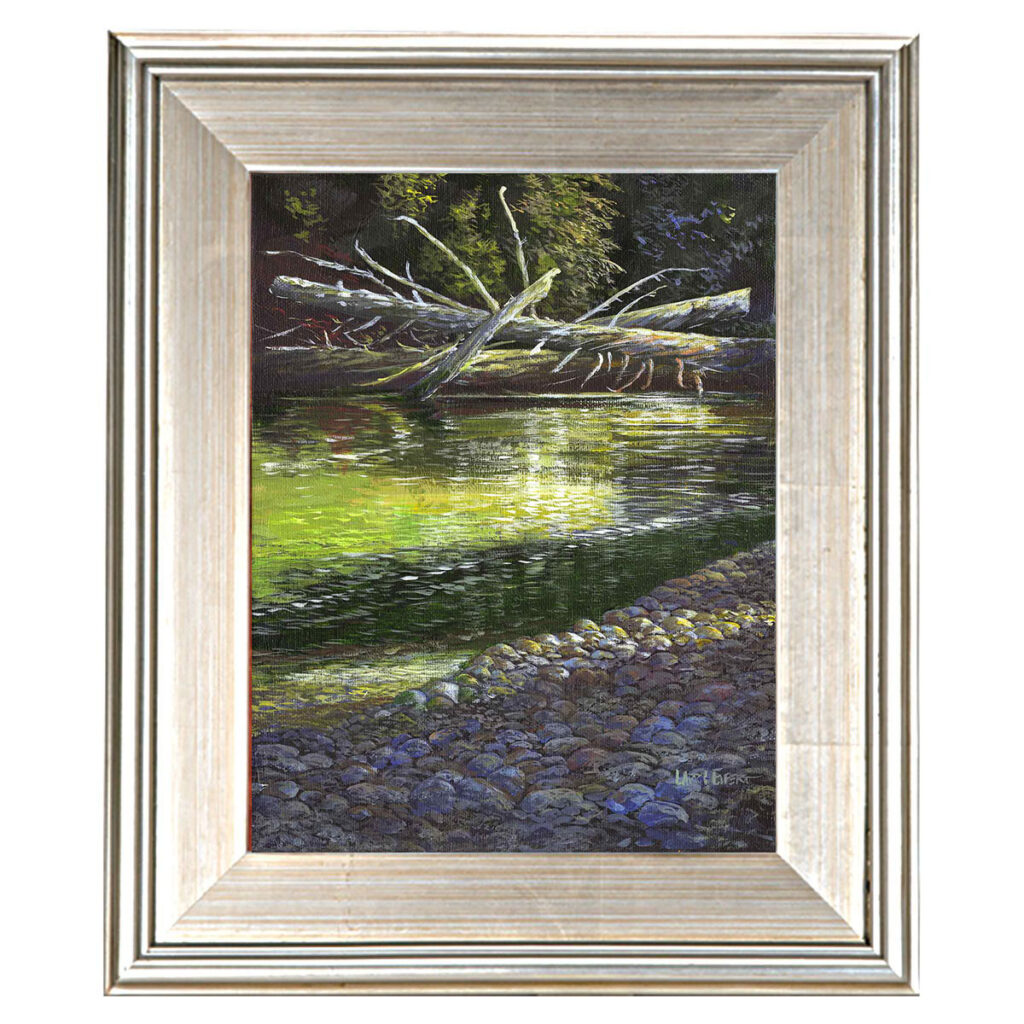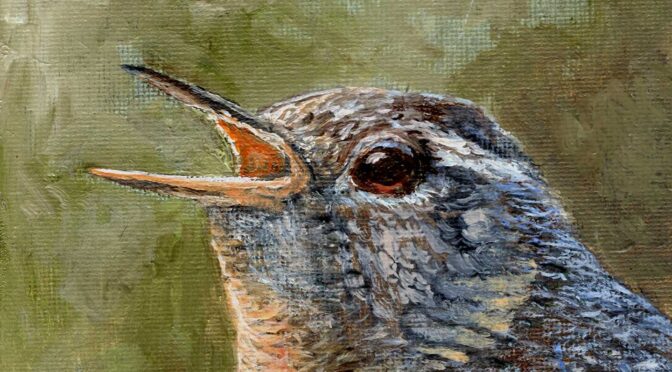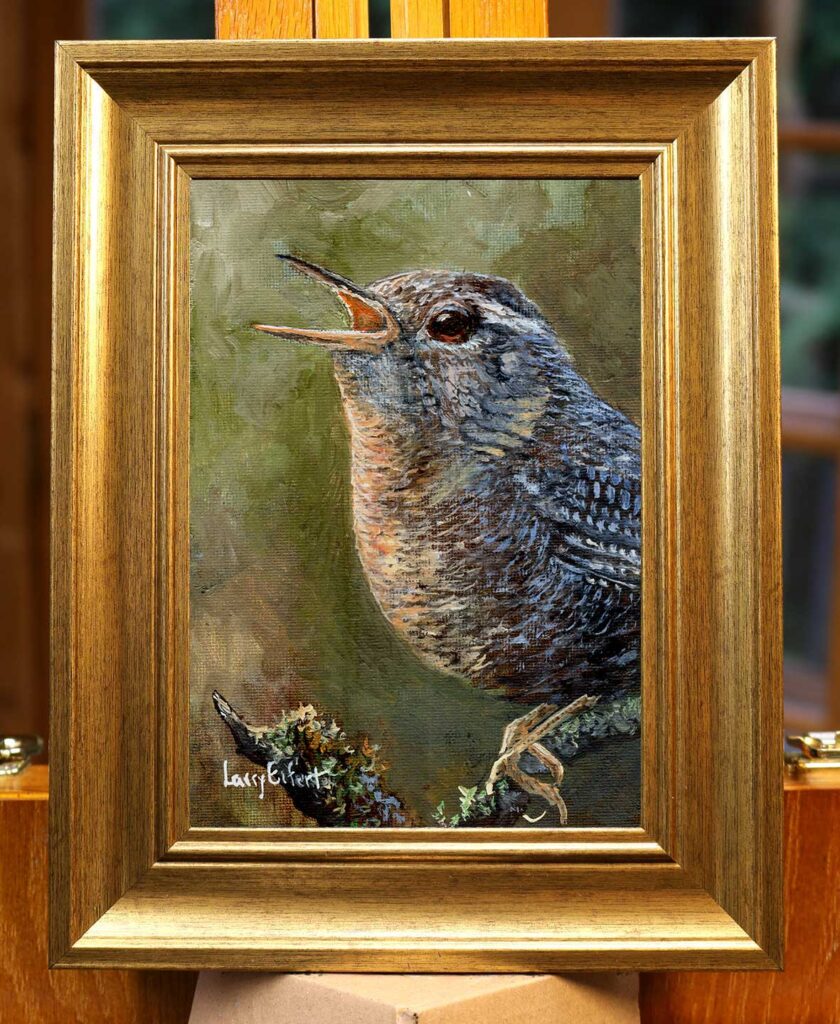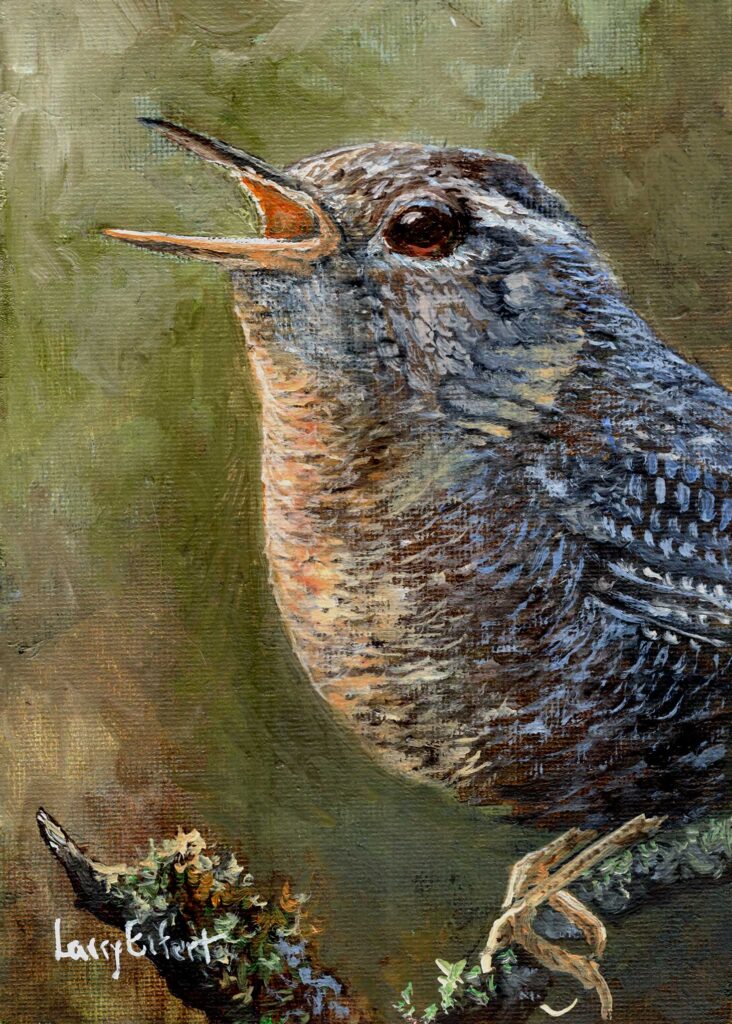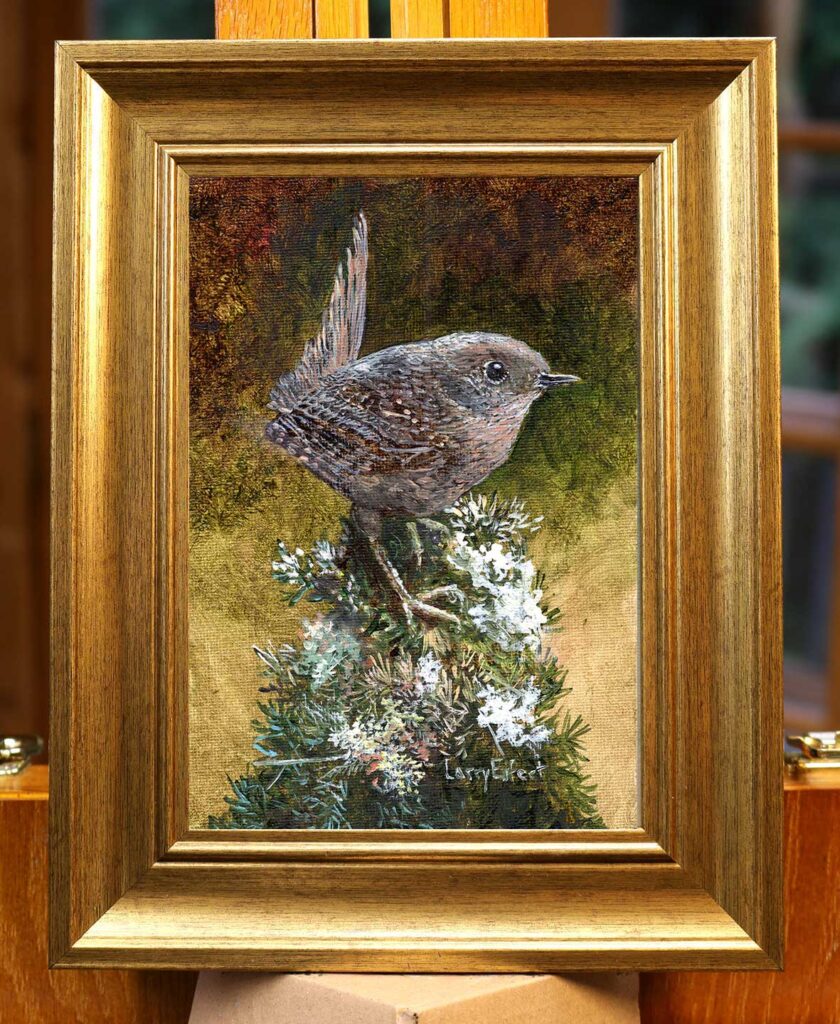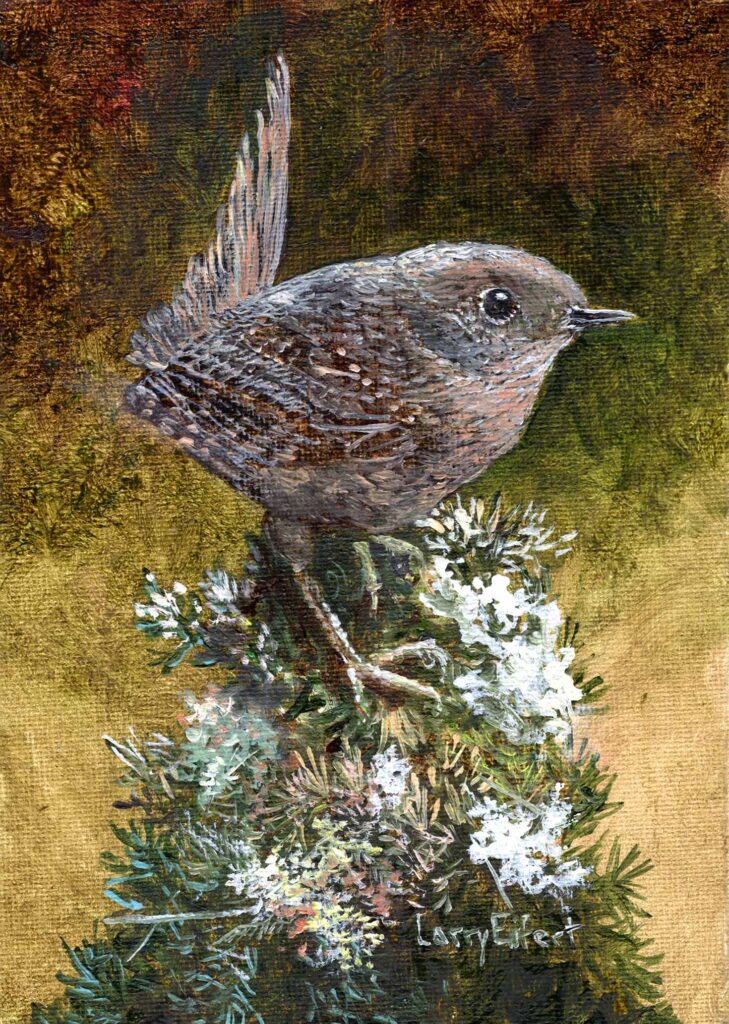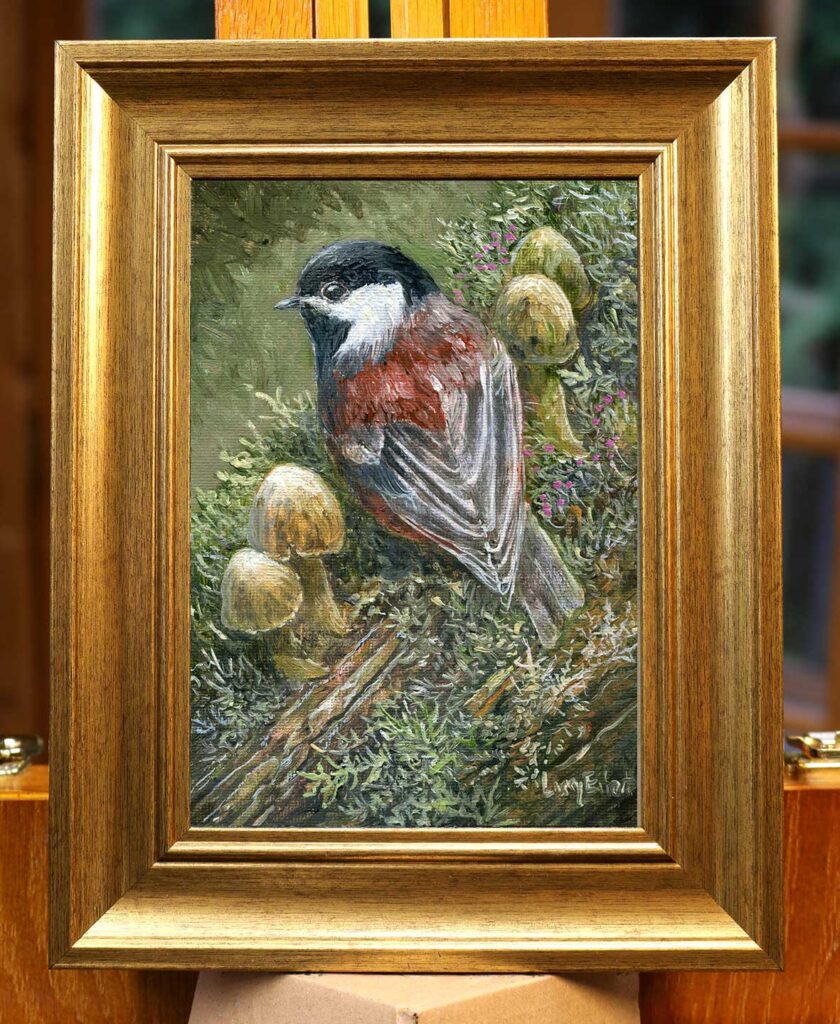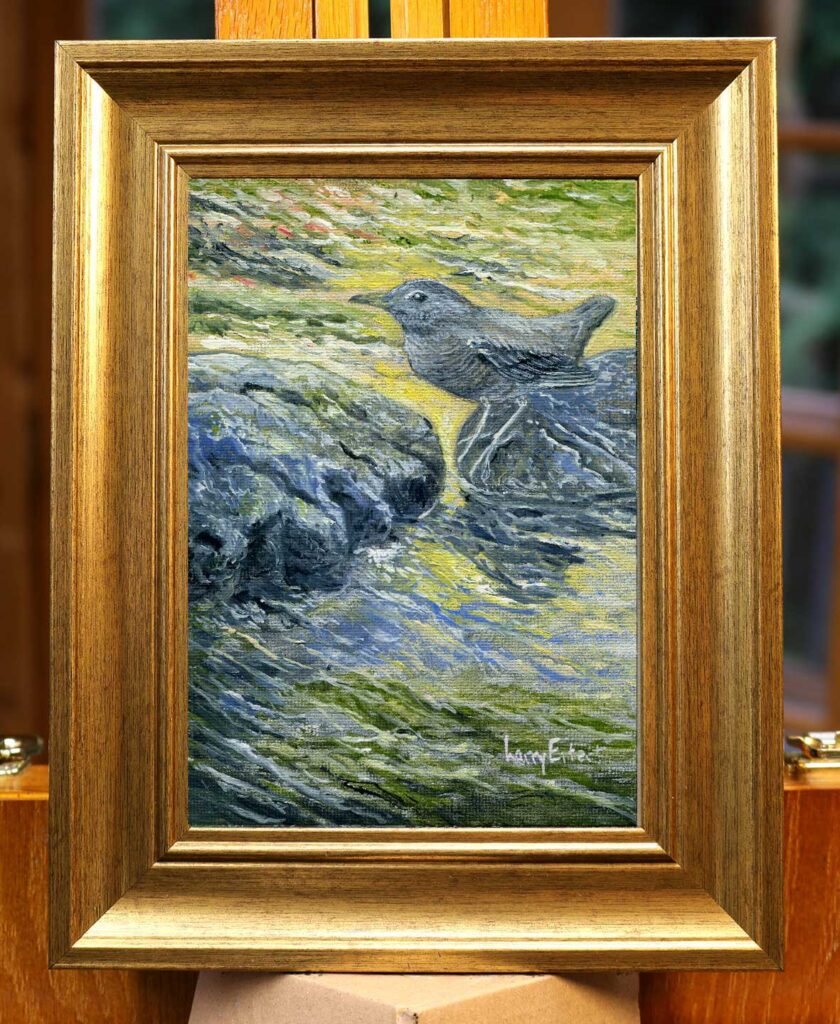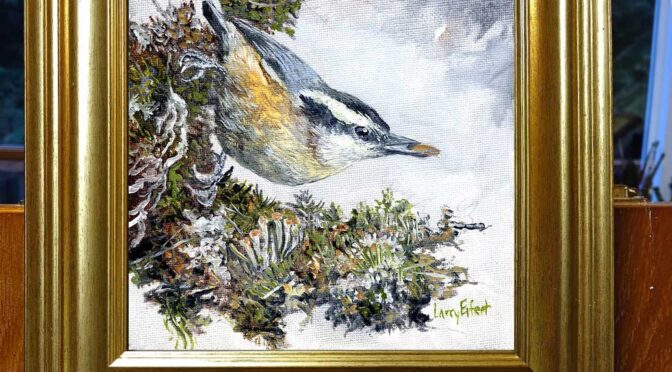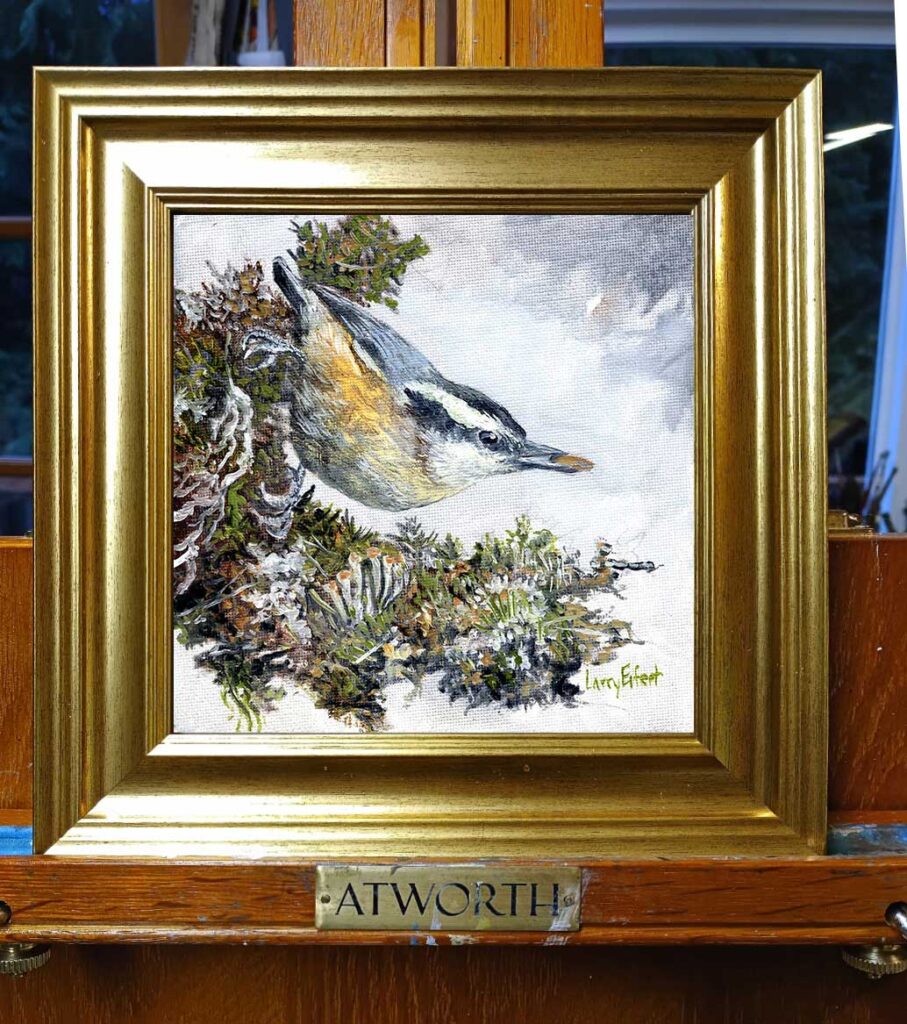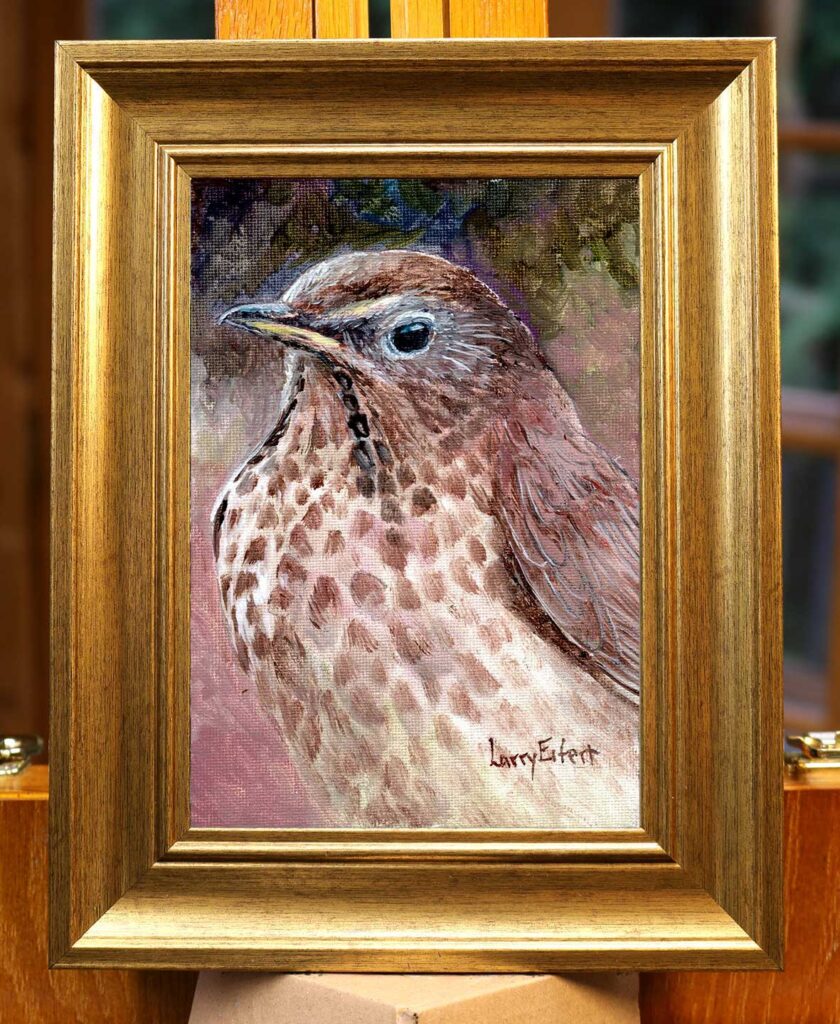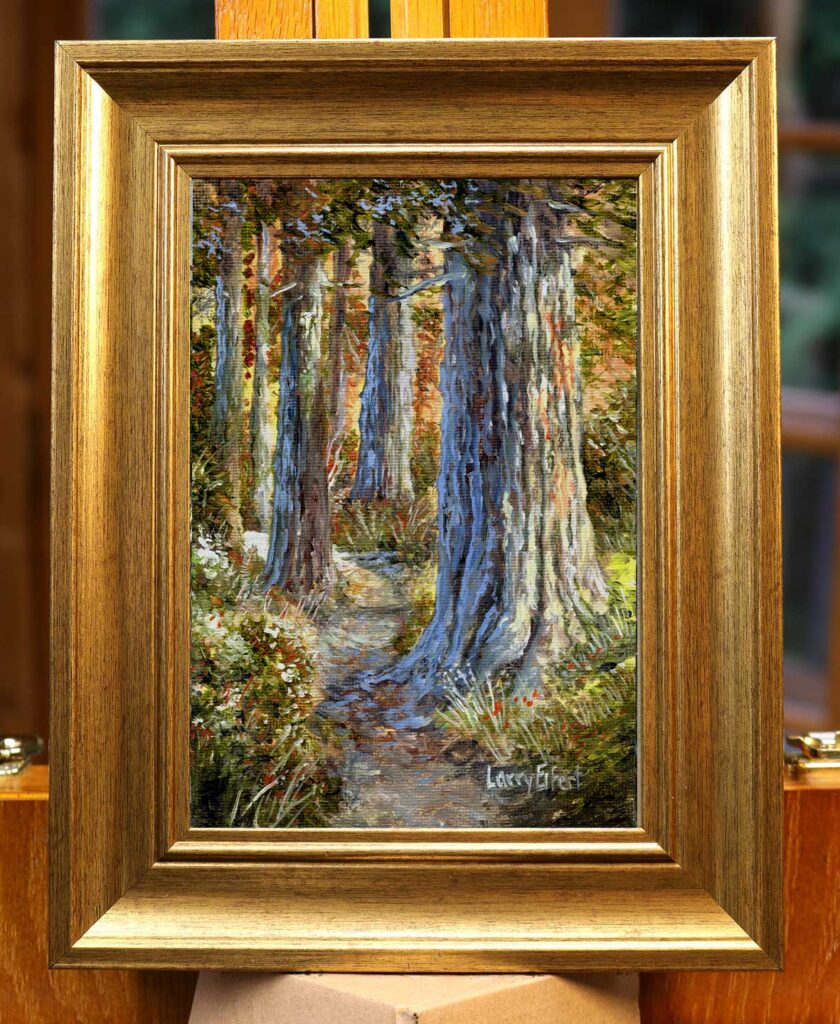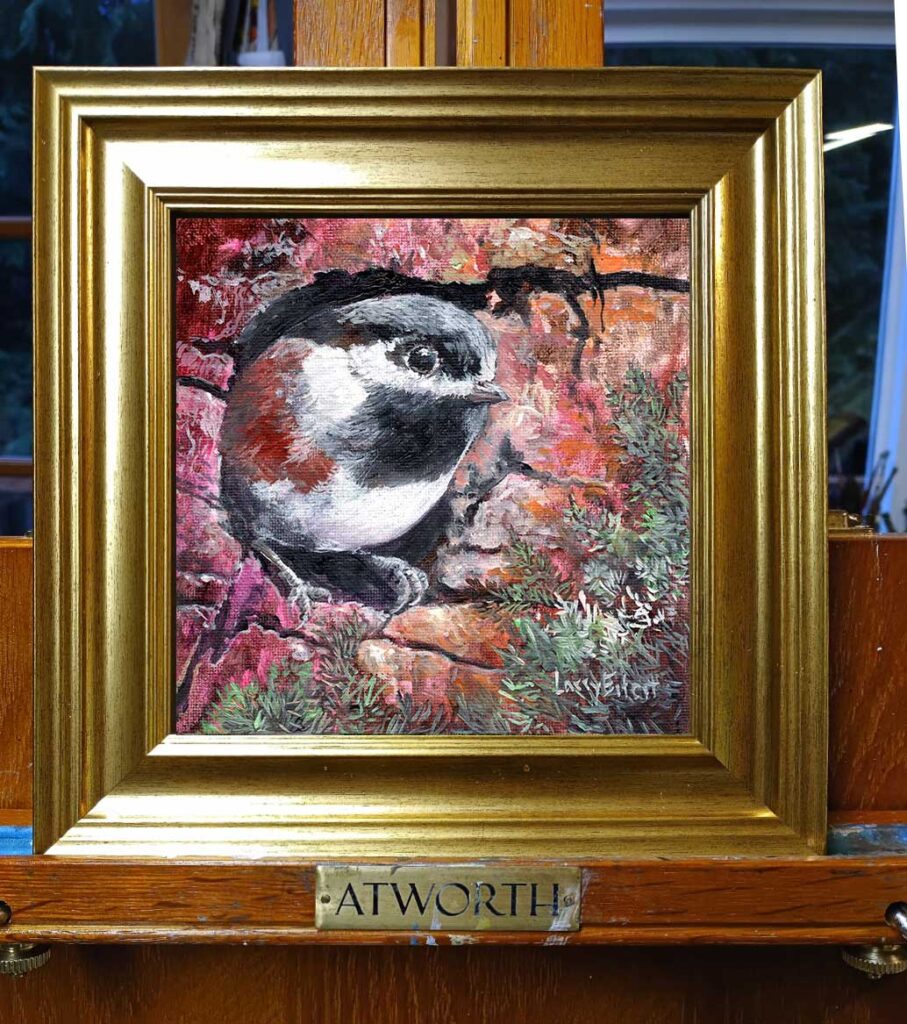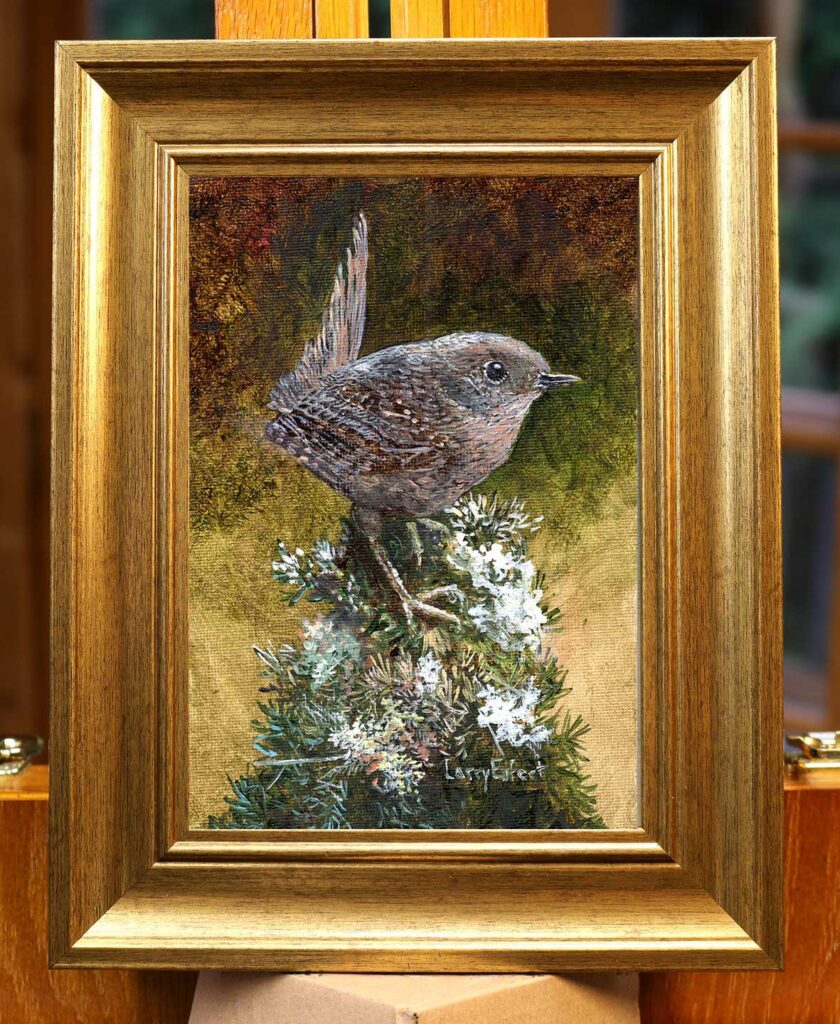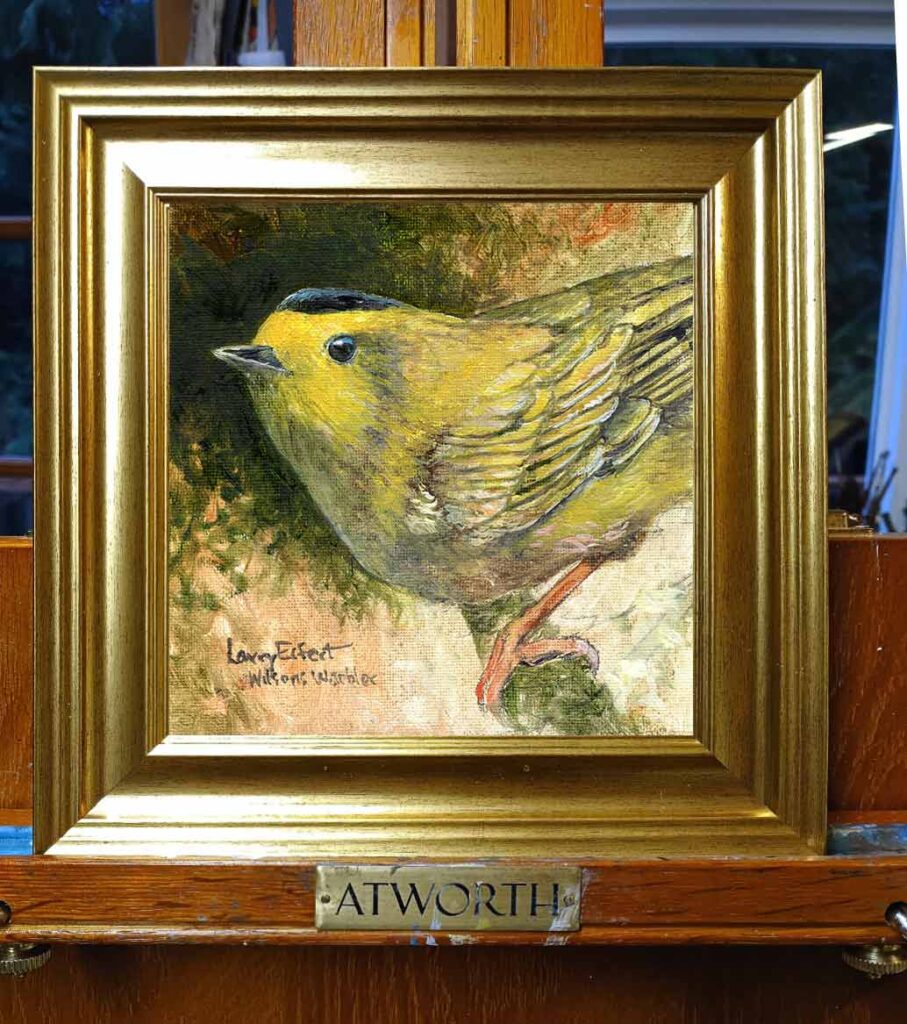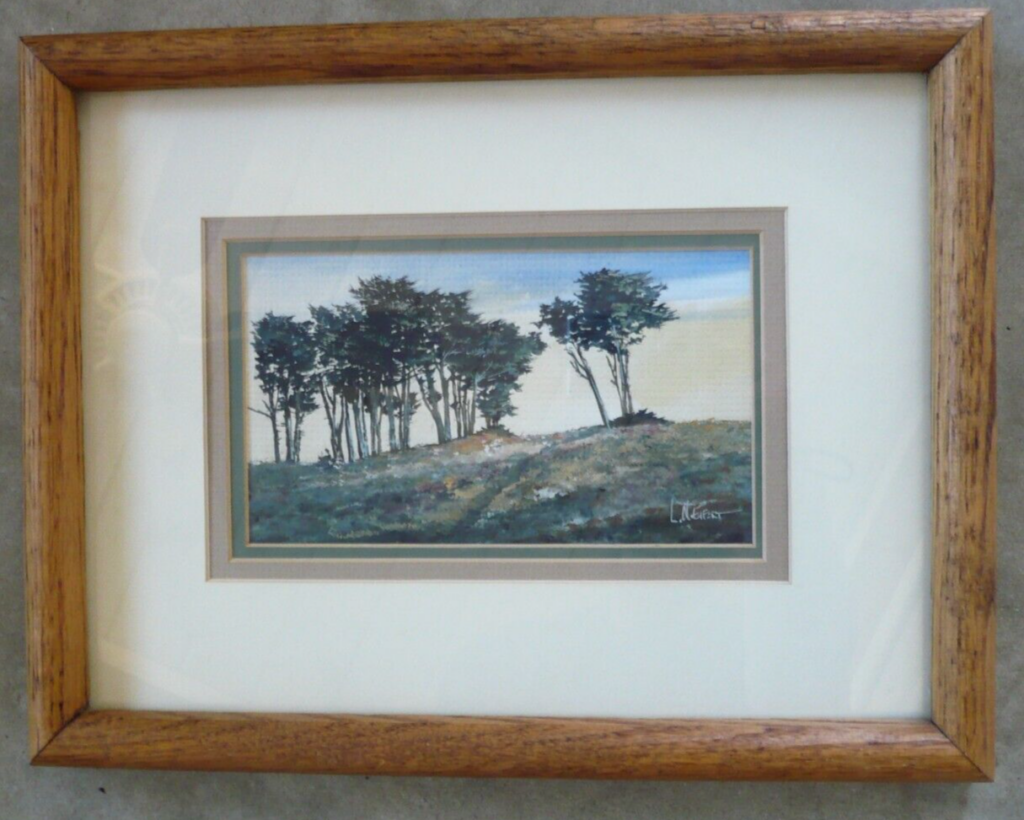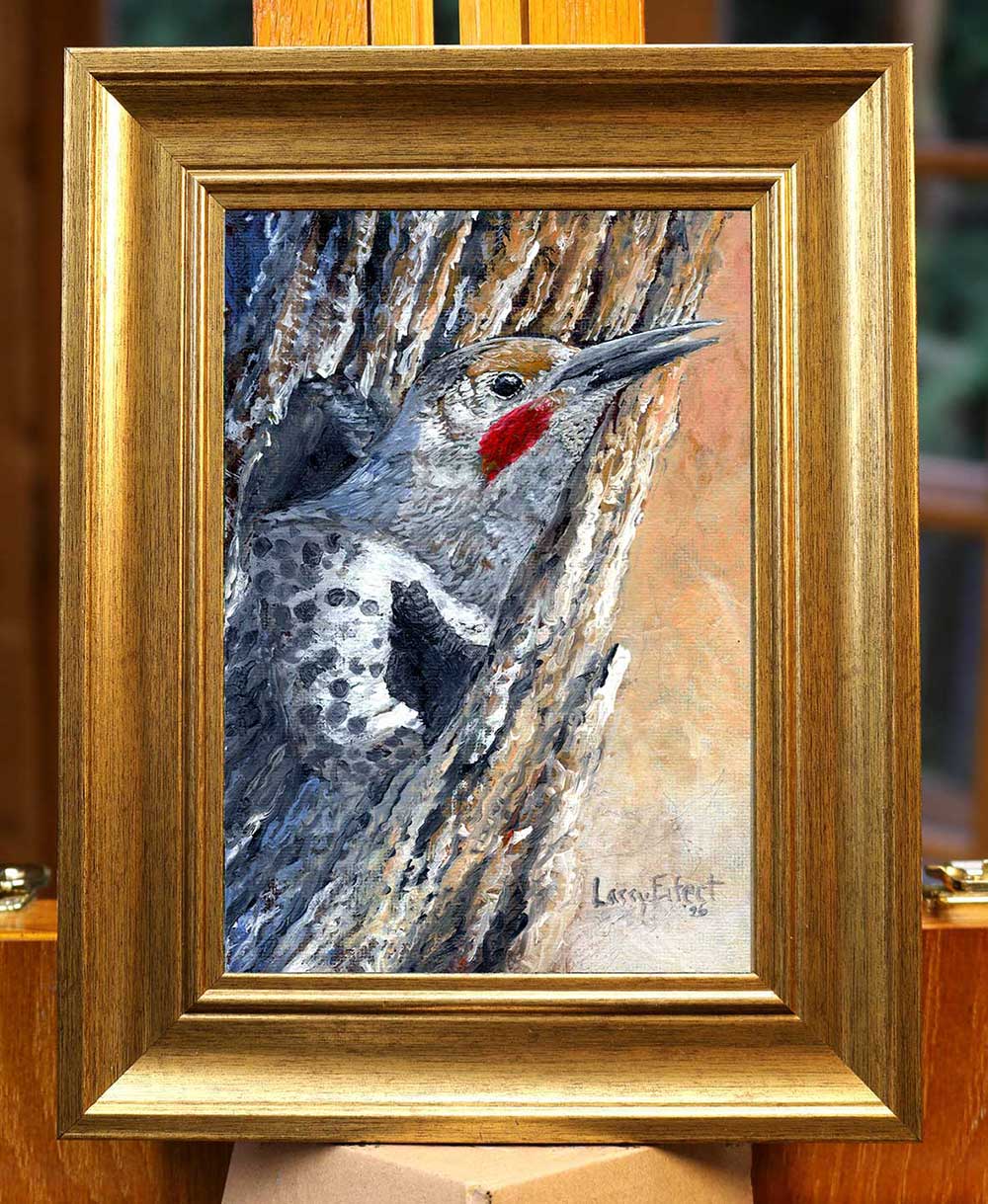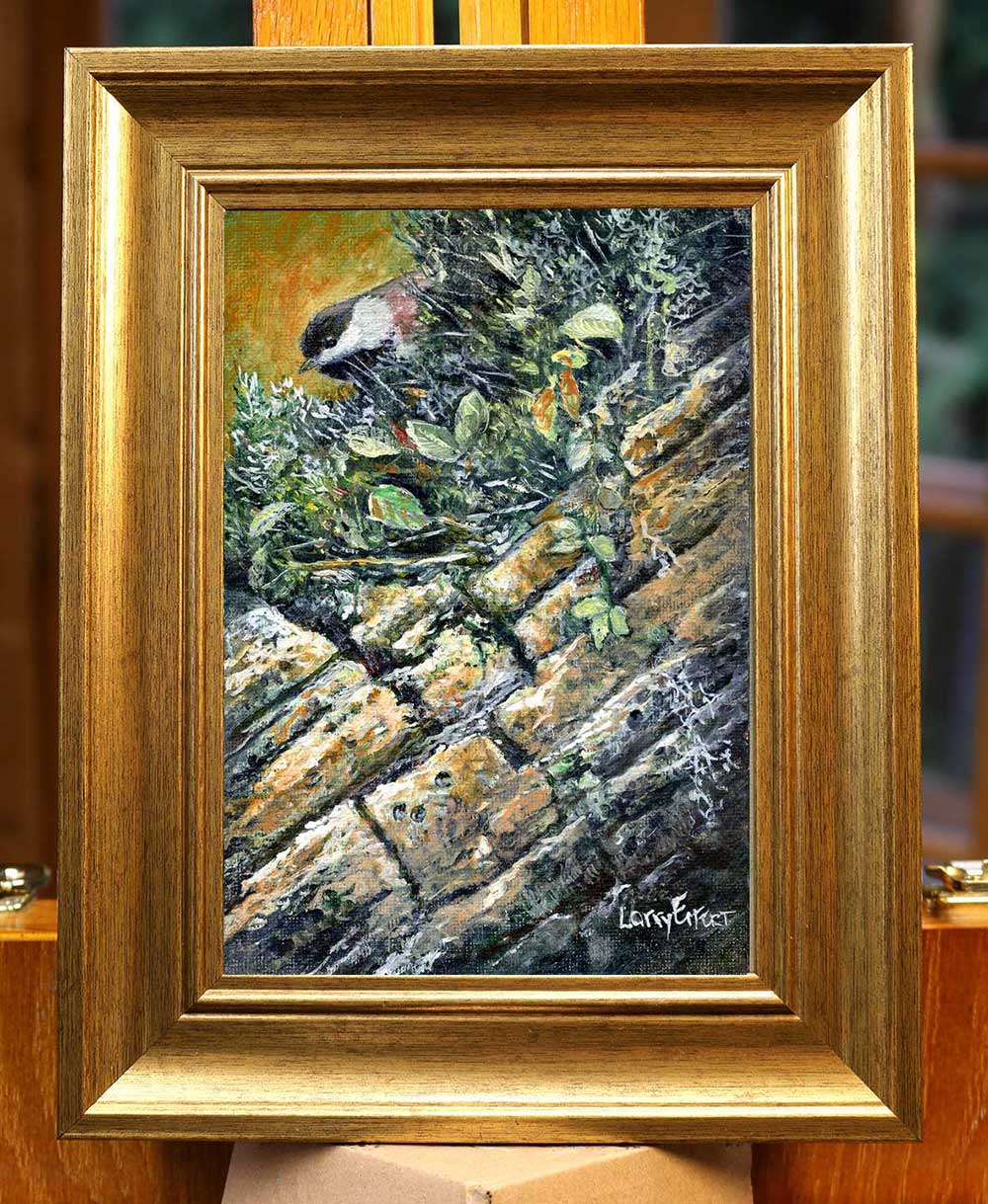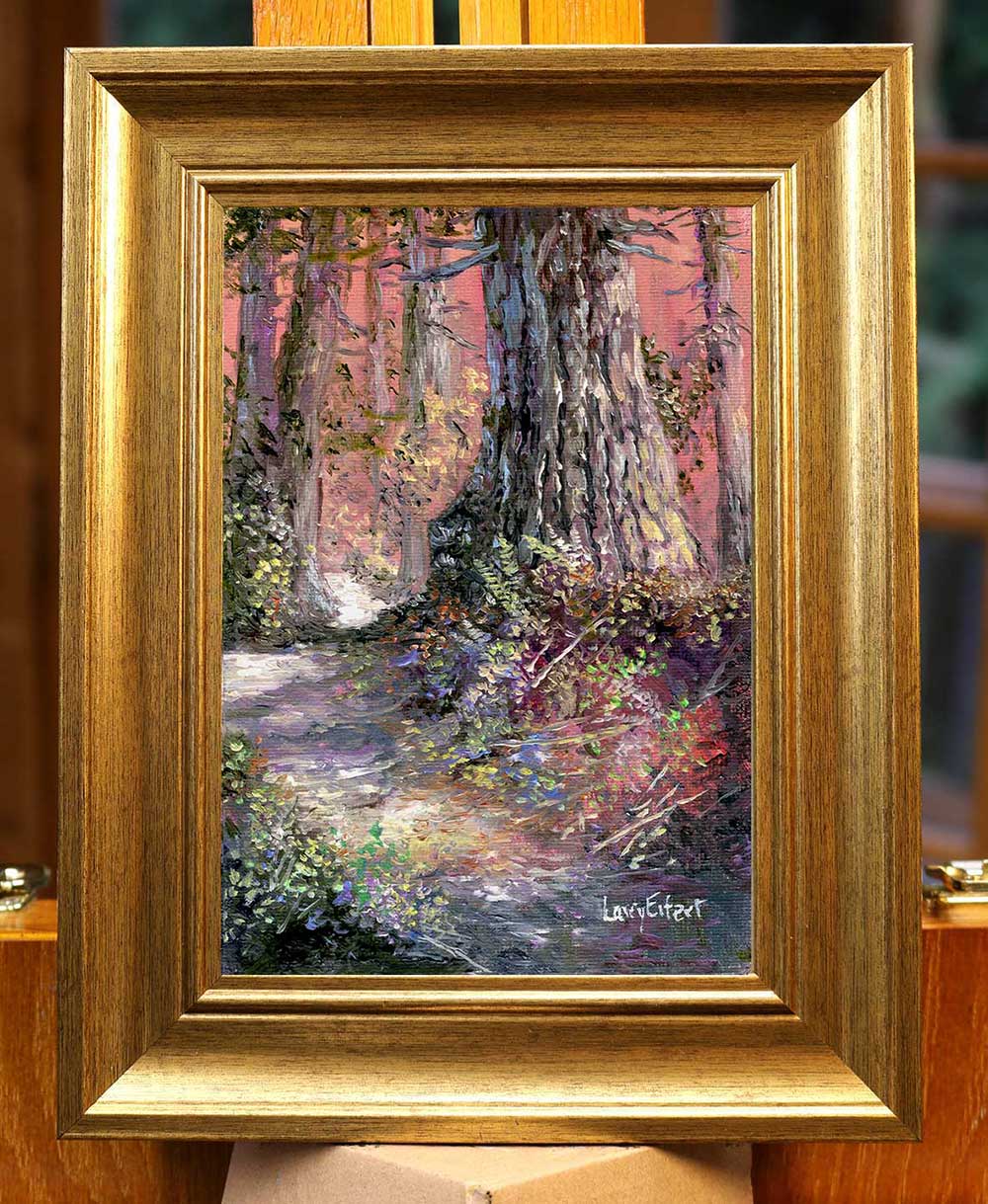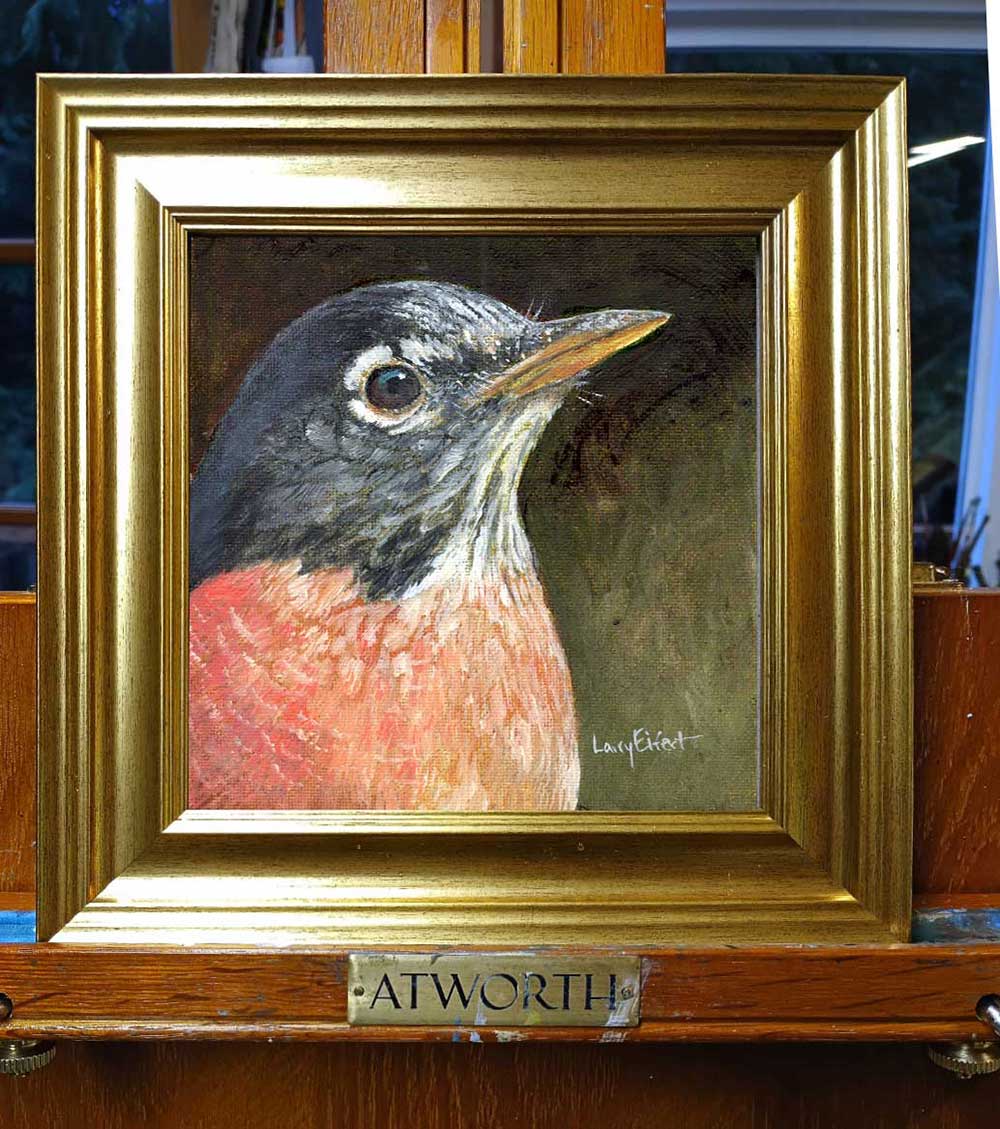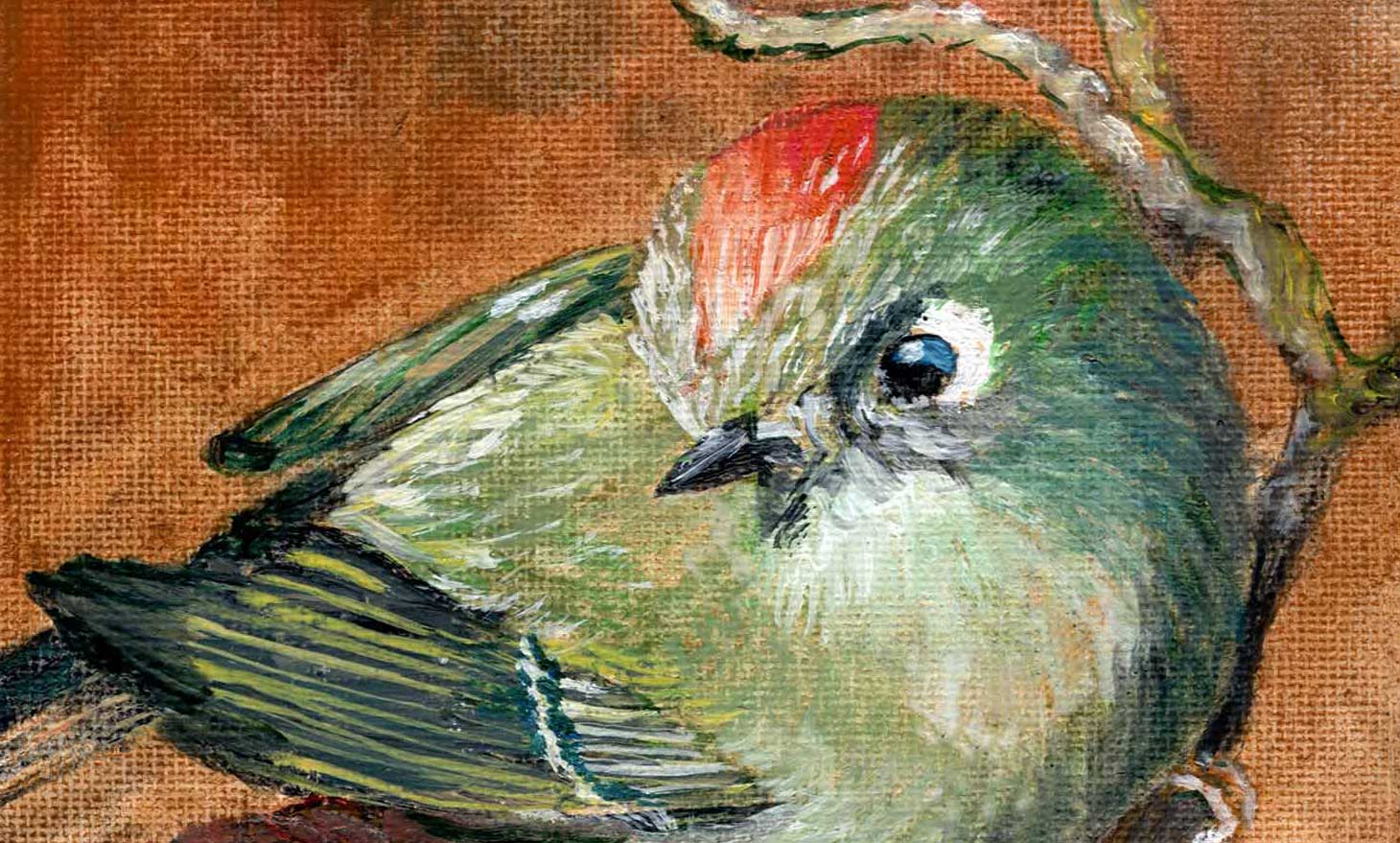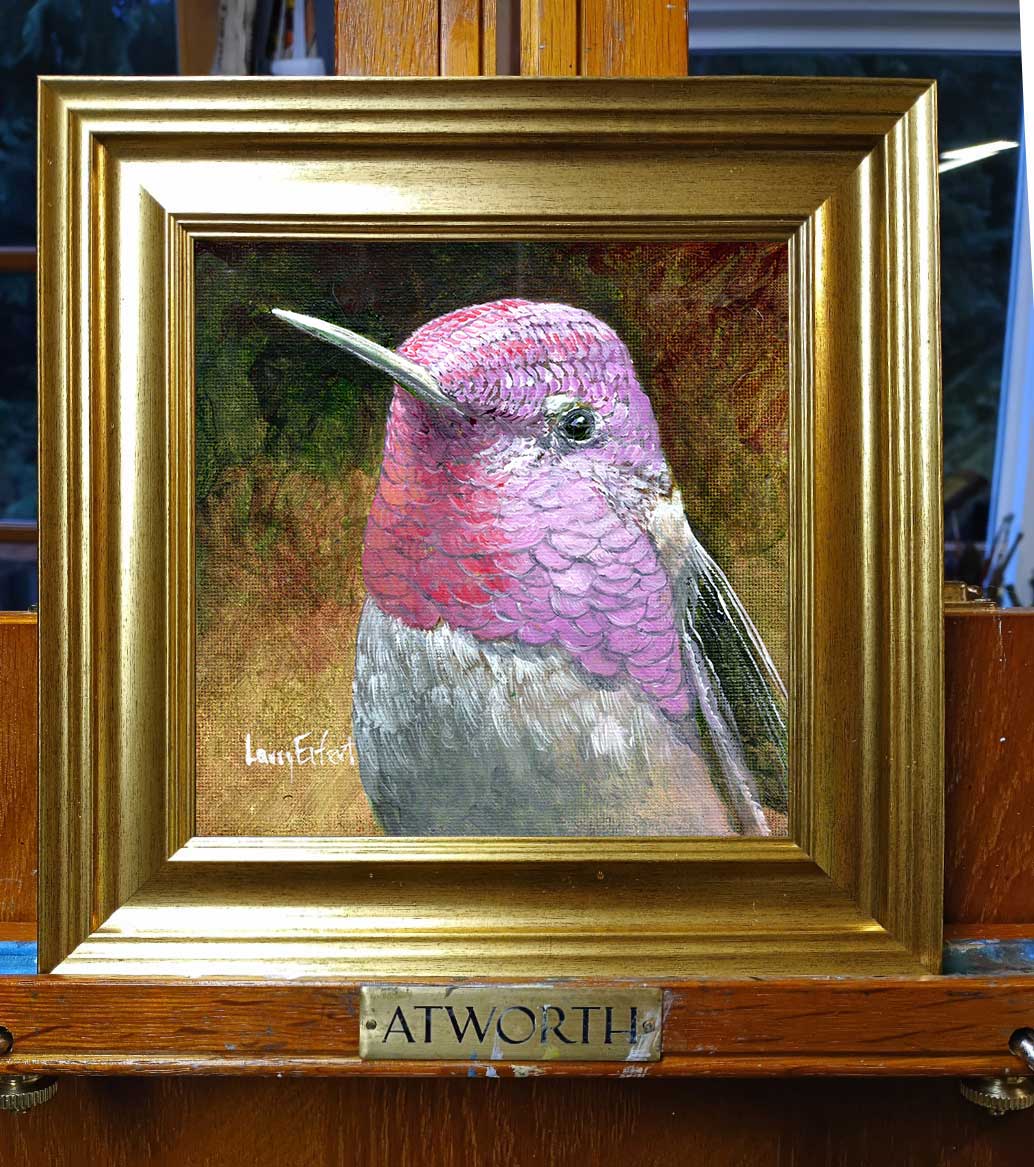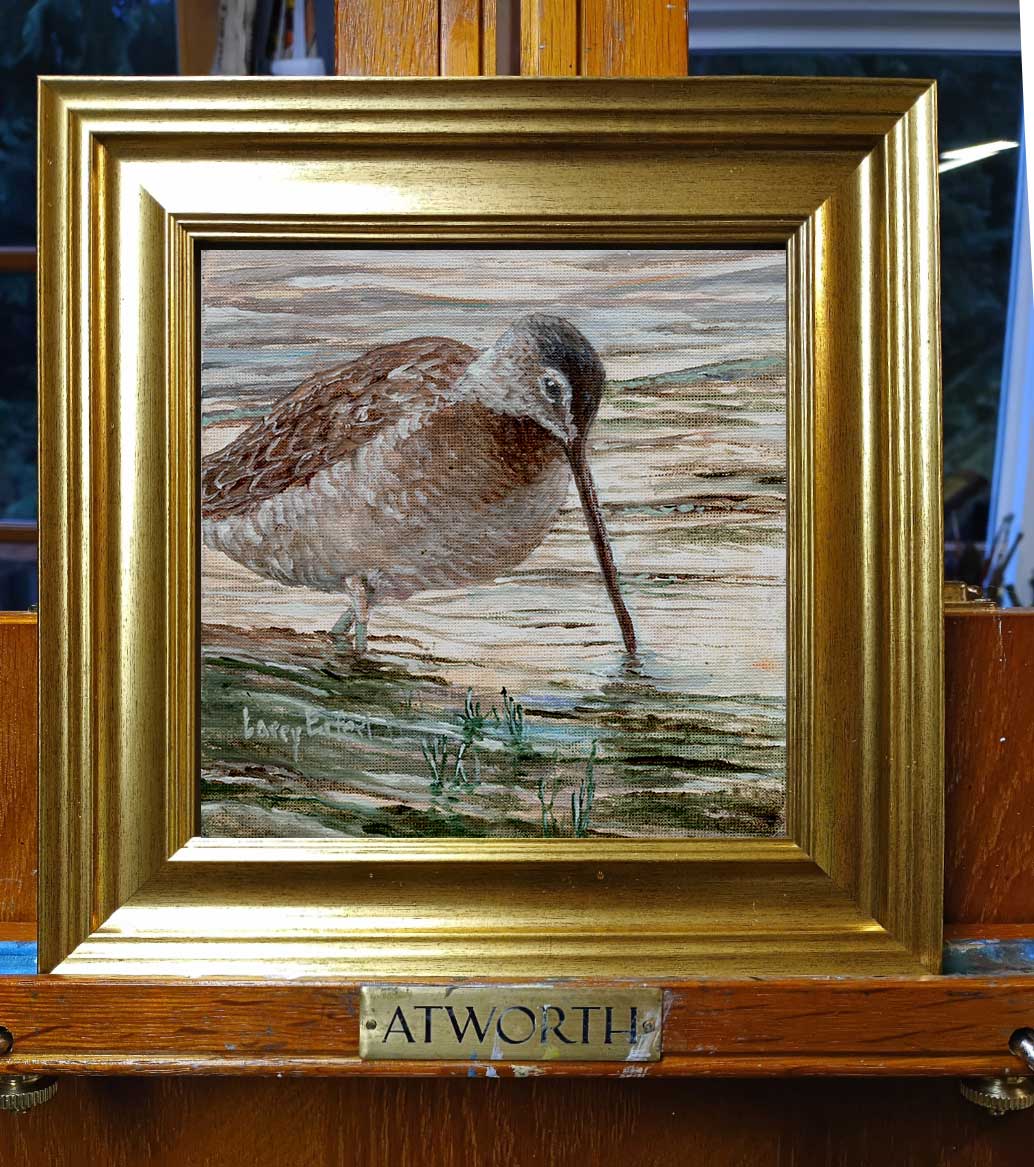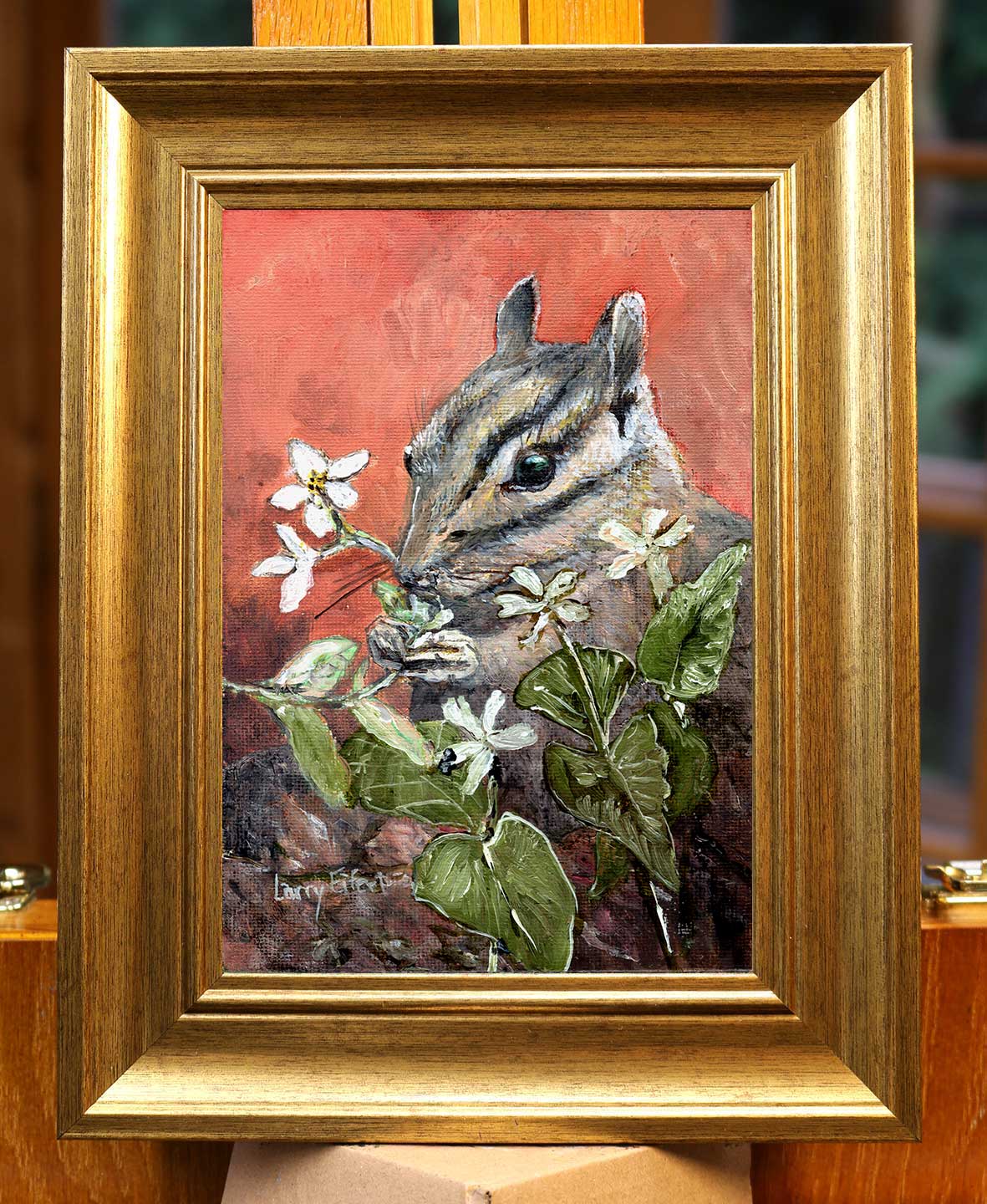
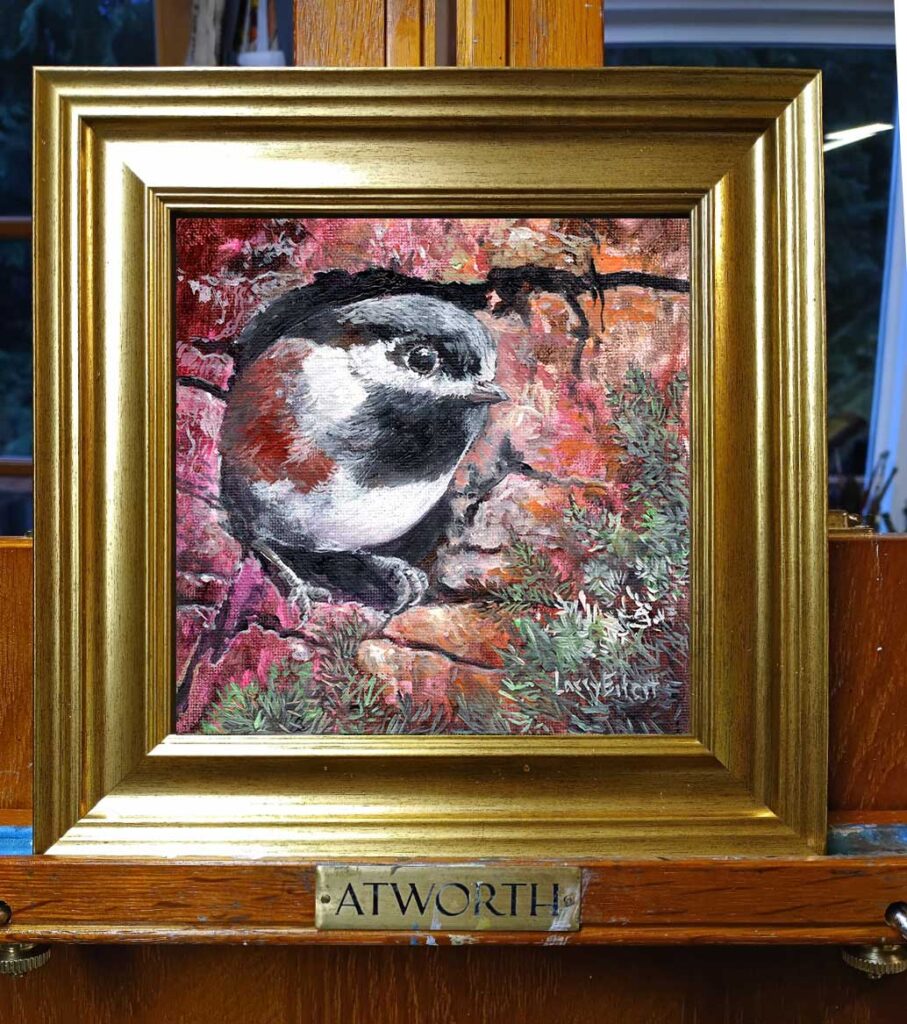
Purple Finch portrait. Click the link to get to my store on Etsy. Outside frame measurements are 7″x9″. This finch was a regular on the seed feeder all last summer. I’d see it often on the old madrona log in our nearby pond, jumping between the pond and little waterfall where all our birds go for baths. They properly wait turns, and this guy did so as well. Good manners. Maybe if I paint it, we’ll see this little guy again. All these are my usual, framed as you see them for $125, free shipping in the US.
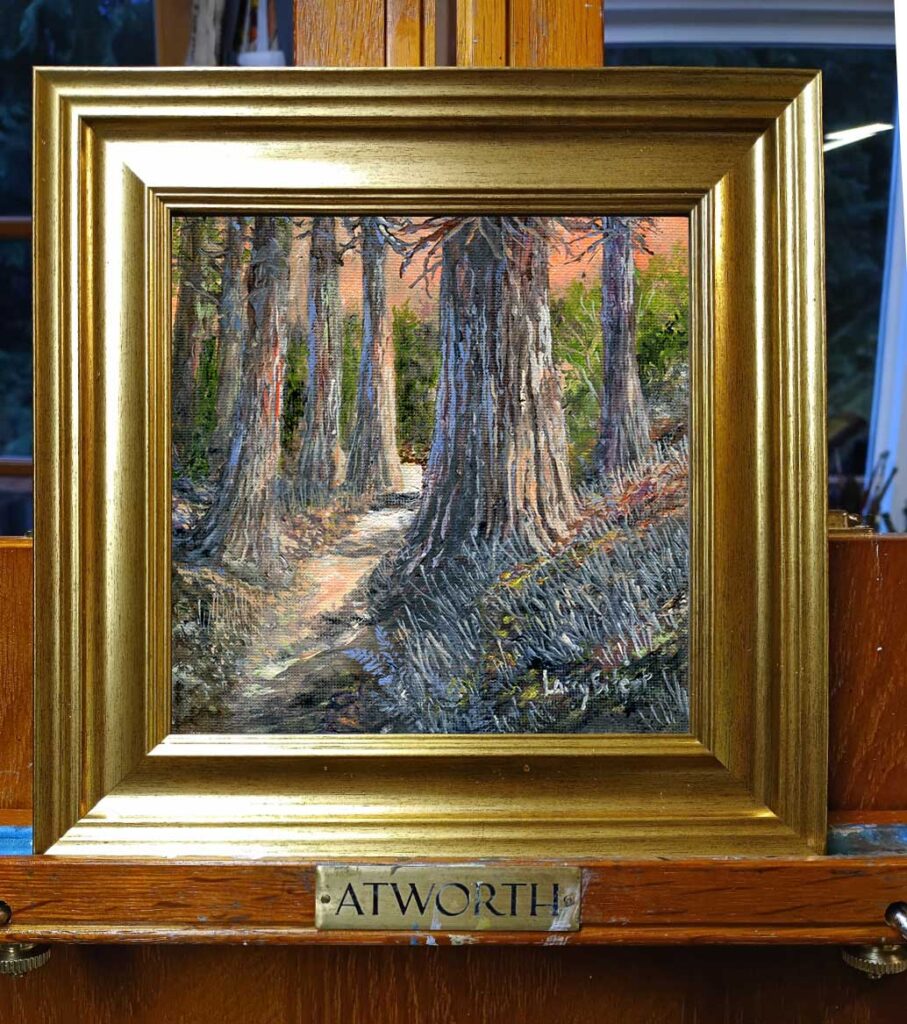
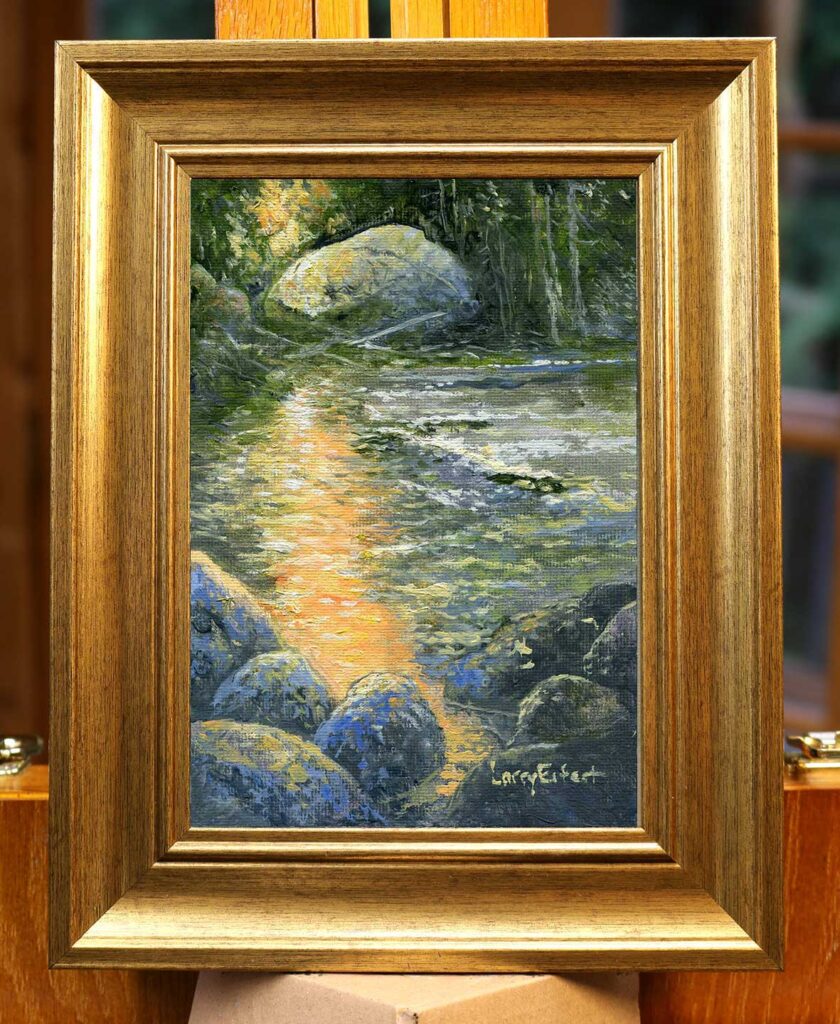
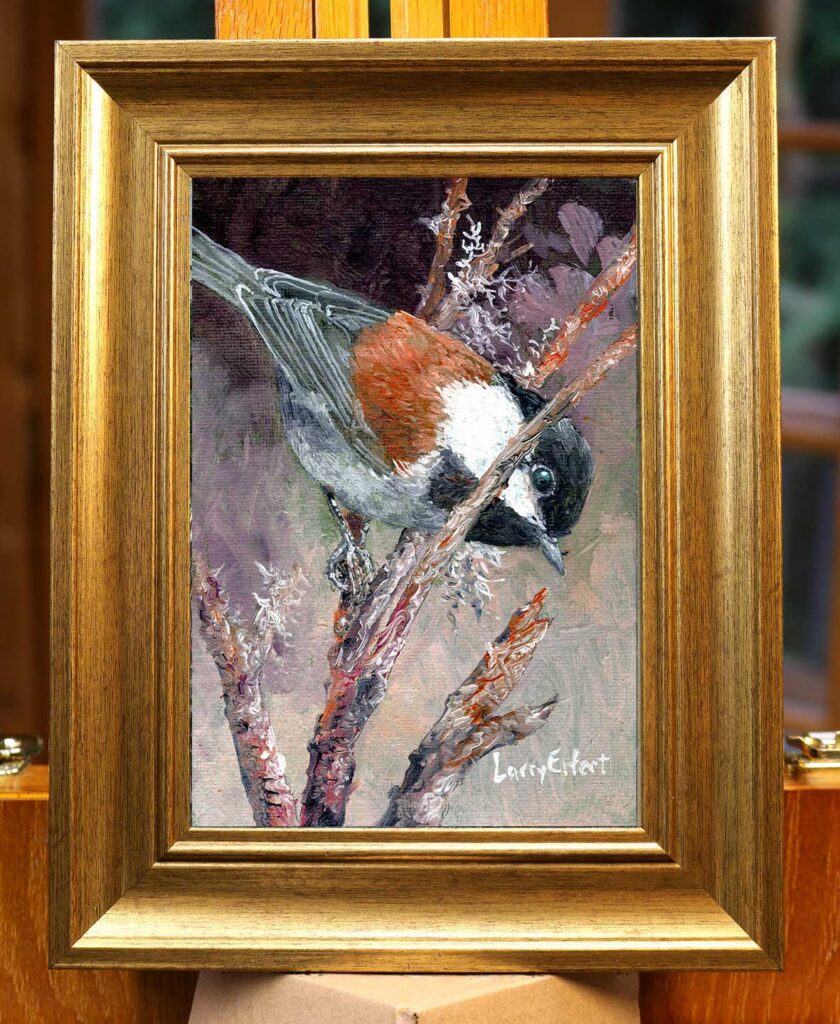
All of these are new oil paintings on canvas board, framed and available. I painted them all at 5″ x 7″, the frame makes the outside edge 8″ x 10″. All are $95 each, shipping included, which is a bit cheaper than what it says on Etsy. Live in Port Townsend or the Quimper Peninsula, I can deliver.
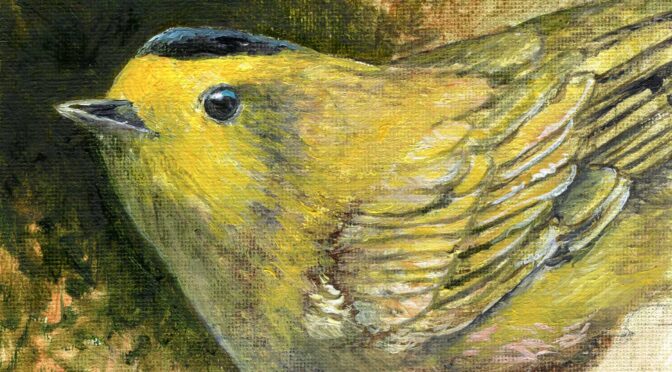
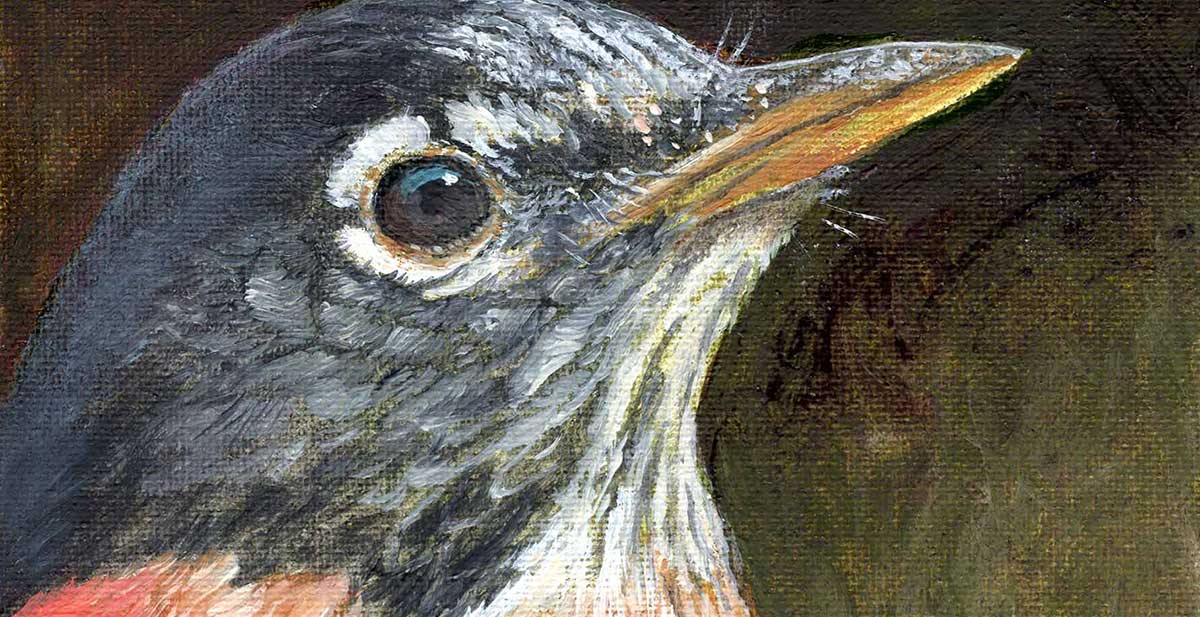
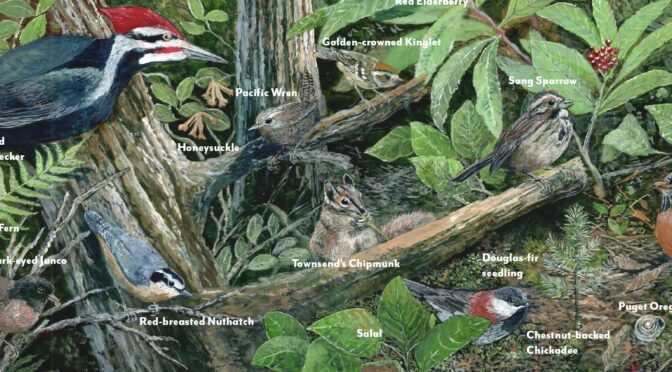
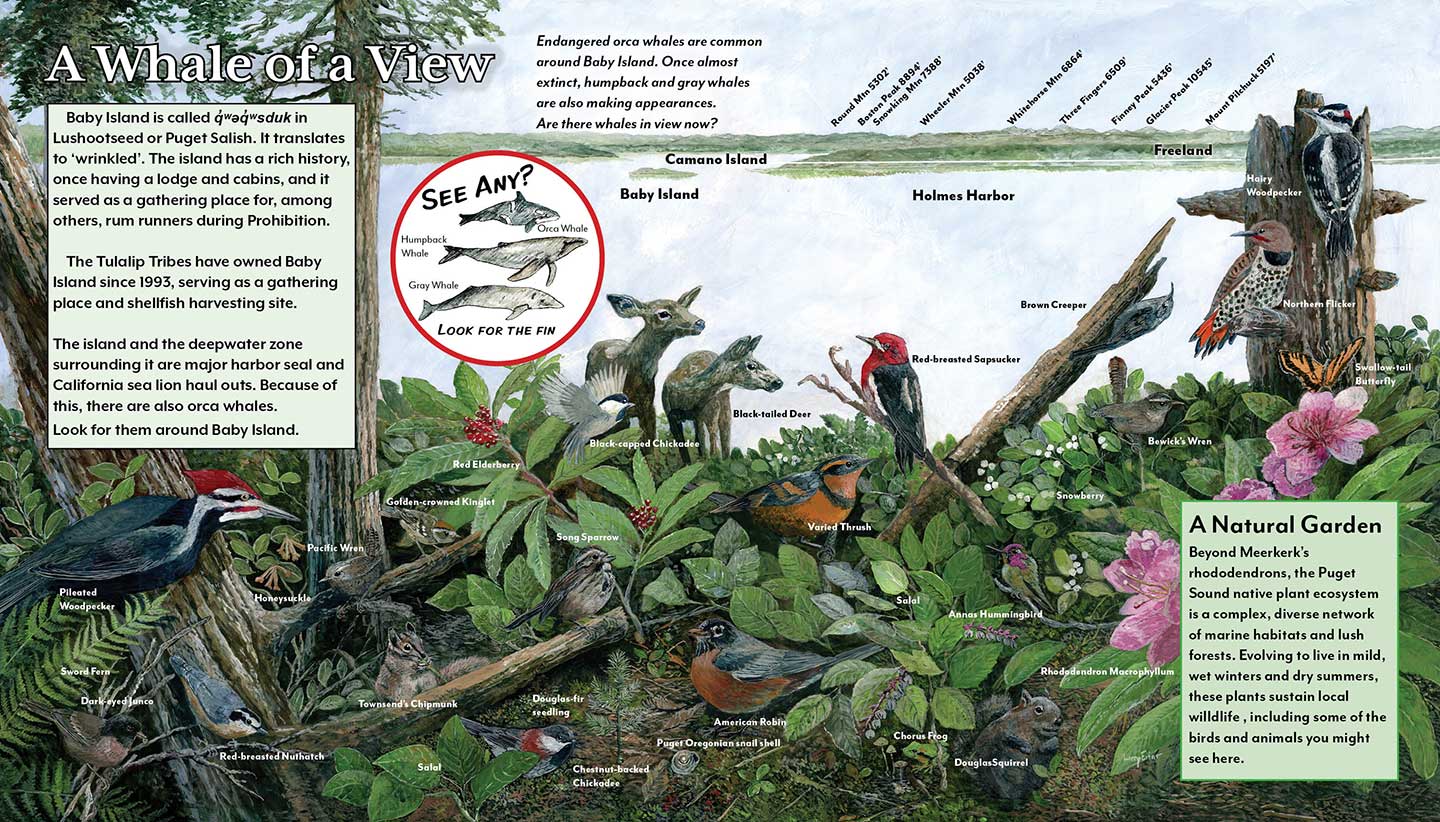
A few months ago I painted similar offerings as these, now mostly sold, and tended to focus on entire stories with little birds involved. They were more like the chickadee painting, above, with the bird a center of interest in an entire ecosystem. These new paintings are more focused on the bird itself, as if the viewer were eyeball-to-eyeball with a little ball of fluff.
Fun for me to have enough information to understand how the eye sits in relation to the bill and head shape. If you’d like to learn more, or want any of these, just drop me an email at larryeifert@gmail.com.
Thanks for reading this week. You can sign up for emails for these posts on my website at larryeifert.com.
Yesterday I sent this and it wasn’t pleasant to view on computers. So, I apologize, but here it goes again. You know, old guys, new software. I don’t need to say more, except thanks for sticking with me.
I just finished these last week so wanted to share. A click will enlarge them nicely.
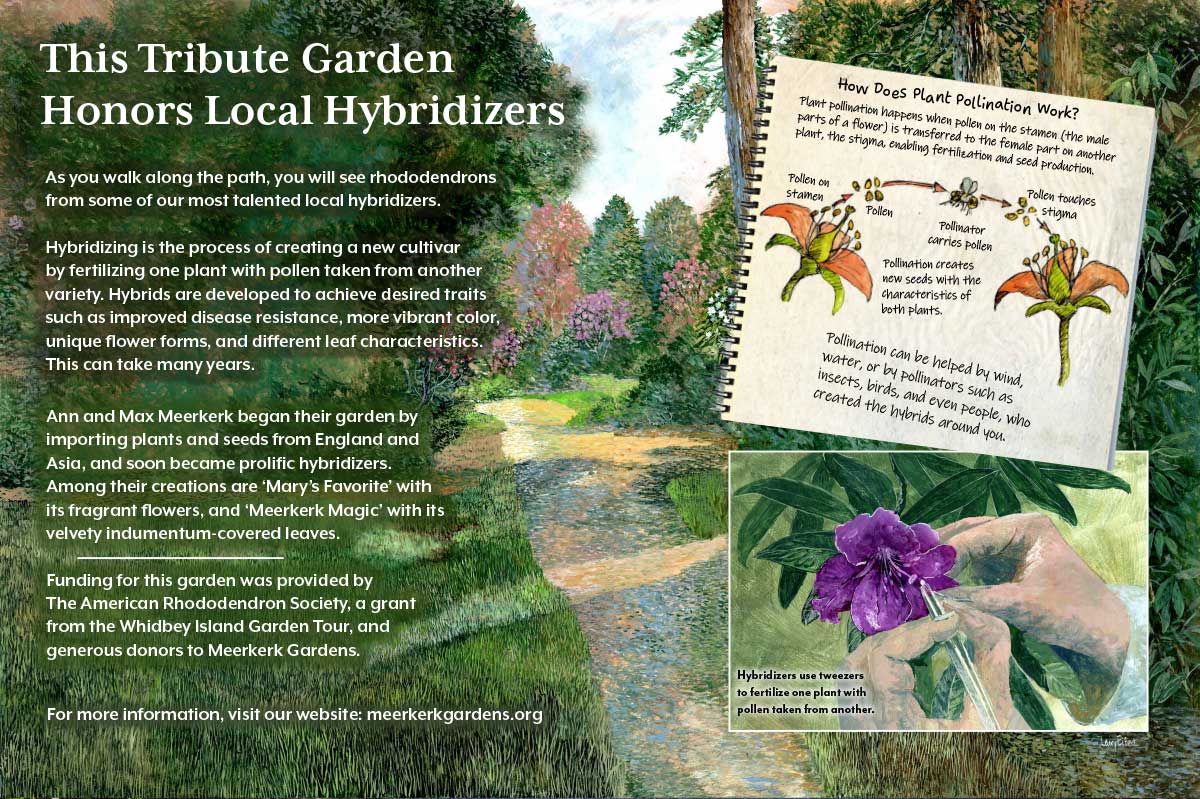
This project was for a native plant garden in Santa Clara County California. It’s a place surrounded by my art in other parks, Mt Diablo, up to Muir Woods, Big Basin Redwoods to Fort Funston and Angel Island, Golden Gate National Recreation Area are some. This park is urban, running along Coyote Creek through San Jose, with a sea of people living along the south shore of San Francisco Bay which includes nearby Silicon Valley and Stanford. Shown here are big background landscape paintings that I was given a fairly free hand it painting – like a gallery show right here in this little park.
Spanish First! So that’s the redundancy of the two sketchbooks in every panel. Took me a bit to accept it, but I’m okay with it now.
These are the very first wayside panels I’ve ever painted with Spanish as the primary language, which says lots about who uses this urban park. I’ve made many of park panels with Spanish as a second language, but never Spanish as the first language – which shows how far this country has changed in the past few decades. I’m proud to be involved in change.
The other interesting direction taken here is that the text isn’t necessarily connected to the art. It’s common to have background art connected to the rest of it, but this is refreshingly ‘wide’ vision of presenting these are more art than school. The sketchbooks are my pencil and watercolor paintings, with canvas acrylics as the backgrounds. All are 42″ wide.
There are elk in this panel, and the title ‘Restore’ suits it. Yes, they’ve introduced Tule elk back into the landscape above the East Bay, and so you can see them here at Hellyer Park up on the ridgetop fairly often.
This last panel is also different, using the entire panel as a thank you to the community’s efforts to repair a landscape much in need of the natural plants that are the foundation of a healthy city.
I want to thank Carolyn at Santa Clara County Parks and Recreation for these, for giving me a free hand at design and art. As I move forward with my art, replacing the almost extinct National Park Service with a path forward in continuing to do what I love – which is to make art that teaches people about their surroundings. It’s clear I didn’t really loose my job as our National Parks closes up shop, and I don’t mean any temporary government shutdown, but these great parks will soon become something else I’m not going to be a part of.
Thanks for reading this week. You can sign up for emails for these posts on my website at larryeifert.com.
I recently made two panels for the Whidbey Island Land Trust and Oak Harbor Garry Oak Society. Here’s the oak panel. This and a panel about nearshore restoration will be installed at the new Keystone Preserve on Whidbey Island very soon. I’m pleased how this all finished up, from concept designs, to making the art and finally making it all work with a text story. Art telling stories, we’ve been talking about that lately.
Garry oaks are the only oak trees in the Pacific Northwest, and they’ve become very rare. This is the same tree as the Oregon white oak, stately and slow-growing forests that were actually cultivated crops for thousands of years by the Indian tribes. These trees provided food and an open forest designed for other important plants such as camas and the other root vegetables for the first people who lived here.
Above is my refined sketch for the painting. I was trying to find a way to show the forest and some way to identify the important native plants that are rare as well. And this bluebird, below, gives a scale to the oak leaves and bird that could fit in the palm of my hand. Watercolor and pencil drawing.
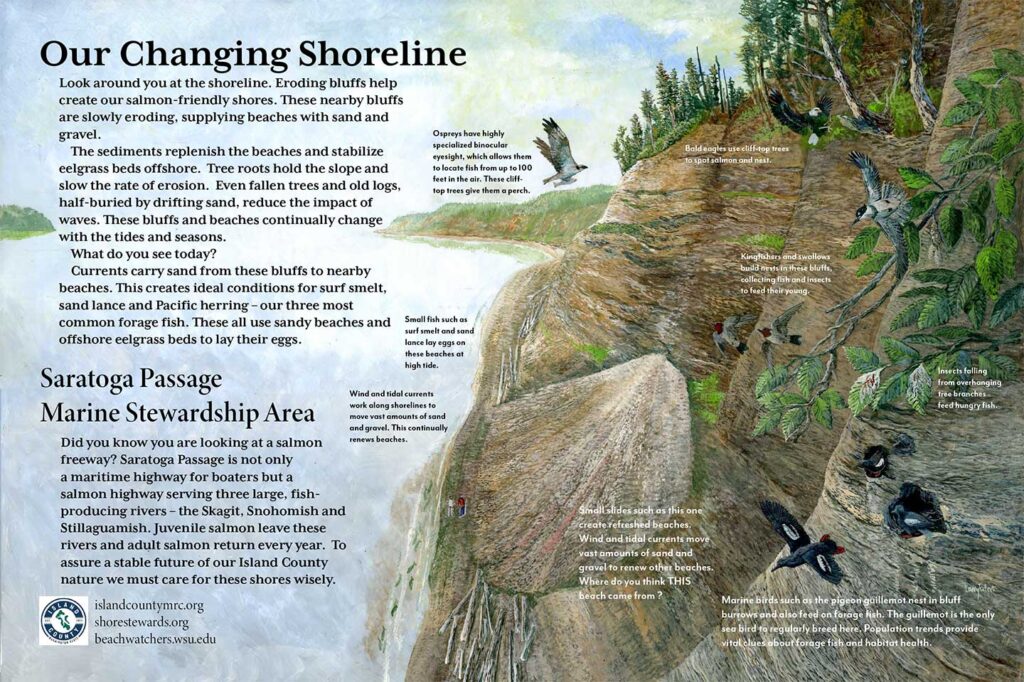
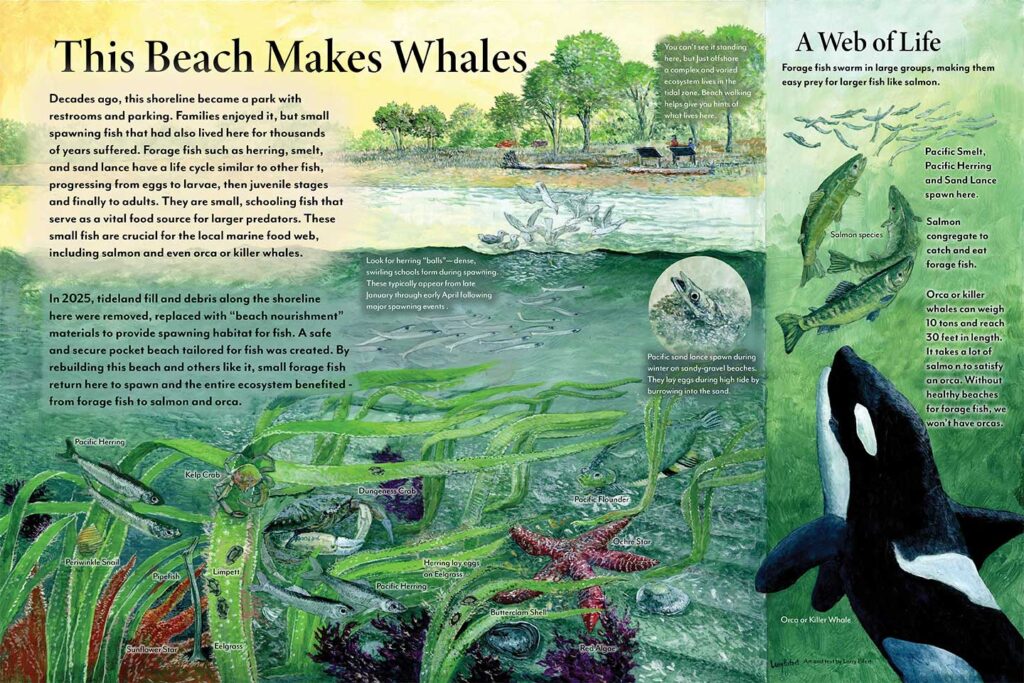
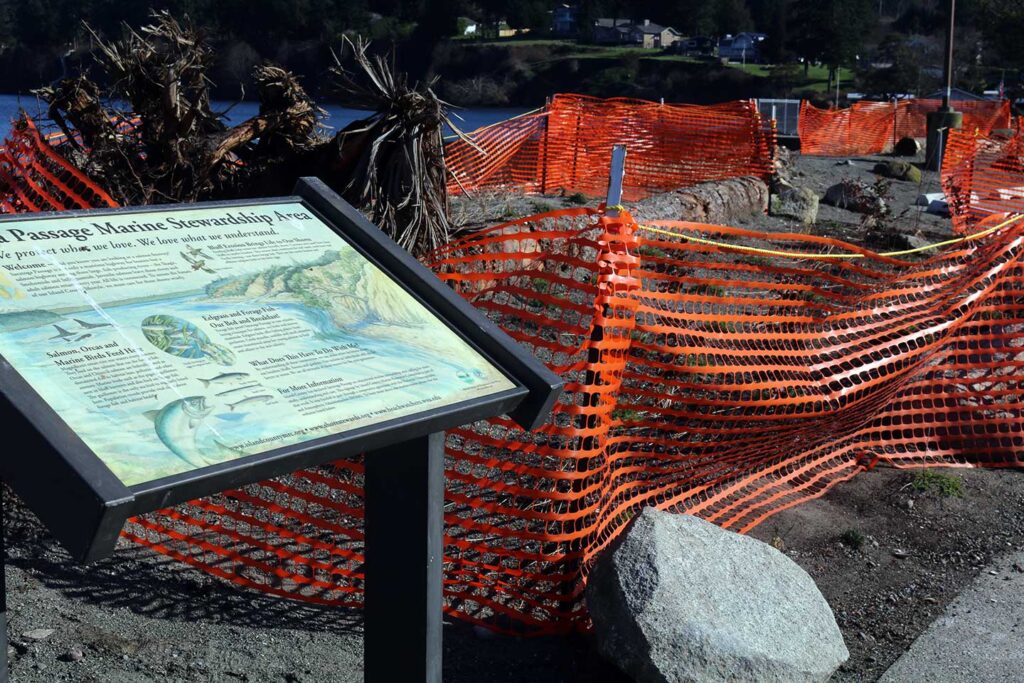
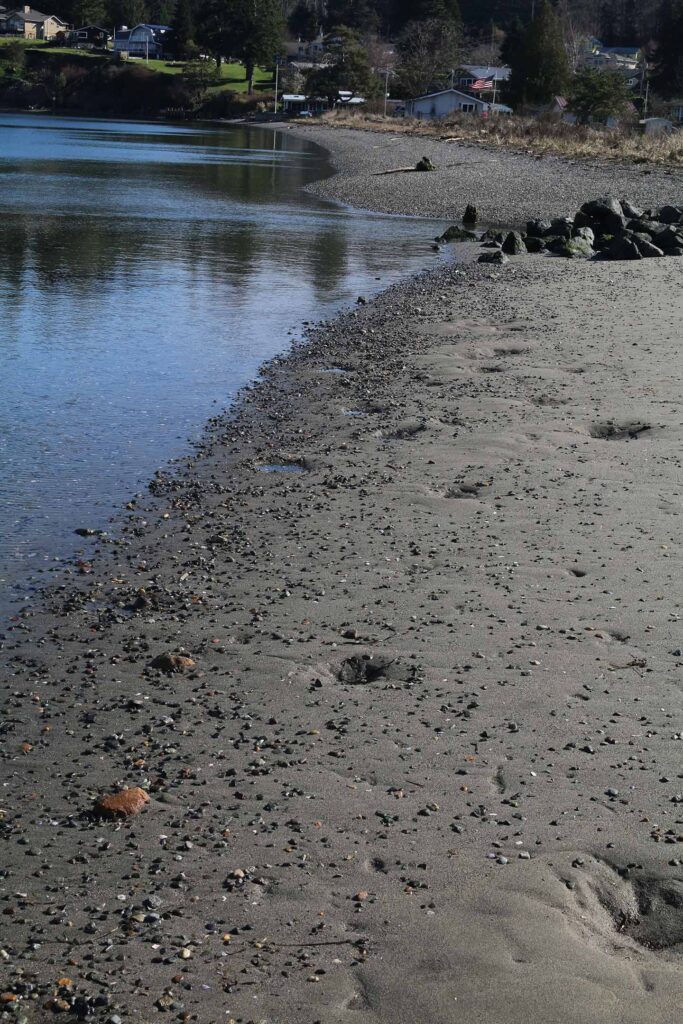
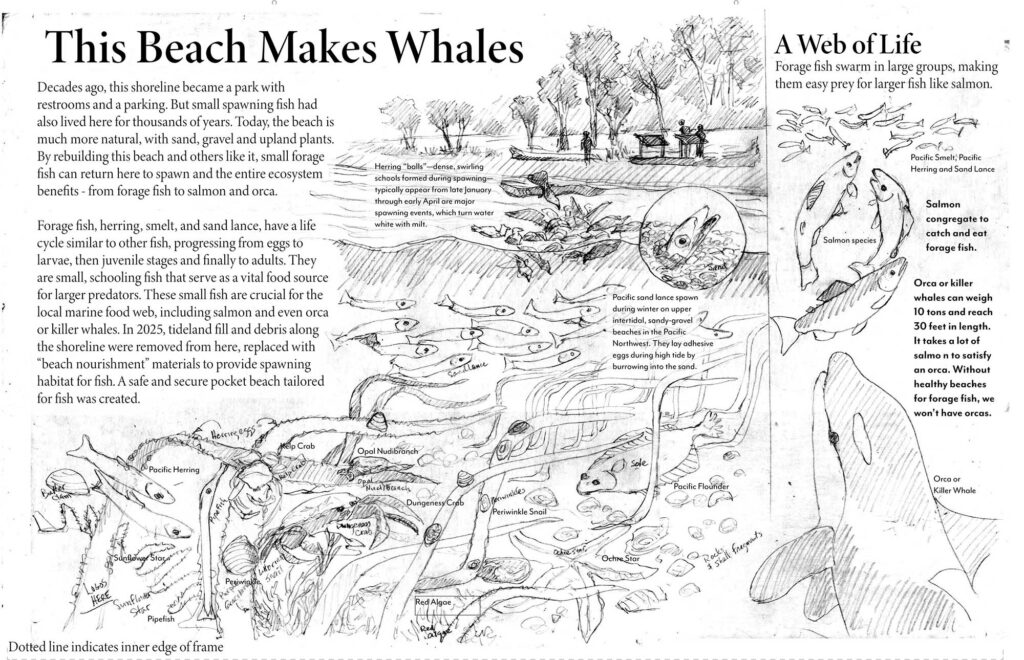
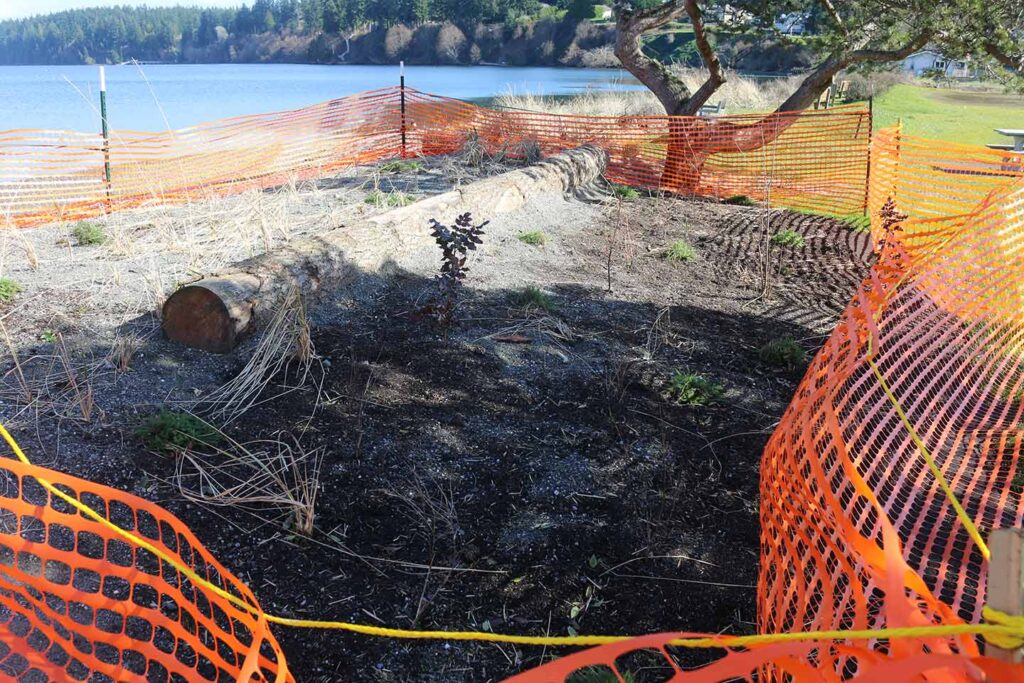
And below, the second panel for this project, about the restoration of the bluff at the Reserve, eelgrass beds, orcas, salmon and forage fish.
People have been asking, are you still painting for the National Park Service as it spirals down to non-existence? Yes, I currently have two projects and two more awaiting for them – but it’s a sad story that shows my work with them is going to end soon – thanks to the Fascist leadership who is setting up the NPS for total failure. It’s been a wonderful experience for me to spend these past decades painting art for a grateful bunch of people who cared more about their country than making money.
Thanks for reading this week. You can sign up for emails for these posts on my website at larryeifert.com.
In 2024, I was commissioned by the Jamestown S’Klallam Tribe in Sequim, Wa to make a series of wayside panels for the Dungeness River Center. This is an interpretive center, exhibits and classrooms, for the wild and free Dungeness, one of the steepest watersheds in the country. The project went on half a year, but I never posted a word about it here. Too many other paintings to talk about, I guess – not to mention finding the time to even sit down to post them.
The Tribe asked me to make these outside panels so when the visitor center is closed, visitors still have a visual learning experience. The panels are around the building, but also along the Olympic Discovery Trail that passes nearby. This trail is also part of the Pacific Northwest National Scenic Trail from Glacier National Park to La Push WA on the Pacific Ocean.
I’m happy with the results. This place is centered around an old railroad bridge (Railroad Bridge Park) and the Tribe bought it, gaining back a bit of their original land they had for thousands of years. In the process, we got to know a rather amazing group of S’Klallam people – and learned a lot doing it. We both felt privileged to be involved.
You’ll see both English and S’Klallam languages on these. The Tribe has programs in the local schools teaching this ancient language, and we tried to blend the languages, especially on the species captions. I think it worked pretty well, although it was a real challenge to figure out a font that has all the characters. Try finding a ADA compliant font with a backwards question mark, or a word that means Belted Kingfisher!
There’s a lot more than just painting that goes into this stuff. I don’t do it all, but from the ground up there’s the concrete pad, an ADA-approved installation of the legs and frame that will last 30 years, the aluminum panel the image is etched on is made only in South Dakota. The entire Adobe Suite of software (usually 4 programs that I use to design it) makes it print-ready. Then a committee has to approve what is written and painted so that it’s an accurate story. The art seems a secondary bit of this, but it takes the most time, and without good art, what is this but a book-on-a-stick!
We tried something new on this panel (above), making the three insets from laser-cut plastic that can be traced with pencil or crayon. School groups can trace the image onto paper to take with them – sort of a hands-on approach to a visual object.
Dusty Humphries, an artisan at the Tribal carving shed (actually a huge new building, not a shed) allowed me in to photograph his work. A truely amazing place.
Lori Grinnell Greninger seemed to be all over this project, giving us help in many ways – and not just modeling her hat – which the building was modeled after.
This last panel has the only image not of my own art or photography. Thanks to John Gussman for the drone image. Also a great thanks to Kathy Steichen for recommending me to the Tribe for this project in the first place. After a lifetime of painting, these new challenges keep me young, and I’ve worked with Kathy on many projects now.
Thanks for reading this week. You can sign up for emails for these posts on my website at larryeifert.com.
Easy to understand my motivation for THIS painting. It’s spring, nature’s renewal, Two robins getting mud in along our pond’s edge so I suspect a nest – and the Indian plum has its early leaves on. I can’t locate the nest, but no big deal.
It’s a common method for me, that of seeing a story happening in nature, then making a painting to tell that story. In this one, I tried to make the robins feel like newly weds, unsure of what to do, unsure of how all this happens. Translating it into a believable painting takes some thought. Even the soft color values might translate into patience.
Below, this rough concept drawing below shows how I went about this. No details to speak of in the drawing, just blocky shapes around the page. There’s more direction here than might meet with understanding – like how the center of interest hits the perfect spot where the top of the nest will be, where those brilliant robin’s-egg blue eggs are. Or the two large triangular areas of nothingness, pulling the viewer’s eyes to that nest area.
This is an original oil painting on stretched linen canvas, varnished and ready to hang. The canvas is 18″x24″ and the 2 1/2″ silver museum frame goes with it, making the outside dimensions 23″ x 29″. As usual for this size, I’m offering it for $1300 plus shipping costs which will probably be standard UPS rates. I have a double box ready to go. If you’re interested in learning more, please email me at larry@larryeifert.com.
Thanks for reading this week. You can sign up for emails for these posts on my website at larryeifert.com.
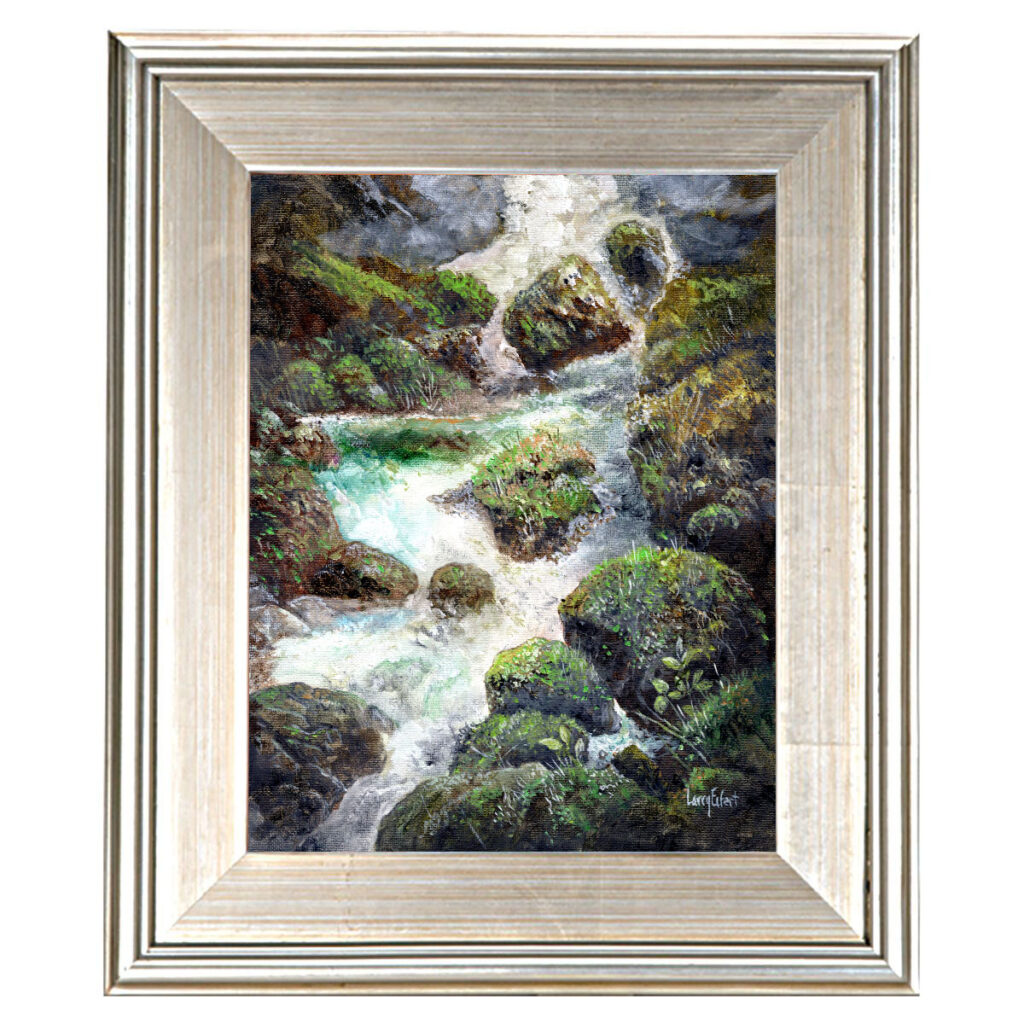
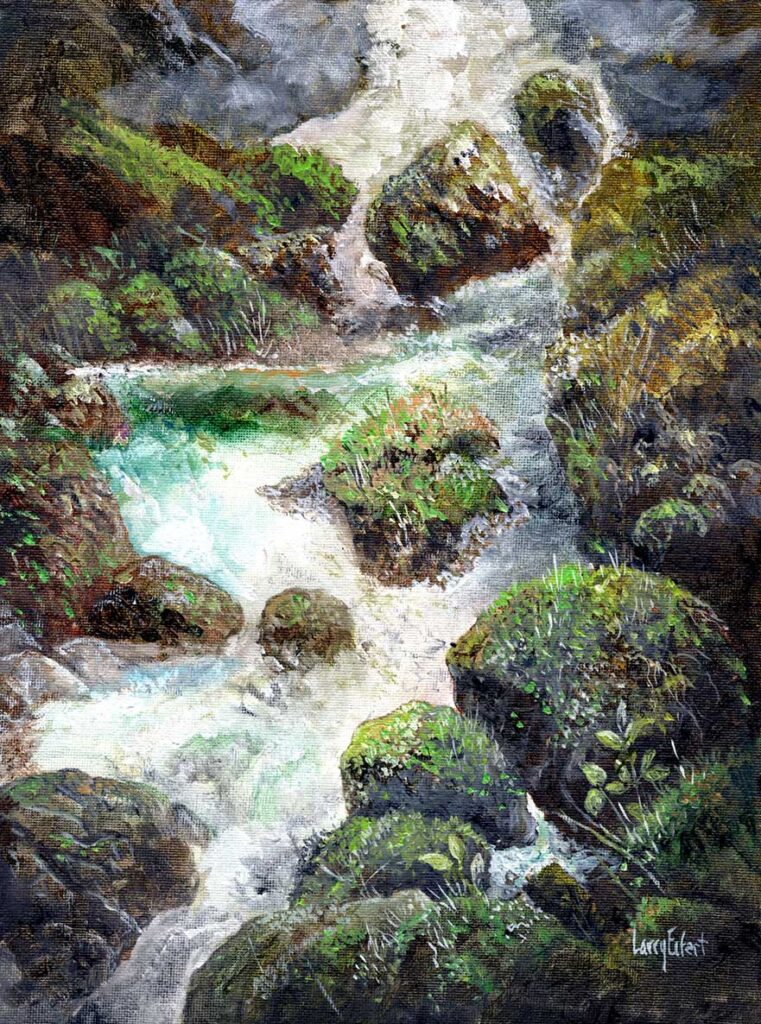
Green Rock is an oil on canvas painting, now available. The canvas is 30″ x 40″ on stretched canvas. It is big enough I thought I’d sell it without the frame, so someone could buy it unstretched, rolled in a tube with the stretcher bars ready to go. We can talk about it.
Below is the painting in a frame, just so you can see what it looks like. I don’t have this frame at the moment, but go ahead and ask.
Where is this place?
The painting is, of course, about salmon (not the green rock). But in these big canvases I find great enjoyment in hiding stuff and telling stories – so how many salmon can YOU find?
I’ve seen many salmon along the Sol Duc River, mostly in Olympic National Park. I even have outdoor exhibit panels there telling the Sol Duc Coho salmon’s story. It’s a special place for both Nancy and me, a place many paintings have been hatched (to use a salmon word). In fact, counting up how many paintings Olympic National Park owns of mine of the Sol Duc Valley: 17! (including one with Nancy in it) Most of them are in a vault at the main visitor center in Port Angeles, so even I can’t see them. All were used for exhibits and reproduced.
If you’d like to find out more about this painting, or if it’s still available, write me at larryeifert@gmail.com.
This is a link to our new Esty store online with some of the available originals.
Northern Spotted Owl: This is an 18″ x 24″ oil on canvas that is now available. The frame comes with it but we have other choices – I just really like the frame colors with this painting. Outside measurements are about 24″ x 30″. We can ship this at cost, double-boxed and ready to hang. Email me at larryeifert@gmail.com if you’re interested in more information. The framed price is $1300.
And here’s just the painting. Through the years, I’ve painted other images of spotted owls, several for Redwood National Park, but those were more ‘interpretive’. This is aimed at showing the dense, vibrant and truly amazing amount of organic ‘life’ in these Pacific Northwest forests. The spotted owl evolved for just this type of landscape with short wings for maneuvering through branches.
Above is a ‘progress’ photo I took in the studio, showing the evolution of this painting. It stayed fairly true to my ideas all the way through. And below are two reference photos. These were taken by Olympic National Park research crews high in the canopy at the Quainault forest. I used these for the big 500 sq ft mural installed at the Hoh Rain Forest Visitor Center and they are the best photos I’ve ever seen of this unseen canopy world, hundreds of feet above hikers on the ground below. It reminds me of an organic messy grocery store.
A very personal painting for me, as these birds live with us in our little meadow here. I know them well.
Varied Thrushes are cousins to American robins, which we also have. They’re at home on the ground in the forest, kicking leaves around looking for insects or berries – while robins tend to live in the open. We have many of these guys right here in our little patch of forest. In Fall through Spring, they can almost disappear when the maples and alders drop their leaves and look exactly the same camouflaged colors. The trillium in bloom shows it’s spring, the big-leaf maple leaves haven’t decomposed yet from last fall, the birds are brighter than normal sporting their breeding colors. I couldn’t resist putting it all together to make a painting based on a Mar’s red base color.
There wasn’t a sketch for this – I just started painting but with some clear ideas of composition. Here are the two reference photos I took not 100 feet from my studio.
At our place, trilliums tend to group together. I understand ants disperse the sweet seeds pods, so maybe ours are just lazy.
In the trillium reference, you can see dozens of alder catkins on the ground – it’s spring! As I progressed with this, I took a progress photo. No sketch, it helps me to see how it’s going if I look at it on a device, even my phone. In some ways, I like this version as well as the final painting.
This painting is 18″ x 24″ acrylic on canvas, and is available. Email me if you’re interested at larryeifert@gmail.com. It’s available with the nice Taos school inspired frame and I already have a shipping crate ready to go.
Thanks for reading this week. You can sign up for emails for these posts on my website at larryeifert.com.
2023-3-11 “The Neighborhood” is an acrylic painting on canvas, 30″ x 40″. It’s a little story about the communities of wildlife on the Olympic Peninsula where we live – paint. This has been on my easel for awhile, changing and evolving, sort of like the critters, themselves. We’ve seen over 90 different species here in our forest, but so far not a single elk.
No preliminary sketches were made for this painting – it was laid out as I went along, placing the elk’s nose right in the center-of-interest and everyone else radiated out from there. I set the stage for a place a bit more wet than here in dry-Port Townsend, a rainforest commonly seen just west of here.
Below are some closeup shots of the details.
I made a funny little video of my process with this painting – it’s up now on my YouTube Channel. I think it’s important to be able to laugh at yourself and this one brought tears. Damned easel. I didn’t do much editing to preserve the absurdity of it.
This painting started out as a deer painting, then it quickly evolved into an elk and after remembering the giant bull elk (two of them) I almost ran into last summer not 2 miles from here. It grew into a full-blown ecosystem effort with many critters, all of which are here in our forest – except the spotted owl. That bird has been replaced by a similar character (barred owl) that might take my head off any minute.
Below: besides the elk, there’s a Pacific wren, two black-headed grosbeaks (they nest here in the forest), a downy woodpecker and snowshoe hare.
This painting is 30″ x 40″ acrylic on canvas and is available for sale. Email me at larry@larryeifert.com for information. Framed as you see it here, I’m asking $2300 framed, normal price for this size. No gallery fees.
And we also have this darker frame. Shipping is extra, but we have the crate ready to go.
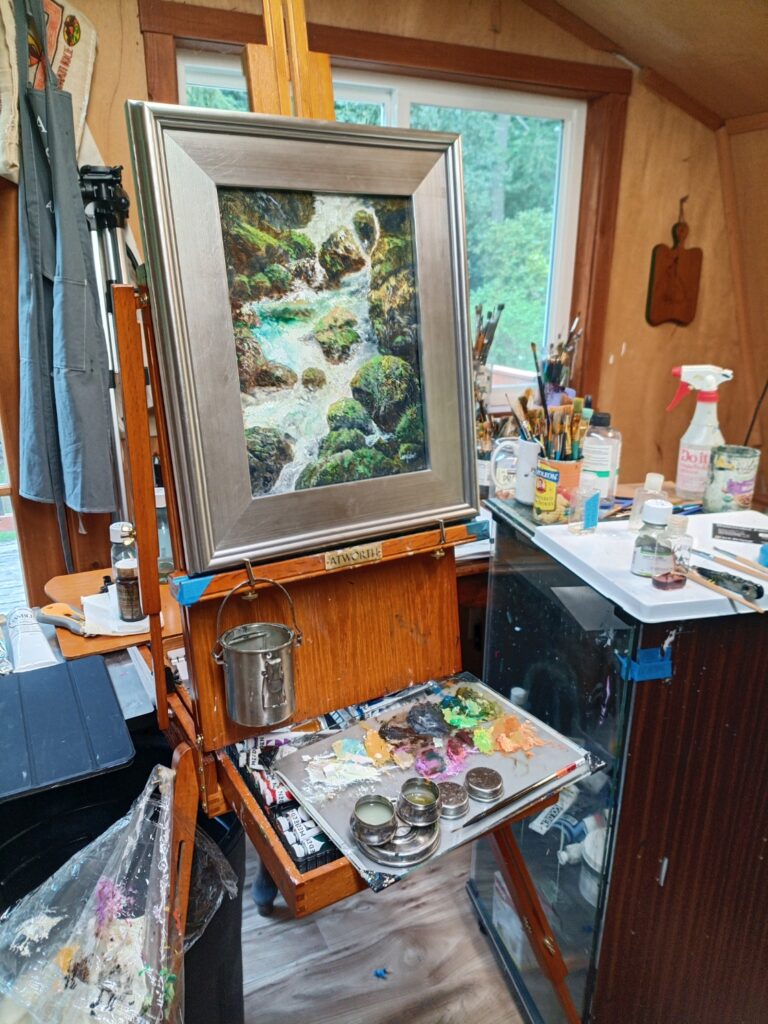
I also did some still photography of the studio recently for my videos. Here’s a fun shot of the interior where I spend many hours of my life. It should enlarge with a click.
Thanks for reading this week. You can sign up for emails for these posts on my website at larryeifert.com.